Commercial deck services cover the full lifecycle of professional decking for businesses, multi-tenant properties, and commercial real estate — from custom design and new construction through repair, replacement, restoration, and protective finishing. For property managers, landlords, and business owners, decks are revenue-generating spaces: outdoor dining areas, rooftop lounges, hotel patios, and retail entryways that directly shape guest experience and property value.
A poorly maintained commercial deck creates liability risk, fails inspection, and drives customers away. Understanding which service applies to which problem is the first step toward protecting both your tenants and your bottom line.
This guide covers every major commercial deck service category — construction, installation, repair, replacement, restoration, staining and sealing — plus materials, costs, contractor selection, and maintenance scheduling.
What Commercial Deck Services Cover
Commercial deck services are the full set of professional offerings that take a deck from initial concept through decades of operational use. Unlike residential decks, commercial structures must meet stricter load ratings, accessibility standards, fire codes, and inspection cycles set by the International Building Code (IBC) and local jurisdictions.
The seven core service categories fall into three operational groups:
- Build-stage services: custom construction and installation
- Lifecycle services: repair, replacement, and restoration
- Protection services: staining and sealing
Each category addresses a specific stage of the deck’s life. A new hotel rooftop bar requires custom construction; a 15-year-old restaurant patio with soft boards needs restoration; a structurally compromised retail entry deck needs full replacement. Knowing which service fits the problem prevents overpaying for unnecessary work and under-investing in dangerous structural decline.
Commercial decks also carry obligations residential decks do not — ADA accessibility, occupancy load calculations, slip-resistance ratings, and commercial-grade fastener requirements. These regulatory layers shape which contractors are qualified to bid and how each service must be executed.
Every category we cover here connects back to a network of vetted specialists, and our professional deck builder services outlines the full range of commercial deck expertise available — from structural framing to finish carpentry — so property managers can match the right contractor to the right project scope.
Custom Commercial Deck Construction
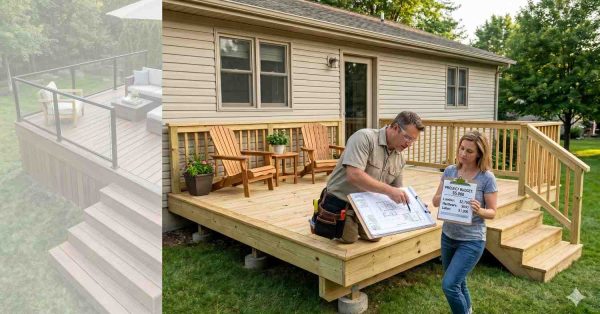
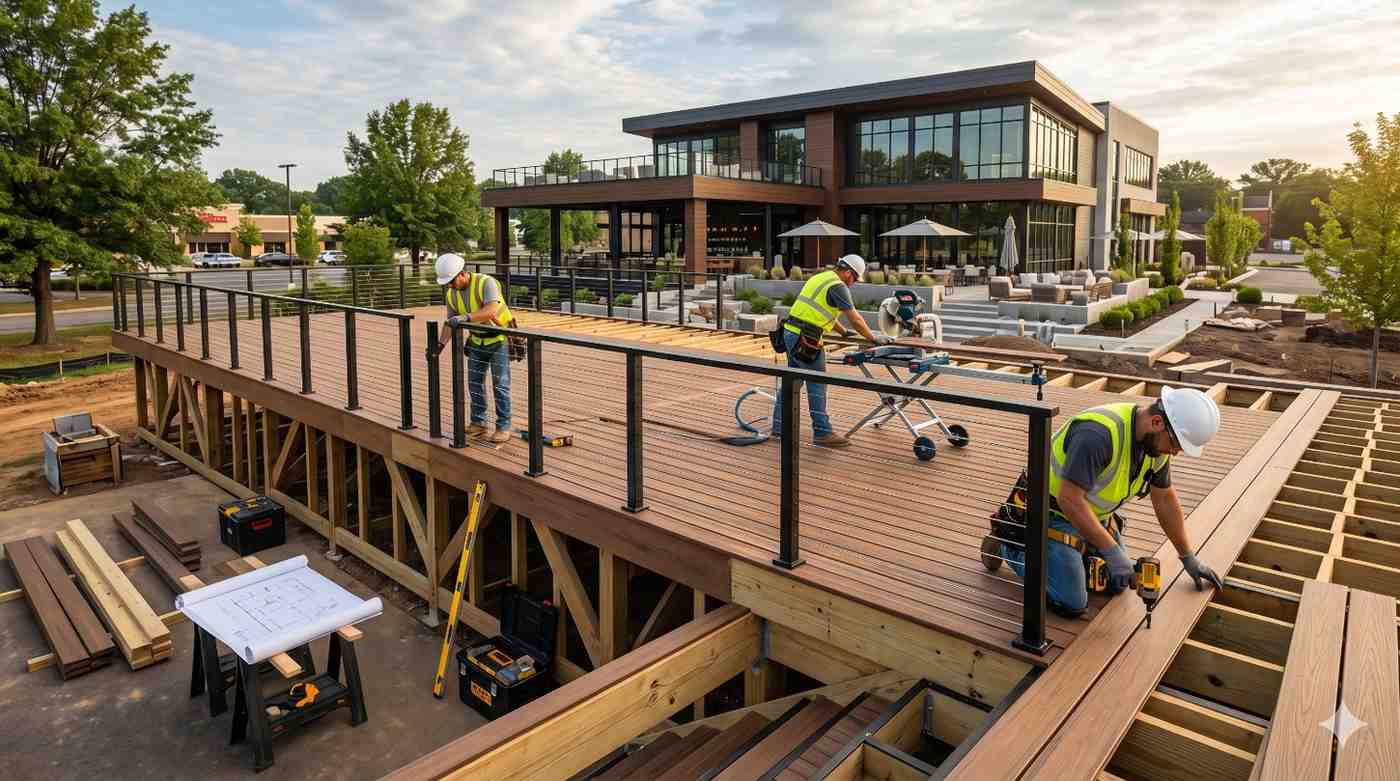
Custom commercial deck construction is the design-and-build process for a brand-new deck engineered to the specific requirements of a commercial property. This is not a catalog product — it begins with site assessment, load calculations, material specifications, and architectural drawings that satisfy both the owner’s vision and local building code.
Commercial custom builds typically address one of four scenarios:
- New construction integration — decks built as part of a new commercial property
- Property expansion — adding outdoor square footage to an existing business
- Reconfiguration — replacing an underused outdoor space with a higher-value deck
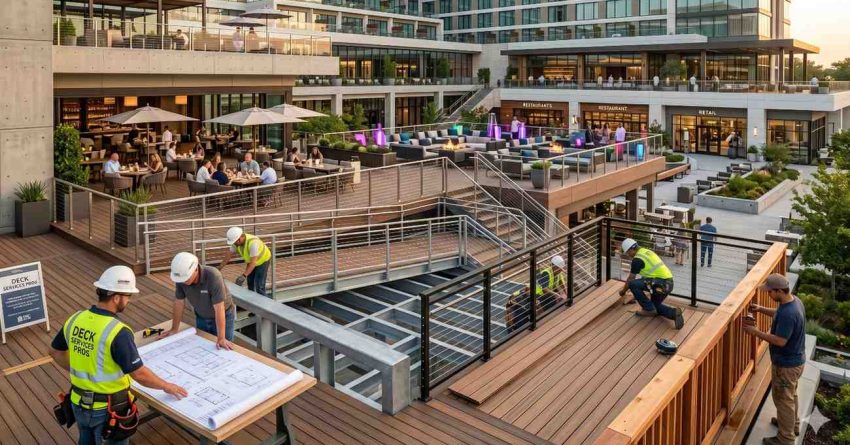
- Rooftop or elevated installations — engineered decks on parking structures, hotels, or mixed-use buildings
The defining feature of custom construction is engineering precision. Commercial loads (people plus furniture plus snow plus wind) often exceed 100 pounds per square foot live load, and the framing, fasteners, and footings must be sized accordingly. Material selection — composite, hardwood, pressure-treated, or aluminum — is driven by traffic volume, climate exposure, and maintenance budget.
Custom builds demand engineering precision, code-compliant framing, and material selection tailored to commercial load requirements, which is why our custom deck construction services walk through the complete design-to-finish process, including load calculations, material specs, and timeline planning.
Commercial Deck Installation
Commercial deck installation is the on-site execution phase — the physical process of building the deck after design is finalized and permits are pulled. Installation differs from construction in that the design is fixed; the contractor’s role is precise, code-compliant execution.
A typical commercial installation moves through six phases:
- Site preparation and demolition (if replacing)
- Footing and foundation installation
- Framing and joist construction
- Decking, railing, and stair installation
- Finish work and accessory installation
- Inspection and handover
Commercial installations are tightly scheduled to minimize business disruption. Restaurants need patios installed in off-season; hotels schedule rooftop decks around occupancy. A skilled installer coordinates with property managers to phase work, isolate construction zones, and maintain customer access wherever possible.
Pre-fabricated commercial deck systems, including modular composite and pedestal-paver rooftop systems, can compress installation timelines by 30 to 50 percent compared to fully stick-built decks, though they require precise site measurements upfront.
Commercial deck materials including composite, hardwood, and aluminum each carry distinct cost, durability, and maintenance trade-offs — our complete materials guide breaks down every option with side-by-side performance data.
Installation timelines, permitting requirements, and structural anchoring vary significantly by jurisdiction and property type, and our commercial deck installation services breaks down every installation phase — from site prep to final inspection — so commercial clients know exactly what to expect at each milestone.
Commercial Deck Repair
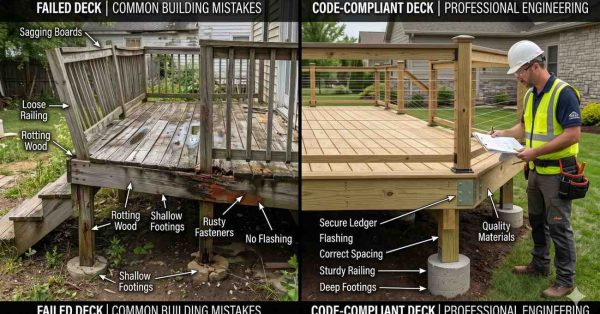
Commercial deck repair targets specific damaged, worn, or unsafe components without replacing the entire structure. Repair is the most cost-effective intervention when damage is localized and the underlying frame remains structurally sound.
Common commercial repair scenarios include:
- Rotted or split deck boards in high-traffic zones
- Loose, wobbly, or non-compliant railings
- Damaged stair treads and stringers
- Compromised joists or ledger boards
- Failing fasteners, screws, or hardware
- Surface damage from heavy equipment, furniture, or freeze-thaw cycles
Diagnostic accuracy matters more than cosmetic appearance. A board that looks fine on top may hide rotted joist hangers underneath; a tight railing may be anchored into deteriorated framing. Professional commercial inspectors probe joists, check moisture content, and assess fastener integrity before scoping the repair.
Repair is also a compliance issue. Loose railings that fail a 200-pound horizontal load test create immediate liability for the property owner. Same for stair treads outside the ¾-inch height variation tolerance set by IBC.
Targeted repairs extend the life of an aging deck without the cost of full replacement, and our commercial deck repair services covers every common failure point — from rotted joists to loose railings — along with the diagnostic process contractors use to assess structural integrity.
Commercial Deck Replacement
Commercial deck replacement is the complete removal and rebuilding of an existing deck. Replacement becomes necessary when damage has spread beyond what repairs can safely address, when the underlying structure has aged past its service life, or when a property upgrade demands a fundamentally different deck.
Replacement is the right call when:
- Multiple structural components (joists, beams, posts) show rot or failure
- The deck no longer meets current code or accessibility standards
- More than 40 percent of decking and framing requires replacement
- The property’s use case has changed and the existing footprint cannot serve it
- Repair costs approach 50 percent or more of full replacement value
Commercial replacement projects involve demolition logistics, debris disposal, and often staged construction to keep at least part of the property operational. For restaurants and hotels, replacement is typically scheduled during shoulder seasons to avoid revenue impact.
Replacement is also the moment to upgrade. Switching from pressure-treated wood to composite, adding integrated lighting, or expanding the footprint costs significantly less when bundled with replacement than as standalone retrofits.
Commercial deck replacement costs vary widely based on size, material, and demolition complexity — our commercial deck cost guide breaks down pricing by service type, material grade, and regional labor rates.
When structural damage spreads beyond what spot repairs can fix, replacement becomes the safer long-term investment, and our full deck replacement services explains the complete teardown-and-rebuild process, demolition logistics, material upgrades, and how to minimize business downtime during the project.
Commercial Deck Restoration
Commercial deck restoration brings an aged, weathered, or cosmetically degraded deck back to safe, attractive, commercial-grade condition without replacing the underlying structure. Restoration sits between repair (component-level) and replacement (full rebuild), targeting decks that are structurally sound but visually and surface-functionally degraded.
A complete commercial restoration typically includes:
- Deep cleaning and power washing to remove mildew, algae, and embedded grime
- Sanding and board refinishing to restore smooth, splinter-free surfaces
- Selective board replacement for cosmetically damaged sections
- Hardware tightening and fastener replacement
- Railing refinishing and reinforcement
- Final staining and sealing to lock in the restored finish
Restoration is the highest-value intervention for commercial properties with 10- to 20-year-old wood decks that still have structural integrity. A full restoration typically delivers 70 to 85 percent of replacement appearance at 30 to 45 percent of replacement cost.
The decision point between restoration and replacement comes down to framing condition. A professional moisture probe and joist inspection determines whether restoration is viable.
Restoration brings a weathered deck back to safe, attractive condition without replacing the underlying structure, and our commercial deck restoration services walks through every step — power washing, board-level sanding, structural reinforcement, and refinishing — that returns a tired deck to commercial-grade performance.
Commercial Deck Staining and Sealing
Commercial deck staining and sealing is the protective finishing service that shields wood decks from moisture, ultraviolet damage, foot traffic, and chemical exposure. While often grouped together, the two products serve distinct functions: stain adds color and UV resistance, while sealant blocks water intrusion and seals the wood grain.
For commercial properties, finishing serves three goals:
- Surface protection against weather, spills, and constant foot traffic
- Slip resistance in high-occupancy areas (often a code requirement)
- Aesthetic consistency that supports brand presentation
Commercial finish systems are not the same products sold for residential use. They are formulated for higher abrasion resistance, faster cure times, and longer recoat intervals. Professional-grade systems typically last 2 to 4 years before recoating, compared to 12 to 18 months for consumer-grade products.
Application timing matters. Stain and sealer must be applied to clean, dry, properly prepared wood with ambient temperatures between 50°F and 90°F and no rain forecast for 24 to 48 hours. Skipping prep is the most common reason commercial finishes fail prematurely.
Permitting and code compliance — including ADA accessibility and IBC structural requirements — vary by state and local jurisdiction — our commercial deck permits and code guide covers the regulations property managers must verify before any service begins.
Sealing and staining protect commercial decks from UV damage, moisture intrusion, and high-traffic wear, and our deck staining and sealing services covers product selection, application timing, recoat intervals, and how the right finish system extends deck lifespan by years.
Commercial Deck Materials and Code Considerations
The right material choice determines lifespan, maintenance cost, appearance, and code compliance. For commercial decks, four material categories dominate:
- Pressure-treated lumber — lowest upfront cost; 10–15 year service life; highest maintenance
- Composite decking — mid-to-high cost; 25–30+ year service life; low maintenance; popular for hospitality
- Tropical hardwoods (ipe, cumaru) — premium cost; 40+ year service life; periodic oiling required
- Aluminum decking — premium cost; 50+ year service life; zero rot; common on rooftops
Material choice is constrained by code. Many jurisdictions require Class A or Class B fire-rated decking for commercial use, especially within defined wildland-urban interface zones or above occupied space. Rooftop installations often require non-combustible materials and tested pedestal systems.
ADA compliance shapes layout decisions. Commercial decks accessible to the public must provide accessible routes with maximum 1:20 slopes, 36-inch minimum clear widths, and compliant ramping where elevation changes exceed ½ inch.
Cost Factors for Commercial Deck Services
Commercial deck pricing is driven by seven primary cost variables:
- Service category (repair is cheapest; custom construction is most expensive)
- Deck size and complexity (square footage plus design features)
- Material selection (composite costs 2–4x pressure-treated)
- Site access and elevation (rooftop decks cost significantly more)
- Permitting and inspection fees
- Demolition and disposal (for replacement)
- Regional labor rates
Average commercial deck pricing ranges run roughly:
- Repair: $300–$3,500 per project
- Restoration: $8–$15 per square foot
- Staining and sealing: $2–$5 per square foot
- Installation (basic): $25–$45 per square foot
- Custom construction: $50–$150+ per square foot
- Replacement: $30–$75 per square foot
Lifecycle cost matters more than upfront price. A composite deck costing $45 per square foot with 30-year service life delivers lower cost-per-year than a pressure-treated deck at $22 per square foot with 12-year service life plus refinishing every 2 years.
How to Choose a Commercial Deck Service Provider
Choosing the right contractor is the single highest-leverage decision in any commercial deck project. The same job executed by a qualified commercial specialist versus a residential generalist can vary by 30 to 50 percent in cost, timeline, and long-term performance.
Verify five qualifications before signing any contract:
- Commercial licensing and bonding specific to your state
- General liability and workers’ compensation insurance with current certificates
- Commercial project portfolio with verifiable references
- Familiarity with commercial code (IBC, ADA, local fire codes)
- Written, itemized estimates that separate labor, materials, and contingencies
Red flags include verbal-only quotes, demands for more than 30 percent deposit upfront, no proof of insurance, and reluctance to provide local commercial references. Quality commercial contractors expect scrutiny and answer due-diligence questions without friction.
Property managers and business owners often face the choice between a full-service deck builder and a general handyman for smaller projects — our deck builder vs. handyman guide explains when each option is appropriate and the risk factors involved.
For multi-property portfolios, a single contractor relationship across all locations simplifies scheduling, ensures consistent quality, and often unlocks volume pricing. For single-property work, local specialists with deep regional code knowledge often outperform national chains.
Selecting a contractor with verified credentials, commercial project experience, and transparent pricing is the single biggest factor in project success — our vetted deck builder network connects property managers with licensed professionals across every service category covered in this guide.
Maintenance Schedule for Commercial Decks
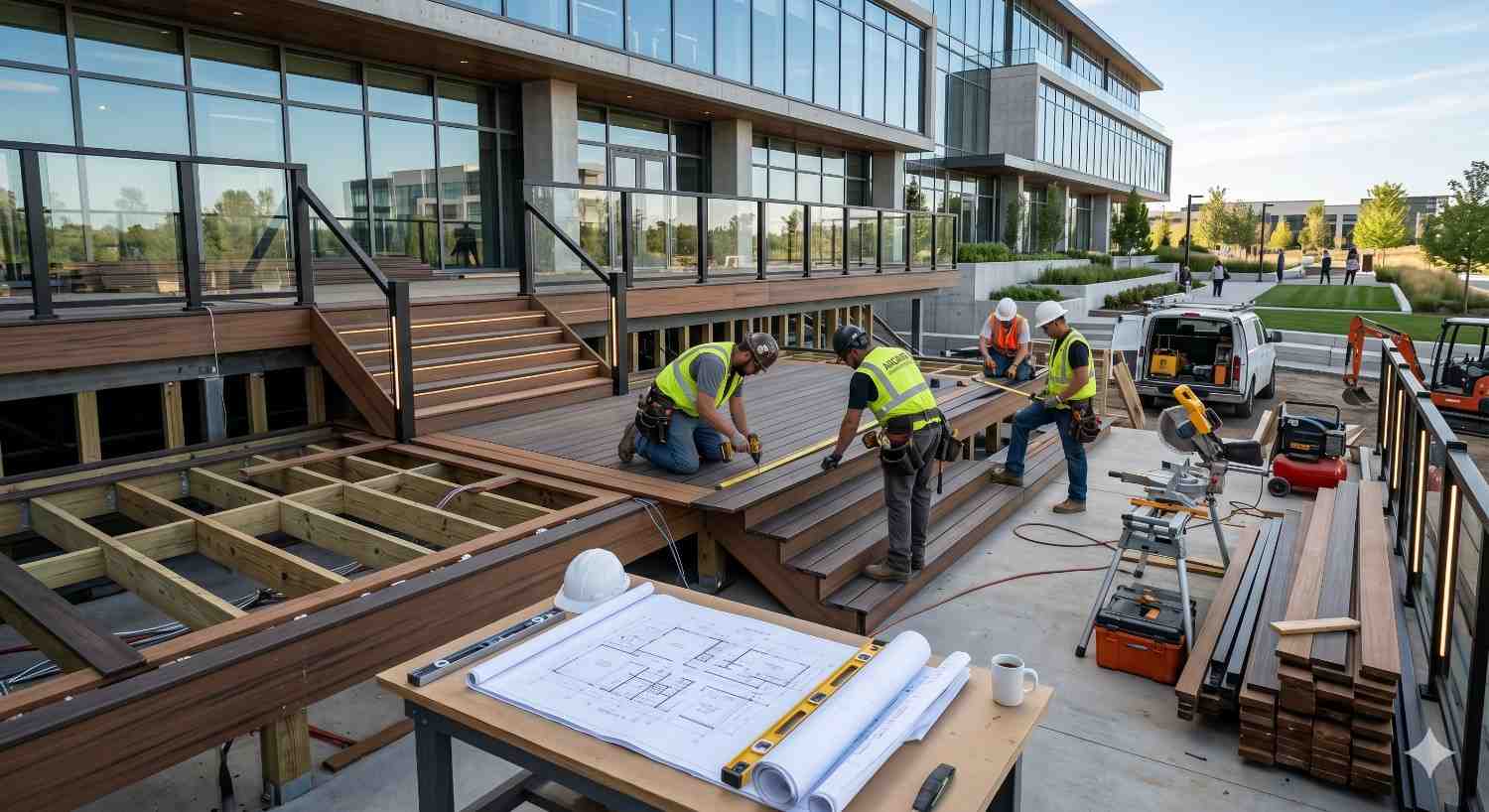
A maintenance schedule transforms a deck from a liability into a long-term asset. Commercial decks face higher loads, more frequent traffic, and stricter inspection cycles than residential decks, so a formal schedule is essential.
A recommended commercial maintenance cycle:
- Weekly: visual walk-through; clear debris; check for hazards
- Monthly: detailed surface inspection; tighten visible fasteners
- Quarterly: professional inspection of joists, ledgers, and railings
- Annually: deep cleaning; spot repairs; railing load test
- Every 2–4 years: restain and reseal (wood decks)
- Every 5–7 years: full professional restoration assessment
Inspection records protect property owners from liability. A documented maintenance log demonstrates due diligence in the event of an accident or insurance claim.
A complete commercial deck inspection follows a defined checklist covering structural, surface, and accessibility points — our commercial deck inspection checklist provides the exact items property managers should verify on every cycle.
Conclusion
Commercial deck services span the complete deck lifecycle — from custom design through long-term maintenance — and matching the right service to the right deck condition protects both safety and investment.
A well-maintained commercial deck supports tenant satisfaction, revenue, and property value. The cluster resources linked throughout this guide go deeper into each individual service.
We help property managers across the USA connect with vetted commercial deck specialists. Contact Mr. Local Services today to start your next deck project.
Frequently Asked Questions
What is the difference between commercial and residential deck services?
Commercial deck services meet higher load ratings, ADA accessibility, fire codes, and commercial-grade material standards. Residential services typically do not address occupancy load, code-compliant accessibility, or commercial liability requirements.
How long does a commercial deck last?
A commercial deck lasts 15 to 50+ years depending on material. Pressure-treated wood lasts 10 to 15 years, composite lasts 25 to 30+ years, hardwoods and aluminum can exceed 40 years with proper maintenance.
When should I repair versus replace a commercial deck?
Repair makes sense when damage is localized and the frame is structurally sound. Replace when more than 40 percent of components show damage or when repair costs approach 50 percent of replacement value.
How often should a commercial deck be inspected?
Commercial decks should receive monthly visual checks, quarterly professional inspections, and annual deep assessments. High-traffic hospitality decks may require more frequent inspections to meet liability and insurance standards.
Do commercial decks require building permits?
Yes, nearly all commercial deck construction, replacement, and major repairs require permits. Permitting requirements vary by jurisdiction and typically include structural review, inspection schedules, and final certificate of occupancy approval.
How long does a commercial deck installation take?
Most commercial installations take 1 to 4 weeks depending on size, complexity, and weather. Custom builds and rooftop installations may extend to 6 to 12 weeks including permitting, fabrication, and inspection cycles.
What is the most cost-effective commercial deck material?
Pressure-treated lumber has the lowest upfront cost, but composite delivers the lowest lifecycle cost over 20+ years due to minimal maintenance and longer service life. The right choice depends on traffic, climate, and budget horizon.