A deck expansion is the process of enlarging or enhancing an existing deck structure, adding square footage, new functional zones, or integrated features to an outdoor space that has outgrown its original footprint or purpose.
Without proper structural assessment, planning, and permit compliance, an expansion can quickly create costly safety hazards, code violations, and material mismatches that undermine the long-term value of your entire investment.
This guide covers expansion planning, structural requirements, design patterns, material matching, permits and codes, contractor selection, cost management, expansion versus replacement decisions, and long-term maintenance for any deck addition project.
What Is a Deck Expansion and When Should You Consider One?
A deck expansion is any structural addition that increases the usable footprint or functional range of an existing deck. This includes outward extensions that add raw square footage, vertical additions that introduce a second level, and purpose-built sections that create dedicated space for a hot tub, outdoor kitchen, or covered pergola structure.
Homeowners typically consider expanding when their current deck is structurally sound but too small for how they want to use it. According to Remodeling magazine’s 2024 Cost vs. Value report, composite deck additions return approximately 68.2% of project cost at resale, while wood deck additions return 82.9%, making deck expansion one of the stronger outdoor investment categories available to residential homeowners.
The strongest candidates for a deck expansion include decks with solid footings and framing that have been regularly maintained, properties with available yard space that meets local setback and lot coverage requirements, homeowners whose lifestyle or family needs have outgrown the original deck’s capacity, and pre-sale projects targeting outdoor living appeal as a specific buyer incentive.
For homeowners evaluating whether an addition makes financial sense before committing to a contractor, our deck expansion ROI calculator total project cost and projected resale value based on local market data, material selection, and expansion size.
Decks showing active structural rot, widespread framing deterioration, or code-deficient construction are generally better candidates for full replacement than addition. The decision between the two paths should always follow a professional structural inspection, not a surface-level assessment of the visible decking boards alone.
If you are approaching your expansion as an opportunity to rethink your entire outdoor living layout, our deck design and planning guide covers shape, style, function, and site-specific considerations that should inform the full scope of your addition from the very beginning.
How to Plan a Successful Deck Expansion
Planning is where deck expansions succeed or fail. Projects that rush or skip the planning phase routinely encounter permit rejections, budget overruns, structural surprises, and design decisions that cannot be corrected without expensive rework after construction has already begun.
Define Your Goals Before Setting a Budget
The first planning question is not “how much will this cost” but “what do I need this expansion to accomplish?” A family adding a 10-person dining area has different space requirements than a homeowner building a dedicated hot tub platform or a covered outdoor kitchen zone. Defining the functional goal first determines the size, configuration, and feature load that then drives the budget.
Evaluate Your Existing Deck’s Structural Condition
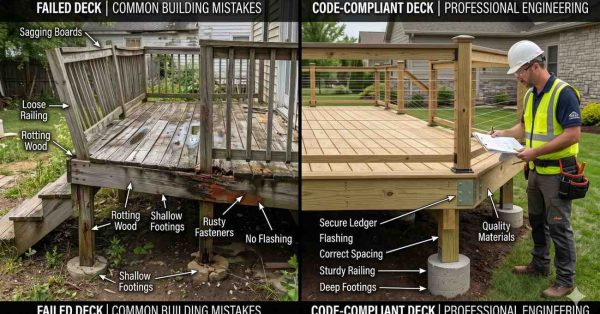
Before any addition can be planned, the existing deck’s substructure must be assessed. Post rot, joist deterioration, failed ledger connections, and shifted footings are common in decks over 10 to 15 years old. An expansion that ties into a compromised structure inherits those risks. In many jurisdictions, inspectors will require the existing structure to meet current code standards before approving any expansion permit application.
Understand Your Lot and Setback Constraints
Every addition must comply with local setback rules: minimum distances from property lines, easements, rights-of-way, and other structures. Setback violations discovered after construction are among the most expensive mistakes in any deck expansion, sometimes requiring partial demolition. Reviewing your local zoning rules and property survey before finalizing the expansion footprint is essential, not optional.
Set a Realistic Budget Based on Materials and Features
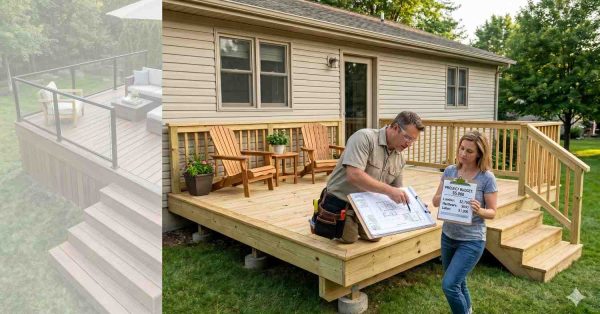
The cost of deck expansions varies significantly based on size, material selection, terrain, and intended features. Basic pressure-treated wood expansions typically run $15 to $25 per square foot for materials and labor. Composite or hardwood expansions range from $35 to $65 per square foot. Specialty elements including stairs, railing upgrades, pergolas, and outdoor kitchen infrastructure each add incremental cost that compounds quickly. Setting a realistic budget before selecting materials prevents the most common planning mistake: designing well beyond available financial capacity.
Plan for the Permit Process Timeline
Most deck expansions require a building permit. Permit applications typically add two to eight weeks to the overall project timeline, depending on jurisdiction. Applications require construction drawings, footing specifications, and in some cases engineering calculations. Factoring this timeline into the project schedule prevents the frustration of a contractor ready to mobilize with no permit in hand.
From setting a realistic budget to avoiding the most common planning pitfalls, our complete deck expansion planning guide covers every decision you need to make before a single board is cut, including how to evaluate your existing deck’s condition, size your addition correctly, and sequence the project for minimum disruption.
Structural Considerations for Deck Additions
Structural integrity is the non-negotiable foundation of any deck expansion. Every decision about how the new section connects to the old one, how loads are transferred to the ground, and how the expanded structure will perform over time comes down to engineering applied through building code compliance and, when required, the formal review of a licensed structural engineer.
Assessing Whether the Existing Structure Can Stay
The first structural question in any expansion is whether the existing deck’s substructure is in sufficient condition to remain in place. This assessment requires physical inspection, not just a visual review of the surface decking. Rot, insect damage, corrosion on metal connectors, and footings that have shifted or heaved from frost cycles can all compromise an existing frame in ways that are completely invisible from above. In most jurisdictions, building inspectors will evaluate the existing structure during the permit process and may require repairs or upgrades before authorizing any expansion work.
Connecting New Structure to Existing
Properly connecting a new expansion to an existing deck frame is the most structurally critical moment of the entire project. The connection must transfer both live loads (the weight of occupants, furniture, snow, and equipment) and dead loads (the weight of the structural materials themselves) across the old-to-new boundary. Standard connections use structural screws, through-bolts, joist hangers, and post-to-beam connectors rated for the specific application. Connections made with non-structural fasteners or improper hardware create failure points that may not appear until the structure is under significant load.
New Footings for Every New Post
Expansion sections require their own footings. Existing footings support existing loads only, and a new post cannot share an existing footing without engineering confirmation that the footing is sized for the combined load. Most expansion footings are poured concrete, sized to below the local frost line depth. In areas with deep frost lines or challenging soil conditions, helical piers are increasingly used as an alternative to poured concrete because they can be installed without excavation and perform well in cold weather conditions.
Engineering for Heavy Feature Loads
Any expansion designed to support a hot tub, an outdoor kitchen structure, or large masonry elements requires load calculations reviewed by a structural engineer. A fully loaded hot tub weighs between 2,500 and 6,000 pounds depending on size, exerting 50 to 100 pounds per square foot on the deck surface. Standard residential deck framing is designed for a 40 psf live load, which means dedicated beams and posts sized for the concentrated load are required to carry a hot tub safely.
Cantilever Limits in Expansion Design
When an expansion extends beyond the outermost beam line without a supporting post, it creates a cantilever. IRC deck code limits cantilever length to no more than one-quarter of the allowable back span for the joist species and size used. Cantilevering beyond these limits creates bounce, deflection, and long-term structural instability under concentrated loads that worsen significantly over time.
For a complete breakdown of load calculations, footing requirements, joist reinforcement, and the engineering decisions that determine whether your existing substructure can support an addition, our guide to structural requirements for deck additions walks through every technical dimension at the depth your project requires.
Deck Addition Design Patterns and Options
Deck expansions take many forms, and the design pattern you choose determines both the structural requirements and the functional outcomes of your project. The right design depends on your lot geometry, functional goals, existing deck configuration, and budget.
Linear Extensions
The simplest and most cost-effective expansion pattern is a straight outward extension of the existing platform. New framing is connected to the existing rim joist or beam, new footings are poured, and new decking is installed to match or complement the existing surface. This approach works best on level lots with adequate setback clearance and requires no change in elevation between old and new sections.
L-Shaped and Wraparound Additions
Adding a wing perpendicular to an existing deck creates an L-shaped footprint. A wraparound addition extends along the corner of a home, following the building perimeter. These configurations are popular because they create distinct functional zones within a single connected structure: a dining area on one side and a lounging area on the other, without the cost or complexity of a fully detached addition.
Multi-Level Additions
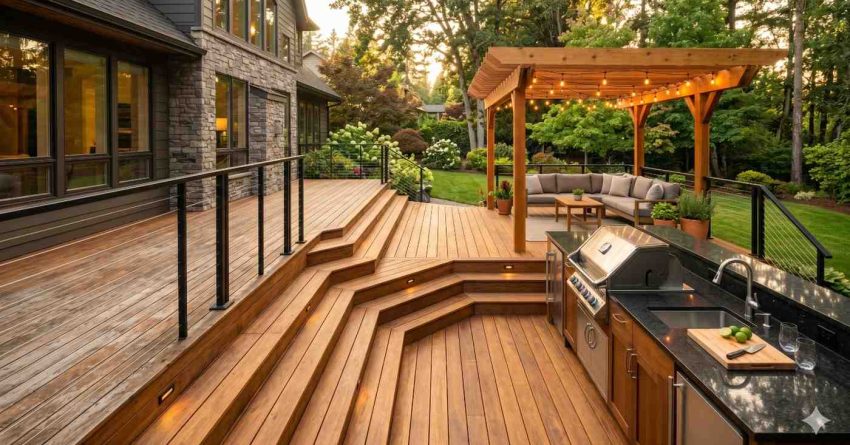
A multi-level expansion introduces a new deck platform at a different elevation than the existing one, connected by stairs or a step-down landing. Multi-level designs are particularly well-suited to sloped yards, where a lower platform can be built near grade while the upper deck remains at door threshold height. This approach adds significant visual interest and clear functional differentiation between activity areas.
Feature-Specific Platform Additions
Some expansions are purpose-built to support a single feature: a hot tub platform, an outdoor kitchen zone, a fire pit area, or a pergola base. These additions require engineering specific to the load and use of the intended feature and are often sized and positioned to be visually distinct from the main deck while remaining structurally connected to it.
For homeowners who want to integrate built-in seating, pergolas, outdoor kitchens, fire features, or lighting into their expansion footprint, our deck features and accessories guide covers every built-in and add-on option available at the design stage.
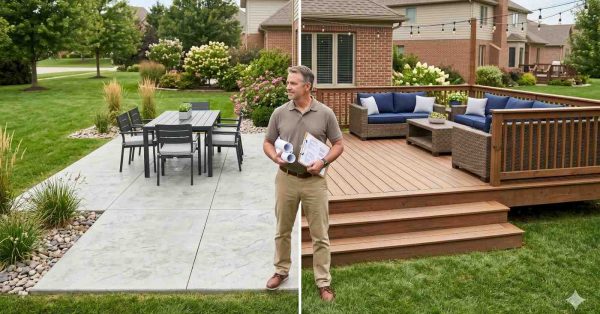
Patio and Grade-Level Connection Expansions
A growing outdoor living design trend is connecting an elevated deck to a ground-level patio through a step-down landing or lower deck section. This hybrid approach dramatically increases total outdoor square footage while creating natural spatial transitions between the elevated entertaining area and the landscaped ground level. The connection zone often becomes a design feature in its own right, incorporating planters, lighting, or a focal-point fire feature.
Pool and Yard Integration
Expanding a deck around or toward a pool requires precise coordination between the expansion footprint, the pool structure, and drainage requirements. Pool-adjacent expansions must also meet specific code requirements for slip resistance, fencing, and self-closing gate hardware that differ from standard residential deck code and carry meaningful liability implications.
Whether you are adding a wraparound, a second level, an outdoor kitchen zone, or a hot tub section, our resource on deck addition design options covers every major expansion configuration with guidance on how each approach works structurally, aesthetically, and functionally.
Matching Materials in a Deck Expansion
Material matching is one of the most underestimated challenges in any deck expansion. Installing new decking boards next to weathered, UV-faded, or previously stained existing boards creates visual gaps that, depending on the material and its age, may never fully close without refinishing the entire deck surface.
The Challenge of Matching Weathered Decking
Wood decking changes color significantly over time through UV exposure, oxidation, and moisture cycling. A new pressure-treated board installed next to a 10-year-old board of the same species will look noticeably different for at least one to two full seasons, regardless of how closely matched the stain or sealer application is. Planning for this visual transition, either by accepting it temporarily or refinishing the full deck immediately after expansion, is an essential part of any project scope discussion.
Understanding the full spectrum of decking materials, from pressure-treated lumber and composite boards to tropical hardwoods and PVC, will help you make the best material decision for your expansion, and our complete guide to deck materials provides in-depth comparisons across every type available for residential expansion projects.
Composite Decking Matching Challenges
Composite decking presents a particular matching challenge because color, texture, and plank profile vary significantly between product generations and manufacturers. A composite deck installed five to eight years ago may use a product line that has since been discontinued or substantially revised. Exact matches are frequently impossible in these cases, which forces one of three strategies: matching as closely as available inventory allows and accepting visible variation, using a contrasting color deliberately as a design feature, or refinishing the entire original deck surface after expansion to create uniform color across both sections.
Mixing Materials Intentionally
When an exact match is not achievable, the most successful expansions treat material contrast as a deliberate design decision rather than a visible repair. A new composite section added to a weathered pressure-treated original can be distinguished with a picture-frame border, a contrasting color transition, or a material change line that becomes a visual design feature rather than evidence of work done at different times.
Refinishing After Expansion
When material matching is essential to the project’s aesthetic goals, the most reliable strategy is to refinish the entire deck surface, original and expansion combined, simultaneously after construction is complete. This approach requires selecting a finish product compatible with the existing surface preparation and applying a uniform color and sheen to both sections as a single project.
For detailed guidance on matching weathered decking, blending composite and wood in a single project, and navigating discontinued product lines, our dedicated resource on material matching for deck expansions covers every strategy and alternative available to homeowners facing this challenge.
Permits, Codes, and HOA Requirements for Deck Expansions
Deck expansions are regulated structures in virtually every U.S. jurisdiction. Understanding the permit and code requirements that apply to your specific project before construction begins is essential. Unpermitted expansions create legal liability, complicate home sales, and can require costly demolition.
When a Permit Is Required
Most jurisdictions require a building permit for any deck expansion that adds structural elements, increases square footage, or changes the load characteristics of an existing structure. Some municipalities exempt ground-level platforms below a certain height or additions below a minimum square footage threshold, but these exemptions vary widely by locality and should never be assumed. The only reliable way to confirm whether your specific expansion requires a permit is to contact your local building department directly before any work begins.
Code Upgrades Triggered by Expansion
Obtaining a permit for a deck expansion frequently triggers a requirement to bring the entire existing structure up to current code. This can include adding ledger flashing, installing lateral load connectors, correcting railing height and baluster spacing, adjusting stair riser and tread dimensions, and increasing footing depth. These code upgrade costs are often not anticipated in initial project budgets, making the pre-permit code review a critical early step in expansion planning.
Setback and Lot Coverage Rules
Expansion footprints must comply with local setback rules: minimum distances from property lines, easements, rights-of-way, and other structures. They must also comply with lot coverage rules that limit the total percentage of a lot that can be covered by impervious or structural surfaces. Exceeding these limits requires a variance application, which adds both time and cost to the overall project timeline.
For the full picture on IRC deck code requirements, inspection processes, and safety standards that apply to both new construction and additions across all 50 states, our comprehensive deck permits, codes, and safety guide covers every regulatory layer relevant to expansion projects of all sizes and configurations.
HOA Approval
Homeowners in communities governed by homeowners associations or architectural review boards must obtain association approval before beginning any expansion project. In many cases, this approval must precede the permit application rather than run in parallel. HOA requirements typically address visual compatibility with the neighborhood aesthetic, materials specifications, screen and fence height limits, and other design constraints. Review timelines can range from two weeks to three months depending on the association.
Retroactive Permitting
Expansions begun without permits face potential stop-work orders, fines, and forced demolition if discovered during a home sale inspection or a complaint from a neighboring property. Some jurisdictions offer retroactive permitting processes for non-conforming additions, but these typically require bringing the structure into full current-code compliance, often at significant additional cost that substantially exceeds what proper permitting would have cost from the start.
From setback rules and lot coverage limits to HOA approval processes and the code upgrades that expansions can trigger on existing structures, our complete guide to permits and code requirements for expansion explains exactly what to expect and how to prepare your permit application successfully.
Hiring Deck Expansion Contractors and Managing Costs
Choosing the right contractor and understanding how costs are structured are two of the most consequential decisions in any deck expansion project. Errors in contractor selection are expensive to correct, and cost surprises discovered mid-project create conflict, scope changes, and sometimes unfinished work.
What to Look for in a Deck Expansion Specialist
Not every general contractor or deck builder has direct experience with the specific structural challenges of expansion work: connecting to existing structures, matching existing materials, and navigating permits for additions rather than new construction. When evaluating contractors, look for demonstrated expansion experience, not just new deck build experience. Request references from expansion-specific projects and review portfolios for work similar to yours in scope and structural complexity.
Licensing, Insurance, and Bonding
Any contractor performing structural work on your property should carry general liability insurance, workers’ compensation insurance, and a valid contractor’s license for your state and municipality. Bonding provides additional financial protection if a contractor fails to complete contracted work or causes property damage. Verify these credentials independently by contacting the issuing agencies rather than relying solely on documents provided by the contractor.
Getting and Comparing Quotes
A complete expansion quote should include a detailed line-item breakdown of materials, labor, permit fees, equipment, and disposal costs. Quotes presenting a single lump-sum total without line-item detail are difficult to evaluate and should be followed up with a specific request for itemization. When comparing multiple quotes, verify that each bid covers the same scope of work. Scope variations between competing bids are the most common explanation for apparent price differences that are actually coverage differences.
Phased vs. Single-Build Approaches
Some homeowners spread expansion projects over multiple seasons, completing the structural addition in one phase and features like pergolas, built-in seating, or outdoor kitchens in subsequent phases. Phasing can reduce the immediate financial burden but typically results in higher total cost than building everything in a single contractor mobilization. Phased projects also create a material aging mismatch between boards installed at different times.
Financing Options
Deck expansion projects are frequently financed through home equity lines of credit, home equity loans, or unsecured personal loans. HELOCs offer the flexibility of drawing only what is needed as construction progresses. Home equity loans provide a fixed lump sum at a fixed interest rate, which can simplify budgeting for a defined project scope. The right financing tool depends on cost certainty, the homeowner’s equity position, and prevailing interest rates.
For a full breakdown of how to hire a qualified deck expansion specialist, what questions to ask before signing a contract, how to compare quotes accurately, and whether a phased or single-build approach suits your budget and goals, our guide to deck expansion contractors and pricing gives you everything you need to make a confident hiring decision.
Expansion vs. Full Replacement: How to Decide
The decision between expanding an existing deck and replacing it entirely is one of the most important project scoping decisions a homeowner can make, and it is frequently made on incomplete information or based on the visible surface condition alone.
When Expansion Makes Sense
Expansion is the right choice when the existing deck’s substructure is structurally sound, the surface materials are in good condition, and the homeowner’s primary need is more space or specific features that do not require rebuilding the existing platform. If your deck passes a professional structural inspection with no significant findings, expansion is almost always more cost-effective than a full replacement.
When Replacement Makes More Sense
Full replacement becomes the better option when the existing substructure has widespread structural damage: multiple rotted joists, failed footings, a compromised ledger board, or extensive corrosion on structural connectors. Replacement also makes more financial sense when the cost of bringing an aging deck into code compliance approaches or exceeds the cost of new construction.
When the cost of reinforcing an aging substructure approaches the cost of rebuilding entirely, homeowners often find that full replacement makes more economic sense, and our complete guide to deck replacement helps you work through that cost-benefit decision with full data on materials, timelines, and what to expect from the replacement process.
The Hybrid Approach
In some cases, the right answer is neither pure expansion nor pure replacement but a combination of both approaches. Replacing a deteriorated existing section while simultaneously expanding the overall footprint allows homeowners to start with a consistent material base while achieving their space goals in a single project mobilization. This approach requires careful project management to coordinate demolition, replacement, and expansion sequences but frequently delivers the best long-term structural and aesthetic outcome.
Maintaining Your Expanded Deck for Long-Term Performance
An expansion investment is only protected by consistent, material-appropriate maintenance. The maintenance needs of an expanded deck mirror those of any deck, with the added complexity of two sections: the original structure and the new addition, which may be different ages, different materials, or at different wear stages when the expansion is completed.
Aligning Maintenance Schedules
When an expansion uses the same material as the original deck, maintenance schedules for both sections should be unified and treated as a single annual task. If the materials differ, each section requires its own maintenance protocol. Wood sections need annual cleaning, periodic sanding, and regular sealer or stain application. Composite sections need biannual cleaning but rarely require staining or sealing. Treating the two sections independently, applying care to one while neglecting the other, leads to uneven deterioration that becomes increasingly visible and expensive to address.
Inspecting the Connection Zone
The structural connection between the original deck and the expansion is the most important annual inspection point for any expanded deck. This zone should be checked each year for signs of differential settling, hardware corrosion, loose fasteners, and early-stage wood rot developing at the transition joint. Connection zone failures are often the first structural problems to appear in expanded decks, and they are significantly cheaper to address early than after they have progressed into the surrounding framing.
Protecting Both Sections as a Unified Surface
A common maintenance error on expanded decks is applying a fresh seal or stain only to the new expansion section while leaving the original deck visually mismatched and chemically unprotected. Any time a finish product is applied to one section of an expanded deck, the entire connected structure should be assessed and treated as a single maintenance unit to ensure consistent protection and a coherent visual appearance.
Whether you have added composite, wood, or mixed materials in your expansion, protecting your investment with the right seasonal care routine is essential, and our deck maintenance and care guide provides material-specific schedules, cleaning protocols, and annual inspection checklists to keep your entire expanded deck performing at its best year-round.
Conclusion
Deck expansion and additions rank among the highest-return investments in residential property, delivering more outdoor living space, new features, and measurable resale value.
Every successful expansion shares the same foundation: honest structural assessment, thorough planning, code-compliant design, precise material coordination, and professional execution by a qualified contractor.
At Mr. Local Services, we connect homeowners with experienced deck expansion specialists who deliver quality craftsmanship, transparent pricing, and lasting results.
Frequently Asked Questions
Do I need a permit to expand my existing deck?
In most U.S. jurisdictions, yes. A building permit is required for any expansion that adds structural elements or increases square footage. Always confirm the specific requirements with your local building department before starting any work.
Can I use composite boards to expand a wood deck?
Yes, though an exact match is rarely achievable. Composite boards can be added as an intentional design contrast or matched as closely as possible, with a full-deck refinishing treatment applied after construction to unify the color and appearance of both sections.
How long does a typical deck expansion project take?
Construction itself takes one to three weeks for most expansions after permits are approved. The permitting process adds two to eight weeks depending on jurisdiction, making the total project timeline from planning to completion typically six to twelve weeks.
What is the average cost to expand a deck?
Pressure-treated wood expansions typically run $15 to $25 per square foot for materials and labor. Composite or hardwood expansions range from $35 to $65 per square foot. A 200-square-foot composite addition typically costs $7,000 to $13,000 before features, permits, or required structural upgrades to the existing structure.
Will expanding my deck require bringing the existing structure up to current code?
In many jurisdictions, yes. Pulling a permit for an expansion often triggers an inspector review of the existing structure, which may require ledger flashing, lateral load connectors, railing height corrections, or footing depth upgrades. Factor this potential cost into your planning budget from the start.
Can I expand a deck that has some rotted boards?
It depends entirely on where the rot is located. Surface board rot that has not penetrated the framing does not necessarily prevent expansion. Structural rot in joists, beams, posts, or the ledger board must be repaired or replaced before any expansion begins. A qualified deck inspector can determine which scenario applies to your specific deck.
What features add the most value to a deck expansion?
Research consistently shows that covered pergola sections, outdoor kitchen zones, and multi-level designs add the strongest resale value to expanded decks. Composite materials carry higher upfront costs than wood but outperform on long-term maintenance costs and durability, making them the stronger overall value choice for most climates and most homeowners.