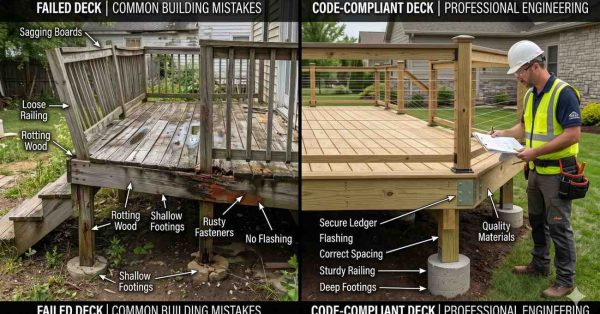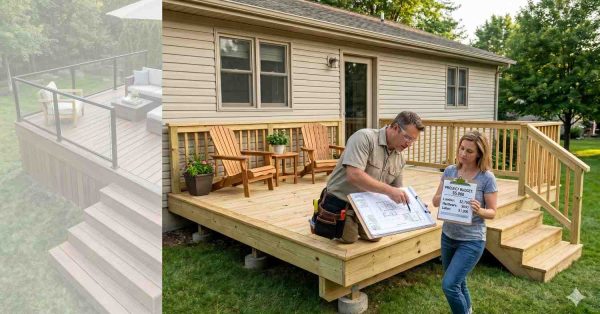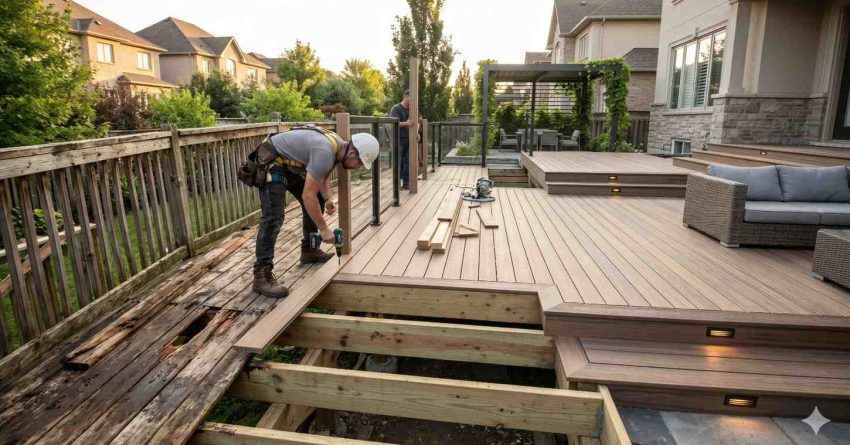
Deck replacement is the complete removal of a failing or outdated deck structure and the construction of a new one in its place, using the same footprint or a redesigned layout with new materials chosen to meet current code standards and long-term performance goals.
Hidden structural deck failure creates compounding safety risks, steadily reduces home value, and dramatically increases replacement cost every season it goes unaddressed, delaying the decision only makes it more expensive.
This guide covers when to replace, how to compare your options, what the project costs, how to plan and permit it, which materials to choose, and how to hire well.
What Is Deck Replacement and When Does It Make Sense?
Deck replacement is the process of removing an existing deck structure and constructing a new one. Unlike repair, which addresses isolated damage in a fundamentally sound structure, or restoration, which renews the surface appearance of a structurally intact deck, full replacement involves removing the entire existing build — from decking boards down through joists, beams, posts, and often the concrete footings — and starting fresh.
Three Scenarios That Trigger Replacement
Most deck replacements fall into one of three categories. The first is structural failure: widespread rot, insect damage, or hardware deterioration that has compromised the frame to the point where repair is neither safe nor cost-effective. The second is end-of-life replacement: when a deck has exceeded its material’s expected service life and further investment in the existing structure returns diminishing value. The third is upgrade-motivated replacement: when a homeowner chooses to rebuild a functioning but outdated deck to expand the footprint, improve aesthetics, add features, or address chronic maintenance spending.
Understanding which category applies shapes every downstream decision, from budget and timeline to material selection and contractor requirements.
Partial vs. Full Deck Replacement
Not every failing deck requires full demolition. In some cases, replacing only the decking boards while retaining a sound, code-compliant frame is a cost-effective middle path. Partial replacement makes sense when the substructure passes a professional structural inspection and meets current building code without modification. When any element of the frame fails that standard, full replacement typically delivers better long-term value. For a structured breakdown of when each scope is appropriate, our guide to partial vs. full deck replacement explains the inspection criteria, cost comparison framework, and decision logic that help homeowners choose the right scope from the outset.
Recognizing When Your Deck Needs Full Replacement
The line between a deck that needs repair and one that needs replacement is almost always a function of how widespread the damage is and whether the structural frame remains sound. Surface-level deterioration rarely justifies full replacement. Structural compromise almost always does.
Physical Warning Signs
Several visible indicators suggest replacement is the appropriate response:
- Soft, spongy decking boards that flex or sink underfoot in multiple locations
- Discoloration or staining consistent with advanced rot at boards, posts, or rim joists
- Boards pulling away from fasteners or lifting at edges despite repeated refastening
- Railings that wobble significantly even after hardware tightening and post inspection
- Stair stringers that are cracked, split, or separating at the landing connection
- Visible gaps or separation at the ledger board where the deck meets the house
Structural Failure Indicators
Below-surface issues are often more serious than homeowners can assess from the deck surface alone:
- Joists showing deflection, rot, or pest damage along a significant portion of their length
- The ledger board pulling away from the house or showing evidence of moisture infiltration behind its flashing
- Posts with rot that has advanced above the post base hardware
- Footings that have shifted, heaved, or settled unevenly, affecting the levelness of the structure
- Pervasive corrosion across structural hardware, reducing overall load-bearing capacity throughout the frame
According to the North American Deck and Railing Association (NADRA), deck structural failures account for thousands of injuries annually in the United States, with many incidents involving structures that appeared visually acceptable while concealing serious frame deterioration.
Deck Lifespan Benchmarks by Material
| Decking Material | Typical Lifespan | Common Replacement Trigger |
| Pressure-Treated Lumber | 15-25 years | Structural rot, widespread frame deterioration |
| Cedar / Redwood | 15-20 years | Surface degradation, moisture damage to frame |
| Composite (Modern Capped) | 25-30 years | Substructure failure, code non-compliance |
| Ipe / Tropical Hardwood | 25-40 years | Frame deterioration, end-of-life substructure |
| PVC Decking | 30+ years | Substructure failure |
When a deck approaches or exceeds these benchmarks and begins showing multiple warning signs simultaneously, the cost-benefit analysis shifts strongly toward replacement rather than continued repair investment. A rigorous assessment of structural condition, material age, repair cost vs. replacement cost, and long-term value is essential before committing to either path — our replacement decision-making guide walks through every factor homeowners and property managers need to make a confident, evidence-based decision rather than one driven by urgency or uncertainty.
Deck Replacement vs. Repair, Restoration, and Refinishing
Before committing to full replacement, it is worth understanding what the alternatives can and cannot accomplish. Repair, restoration, and refinishing each serve legitimate purposes for specific conditions. Choosing the wrong approach wastes money without solving the underlying problem that actually determines the deck’s future.
When Deck Repair Is the Right Call
Deck repair addresses isolated damage in a structure that is fundamentally sound. When the joists and beams are in good condition but a handful of boards have cracked, a single railing post has worked loose, or fasteners in one section have corroded without spreading to the rest of the frame, targeted repair is almost always more cost-effective than replacement. A deck that is less than fifteen years old, passes a professional structural inspection, and has clearly localized damage is an ideal candidate for repair. Repair extends usable life by years without the disruption and cost of full demolition.
When the damage appears manageable on the surface but continues spreading or appears across multiple structural systems simultaneously, repair becomes a series of incremental investments that postpones rather than resolves the underlying deterioration. Our complete deck repair guide covers every repair type — from single board replacement and joist sistering to ledger board reattachment and full hardware upgrades — with a clear assessment framework to confirm whether repair is viable before any replacement decision is made.
A Note on Deck Refinishing
Refinishing involves removing an old, incompatible, or failed finish and applying a fresh coating. It addresses surface protection and appearance, not structural integrity. Refinishing is an appropriate step within a broader restoration process, but it does not solve rotting boards, compromised joists, or structural hardware failure. It should not be conflated with either repair or restoration.
When Deck Restoration Makes Sense
Deck restoration is a comprehensive surface-renewal process involving deep cleaning, chemical stripping of old finishes, mechanical sanding, and fresh stain or sealer application. It is appropriate when the structural frame and decking boards are intact and the goal is restoring weatherproofing performance and appearance rather than addressing structural damage. Restoration typically costs 20 to 40 percent of a full replacement quote and can extend the functional life of a well-built existing deck by five to ten years.
For decks that are structurally solid but visually weathered, our guide to the deck restoration process explained covers the complete restoration sequence — including product selection, surface preparation techniques, and realistic cost comparisons against full replacement — helping homeowners quantify whether restoration is a financially sound alternative before committing to demolition.
The Cost Tipping Point
The decision shifts clearly toward replacement when repair or restoration costs would exceed 40 to 50 percent of a full replacement quote, when structural damage spans multiple systems across the frame, when the existing structure is at or past its material’s expected service life, or when code non-compliance requires upgrades so extensive they effectively constitute a structural rebuild. At these thresholds, continued investment in the existing structure rarely recovers its cost through extended service life or improved resale value.
Planning Your Deck Replacement Project
Thorough planning before demolition begins is what separates a smooth replacement project from one defined by delays, change orders, and overspent budgets. Several key decisions must be finalized before contractor quotes are solicited or any work is scheduled.
Same Footprint or Expand?
Deck replacement is often the most cost-efficient opportunity homeowners have to reconfigure their outdoor living space. Rebuilding within the existing footprint keeps permitting straightforward and project costs predictable. Expanding the footprint, adding a second level, or wrapping around a corner of the home are decisions that affect permit requirements, structural engineering scope, and total project cost substantially. These choices must be confirmed before any contractor conversation begins — changes made after a contract is signed typically trigger expensive change orders.
Upgrading Materials During Replacement
Replacement is the optimal moment to upgrade from wood decking to composite or PVC boards, or to shift from a conventional pressure-treated substructure to a longer-lasting engineered framing option. Material upgrades made during a planned replacement are substantially less expensive than retrofitting them later. The total cost-of-ownership case for composite decking over a 25-year period frequently offsets its higher upfront cost when homeowners account for the cumulative expense of wood maintenance performed every one to two years over the same ownership period.
Timeline and What to Expect
Most deck replacements in the United States require a building permit. Permit approval typically adds one to four weeks to the project timeline before construction can begin. Once permits are in hand, a standard mid-size replacement takes three to ten business days of active construction, depending on size, material choice, and design complexity. Weather delays, inspection scheduling, and material lead times can all extend this range.
From confirming the footprint and selecting materials before demolition starts to managing permit timelines and preparing your property and household for active construction, our replacement project planning guide walks through every pre-construction decision in the exact sequence your contractor will need confirmed before work begins.
How Much Does Deck Replacement Cost?
Deck replacement costs vary widely based on size, material, substructure condition, geographic labor rates, design complexity, and the scope of what is included in the demolition and rebuild. Understanding the full range of cost drivers is essential for evaluating contractor quotes accurately and budgeting for the complete project rather than just the most visible line items.
Average Cost by Size and Material
The ranges below reflect typical all-in costs for full deck replacement including demolition, materials, labor, standard railings, and stairs. Projects with complex design features, second-level structures, or premium finishes push toward the upper end of each range.
| Deck Size | Pressure-Treated Wood | Composite | PVC |
| 200 sq ft | $4,500 – $9,000 | $7,500 – $15,000 | $9,000 – $18,000 |
| 400 sq ft | $9,000 – $18,000 | $15,000 – $30,000 | $18,000 – $36,000 |
| 600 sq ft | $13,500 – $27,000 | $22,000 – $44,000 | $27,000 – $54,000 |
These are baseline ranges for standard designs in moderate labor-cost markets. High-cost metropolitan areas and premium finish specifications regularly produce quotes above the upper range.
Hidden Costs to Budget For
Several cost categories consistently surprise homeowners who budget only from the top-line contractor estimate:
- Footing replacement: Failed, undersized, or non-code-compliant footings add $600 to $1,800 per footing depending on frost-depth requirements and excavation difficulty.
- Ledger board replacement: A compromised ledger board adds $400 to $1,400 in labor alone, beyond the material cost.
- Permit fees: Municipal building permit fees typically range from $150 to $1,000 depending on project scope, jurisdiction, and valuation-based fee schedules.
- Debris disposal: Contractor haul-away or dumpster rental for a mid-size deck runs $350 to $800.
- Code compliance upgrades: Bringing a non-compliant existing structure into conformance with current standards can add $500 to $3,000, depending on how far the original build deviates from today’s code.
- First-season finish treatment for wood decks: Staining and sealing a new 400-square-foot wood deck adds $300 to $800 to the post-installation cost.
Financing and Insurance
Most homeowners finance deck replacements through home equity lines of credit, home equity loans, or personal loans. Several contractors offer direct financing programs. When deck failure resulted from a covered event — storm damage, falling tree, or sudden structural collapse — homeowner’s insurance may cover partial or full replacement costs. Standard wear-and-tear deterioration is excluded from most policies. Documentation of cause is essential when filing a claim, and engaging a public adjuster can improve outcomes on larger claims.
For a complete reference covering cost calculator tools, per-square-foot pricing across all major material categories, the full list of hidden cost items, and guidance on financing and insurance claims, our deck replacement cost breakdown provides the depth and specificity that general cost ranges cannot.
The Deck Tear-Out Process
Before new construction begins, the existing deck must be safely and systematically removed. The tear-out process is more involved than most homeowners expect, and how demolition is managed directly affects both the cost and quality of the new build.
Safe Demolition Practices
Professional deck demolition involves disconnecting electrical or lighting connections, removing fasteners in a controlled sequence that prevents unexpected structural collapse, protecting the home’s siding and window wells from impact damage, and managing large structural members safely as they come down. Poorly sequenced or rushed demolition can damage the ledger attachment zone at the house, compromise exterior flashing, and create additional scope work that increases the overall project cost.
Most contractors include demolition in their replacement scope as an integrated service. Confirming that tear-out, haul-away, and site cleanup are all explicitly included in the quoted price is important before any contract is signed.
Disposing of Old Materials
Old deck materials require specific handling. Most municipalities prohibit pressure-treated lumber from standard residential waste streams because of its chemical treatment content. Some transfer stations and recycling facilities accept treated lumber for specialized processing. Composite decking is generally non-recyclable and goes to approved waste facilities. Untreated wood can often be repurposed, donated, or accepted at wood waste recycling centers.
When disposal is not included in a contractor’s quote, budget for a 10 to 15-yard dumpster rental at approximately $350 to $600 for a typical mid-size deck project.
Saving Usable Footings
Existing concrete footings can frequently be retained when they were installed at the correct frost depth for your region, show no cracking or heaving, and were sized appropriately for the new structural load. A professional inspection or structural engineering review determines viability. Retaining sound footings reduces project costs by $1,000 to $3,500 on most mid-size replacements and eliminates significant excavation work.
From managing pressure-treated lumber disposal requirements and protecting the home’s exterior during teardown to evaluating which footings are worth retaining and what a properly sequenced demolition looks like, our guide to deck demolition and tear-out covers the full process in the order a professional crew follows, with practical detail on what each step should cost and what to watch for when oversight matters most.
Choosing Materials for Your Replacement Deck
Material selection at replacement time is one of the most consequential decisions in the entire project. It determines performance characteristics, maintenance demands, lifespan expectations, and long-term cost of ownership for the next two to three decades. It is also a decision that cannot be easily changed after construction is complete.
Composite vs. Wood for Replacement Projects
Wood decking — primarily pressure-treated lumber, cedar, and redwood — offers lower upfront installation costs and a natural aesthetic that many homeowners value strongly. The trade-off is a meaningful annual maintenance commitment: cleaning, sanding, and refinishing every one to two years to prevent accelerated weathering, surface rot, and board degradation. Wood is also more vulnerable to moisture infiltration, insect activity, and freeze-thaw cycling in cold-climate regions.
Composite decking trades a higher initial installation cost for dramatically reduced maintenance requirements. Modern capped composite boards are factory-coated with a protective polymer shell that resists moisture absorption, mold growth, surface staining, and UV fading. Most premium composite products are warranted for 25 to 30 years against structural failure and significant color change — a warranty profile wood simply cannot match.
If low-maintenance performance and long-term durability are the primary criteria for your replacement material decision, our composite decking complete guide covers every composite board type, the critical structural difference between capped and uncapped construction, the top-performing brands at each price tier, and real 25-year cost-of-ownership data that makes the comparison against wood concrete rather than speculative.
Low-Maintenance Material Options
PVC decking occupies the premium end of the low-maintenance spectrum, offering resistance to moisture, insect infiltration, surface staining, and UV degradation that composite products approach but do not fully replicate. The trade-off is the highest upfront cost of any residential decking material. Thermally modified wood products, such as Kebony and Accoya, provide a natural wood aesthetic with significantly improved resistance to rot and moisture compared to conventional lumber, making them a useful middle ground for homeowners who want wood’s appearance without standard wood maintenance demands.
Climate and Performance Considerations
Material performance varies meaningfully by geographic environment. Composite decking in high-heat regions can absorb significantly more radiant surface heat than wood, making lighter-colored board selection an important planning consideration. Coastal environments require stainless steel Grade 316 hardware throughout the entire deck structure regardless of the decking material chosen, since standard hardware corrodes rapidly in salt-air environments. Northern climates with aggressive freeze-thaw cycles place high structural demands on both board materials and the substructure connection hardware that must be specified accordingly.
For a complete comparison of climate performance data, maintenance requirements, lifespan benchmarks, and 25-year cost-of-ownership scenarios across all major material categories, our guide to best replacement deck materials 2025 gives homeowners the full picture needed to match material selection to their property’s specific site conditions, climate exposure, and long-term budget priorities.
How the Replacement Build Works
Once permits are approved and materials are ordered, replacement construction follows a structured sequence that parallels new deck construction with several critical differences driven by existing site conditions and structural assessment results.
Reusing the Existing Substructure
Whether the frame can be retained rather than fully replaced is determined through a professional structural inspection of joists, beams, posts, and the ledger board. Sound pressure-treated framing installed within the last ten to fifteen years frequently passes inspection and can support new decking boards without replacement, which significantly reduces both material and labor costs. Any rot, pest damage, deflection, or code non-compliance discovered during inspection typically requires frame replacement as well, eliminating the cost savings entirely.
Code Compliance During Replacement
A permitted replacement gives the local building department authority to require current code compliance in areas the original structure was built under older, less stringent standards. Common compliance requirements triggered during replacement include updated ledger attachment specifications and flashing details, revised railing height and baluster spacing under current standards, stair rise-and-run ratios that meet today’s code, and footing depths that meet current frost-line maps. IRC Section R507, the primary residential deck construction standard, has been revised multiple times since 2000, and many existing decks were built under substantially different requirements.
Adding Features During Replacement
Replacement is the most cost-efficient opportunity to incorporate features that would be expensive to add after the structure is complete. Built-in bench seating, electrical conduit runs for lighting circuits, blocking framed in for future hot tub installation, under-deck drainage system components, and pergola foundation posts can all be integrated during the replacement construction phase at a fraction of what standalone installation would cost.
Whether the existing substructure passes inspection and can be retained, which specific code sections apply to your project, and how to sequence feature additions without inflating the construction timeline are all decisions your contractor will navigate — our guide to replacement build process details explains each phase of the construction sequence so homeowners can follow along and hold their contractor accountable throughout the project.
Permits and Code Requirements for Deck Replacement
Nearly all deck replacements in the United States require a building permit. Proceeding without the required permits creates significant risk: difficulty at resale, potential code enforcement action, complications with homeowner’s insurance claims related to the unpermitted structure, and personal liability exposure if a structural issue arises after the fact.
Do You Need a Permit?
As a general rule, any deck replacement involving a tear-out and rebuild, modification of structural elements, or a change to footprint or height requires a building permit. Some jurisdictions allow cosmetic board-only replacements on a compliant existing frame without a full permit, but this varies significantly by municipality. The safest and most legally sound approach is to confirm permit requirements with your local building department before any work begins.
Understanding which permits your project requires, how the application and approval process works in your jurisdiction, and what inspectors will check at the footing, framing, and final stages is essential before demolition begins — our deck permit and code guide explains the full permit application process, the sections of the International Residential Code most directly relevant to replacement projects, and how local building departments commonly vary from the base residential code standard.
Code Updates Triggered by Replacement
A permitted replacement gives inspectors the authority to require compliance with current code in areas the original deck may have been built under older, less demanding standards. This commonly includes updated ledger flashing details, specific connector and fastener requirements that current code mandates, railing heights and baluster spacing under current specifications, and stair geometry within current rise-and-run tolerances. Budgeting $500 to $2,500 for unexpected code-compliance work prevents significant project delays when inspectors identify non-conformance items during construction phases.
Hiring a Deck Replacement Contractor
The contractor you hire is as consequential to the quality of your project outcome as the materials you choose. The deck replacement contractor selection process deserves structured evaluation rather than defaulting to the most familiar name or the lowest bid.
What to Look For
A qualified deck replacement contractor carries active general liability insurance and workers’ compensation coverage, holds any licensing required in your state, and can provide verifiable references from completed deck replacement projects specifically — not only new build work. NADRA membership is a useful indicator of professional engagement with deck construction industry standards. Experience managing permit applications, structural inspections, and code compliance within your specific municipality adds practical value that broader construction credentials cannot always substitute for.
Questions to Ask Before Signing
Before executing any replacement contract, homeowners should confirm the following: Who pulls the permit — you or the contractor? Is demolition and debris disposal explicitly included in the quoted scope? What does the payment schedule look like and when is the final payment due? What labor warranty does the contractor provide separate from material manufacturer warranties? How are change orders identified, priced, and approved during construction?
Comparing Quotes Fairly
Price variation of 20 to 30 percent between legitimate contractor quotes is entirely normal and typically reflects differences in material specifications, included scope items, labor overhead structure, and warranty coverage rather than differences in workmanship quality. Quotes that fall substantially below the average for your market warrant close scrutiny — they frequently exclude permit costs, disposal fees, code compliance work, or substructure items that other quotes have properly accounted for. A scope-by-scope line item comparison reveals far more than a top-line price comparison.
From verifying license and insurance credentials and recognizing contractor red flags to comparing warranty coverage across bids and understanding which contract clauses protect homeowners if disputes arise, our guide to hiring deck replacement professionals covers every step of the selection process, including the specific questions that reveal how candidates handle unexpected problems before you are locked into an agreement.
Does Deck Replacement Add Home Value?
Deck replacement is consistently cited by real estate professionals as one of the outdoor improvements with the strongest return profile relative to overall remodeling investment. The return varies by material, geographic market, and the condition of comparable properties in the local area.
Historical data from Remodeling Magazine’s Cost vs. Value Report shows that wood deck projects have consistently returned between 60 and 75 percent of project costs at resale across most U.S. markets, making them one of the stronger-performing exterior remodeling categories year over year. Composite deck replacements carry higher upfront costs that affect the percentage return calculation, but they consistently attract measurable buyer interest because low maintenance demands are a factor buyers increasingly weigh in their long-term ownership cost assessments.
For landlords and property managers, deck condition directly affects rental appeal and sustainable rental rate. A structurally compromised or visually neglected deck functions as a deterrent to quality tenants. A fresh, well-designed replacement deck can meaningfully improve occupancy rates and justify rental premiums in competitive rental markets, particularly in regions where outdoor living space commands significant tenant value.
For a detailed breakdown of ROI data by material type, regional market variation, and buyer perception factors that affect realized returns, our guide on deck replacement return on investment covers the resale value impact across material categories and how replacement timing relative to a planned sale affects overall project value calculation.
Caring for Your New Deck After Replacement
A replacement deck represents a significant investment, and the right maintenance approach from day one is what protects that investment across decades of use. New pressure-treated wood decks require six to twelve months for the lumber to reach adequate moisture equilibration before the first stain or sealer application is effective — applying finish too early traps residual moisture and causes premature coating failure.
New composite decks benefit from an initial cleaning to remove mill glaze and construction debris that accumulates during installation before the surface fully develops its final appearance. Annual structural inspection is essential regardless of material — checking board movement, hardware corrosion, ledger integrity, and moisture intrusion at post bases and framing connections catches developing issues at a stage where they cost far less to address than after they have advanced.
Protecting the investment you have made in your replacement deck requires a proactive maintenance routine from day one, and our complete deck maintenance guide covers annual inspection schedules, material-specific cleaning protocols, seasonal care checklists, and the preventive measures that extend a new deck’s service life by decades rather than just years.
Conclusion
Deck replacement combines structural assessment, material selection, code compliance, and contractor quality into a project that protects your property and its long-term value.
Every major decision in this project has a dedicated resource behind it, from material comparisons and cost planning to permit requirements and contractor selection.
When you’re ready to begin, Mr. Local Services connects you with qualified deck replacement professionals who deliver quality, transparency, and lasting value on every project.
Frequently Asked Questions
How long does a deck replacement take from start to finish?
Most residential deck replacements take three to ten business days of active construction once permits are approved. The permit approval process typically adds one to four weeks before construction can begin, depending on local building department workload and project scope.
Can I replace just the decking boards without replacing the entire frame?
Yes, provided the existing substructure passes a professional structural inspection and meets current building code requirements without modification. A qualified contractor should inspect joists, beams, posts, and the ledger board before confirming board-only replacement is both structurally viable and safe.
What does it typically cost to replace a 400-square-foot deck?
A 400-square-foot deck replacement generally ranges from $9,000 to $18,000 for pressure-treated wood and $15,000 to $30,000 for composite decking, including demolition, materials, standard railings, stairs, and labor. Geographic location, substructure condition, and design complexity significantly affect where a specific project falls within these ranges.
Do I need a building permit to replace my deck?
In most U.S. jurisdictions, yes. Full deck replacements involving tear-out and rebuild, structural modifications, or footprint changes require a building permit. Some municipalities allow cosmetic board-only replacements on compliant existing frames without a full permit. Always confirm requirements with your local building department before any work begins.
How do I determine whether my deck needs replacement or just repair?
Isolated damage limited to a few boards, individual hardware components, or a single railing section typically warrants targeted repair. Widespread structural damage across joists, posts, or the ledger board, a deck that has exceeded its material’s expected service life, or pervasive code non-compliance across multiple systems generally justifies full replacement. A professional structural inspection provides the most definitive assessment.
What is the best decking material to choose when replacing an old wood deck?
Composite decking is the most common replacement choice because it eliminates the annual maintenance cycle required by wood while delivering comparable aesthetics and a 25 to 30-year service life. PVC decking offers even greater durability at a higher initial cost. The best choice depends on climate, budget, planned ownership duration, and maintenance preferences.
Does deck replacement increase a home’s resale value?
Yes, in most markets. Historical data from Remodeling Magazine’s Cost vs. Value Report shows wood deck projects consistently returning between 60 and 75 percent of project costs at resale. Composite decks carry higher upfront costs that reduce the percentage return, but are increasingly valued by buyers who factor long-term maintenance demands into their total ownership cost assessments.