A rooftop deck is an outdoor living space built on a flat or low-slope roof, converting unused overhead square footage into usable, accessible living area. Urban homeowners and property managers across the USA use rooftop decks to maximize property value and expand functional outdoor space.
Understanding rooftop deck construction matters now because poorly planned projects fail structurally, void waterproofing warranties, and create costly, damaging leaks. Getting the fundamentals right protects your property and investment long-term.
This guide covers rooftop deck suitability, structural engineering, waterproofing, pedestal systems, materials, design choices, building codes, project costs, ROI, contractor selection, and long-term maintenance — linking each topic to dedicated resources.
What Is a Rooftop Deck and Why Build One?
The Rooftop Deck Defined
A rooftop deck is a structured outdoor platform built directly on the roof surface of a residential or commercial building. Unlike a ground-level deck constructed on footings at or near grade, a rooftop deck uses the building’s own roof plane as its structural base. This creates a fundamentally different construction challenge: every component of the project — from the waterproofing membrane to the deck surface to the railing system — must account for the fact that occupied living or commercial space lies directly below.
Rooftop decks are most common on flat-roof buildings: urban townhouses, brownstones, rowhouses, multi-unit residential buildings, and commercial properties where yard space is limited or nonexistent. In dense urban settings, the roof is often the only available location for private outdoor space of any meaningful size.
Why Rooftop Decks Are Rising in Popularity
Urban density is the primary driver. As U.S. Census Bureau data on urbanization shows, urban areas account for a growing share of the U.S. population, and with that density comes a persistent premium on private outdoor space. A rooftop deck solves the problem of where to create outdoor living area when there is no usable yard.
Beyond solving a space problem, rooftop decks generate meaningful returns. In major urban markets — New York City, Chicago, Washington D.C., San Francisco, and Boston — a well-designed rooftop deck can add 15 to 30 percent to a property’s marketable value, making it one of the highest-value outdoor improvements available for urban properties.
Types of Properties That Benefit Most
- Flat-roof rowhouses and townhouses in urban neighborhoods
- Multi-unit residential buildings with dedicated or private roof access rights
- Commercial properties adding outdoor hospitality or amenity space
- Condominiums where residents hold exclusive roof rights above their unit
The foundational concepts introduced here are only the starting point — our complete guide to rooftop deck fundamentals [URL TBD] covers every definition, key comparison, core terminology, and starting-point decision a property owner needs before committing to a rooftop construction project.
Is Your Roof Suitable for a Rooftop Deck?
The first question in any rooftop deck project is not “what kind of deck do I want” — it is “can my roof actually support a deck.” This is not a question with a universal answer. Suitability depends on roof type, structural capacity, building age, and the condition of the existing waterproofing system.
Roof Type and Slope Requirements
Rooftop decks require a flat or very low-slope roof — typically no more than a 2:12 pitch, which is approximately 9.5 degrees of slope. Steeper roofs cannot safely or practically support a deck platform. Most urban buildings with flat roofs qualify naturally. Suburban homes with conventional pitched roofs generally do not, which is why rooftop decks are predominantly an urban and dense-suburban project type.
Even among flat-roof buildings, the structural system matters. Concrete slab roofs, wood-frame roofs with adequate joist capacity, and steel deck systems are the most common bases for rooftop decks. Each carries different inherent load capacities and different reinforcement options.
Structural Capacity: What Your Roof Must Support
A standard residential roof is designed to carry a dead load — the permanent weight of the roofing assembly itself — plus a live load allowance for maintenance access and, in applicable regions, snow accumulation. Combined, this typically totals 15 to 30 pounds per square foot (psf). A rooftop deck significantly exceeds that baseline:
- A pedestal system with composite deck tiles adds approximately 3 to 6 psf of dead load
- A pedestal system with porcelain pavers can add 10 to 15 psf or more
- Furniture, people, grills, and planters create 40 to 60 psf of variable live load
Most existing residential roofs will require a structural engineering assessment — and many will require targeted reinforcement — before a rooftop deck is buildable. This is not a determination that can be made by a homeowner or a general contractor without engineering credentials.
The Pre-Project Professional Assessment
Before spending anything on design or materials, engage a licensed structural engineer to assess the specific building and roof. The engineer reviews existing framing plans where available, inspects current roof conditions, evaluates the building envelope, and identifies what modifications are needed. This assessment typically costs $500 to $2,000 — a modest upfront investment before committing to a project that may run tens of thousands of dollars.
Before committing to any rooftop deck project, it pays to work through a complete pre-project evaluation — our dedicated guide on roof suitability for a deck [URL TBD] walks through every factor a structural engineer and deck contractor will assess, from roof pitch and framing type to membrane condition and building age.
Rooftop Deck vs. Balcony vs. Terrace: Understanding the Differences
Rooftop decks are frequently confused with balconies and terraces. Understanding how they differ matters for structural engineering scope, permitting requirements, insurance coverage, and HOA approval processes.
Understanding the Key Differences
A balcony extends outward from the building’s facade, supported by cantilever framing, structural brackets, or columns integrated into the main building frame. Balconies project from the building’s vertical profile and are typically enclosed on three sides by railings. They are part of the building’s structural design from the outset in most cases.
A terrace most commonly refers to a ground-level or low-elevation outdoor area adjacent to a building — essentially an elevated patio. In some architectural contexts, the term describes an open outdoor platform on a lower floor of a multi-story structure. Terraces do not involve the roof plane and do not require the waterproofing or elevated structural engineering that rooftop decks demand.
A rooftop deck is built on the horizontal roof surface of the building and uses that surface as its structural base. It requires a waterproof membrane system beneath the deck surface, an engineering review of the roof structure’s load capacity, and a drainage design that balconies and ground-level terraces do not require. Rooftop decks also create specific fire egress, railing, and code compliance obligations that differ from balcony and terrace requirements.
These distinctions are practically important: rooftop decks trigger a different permit type than balconies in most jurisdictions, require a broader engineering scope, carry separate HOA approval pathways in multi-family buildings, and carry waterproofing maintenance responsibilities that the other outdoor space types do not.
If you are weighing these options before committing to a rooftop project, our full breakdown of rooftop deck vs balcony vs terrace [URL TBD] covers the structural requirements, permitting differences, design considerations, and cost implications that distinguish each type of elevated outdoor living space.
Structural Engineering: The Foundation of Every Rooftop Deck
No single factor separates successful rooftop deck projects from expensive failures more reliably than structural engineering. A ground-level deck involves relatively straightforward footing and framing calculations. A rooftop deck sits above occupied living or commercial space, where a structural failure has consequences that go far beyond cosmetic damage.
Why Structural Analysis Is Non-Negotiable
Every rooftop deck project must begin with a structural analysis performed by a licensed professional engineer (PE). This is not optional in most jurisdictions, and it should not be skipped even in areas where local enforcement is inconsistent. The engineer evaluates the existing roof structure’s capacity to carry additional permanent loads and the variable loads the deck will experience in full use.
In the majority of existing residential buildings, the structural analysis will reveal that some degree of reinforcement is needed — this is normal and expected. What varies from project to project is the extent and cost of that reinforcement, which is why early engineering engagement prevents late-stage budget surprises.
Live Load vs. Dead Load: What Your Roof Must Carry
Dead loads are the permanent, fixed weights added by the deck system: pedestals, deck surface materials, railings, any built-in features, and permanent equipment. For a composite tile pedestal system, dead loads are modest — approximately 3 to 8 psf. Porcelain or stone paver systems push this to 15 to 25 psf. A hot tub installation creates a concentrated point load that can reach 100 psf or more within its specific support footprint.
Live loads are variable: people, furniture, portable planters, grills, and snow in applicable climates. Building codes in most U.S. jurisdictions require rooftop deck designs to accommodate at least 40 psf live load capacity for general occupancy. Specialty installations such as outdoor kitchens with heavy masonry elements require additional point-load analysis.
The engineering standards that govern rooftop deck loads connect directly to broader building code frameworks — our complete guide to deck codes and load requirements [URL TBD] explains how live load, dead load, and lateral load specifications translate into the full permit application and inspection process for elevated deck structures across the USA.
Wind Uplift and Lateral Load Considerations
Rooftop decks are fully exposed to wind forces that ground-level decks rarely encounter at comparable intensity. Two structural wind challenges must be engineered: wind uplift — the upward force attempting to displace deck materials, railings, or freestanding structures — and lateral loading — the horizontal force acting on railings, privacy screens, and pergola elements.
These forces are significant. In coastal regions, high-elevation urban sites, or areas with documented high-wind events, lateral and uplift loads can exceed 30 psf on exposed deck elements. Every railing system, pergola, shade structure, and privacy screen on a rooftop deck must be engineered specifically for site wind loads — not simply selected for aesthetics.
When Roof Reinforcement Is Required
Reinforcement typically involves adding structural support from below: sistering existing joists, installing new steel beams, or adding columns that transfer deck loads down through the building structure to the foundation system. The scope and cost of reinforcement depend entirely on the existing building’s structural capacity and the proposed deck’s design loads. Committing to a deck design before the engineering analysis is complete regularly leads to costly redesigns.
Every rooftop deck project requires a thorough engineering analysis before a single component is specified — our dedicated resource on rooftop deck structural engineering [URL TBD] explains roof load capacity calculations, reinforcement strategies, wind uplift design requirements, and how to work productively with a licensed structural engineer from project initiation through construction.
Waterproofing and Membrane Systems for Rooftop Decks
If structural engineering governs safety, waterproofing governs the long-term integrity of the building itself. A rooftop deck sits directly above occupied space. Any moisture that penetrates the roof surface migrates into the structure below — eventually reaching ceilings, walls, insulation, and framing. Membrane quality, installation precision, and protection throughout the deck’s service life are the three non-negotiables in every rooftop deck project.
Why Waterproofing Is the #1 Priority
The waterproofing membrane is the continuous layer between the building structure and the deck surface system above it. It must be seamless, properly terminated at all edges and penetrations, and detailed carefully around every point where something penetrates or connects to the roof plane — drains, railing anchor points, utility access.
What makes rooftop deck waterproofing particularly critical is that membrane failure is rarely apparent immediately. Slow leaks allow moisture to travel through building assemblies for months before water becomes visible at interior surfaces. By the time damage is noticed, structural rot, mold growth, and insulation degradation may already be extensive. Preventing membrane failure costs a fraction of what remediating building moisture damage requires.
TPO, EPDM, and PVC Membranes: A Comparison
Three membrane types dominate residential and light commercial rooftop deck applications in the USA:
TPO (Thermoplastic Polyolefin) is a heat-welded, single-ply membrane that reflects UV radiation effectively, reducing heat buildup in the roof assembly. It is the most common choice for new rooftop deck projects and performs well across climate zones. Typical service life: 15 to 30 years.
EPDM (Ethylene Propylene Diene Monomer) is a rubber-based membrane with excellent flexibility across extreme temperature ranges. EPDM is typically black — heat-absorbing — and is bonded or mechanically fastened rather than heat-welded. It performs particularly well in cold-climate applications. Typical service life: 20 to 30 years.
PVC (Polyvinyl Chloride) is a heat-welded membrane with strong resistance to chemicals, grease, and oils — relevant where deck cleaning products or outdoor kitchen use might bring these substances into contact with the roof surface. PVC generally costs more than TPO but performs comparably in most residential rooftop deck applications.
Drainage System Design Under the Deck
Proper drainage is as critical as the membrane itself. Water that pools on the roof surface eventually exploits any weakness in the waterproofing system. The membrane must slope toward internal roof drains — a minimum pitch of 1/8 inch per foot is the standard design requirement. Drains must be sized adequately for local rainfall intensity. Pedestal systems that create an air gap between the deck surface and the membrane facilitate drainage naturally when properly detailed, but they do not eliminate the need for adequately sized drain openings in the membrane plane below.
Protecting the Membrane During and After Construction
Construction traffic is one of the leading causes of early rooftop membrane damage. Deck contractors must lay protection boards over the membrane throughout all construction activities on the roof surface. All membrane penetrations — drain connections, railing post anchor points, utility access installations — must be professionally flashed and sealed by a qualified waterproofing installer. Caulk-only penetration treatment is not an acceptable standard for rooftop deck applications above occupied space.
Choosing and protecting the right membrane system is one of the most consequential decisions in any rooftop deck project — our complete guide to rooftop deck waterproofing systems [URL TBD] covers TPO, EPDM, and PVC membrane comparisons in full detail, drainage system design, construction protection protocols, and leak detection approaches that protect your building investment throughout the deck’s service life.
Pedestal Systems: Building the Deck Surface Above the Membrane
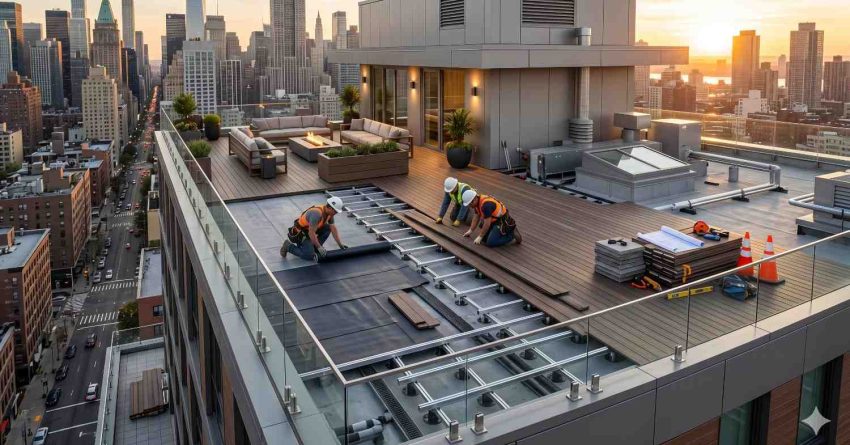
The pedestal system is the structural interface between the protected waterproof membrane below and the usable deck surface above. Without a pedestal system, a rooftop deck surface would rest directly on the membrane — compressing it, blocking drainage, and making membrane inspection and maintenance effectively impossible without demolishing the entire deck installation.
How Pedestal Systems Work
A pedestal is a support — typically manufactured from high-density polypropylene — that elevates the deck surface material above the membrane plane. The air gap created by the pedestal system serves three essential functions:
Drainage: Water from precipitation and deck surface runoff flows freely below the deck surface to membrane-level drains without pooling beneath the decking material — preventing the trapped moisture conditions that accelerate membrane wear.
Slope correction: Adjustable pedestals allow the deck surface to be leveled even on a roof that slopes toward its drains, which is the standard condition in flat-roof buildings. A perfectly level walking surface is achievable regardless of the roof’s drainage pitch.
Membrane accessibility: The deck surface can be lifted section by section for membrane inspection, localized repair, or eventual full membrane replacement — without requiring demolition of the entire deck surface system.
Adjustable vs. Fixed Pedestal Systems
Adjustable pedestals use a threaded stem that allows support height to be dialed in during installation, compensating for membrane slope variation across the roof field. They are the preferred system for the majority of residential and commercial rooftop deck projects because they provide leveling flexibility during installation and access flexibility for the life of the deck.
Fixed pedestals are appropriate where height variation across the roof surface is minimal and drainage is predictable. They reduce material cost modestly but offer less flexibility during installation and none afterward. They are a practical choice for simpler, smaller rooftop configurations with consistent slope and uncomplicated drain placement.
Compatible Surface Materials for Pedestal Decks
Not all deck surface materials are compatible with pedestal systems. The most widely used compatible surfaces:
- Composite deck tiles — interlocking modular systems, lightweight and weather-resistant
- Porcelain pavers — premium aesthetic, significant added weight
- Natural stone pavers — maximum weight, maximum premium
- Ipe and hardwood wood tiles — natural warmth, higher maintenance demand
- Artificial turf modules — green roof aesthetic, minimal structural load
Selecting the right pedestal system involves more than choosing a height range — our full guide to rooftop pedestal deck systems [URL TBD] covers adjustable vs. fixed system comparisons, leading brand reviews including Bison and Buzon systems, load distribution and spacing calculations, and the surface materials that integrate best with each pedestal type.
Best Materials for Rooftop Decks
Material selection for a rooftop deck involves constraints that ground-level projects do not face: structural weight limits, wind uplift resistance requirements, heat absorption characteristics in fully exposed urban environments, and compatibility with pedestal support systems. The material that performs beautifully in a backyard deck setting may be impractical — or structurally impossible — at rooftop elevation.
Weight, Drainage, and Heat as Primary Selection Criteria
Every rooftop deck surface material must be evaluated against three performance criteria before aesthetics are considered:
Weight: Every pound added to the deck surface translates directly into structural load. Lightweight materials reduce reinforcement requirements and associated costs. Composite tiles typically weigh 2 to 5 lbs per square foot; porcelain pavers range from 8 to 12 lbs per square foot; natural stone can exceed 15 lbs per square foot. The engineering analysis establishes the maximum allowable dead load, which directly governs material selection.
Drainage: Materials must allow water to move below the deck surface to membrane-level drains. Interlocking tiles with open joints and paver systems on pedestal supports with drainage gaps meet this requirement. Continuous-plank decking systems applied without adequate pedestal spacing can impede drainage.
Heat absorption: Rooftop surfaces in urban environments absorb significant solar radiation without the shading benefit that trees or adjacent structures provide at grade. Dark-colored surfaces — certain composite tiles, dark natural stone — can reach surface temperatures that make barefoot use uncomfortable and contribute to urban heat island effect. Lighter colors and materials with lower solar absorptance ratings improve both user comfort and building energy performance.
Composite and PVC Deck Tiles
Composite deck tiles are the most widely specified surface material for residential rooftop decks. They are lightweight, UV-stable, moisture-resistant, and available in wood-look finishes that satisfy most aesthetic goals. Most composite tile systems are specifically engineered for pedestal installation without adhesive — making both initial installation and future membrane access or tile replacement straightforward.
Understanding how rooftop deck surface materials compare to all decking options across climates and building applications requires a broader reference — our comprehensive deck material selection guide [URL TBD] covers all decking material types with full performance comparisons, lifespan data, climate-specific recommendations, and substructure compatibility information that applies across residential and commercial projects.
Porcelain and Natural Stone Pavers
Porcelain pavers offer a sophisticated, contemporary aesthetic that is particularly well-suited to urban rooftop environments. Large-format porcelain pavers — 24 x 24 or 24 x 48 inches — create clean, minimal surface patterns that read well at scale. The limitation is weight: a full porcelain installation adds significant structural dead load that must be explicitly accounted for in the engineering analysis before materials are specified. Natural stone pavers are heavier still and are typically reserved for projects where the building’s structural capacity and the project budget both comfortably support premium selections.
Wood Deck Tiles and Modified Wood Options
Ipe, teak, and thermally modified wood tiles bring a natural warmth and richness to rooftop deck surfaces that composite materials cannot fully replicate. Wood tiles installed on pedestal systems are a viable rooftop option, but they require consistent maintenance — periodic cleaning, oil application, and board-by-board condition inspection — that composite alternatives avoid. Thermally modified wood products, including Accoya and Kebony, offer meaningfully improved dimensional stability and biological decay resistance compared to standard hardwood species, making them a better long-term performer in fully exposed, elevated environments.
Material selection for rooftop applications involves trade-offs unique to elevated environments — our dedicated guide to the best rooftop decking materials [URL TBD] covers weight ratings, heat absorption data, slip resistance ratings, drainage compatibility requirements, and maintenance demands for every rooftop surface option, including composite tiles, porcelain pavers, natural stone, wood tiles, and artificial turf.
Designing Your Rooftop Deck: Key Considerations
A rooftop deck design cannot simply replicate a ground-level deck’s layout and apply it to the roof. The elevated environment introduces specific design constraints — primarily wind exposure, privacy above the roofline, and weight limits for all design elements — while offering distinct advantages: unobstructed sightlines, separation from street-level noise, and a sense of elevated openness that grade-level outdoor spaces cannot provide.
Wind-Resistant Design Principles
Wind is the defining environmental condition in rooftop deck design. At roof level, wind speeds are consistently higher than at grade, and gusts impose meaningful horizontal and uplift forces on structures, furniture, and users. Effective rooftop deck design addresses wind systematically:
- Low-profile and built-in seating: Reduces wind exposure and prevents furniture from becoming a hazard during high-wind events
- Perforated and slatted privacy screens: Allow wind to pass through rather than acting as solid barriers that generate extreme lateral loads on the connection structure
- Engineered pergola and shade structures: Specified for wind uplift and lateral load resistance, not only for aesthetic purpose
- Fixed or integrated planters: Anchored to or built into the deck structure rather than left as freestanding elements that wind can displace or overturn
Privacy, Shade, and Urban Context
Urban rooftop decks are typically visible from adjacent or taller neighboring buildings. Privacy is a design priority, not an afterthought. Slatted or louvered screens provide visual privacy while allowing wind to pass through. Louvered pergola systems with adjustable louver panels offer dynamic shade control without creating a permanent solid roof structure that adds dead load and may trigger additional permit requirements.
The broader principles of spatial planning, functional zoning, and style decision-making that inform quality deck design apply directly to rooftop environments — our comprehensive resource on rooftop deck design principles [URL TBD] covers layout strategies, zone allocation approaches for dining, lounging, and active use areas, and how to collaborate effectively with deck designers and architects on elevated outdoor projects.
Outdoor Kitchens, Hot Tubs, and Feature Additions
Rooftop decks can accommodate the same features found on ground-level decks, but each requires additional consideration specific to the elevated environment:
Outdoor kitchens require gas line routing to the roof — often a significant plumbing and permitting task — as well as fire code compliance for appliance clearances from combustible materials. The weight of masonry countertops, appliances, and cabinet structures must be included in the structural dead load analysis.
Hot tubs and spas create extreme concentrated point loads. A standard 6-person hot tub filled with water weighs 4,000 to 6,000 lbs or more. Hot tub installations must be integrated into the structural engineering analysis from the very beginning of the project — not added after the deck structure is designed.
Planters and garden elements add load in direct proportion to soil volume and moisture content. Lightweight engineered growing media, fiberglass or composite planters positioned near structural bearing points, and drip irrigation systems that minimize soil saturation weight allow meaningful planting without exceeding structural load limits.
Plant Integration and Green Roof Hybrid Design
Some rooftop deck projects integrate extensive or intensive green roof elements alongside the usable deck area. This creates a hybrid of planted zones and walkable outdoor surface that adds thermal insulation value, stormwater management benefit, and aesthetic richness beyond what a hardscape deck surface alone provides. Rooftop deck maintenance is unique to elevated environments and distinct from the care that standard decks require — our dedicated resource on rooftop deck maintenance and seasonal care walks through annual membrane inspections, pedestal condition checks, drain clearing schedules, and wind-damage assessment protocols that protect both the deck system and the building below it.
Designing a rooftop deck that performs well in wind, delivers meaningful privacy, and integrates functional features requires specialized design expertise — our full guide to rooftop outdoor living design [URL TBD] covers 25 design concepts for urban and suburban rooftop environments, wind-resistant layout strategies, shade and privacy solutions, outdoor kitchen and hot tub integration planning, and how to incorporate plant and garden elements effectively at elevation.
Permits, Building Codes, and Safety for Rooftop Decks
Rooftop decks require permits in virtually every U.S. jurisdiction. This is not a project where building first and addressing compliance later is a viable strategy. Unpermitted rooftop construction creates insurance coverage gaps, creates direct legal liability, and in some jurisdictions leads to mandatory removal at the property owner’s full expense.
Why Permits Are Almost Always Required
A rooftop deck is a structural modification to the building that affects fire egress routes, loads on occupied space below, the waterproofing system, and the building’s exterior profile. Building departments require permits because they need to verify that the project is properly engineered and inspected at key construction milestones.
Permit applications for rooftop decks in most jurisdictions require:
- Stamped structural engineering drawings from a licensed PE
- Waterproofing system specification and membrane details
- Site plan showing roof access routes and egress compliance
- Mechanical or electrical plans when outdoor kitchens, hardwired lighting, or HVAC components are included
The rooftop deck permit process also takes longer than standard deck permits in most markets — factor 8 to 16 weeks for municipal review in urban jurisdictions with active building departments.
Railing Heights, Egress, and Fire Code
The International Residential Code (IRC) and International Building Code (IBC) govern most rooftop deck construction in the USA, with local amendments in effect in many jurisdictions. Key requirements include:
- Railing height: A minimum of 42 inches for elevated decks in most jurisdictions; some rooftop-specific local codes and condo building standards require higher guards
- Baluster spacing: Maximum 4-inch clear opening between baluster elements to prevent child entrapment
- Egress compliance: The access route from the building interior to the rooftop deck must comply with minimum clear width requirements and the fire resistance rating of adjacent construction
- Fire code: Restrictions on combustible surface materials directly above occupied spaces apply in some jurisdictions; open-flame appliance clearances must comply with local fire code specific to the installation height
HOA and Condo Board Approval
In multi-family buildings and HOA-governed communities, municipal permitting is not the only approval required. Condo boards and homeowners associations typically have independent review and approval processes for rooftop deck projects. These processes can take weeks to months and may require architectural review board evaluation alongside the board vote itself. Property owners should initiate HOA approval in parallel with municipal permit application — not sequentially — to prevent unnecessary project timeline extension.
Insurance Requirements and Liability Implications
Adding a rooftop deck changes the building’s character, replacement cost value, and risk profile. Property owners must notify their insurer before construction begins and update their policy to reflect the completed structure. Some insurance policies explicitly exclude uninspected or unpermitted structures from coverage — making permit compliance directly connected to insurance protection in the event of a claim.
A critical but often underestimated issue is liability for rooftop deck problems that affect neighboring properties — roof drainage, wind-displaced materials, or waterproofing failures that cause water intrusion into shared building assemblies. Proper permitting, engineering, and professional installation are the first line of defense against these liability exposures. Our dedicated resource on rooftop deck problems and how to fix them covers the most common rooftop deck failure patterns — from membrane leaks and pedestal settlement to railing uplift and drainage system blockage — and explains how each is identified and resolved.
Navigating the full scope of code compliance for a rooftop deck is more involved than most homeowners anticipate — our dedicated resource on rooftop deck building codes [URL TBD] walks through IBC and IRC requirements in full detail, railing height and egress specifications, HOA and condo board approval processes, fire code considerations, and insurance requirements specific to elevated deck structures.
Rooftop Deck Cost, ROI, and Hiring the Right Contractor
Rooftop deck construction is one of the more expensive outdoor projects a property owner can undertake — and one of the most valuable in urban markets where private outdoor space commands a genuine premium. Understanding what drives the cost, how ROI is measured, and what qualifications to look for in a contractor positions you to make well-informed decisions throughout the project.
What Does a Rooftop Deck Actually Cost?
Rooftop deck costs vary significantly based on size, structural reinforcement requirements, material selection, geographic market, and feature complexity. Representative ranges for complete rooftop deck projects in the USA:
- Small rooftop deck (200 to 400 square feet): $15,000 to $35,000
- Mid-size rooftop deck (400 to 800 square feet): $35,000 to $70,000
- Large or premium rooftop deck (800+ square feet or high-end finishes): $70,000 to $150,000 or more
These ranges reflect structural engineering fees, waterproofing system installation, pedestal system, surface materials, railings, and basic lighting. Outdoor kitchens, hot tubs, custom pergolas, green roof elements, and integrated audio or lighting add significant cost above these baselines.
Why Rooftop Decks Cost More Than Ground-Level Decks
The cost differential between a rooftop deck and a comparable ground-level deck is significant — often two to four times the cost per square foot. The primary rooftop-specific cost drivers:
- Structural engineering fees: $1,500 to $5,000 for PE analysis and stamped construction drawings
- Structural reinforcement work: $3,000 to $25,000 or more, depending on existing building conditions
- Waterproofing system installation: $3,000 to $15,000 depending on membrane type, roof area, and drain configuration
- Material hoisting logistics: Moving materials to the roof adds labor time and equipment requirements relative to grade-level projects
- Permitting complexity: Rooftop permit applications require engineering documentation and often face longer municipal review periods than standard deck applications
ROI and Home Value Impact
In urban markets where private outdoor space is genuinely scarce, rooftop decks deliver compelling long-term returns. According to Remodeling Magazine’s Cost vs. Value Report, deck additions consistently rank among the stronger-returning outdoor improvement investments nationally. In high-density urban markets where rooftop access is rare and differentiated, the market premium for properties with private rooftop decks frequently exceeds national deck ROI averages.
Properties with well-designed rooftop decks in major urban markets tend to sell faster and at stronger asking prices than comparable properties without private outdoor space — making the investment rational both for property owners planning a sale within five to ten years and for those holding long-term who want maximum use and enjoyment of their property.
Selecting a Qualified Rooftop Deck Contractor
Not every deck contractor is equipped to build a rooftop deck. Key qualifications to evaluate before signing any contract:
- Structural engineering relationships: The contractor should routinely collaborate with licensed professional engineers and treat engineering as a project prerequisite, not an afterthought
- Documented waterproofing experience: Direct experience specifying membrane systems and protecting them during construction — not simply working around an existing roof
- Rooftop-specific project portfolio: Request completed rooftop deck references explicitly, not just ground-level deck examples
- Permit application capability: Rooftop permit applications require engineering documentation coordination that general deck contractors may not be equipped to manage
Getting a complete and accurate picture of rooftop deck costs — broken down by structural engineering, waterproofing, materials, hoisting, and contractor fees — requires more detail than any general range provides — our complete resource on rooftop deck project costs [URL TBD] covers average pricing by component, compares ground-level vs. rooftop cost differences in detail, explains phased project approaches, and walks through the contractor qualification process specific to elevated deck construction.
Conclusion
Rooftop decks transform unused roof space into high-value outdoor living areas, requiring careful engineering, waterproofing, code compliance, and material selection at every stage.
Each section in this guide links to a dedicated spoke resource — follow those to go deeper on engineering, waterproofing, materials, design, or costs.
Mr. Local Services connects homeowners and property managers with qualified rooftop deck specialists who manage engineering, permitting, construction, and final inspection from start to finish.
Frequently Asked Questions
What type of roof is needed for a rooftop deck?
A rooftop deck requires a flat or low-slope roof — typically no steeper than a 2:12 pitch. Most urban flat-roof buildings meet this requirement and are well-suited for rooftop deck construction.
Do I need a structural engineer for a rooftop deck?
Yes. A licensed structural engineer must evaluate your roof’s load capacity before any rooftop project begins. Most roofs require some reinforcement to safely carry the combined dead and live loads.
How much does a rooftop deck cost in the USA?
Rooftop deck costs typically range from $15,000 for a small, basic installation to $150,000 or more for a large, fully featured project with premium materials, structural reinforcement, and outdoor features.
What is a pedestal system on a rooftop deck?
A pedestal system is a height-adjustable support that elevates the deck surface above the waterproof membrane, allowing drainage beneath the surface, slope correction, and membrane access for inspection.
Do rooftop decks require building permits?
Yes. Rooftop decks require permits in virtually all jurisdictions because they involve structural modifications above occupied space. Most permit applications require stamped structural engineering drawings and a waterproofing specification.
What is the best material for a rooftop deck?
Composite deck tiles are the most popular rooftop choice — lightweight, weatherproof, and low-maintenance. Porcelain pavers add structural load but offer premium aesthetics. Wood tiles bring warmth but need regular maintenance.
Does a rooftop deck add value to a home?
Yes. A rooftop deck can add 15 to 30 percent to a property’s resale value in urban markets, where private outdoor space is scarce and commands a significant premium.