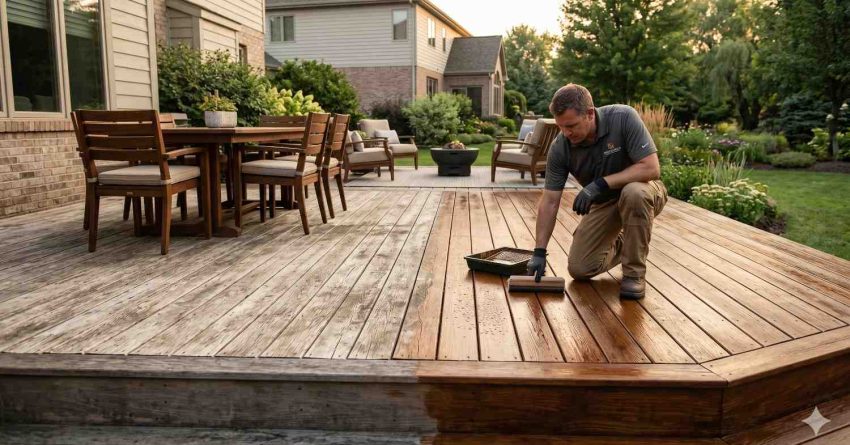
Deck staining and sealing are the two most important protective treatments for any wood deck. Stain penetrates wood fibers to deliver color and UV protection; sealer creates a moisture barrier that prevents rot and structural breakdown. Together, they determine how long a deck lasts and how well it performs.
Without routine staining and sealing, an unprotected wood deck will gray, crack, and deteriorate within a few seasons, turning a long-term property investment into an urgent repair or full replacement.
This guide covers the key difference between staining and sealing, all major stain and sealer types, top brand reviews, application techniques, wood-specific recommendations, full cost expectations, and professional hiring guidance.
What Is Deck Staining and Sealing?
Deck staining and sealing are often discussed as a single activity, but they are two distinct protective treatments that serve different purposes on wood decking. Understanding both individually is the starting point for making smart product choices and building an effective maintenance routine.
Defining Deck Staining
Deck stain is a penetrating wood finish that delivers pigment or dye into the wood surface. Depending on the opacity level, stain provides UV protection, color enhancement, and varying degrees of surface coverage. The amount of pigment in a stain directly determines how much ultraviolet protection it delivers — more pigment blocks more UV radiation, which slows the breakdown of lignin, the natural polymer that holds wood fibers together.
Stain is primarily a surface and UV protection product. Its ability to repel moisture depends on whether waterproofing agents are included in the formulation. Many modern stains are sold as combination stain-sealer products, but traditional stain alone provides limited moisture protection on its own.
Defining Deck Sealing
Deck sealer is a clear or lightly tinted product that creates a water-repellent barrier at the wood surface or within the wood structure. Sealers work by blocking the microscopic pores in wood through which liquid water and water vapor enter. When water is absorbed and released repeatedly through rain, humidity, and seasonal temperature cycles, wood swells, contracts, cracks, and eventually decays. A quality sealer reduces this moisture cycling significantly.
Sealers vary in how they work. Penetrating sealers absorb into the wood fiber and harden within the cell structure. Film-forming sealers create a surface layer over the wood. Most deck sealers provide no or minimal UV protection on their own — their primary function is moisture management.
Why Both Treatments Work Together
The most common and effective approach for residential wood decks is to use a combination stain-sealer product that delivers both UV-blocking pigment and water repellency in a single formula. This eliminates the need for two separate applications while ensuring the deck is protected from both major threats: solar degradation and moisture intrusion.
In practice, the terms “staining” and “sealing” are used interchangeably in many discussions, but homeowners who understand the distinction are better equipped to choose the right product, identify the right reapplication timing, and troubleshoot problems when a finish fails.
Deck Staining vs. Deck Sealing: Understanding the Difference
While staining and sealing both protect wood decking, they target entirely different failure mechanisms. Knowing which threat your deck faces most acutely helps determine where to focus your protection strategy.
What Stain Does for Wood
Stain’s primary job is defending wood against ultraviolet radiation. Direct sunlight breaks down lignin at the surface of wood fiber, causing the familiar gray weathering that turns untreated decks silver or charcoal within one to two seasons. Pigmented stains absorb and scatter UV rays before they penetrate deeply into the wood structure. The more opaque the stain — moving from transparent to semi-transparent to solid — the greater the UV protection it delivers, though at the cost of reducing the visible wood grain.
Without stain, UV-degraded wood becomes dry, brittle, and porous. Surface checking (small surface cracks) develops rapidly, and the wood becomes far more susceptible to moisture intrusion as a secondary consequence. Staining is, in this sense, the first line of defense.
What Sealer Does for Wood
Sealer’s job is defending wood against moisture. Water enters wood through pores and end grain, swelling the fibers when it arrives and causing them to contract as it leaves. This constant movement generates physical stress that produces cupping, warping, cracking, and ultimately rot. A quality penetrating sealer significantly reduces the rate at which wood absorbs liquid water and water vapor, stabilizing the wood’s moisture content and extending its structural life.
Water damage compounds over time. A deck with failed sealer protection in a high-rainfall or high-humidity environment will show visible warping, mold growth, and early rot signs within a single season of unprotected exposure.
Combining Stain and Sealer in One Product
For most homeowners, a quality combination stain-sealer product provides the most practical solution. These formulas deliver pigment-based UV protection alongside waterproofing chemistry in a single application, reducing labor, simplifying recoating, and ensuring both threats are addressed simultaneously.
In extreme situations — a highly exposed deck in the American Southwest, or a deck under dense tree canopy in the Pacific Northwest — the balance between UV protection and moisture protection may favor emphasizing one product type over the other. But for the majority of residential decks across the United States, a semi-transparent or solid combination stain-sealer product covers both needs effectively.
The precise difference between staining and sealing — including when each treatment is appropriate, when they combine most effectively, and what specific consequences follow from choosing one without the other — is explored in full detail in our staining and sealing fundamentals guide, which walks through every decision point with product-level specificity and practical guidance for homeowners.
Types of Deck Stain
Deck stains are available in four primary opacity levels, each engineered for a different balance of wood grain visibility, UV protection, and long-term maintenance requirements. Choosing the right opacity level for your deck is one of the most consequential decisions in any staining project.
Transparent Stains
Transparent stains contain the lowest pigment concentration of any stain category. They enhance the natural color and grain of wood with minimal visual change — which is their primary appeal. New decks with attractive grain patterns, premium hardwood installations, and decks where the natural wood aesthetic is a priority are natural candidates for transparent formulations.
The limitation is protection. Transparent stains offer minimal UV defense and require the most frequent reapplication — typically every one to two years. They perform best on hardwoods with inherent UV resistance, sheltered decks with limited direct sun exposure, and climates with moderate rather than extreme UV intensity.
Semi-Transparent Stains
Semi-transparent stains are the most widely used category among residential decks, and for good reason. They allow the natural wood grain to show through while providing meaningful UV protection. Semi-transparent formulas penetrate deeply into wood fibers, building protection from within rather than forming a surface film. This deep penetration produces durable, low-maintenance results with a reapplication window of two to three years under normal conditions.
Semi-transparent stains are the best general-purpose choice for pressure-treated, cedar, and moderate hardwood decks across most US climates. They are the most forgiving during reapplication — new product can often be applied over a worn semi-transparent finish without full stripping, provided the existing finish has deteriorated uniformly.
Solid Stains
Solid stains behave more like paint than traditional stains. They fully opacify the wood surface, hiding grain, knots, and color variation in favor of a uniform, painted appearance. Solid stains provide the highest UV and weathering protection of any stain category, making them well suited for older, heavily weathered decks, decks with inconsistent board coloring, or decks in extreme high-UV environments.
Solid stains typically last three to five years before reapplication is needed — a significant advantage in long-term maintenance planning. The tradeoff is that reapplication is more demanding. When a solid stain begins to fail, it peels and cracks rather than fading uniformly, requiring thorough stripping before any new coat can be applied.
For homeowners weighing whether to use a solid deck stain or exterior deck paint — two products that look similar in the can but perform very differently in terms of durability, reapplication complexity, and long-term maintenance — our stain vs deck paint comparison breaks down every performance and cost difference that affects this choice.
Oil-Based vs. Water-Based Formulas
Across all opacity levels, stains are available in oil-based and water-based formulations. Oil-based stains penetrate deeply, cure to a highly durable finish, and have traditionally been preferred by contractors for demanding applications. They require longer drying times and have higher VOC (volatile organic compound) content than water-based alternatives.
Water-based stains apply more easily, dry faster, clean up with water, and have significantly lower environmental impact. Modern water-based formulas have largely closed the performance gap with oil-based products in most categories, and in wet climates, water-based stains often perform as well or better over time.
When the time comes to switch stain types — for example, moving from a solid stain to a semi-transparent formula — the deck must be fully stripped before any new product is applied, and our deck refinishing guide covers every step of that process in detail, from chemical stripping and sanding through product compatibility and final application.
For a thorough breakdown of every stain category — covering transparent, semi-transparent, and solid formulas, oil-based vs. water-based chemistry, penetrating vs. film-forming behavior, hybrid products, and acrylic vs. alkyd performance differences — our complete guide to deck stain types covers every option with product-level comparisons and best-use guidance for each scenario.
Types of Deck Sealers
Deck sealers occupy a separate but equally important product category from stains, and the range of formulations available reflects the variety of moisture threats wood decks face across different climates and exposures.
Clear and Penetrating Sealers
Clear sealers are water-repellent products that deliver moisture protection with minimal or no visual change to the wood surface. They are often the first product applied to freshly installed decks to provide early moisture protection without making a long-term commitment to a color or tinted finish. Clear sealers typically require annual reapplication — they wear faster than pigmented products because they lack UV stabilizers to slow their own degradation.
Penetrating sealers are a subcategory that works by soaking into the wood fiber structure and hardening within the cell walls. Unlike film-forming products, penetrating sealers do not crack, peel, or flake as they age. They are low-maintenance and highly compatible with subsequent stain applications, making them a preferred base treatment for decks that will later receive a pigmented finish.
Film-Forming Sealers
Film-forming sealers create a surface layer over the wood rather than penetrating the fiber structure. While they can produce a visually richer, more lustrous appearance in the short term, they are more prone to peeling and flaking as the surface layer breaks down — particularly on horizontal surfaces exposed to foot traffic and standing water. Film-forming products require more intensive prep at reapplication time because the old surface film must be removed before new product can adhere properly.
For most exterior deck applications, penetrating sealers outperform film-forming products in durability, maintenance ease, and long-term adhesion.
UV-Protective and Waterproofing Sealers
UV-protective sealers combine a water-repellent base with UV stabilizers, offering more complete environmental protection than a basic clear sealer without the color addition of a stain. These are useful for homeowners who want meaningful UV protection while preserving the wood’s natural appearance.
Waterproofing sealers are formulated with enhanced moisture-blocking agents — often silicone-based or polymer-based chemistry — for decks in high-rainfall or near-water environments. Eco-friendly and low-VOC sealer options have also expanded significantly in recent years, offering strong performance without the health and environmental concerns associated with solvent-heavy formulas.
Whether you need a clear penetrating sealer, a UV-protective waterproofing formula, a hardwood-specific oil, or an eco-friendly low-VOC option, our deck sealer types guide covers every category in full detail — including a breakdown of film-forming vs. penetrating behavior, waterproofing vs. UV-protective distinctions, and the specific question of whether composite decking needs sealing at all.
Best Deck Stain and Sealer Brands
The deck finish market includes a range of brands from widely available retail products to professional-grade formulas sold through specialty dealers. Understanding which brands consistently perform at each price and quality tier is a practical first step before investing in materials.
Top Stain Brands at a Glance
Cabot is a respected professional and contractor-grade brand known for its Australian Timber Oil and penetrating semi-transparent stain lines. Cabot products are particularly well-regarded in high-humidity environments for their deep penetration and moisture-resistant durability.
Behr offers widely available mid-range deck stains that perform well for DIY applications. Its DeckOver product line addresses heavily weathered decks with a thick-film resurfacing formula. Coverage is straightforward and application is forgiving for first-time users.
Olympic produces a range of penetrating and solid formulas, with its Elite line combining strong water repellency and mildew resistance. Olympic products are a reliable mid-market choice for humid and temperate climates.
Ready Seal is a popular semi-transparent combination stain-sealer preferred by contractors for its natural finish, easy application, and low-maintenance recoating characteristics. It is particularly well-suited to cedar, pine, and pressure-treated lumber.
TWP (Total Wood Preservative) is a penetrating oil-based stain consistently rated highly for cedar and hardwood applications where deep penetration and multi-year durability are priorities. It requires careful application but delivers exceptional performance on high-value decks.
Top Sealer Brands at a Glance
At the premium end, Sikkens and Sansin produce professional-grade penetrating finishes used on custom and high-value decks where multi-year durability and premium wood protection justify a higher per-gallon cost. Penofin specializes in hardwood-specific penetrating oils for tropical species like Ipe and Cumaru where standard stains fail to penetrate effectively.
For in-depth evaluations of every major brand — including side-by-side performance comparisons of Cabot, Behr, Olympic, Ready Seal, TWP, Penofin, and premium options like Sikkens and Sansin — our deck stain and sealer brand reviews cover durability data, coverage rates, ease of application, and long-term value across every major product category and price point.
How to Apply Deck Stain and Sealer
Successful deck staining and sealing depends as much on the preparation process as on the product itself. Homeowners who rush or skip surface prep consistently experience poor adhesion, blotchy coverage, premature peeling, and early finish failure — regardless of product quality. The application process follows a predictable sequence, and understanding each stage at the orientation level is essential before deciding whether to proceed as a DIY project or engage a professional.
Surface Cleaning and Preparation
All new stain and sealer applications begin with cleaning. The wood surface must be completely free of dirt, mildew, algae, grease, tannin bleed, oxidized wood fiber, and any residue from previous finishes. Pressure washing is the standard cleaning method, though the correct pressure setting (typically 1,000 to 1,500 PSI for most wood species) must match the wood’s density and condition to avoid surface fiber damage.
After pressure washing, a deck brightener is applied to restore the wood’s natural pH and open the wood pores for maximum product absorption. Brighteners are especially important after using chemical cleaners or strippers, which can leave the wood in an alkaline state that inhibits stain adhesion.
Stripping and Sanding Existing Finishes
When an existing finish is present, new stain will not penetrate or adhere properly unless the old material is fully removed. Chemical strippers are used for heavy solid stains, painted surfaces, and multi-coat failures. Sanding is used to smooth raised wood grain after washing or chemical treatment and to feather edges where old finish remains.
If your deck requires a full cleaning, stripping, and brightening cycle before any new stain or sealer can be applied — a process that can take as much time as the application itself — our complete guide to deck restoration walks through every step in detail, from initial deep-cleaning and deck brightener use through surface prep sequencing and final coat application timing.
Application Methods Compared
Three tools are used for applying deck stain and sealer: brush, roller, and pump sprayer. Each has distinct advantages depending on the deck’s surface complexity and the product being applied.
Brushes deliver the deepest penetration and are ideal for tongue-and-groove boards, around balusters and spindles, and anywhere the product needs to be worked thoroughly into the wood grain. Rollers cover large flat surfaces quickly and are commonly used for the deck field before back-brushing to work the product in. Pump sprayers apply product fastest for large decks but require careful masking of adjacent surfaces and almost always require back-brushing to ensure adequate penetration.
Drying and Curing Times
Drying and curing are not the same process. A stain may be dry to the touch within four to eight hours but require three to seven days to fully cure under foot traffic and weather exposure. Applying a second coat before the first has dried adequately — or allowing rain to contact a fresh coat before it has dried — are among the most common causes of finish failure.
Most water-based stains require four to six hours between coats. Oil-based products typically require twelve to twenty-four hours. Temperature and humidity directly affect these windows: cool, humid conditions extend drying time significantly.
For the complete step-by-step application framework — covering pressure washing timing, moisture testing before application, brush vs. roller vs. sprayer selection, lap mark prevention, proper coat counts by product type, recoating schedules, and a full breakdown of the most common application mistakes that cause premature finish failure — our deck staining application techniques guide provides every hands-on detail the project requires.
Choosing a Stain or Sealer by Wood Type
Wood species differs considerably in grain density, natural oil content, tannin levels, and surface porosity — and these differences directly determine how stain and sealer products penetrate, adhere, and perform over time. Selecting a product optimized for your specific species is one of the most commonly overlooked variables in home deck care.
Pressure-Treated Lumber
Pressure-treated lumber is the most common deck material across North America. New pressure-treated wood must dry before receiving any stain application. Despite feeling dry to the touch, freshly installed PT boards retain treatment solution and manufacturing moisture that prevents effective product absorption.
The traditional waiting period was 30 to 90 days for air-dried PT lumber, but modern kiln-dried pressure-treated wood (marked “KDAT” — Kiln Dried After Treatment) often accepts stain within two to four weeks of installation. The water bead test is the most reliable readiness indicator: if water beads on the surface rather than absorbing immediately, the wood needs more drying time. A semi-transparent oil-based stain or penetrating stain-sealer combination delivers reliable results on most PT species.
Cedar and Redwood
Cedar and redwood carry natural oils that resist decay but also initially resist stain absorption. Freshly milled cedar and redwood often require only a light cleaning and a high-quality semi-transparent penetrating stain. As these species age and their natural oils deplete, absorption improves and more oil-based treatment is required to restore moisture resistance and prevent excessive drying and checking.
Tannin bleed is a frequent issue with cedar and redwood. Tannins drawn to the surface by water contact produce dark staining on the deck boards and any adjacent surfaces below. Proper pre-treatment cleaning and the use of a deck brightener before staining significantly reduces tannin bleed during the first season.
Tropical Hardwoods
Tropical hardwoods — including Ipe, Cumaru, Tigerwood, and Garapa — are among the densest and most oil-rich decking materials available. Standard deck stains, including oil-based products, do not penetrate effectively into these species due to their extremely tight grain and high natural oil content. Specialized hardwood-penetrating oils — such as Penofin’s Ipe Oil or equivalent hardwood-specific products — are required to maintain color richness and replenish natural oils that UV exposure depletes.
These products require more frequent application than standard stains — typically once per year in most climates, and twice per year in high-UV or high-rainfall environments — but deliver exceptional long-term results when applied consistently.
The species-specific characteristics that directly affect stain absorption — including grain density, natural oil content, tannin levels, and the fundamental difference between softwoods and hardwoods — are explored in depth in our complete guide to wood decking, which covers every species from pressure-treated lumber and cedar through tropical hardwoods and thermally modified wood options.
For every wood-specific product recommendation, timing guidance, and maintenance schedule — broken down species by species — our staining and sealing by wood type guide is the complete resource for species-matched treatment decisions, covering cedar, redwood, pressure-treated, Ipe, Cumaru, mahogany, tigerwood, thermally modified wood, and bamboo.
Deck Staining and Sealing Costs
The cost of deck staining and sealing depends on the deck’s size and complexity, whether surface prep is required, product selection, and whether the work is completed as a DIY project or by a professional contractor. Understanding both cost scenarios enables homeowners to budget accurately and evaluate contractor quotes with confidence.
DIY Cost Breakdown
A typical 200 to 400 square foot deck requires approximately one to two gallons of stain or sealer for a single coat, depending on the wood’s porosity and the product’s coverage rate. Most mid-range semi-transparent stains carry a coverage rate of 150 to 250 square feet per gallon at a cost of $30 to $55 per gallon. Deck cleaners, deck brighteners, brushes, rollers, and tape typically add $50 to $100 to the total project cost.
Total DIY material investment for a 300 square foot deck typically runs $150 to $350, depending on product selection and the number of coats required. Labor — the homeowner’s time — is the primary offset against professional service costs.
Professional Service Costs
Professional deck staining and sealing costs range from $1 to $4 per square foot for labor alone, translating to $300 to $1,200 in labor for a 300 square foot deck before materials. Full-service projects — including cleaning, prep, and application — commonly run $500 to $2,500 for a standard residential deck. According to HomeAdvisor’s 2024 national data, the average US homeowner pays approximately $800 to $1,200 for professional deck staining service on a medium-sized deck.
Decks with multiple levels, intricate railing systems, extensive prep requirements, or remote locations fall toward the upper end of the professional cost range. The frequency of reapplication also affects long-term cost: a clear sealer requiring annual application may cost more over a ten-year period than a quality semi-transparent stain-sealer applied every two to three years.
For a complete financial picture of deck staining and sealing — including regional professional pricing data, a full DIY vs. professional cost comparison, what a proper contractor quote should include, how to evaluate multiple bids, stain coverage calculators, and what questions to ask a deck staining contractor before signing — our deck staining cost and hiring guide covers every number and decision framework.
When to First Stain a New Deck
The timing of a new deck’s first stain or sealer application is one of the most commonly misunderstood aspects of deck care. Applying too early traps moisture and prevents adhesion; waiting too long allows the initial UV weathering cycle to begin before the wood has any protection.
Timing for Pressure-Treated Lumber
New pressure-treated lumber retains treatment solution and manufacturing moisture that prevents effective stain absorption despite appearing dry to the touch. Air-dried PT lumber traditionally required a 30 to 90 day waiting period after installation before staining could begin. Modern kiln-dried pressure-treated lumber — identifiable by the “KDAT” stamp — has already been dried post-treatment and can typically accept stain within two to four weeks of installation.
The water bead test provides a reliable confirmation regardless of treatment type: sprinkle water on the deck surface. If it beads up and rolls off within 10 to 15 seconds, the wood is not yet ready. If the water absorbs into the surface within a few seconds, the wood has dried sufficiently to accept treatment.
Timing for Cedar, Redwood, and Hardwoods
Cedar, redwood, and tropical hardwoods present the opposite timing challenge. These species contain natural surface oils that resist product absorption when freshly installed. Many experienced installers recommend waiting one full season — three to six months — before applying penetrating stain or oil to new cedar, redwood, or hardwood decks. This delay allows the natural oils near the surface to migrate deeper into the wood, opening the grain for better product penetration.
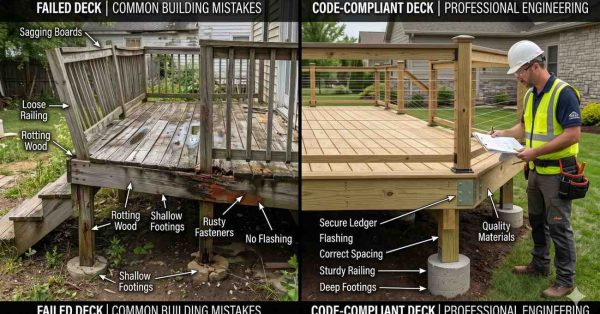
Before applying any finish to a new or recently inspected deck, a walk-through inspection should confirm the surface is free of installation damage, protruding fasteners, gaps requiring adjustment, or boards that show early checking. Our complete guide to deck repair walks through every common issue to address before the first treatment — ensuring the surface is fully ready for stain and sealer application and that no underlying damage is sealed beneath the finish.
Signs Your Deck Needs Restaining or Resealing
Recognizing when a deck’s existing finish has worn past its effective service life is as important as knowing how to apply a new one. Waiting too long allows UV damage and moisture intrusion to accelerate, requiring a more intensive prep process before new product can adhere successfully.
Visual Warning Signs
The most visible indicator of stain failure is color change — specifically the onset of graying or silvering as UV degrades the wood surface below the failed stain. Other visual signs include blotchy or uneven coloration indicating non-uniform UV degradation, peeling or flaking on film-based finishes, visible surface cracking or checking in the wood fiber, and dark discoloration from mold or mildew activity on the wood surface.
On solid stain finishes, peeling that reveals bare wood beneath is a clear signal that the finish has failed completely and full stripping is required before reapplication. On semi-transparent or transparent stains, fading to a lighter or grayer color than the original application indicates the UV-protective component has been depleted.
The Water Bead Test
The water bead test is the most reliable practical indicator of sealer failure and does not require visual degradation to be meaningful. Sprinkle a small amount of water onto the deck surface. Properly sealed wood causes water to bead up and remain on the surface for 30 seconds or more before slowly absorbing. Wood with a failed or significantly worn sealer absorbs the water almost immediately, within two to five seconds.
Any deck that fails the water bead test in multiple locations should be scheduled for cleaning and restaining or resealing. Most quality deck finishes require annual inspection and reapplication every one to three years, with the specific timing determined by product type, climate intensity, UV exposure, and foot traffic volume. Decks in high-UV environments such as the Southwest, or in high-moisture environments such as the Pacific Northwest, will exhaust their finish protection faster than decks in temperate, moderate climates.
Deck Staining and Sealing in Your Long-Term Maintenance Plan
Deck staining and sealing are not one-time projects — they are recurring maintenance activities that must be scheduled and executed consistently to deliver their full protective value over the lifespan of a deck.
Building a Maintenance Schedule
A complete deck care routine integrates seasonal inspections, regular cleaning to prevent mold and mildew accumulation, prompt repair of any damaged components, and the timely reapplication of stain and sealer before the underlying wood becomes unprotected. According to the North American Deck and Railing Association (NADRA), the majority of deck failures and structural deterioration are preventable through consistent routine maintenance rather than reactive repair after visible damage occurs.
The most common mistake homeowners make is treating staining and sealing as a project to be scheduled when the deck “looks bad” rather than on a proactive timetable. A well-maintained deck that receives cleaning and finish reapplication on schedule can remain structurally sound and visually attractive for 25 to 40 or more years. An identical deck that receives finish treatment only when deterioration becomes visible may require board replacement or full deck replacement within 10 to 15 years.
Climate and wood type determine how aggressive the maintenance schedule needs to be. Cedar and pressure-treated decks in the Pacific Northwest or Gulf Coast require more frequent inspection and reapplication than hardwood or well-sealed decks in dry inland climates. Building a material-specific, climate-appropriate schedule — and sticking to it — is the single most impactful thing a homeowner can do to protect a deck investment.
Staining and sealing are two cornerstones of a complete deck care routine, and understanding exactly how they fit within a full annual maintenance schedule — including seasonal inspection checklists, cleaning protocols, preventive care tasks, and material-specific upkeep requirements for wood and composite decks — is the focus of our complete deck maintenance and care guide, which covers every aspect of keeping a deck protected year-round.
Conclusion
Deck staining and sealing together protect wood from UV degradation and moisture damage, the two forces shortening every deck’s functional lifespan.
Choosing the right treatment, product, and application schedule for your specific wood type and climate is what this guide helps you establish.
When you’re ready to schedule professional deck staining or sealing, Mr. Local Services connects you with qualified, reliable deck care professionals in your area.
Frequently Asked Questions
How often should I stain and seal my deck?
Most decks need restaining every two to three years. Clear sealers require annual reapplication, while quality solid stains can last three to five years with proper surface preparation before each coat.
What is the difference between deck stain and deck sealer?
Stain adds pigment to protect wood against UV damage and color change. Sealer creates a water-repellent barrier to prevent moisture absorption, rot, swelling, and long-term structural deterioration.
Can I apply new stain over old stain without stripping first?
Only when the old stain is still intact, the new product is chemically compatible, and the wood surface is thoroughly cleaned. Any peeling or significantly failed stain must be fully stripped before reapplication.
What is the best time of year to stain or seal a deck?
Late spring through early fall is ideal. Air temperatures between 50 and 90 degrees Fahrenheit with no rain in the forecast for 24 to 48 hours produce consistent application conditions and best drying results.
How long after staining can I walk on my deck?
Most stains allow light foot traffic within 24 to 48 hours of application. Full cure — which allows normal heavy use and furniture replacement — typically takes three to seven days depending on product type and ambient temperature.
Does composite decking need to be stained or sealed?
Most modern capped composite decking does not require staining or sealing. Some older uncapped composite products benefit from a composite-specific cleaner and protectant applied annually to slow surface oxidation and fading.
Should I repair my deck before or after staining?
Always before. Any damaged boards, loose fasteners, rot, or structural issues should be fully addressed before any stain or sealer is applied. Sealing over damaged wood locks in moisture and accelerates deterioration beneath the finish.