Electricians have the highest average IQ among skilled trades, with studies placing their mean cognitive score around 110, above the general population average of 100. This ranking reflects the heavy problem-solving, mathematical reasoning, and code-interpretation work the trade demands. Other high-scoring trades include HVAC technicians and plumbers, both of which require strong spatial reasoning and diagnostic thinking. For homeowners and property managers, this matters because cognitively demanding trades often correlate with safer, more accurate workmanship.

The Trade With the Highest Average IQ
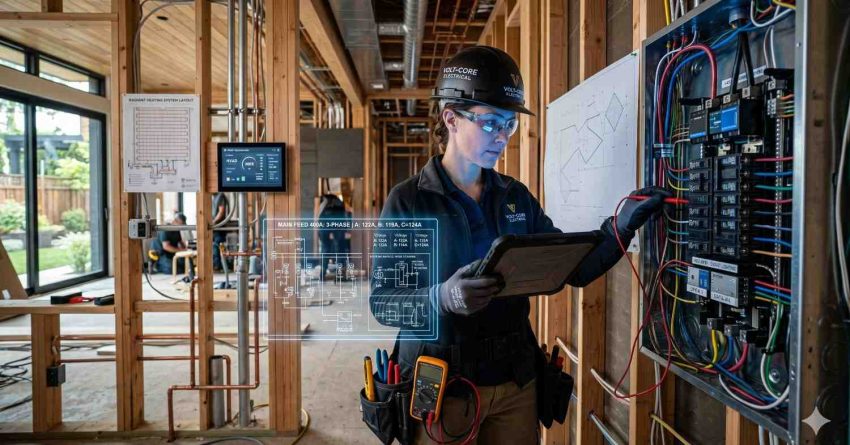
Electricians consistently rank as the trade with the highest average IQ. Multiple cognitive assessments place electricians near a mean score of 110, ahead of carpenters, welders, and general laborers. The work requires reading blueprints, applying Ohm’s law, interpreting the National Electrical Code, and troubleshooting live circuits without error. These tasks demand abstract reasoning and precise calculation under pressure.
Why Electricians Score Highest on Cognitive Tests
Electrical work blends mathematics, physics, and rule-based logic in real time. Technicians calculate load capacities, voltage drops, and circuit balances on every job. Misreading a single wire can cause fires, equipment damage, or fatal shocks. That risk filters the trade toward workers with strong analytical skills. Apprenticeships also span four to five years, longer than most trades, and include classroom instruction in algebra, trigonometry, and electrical theory. The training itself selects for cognitive aptitude.
How IQ Is Measured Across Skilled Trades
IQ comparisons across trades typically rely on aptitude tests like the Wonderlic, ASVAB, or general cognitive assessments administered during apprenticeship screening. These tests measure pattern recognition, numerical reasoning, vocabulary, and spatial logic. Electricians, HVAC technicians, and plumbers tend to cluster at the top because their daily work mirrors what these tests measure. Trades focused on repetitive physical tasks score lower on average, though individual variation within every trade remains wide.
The cognitive ranking explains the ability gap. The practical question for property owners is how to translate that knowledge into hiring a qualified electrician who delivers safe, code-compliant work.

Why Cognitive Demand Varies Across Skilled Trades
Different trades require different cognitive profiles. Electricians lean on numerical and abstract reasoning. Plumbers apply fluid dynamics and spatial planning to route pipes through complex structures. HVAC technicians combine electrical knowledge with thermodynamics and refrigeration cycles. Carpenters and tile setters rely heavily on geometric and spatial intelligence. The “highest IQ” label depends on which cognitive skills the test prioritizes.
Trades That Rank Just Below Electricians
HVAC technicians typically follow electricians in IQ rankings, with average scores around 107. Plumbers come close behind, balancing physics, code knowledge, and diagnostic reasoning. Carpenters score slightly lower on numerical tests but excel in spatial reasoning. Across the range of skilled trades, the differences are modest, and competence depends as much on training quality and experience as on raw cognitive scores.
What High-IQ Trades Mean for Property Owners
Cognitive demand correlates with diagnostic accuracy. When an electrician troubleshoots a flickering panel or an HVAC technician traces a refrigerant leak, sharp reasoning shortens repair time and reduces callbacks. For homeowners, landlords, and property managers, hiring vetted professionals from cognitively demanding trades typically means fewer misdiagnoses, cleaner code compliance, and longer-lasting repairs. The IQ ranking is less about prestige and more about the type of thinking quality work requires.
Conclusion
Electricians hold the highest average IQ among skilled trades, driven by the math, code, and problem-solving the work demands daily. HVAC technicians and plumbers follow closely behind for similar reasons.
For property owners, the takeaway is practical. Hiring trades that attract analytical thinkers reduces risk, improves accuracy, and protects long-term property value across every repair.
We connect you with vetted, high-skill professionals across every trade. Contact Mr. Local Services today and book the right expert for your property.
Frequently Asked Questions
Which trade is the most mentally demanding?
Electrical work is the most mentally demanding trade. It combines real-time math, code interpretation, circuit diagnostics, and safety risk management in nearly every job.
Do plumbers have a higher IQ than carpenters?
On average, plumbers score slightly higher than carpenters on numerical reasoning tests, though carpenters often outperform on spatial intelligence tasks involving geometry and structure.
Is HVAC a smart trade to enter?
HVAC ranks among the smartest trades to enter. It requires electrical, mechanical, and thermodynamic knowledge, and demand for skilled technicians continues growing across residential and commercial markets.
What is the average IQ of a skilled tradesperson?
The average IQ across skilled trades sits near 101 to 105, slightly above the general population mean, with electricians and HVAC technicians pulling the top end higher.
Does a higher IQ mean better workmanship?
Higher IQ correlates with faster diagnostics and fewer errors, but training, experience, and attention to detail matter just as much in delivering quality workmanship.