A yurt can function as a permanent home when it is properly permitted, built on a solid foundation, and equipped with full residential systems including plumbing, electricity, and climate control. Thousands of homeowners across the USA now live in yurts year-round, drawn by lower construction costs, a smaller environmental footprint, and a simpler way of life.
Making that transition successfully requires understanding what separates a weekend retreat yurt from a code-compliant, livable permanent residence. The gap is real, and the decisions you make early determine whether your yurt becomes a comfortable long-term home or an expensive problem.
This guide covers everything permanent yurt residents need to know: legality, costs, essential systems, maintenance requirements, and the honest trade-offs of full-time yurt living.
What Is a Yurt and Why Are People Using It as a Permanent Home?
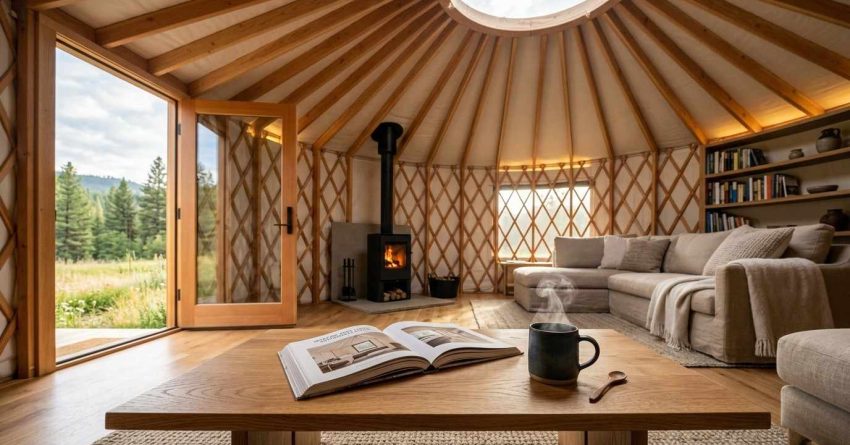
A yurt is a circular, semi-permanent structure built around a lattice wall frame, a central roof ring, and a fabric or vinyl cover. Originally developed by nomadic peoples of Central Asia, the modern yurt has been redesigned for stationary use with insulated walls, solid doors, framed windows, and platform foundations that support full residential living.
Yurts belong to a growing category of alternative dwellings — our complete guide to tiny home living covers the full spectrum of compact, non-traditional housing options available to homeowners across the USA.
People choose yurts as permanent homes for several reasons. Construction costs are significantly lower than traditional stick-built homes. The circular design uses space efficiently and creates a distinctive living environment. Many yurt owners report lower energy costs when the structure is properly insulated and oriented. For rural landowners, a yurt can be the most practical path to a permitted, livable structure on land that would otherwise sit unused.
Traditional Yurt vs. Modern Permanent Yurt
Traditional yurts were designed to be assembled and disassembled quickly, using felt insulation and wooden lattice walls. Modern permanent yurts retain the circular form but replace felt with multi-layer insulated wall and roof systems, add solid wood or fiberglass doors, incorporate double-pane windows, and sit on fixed platform foundations. The result is a structure that looks similar from the outside but performs like a conventional home on the inside.
Key Features That Make a Yurt Livable Year-Round
A yurt suitable for permanent living needs a minimum of four features: a well-insulated wall and roof system rated for local climate conditions, a solid platform foundation that separates the floor from ground moisture, a full mechanical system including heat, plumbing, and electricity, and a building permit that classifies the structure as a permanent dwelling. Without all four, a yurt functions as a seasonal shelter rather than a home.
Is It Legal to Live in a Yurt Permanently in the USA?
Yes, it is legal to live in a yurt permanently in many parts of the USA, but legality depends entirely on local zoning laws and building codes rather than federal or state-level rules. Some counties actively permit yurts as permanent dwellings. Others classify them as temporary structures or recreational vehicles, which prohibits full-time occupancy. A small number of jurisdictions have no specific yurt classification at all, which creates a gray area that requires direct communication with the local planning department.
The most important step before purchasing a yurt for permanent use is confirming the zoning classification of your land and the permit requirements in your county. Skipping this step is the most common and most costly mistake new yurt owners make.
Zoning Laws and Building Permits for Yurts
Zoning laws determine whether a yurt can be placed on a given parcel of land and whether it can be used as a primary residence. Agricultural and rural residential zones are the most permissive. Urban and suburban residential zones are the most restrictive. Building permits for permanent yurts typically require a site plan, a foundation design, and documentation of mechanical systems. Some counties require the yurt to meet the International Residential Code (IRC) standards. Others apply their own local standards. Engaging a local contractor or permit expediter familiar with alternative structures can significantly reduce the time and cost of the permitting process.
For a detailed state-by-state breakdown of yurt zoning requirements, see our resource on yurt zoning laws by state.
States and Counties Most Friendly to Permanent Yurt Living
States with large rural land areas and flexible zoning frameworks tend to be the most accommodating for permanent yurt living. Oregon, Colorado, Hawaii, Vermont, and New Mexico have established track records of permitting permanent yurts. Within those states, rural counties are almost always more permissive than urban ones. Hawaii is notable because yurts are widely used as primary residences on agricultural land under the state’s farm dwelling exemptions. Colorado’s mountain counties have permitted yurts for decades, particularly in areas with off-grid homesteading traditions.
What Does It Cost to Set Up a Yurt as a Permanent Home?
The total cost of setting up a yurt as a permanent home ranges from approximately $30,000 to $150,000 or more, depending on yurt size, foundation type, mechanical systems, and finish level. This range is wide because a basic yurt on a simple platform with minimal systems sits at the low end, while a fully finished yurt with a concrete foundation, full plumbing, HVAC, and custom interior work sits at the high end.
For a complete cost breakdown by component, our dedicated resource on yurt cost breakdown covers purchase price, installation, foundation, and ongoing expenses in detail.
Yurt Purchase and Installation Costs
A standard residential yurt from a reputable manufacturer costs between $15,000 and $50,000 depending on diameter and insulation package. Common sizes for permanent living range from 24 feet in diameter (approximately 450 square feet) to 30 feet (approximately 700 square feet). Installation labor, foundation construction, and freight shipping typically add $10,000 to $40,000 to the base purchase price. Larger yurts with premium insulation packages and factory-installed windows and doors sit at the upper end of both ranges.
Ongoing Maintenance and Utility Costs
Ongoing costs for a permanent yurt include cover replacement every 10 to 15 years (typically $3,000 to $8,000 depending on size and material), annual inspection and resealing of seams and connections, and standard utility costs for heating, cooling, water, and electricity. Utility costs vary widely based on climate, insulation quality, and whether the yurt is connected to municipal services or operates off-grid. Owners in cold climates with well-insulated yurts report heating costs comparable to a similarly sized conventional home.
Essential Systems Every Permanent Yurt Needs
A permanent yurt requires the same core systems as any residential dwelling: a foundation, structural framing, insulation, plumbing, electrical service, and climate control. The difference is that each of these systems must be adapted to a circular structure with no conventional stud walls, no attic space, and a roof that converges at a central ring rather than a ridge line. Planning these systems before construction begins is critical because retrofitting them after the yurt is assembled is significantly more expensive.
Plumbing, Electrical, and HVAC in a Yurt
Plumbing in a permanent yurt is typically run through the platform foundation before the yurt is assembled, with supply and drain lines routed to a central utility core or along the perimeter wall. Running water in a yurt demands careful pipe routing and freeze protection, and our overview of yurt plumbing setup walks through the connection types, materials, and professional installation steps required for a code-compliant system.
Heating and cooling a circular structure requires specialized planning, and our resource on yurt HVAC systems explains the equipment options, sizing considerations, and installation requirements that keep a permanent yurt comfortable in every season. Mini-split heat pumps are the most common choice for permanent yurts because they require no ductwork and can be mounted on the lattice wall. Wood stoves and propane heaters are popular in rural and off-grid installations.
Safe electrical installation in a yurt requires routing wiring through a non-standard circular wall system, and our on yurt electrical wiring outlines panel placement, circuit planning, and code compliance for permanent yurt residences. Most permanent yurts use a standard residential electrical panel mounted on an interior wall section or utility cabinet.
Insulation, Flooring, and Structural Upgrades
Insulation is the single most important factor in making a yurt comfortable as a permanent home. Modern yurt manufacturers offer multi-layer wall and roof insulation systems with R-values ranging from R-14 to R-30 or higher. The platform and floor covering you choose directly affect comfort and energy efficiency — our guide to yurt flooring options compares subfloor systems, insulation layers, and finish materials suited to circular yurt platforms. Structural upgrades for permanent use typically include a reinforced roof ring, additional rafter supports for snow load, and a solid door system with weatherstripping rated for local wind and temperature conditions.
Maintaining a Yurt as a Long-Term Residence
A permanent yurt requires consistent maintenance to remain structurally sound and weathertight. The cover, tension bands, lattice wall connections, and roof ring are the four components that need the most attention. Unlike a conventional home where the exterior is rigid and largely self-maintaining, a yurt’s fabric or vinyl cover is subject to UV degradation, wind stress, and moisture infiltration over time. Establishing a regular inspection and maintenance schedule from the first year of occupancy prevents small issues from becoming expensive repairs.
Routine Upkeep and Seasonal Maintenance
Routine yurt maintenance includes inspecting and tightening tension bands twice per year, checking all seams and connection points for gaps or wear, cleaning the cover to prevent mold and UV damage, and inspecting the door and window seals before each winter. Many routine yurt maintenance tasks are handled efficiently by a skilled generalist, and our on yurt handyman repairs details the recurring tasks best suited to professional hands. In snow-prone climates, clearing heavy snow accumulation from the roof is a critical winter task that protects the roof ring and rafter system from overload.
When to Call a Professional for Yurt Repairs
Some yurt repairs require professional expertise rather than DIY effort. Roof ring damage, lattice wall structural failures, and cover replacement all require specialized knowledge and, in most cases, manufacturer-specific components. The fabric or vinyl roof cover is the most weather-exposed component of any permanent yurt, and our guide to yurt roof cover repair covers inspection schedules, patch methods, and full cover replacement timelines.
Roof ring leaks and cover seam failures can allow moisture into the structure quickly, and our resource on yurt water damage repair explains how professionals assess, dry, and restore a yurt after water intrusion. Catching moisture damage early is essential because the lattice wall and platform framing can deteriorate rapidly once water penetrates the cover system.
Pros and Cons of Living in a Yurt Full-Time
Living in a yurt full-time offers genuine advantages alongside real limitations. Understanding both honestly is the best way to decide whether permanent yurt living is the right choice for your situation.
Advantages of permanent yurt living:
- Lower construction cost compared to a conventional home of similar square footage
- Faster build time — most yurts can be assembled in days once the foundation is complete
- Distinctive, open living environment with natural light from the roof ring skylight
- Lower environmental impact due to smaller footprint and efficient use of materials
- Flexibility to expand by adding a second yurt connected by a covered walkway
Limitations of permanent yurt living:
- Limited interior privacy due to the open circular floor plan
- Cover replacement is a recurring cost that conventional homeowners do not face
- Financing is more difficult — most traditional mortgage lenders do not finance yurts
- Resale value is less predictable than a conventional home
- Zoning restrictions eliminate many desirable locations
Custom built-ins, lofted sleeping platforms, and curved cabinetry are among the most popular yurt interior upgrades — our on yurt interior carpentry explains how skilled carpenters adapt standard woodworking techniques to a circular floor plan. Adding or upgrading windows in a yurt lattice wall requires custom framing solutions, and our resource on yurt window installation covers the sizing, sealing, and structural reinforcement steps involved.
Conclusion
A yurt can be a fully functional, comfortable permanent home when it is properly permitted, built on a solid foundation, and equipped with complete residential systems. The key decisions — zoning confirmation, insulation selection, mechanical system planning, and cover quality — determine whether a yurt becomes a long-term home or a costly experiment.
Permanent yurt living rewards careful planning and consistent maintenance. Owners who invest in quality systems upfront and follow a regular inspection schedule report high satisfaction with the lifestyle and lower overall housing costs compared to conventional homeownership.
At Mr. Local Services, our network of skilled professionals handles every system a permanent yurt requires — from plumbing and electrical installation to roofing, flooring, and ongoing maintenance — so your yurt stays safe, functional, and comfortable year-round.
Frequently Asked Questions
Can a yurt be a permanent residence in the USA?
Yes, a yurt can be a permanent residence in many parts of the USA. Legality depends on local zoning laws and building codes, which vary by county. Confirming your land’s zoning classification and obtaining the correct building permit before purchasing a yurt is the essential first step.
How long does a yurt last as a permanent home?
A well-maintained yurt structure can last 20 to 30 years or more. The lattice wall and roof ring are the most durable components. The fabric or vinyl cover typically requires replacement every 10 to 15 years depending on climate, UV exposure, and maintenance quality.
Do yurts hold up in cold climates?
Yes, modern permanent yurts are designed for cold climates when equipped with high-R-value insulation packages and an appropriate heating system. Yurts in Alaska, Montana, and Vermont are used as year-round primary residences. Snow load capacity and insulation rating are the two most important specifications to confirm for cold-climate installations.
Can you get a mortgage for a yurt?
Traditional mortgage financing for yurts is difficult because most lenders classify them as non-standard structures. Some owners finance yurt purchases through personal loans, construction loans, or land equity lines of credit. A small number of lenders specializing in alternative housing have begun offering yurt-specific financing products, but availability varies by state.
What is the minimum size yurt suitable for permanent living?
Most permanent yurt residents consider a 24-foot diameter yurt (approximately 450 square feet) the practical minimum for a single occupant or couple. Families typically require a 30-foot diameter yurt (approximately 700 square feet) or a multi-yurt configuration to accommodate separate sleeping and living areas comfortably.
How much does it cost to maintain a yurt annually?
Annual maintenance costs for a permanent yurt typically range from $500 to $2,000 depending on climate, yurt age, and the scope of work performed. This includes inspection, seam sealing, tension band adjustment, and cover cleaning. Cover replacement, when needed, is a separate one-time cost of $3,000 to $8,000.
Do yurts require building permits for permanent use?
Yes, permanent yurts require building permits in most jurisdictions. The permit process typically involves submitting a site plan, foundation design, and mechanical system documentation. Requirements vary significantly by county, and some areas have no established yurt permit category, which requires working directly with the local planning department to determine the applicable process.