
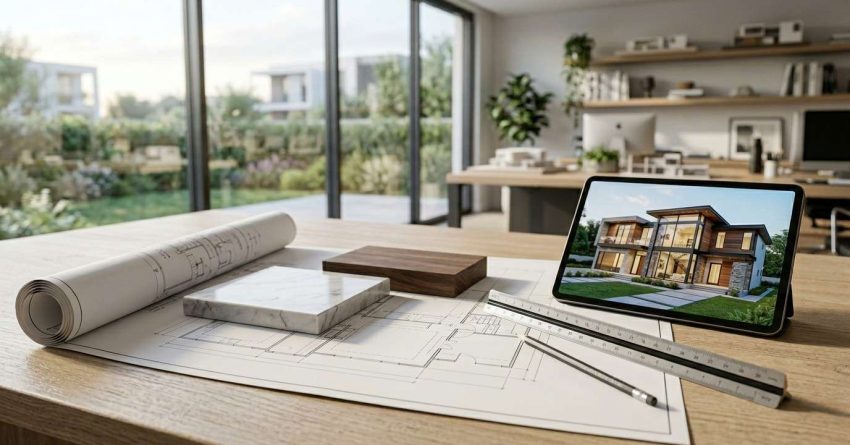
Working with a custom home architect is one of the most significant decisions a homeowner can make — and getting it right from the start determines whether your project finishes on time, on budget, and exactly as you envisioned. Custom home architects manage far more than drawings. They guide your project from the first concept sketch through construction completion, coordinating every trade, permit, and design decision along the way.
Understanding this process matters now because custom home projects are complex, expensive, and difficult to course-correct once construction begins. Knowing what to expect protects your investment.
This guide covers everything you need: what architects do, when to hire one, how to find the right fit, what fees look like, and how to collaborate effectively throughout your build.
What Does a Custom Home Architect Actually Do?
A custom home architect is a licensed design professional who translates your vision for a home into a buildable, code-compliant reality. Their work spans the full project lifecycle — from early concept sketches to final construction oversight — and touches every decision that shapes how your home looks, functions, and holds up over time.
At the most basic level, an architect listens to what you need, studies your site, and produces the drawings and documents that make construction possible. But the role goes well beyond drafting. Architects analyze how natural light moves through a space, how traffic flows between rooms, how structural systems interact with mechanical ones, and how every design choice affects your long-term comfort and property value.
They also serve as your primary technical advocate during construction — reviewing contractor work, flagging deviations from the approved plans, and making real-time decisions when field conditions require adjustments. This oversight function is one of the most valuable things an architect provides, and it is one that homeowners most often underestimate before their project begins.
Understanding what an architect does is the first step — if you are already planning a renovation, our remodeling services guide covers every service type, scope, and timeline you need to plan your project with confidence.
Design Services vs. Project Management
Architects provide two distinct categories of service, and understanding the difference helps you set realistic expectations before you sign a contract.
Design services include everything that happens before a shovel hits the ground: site analysis, space planning, schematic drawings, material specifications, energy modeling, and the production of construction documents. These documents — sometimes called “the plans” — are the legal and technical foundation of your build. Every contractor, subcontractor, and inspector will reference them throughout construction.
Project management, or what architects call construction administration, is the oversight role that continues after the plans are complete. During this phase, your architect reviews contractor submittals, responds to requests for information, conducts site visits, and confirms that the work being built matches what was designed. Not every architect offers full construction administration, and not every homeowner chooses to pay for it — but skipping this phase is one of the most common and costly mistakes in custom home projects.
Some architects also offer pre-design services, including feasibility studies, zoning analysis, and budget benchmarking. These early-stage services can save significant money by identifying constraints before design work begins.
How Architects Differ from Home Designers and Builders
The terms architect, home designer, and builder are often used interchangeably, but they describe very different roles with different qualifications, legal authority, and scope of responsibility.
A licensed architect has completed an accredited professional degree, served a multi-year internship, and passed the Architect Registration Examination administered by the National Council of Architectural Registration Boards. Architects are legally authorized to stamp and seal construction documents, which is required for most permitted construction projects. They carry professional liability insurance and are bound by a code of ethics enforced by their state licensing board.
A home designer — sometimes called a residential designer or building designer — may have significant experience and skill, but typically does not hold an architecture license. In many states, home designers can produce plans for single-family residential projects below a certain size or complexity threshold. For larger, more complex, or commercially zoned projects, a licensed architect is legally required.
A general contractor or builder manages the physical construction of your home. They hire and coordinate subcontractors, purchase materials, manage schedules, and are responsible for the quality of the work built on site. Builders work from the plans an architect produces — they do not typically create those plans themselves. For smaller-scale work that falls outside an architect’s scope, our handyman services overview explains which repairs and improvements a skilled handyman can handle without requiring a licensed design professional.
When Do You Need a Custom Home Architect?
Not every home project requires a licensed architect, but many do — and knowing when to hire one protects you from legal, financial, and structural problems that are far more expensive to fix after the fact.
The clearest signal that you need an architect is project complexity. If your project involves structural changes, new construction, significant additions, or anything that requires a building permit in your jurisdiction, an architect is almost always the right choice. Many municipalities require architect-stamped drawings for permitted work above a certain square footage or structural complexity threshold.
Beyond legal requirements, the practical case for hiring an architect is strong whenever your project involves multiple trades, significant budget, or design decisions that will affect your home for decades. The cost of architectural services is typically a fraction of the cost of fixing design errors discovered during or after construction.
Major structural projects — including roof replacements tied to additions or new builds — often run alongside architectural work, and our roofing services guide explains what roofing professionals handle and when their involvement is required during construction.
New Custom Home Construction
Building a custom home from the ground up is the most common reason homeowners hire an architect. A new custom home involves every system — structural, mechanical, electrical, plumbing, and envelope — and requires a complete set of construction documents before a building permit can be issued.
An architect on a new construction project begins with site analysis: studying the lot’s orientation, topography, drainage patterns, setback requirements, and zoning restrictions. These factors shape every design decision that follows. A home designed without this analysis often ends up fighting its site rather than working with it — resulting in poor natural light, drainage problems, or wasted square footage.
From site analysis, the architect moves into schematic design, developing the overall layout, massing, and character of the home. This is the phase where your input matters most. The decisions made here — room relationships, ceiling heights, window placement, indoor-outdoor connections — are the hardest and most expensive to change later.
Major Renovations and Additions
Significant renovations and home additions are the second most common reason homeowners engage a licensed architect. Adding square footage, reconfiguring load-bearing walls, converting spaces, or changing the roofline all require structural analysis and permitted drawings that only a licensed architect can legally produce in most jurisdictions.
Even renovations that seem straightforward — opening up a floor plan, adding a second story, or converting a garage — often reveal hidden complexity once walls come down. An architect who has done the structural analysis upfront can anticipate these issues and address them in the design, rather than discovering them as expensive surprises during construction.
Additions also require careful attention to how new construction connects to existing structure. Matching materials, maintaining consistent ceiling heights, and ensuring the addition reads as part of the original home rather than an afterthought are design challenges that benefit from professional architectural guidance.

How to Find and Hire the Right Custom Home Architect
Finding the right architect is not simply a matter of finding the most credentialed one. It is about finding a professional whose design sensibility aligns with yours, whose communication style works for you, and whose experience matches the specific demands of your project.
Start by defining your project clearly before you begin outreach. Know your approximate budget, your timeline, your site, and your priorities. Architects who specialize in custom residential work will ask these questions immediately, and having clear answers signals that you are a serious client and helps them assess whether your project is a good fit for their practice.
The same principles that apply to hiring an architect — verifying credentials, reviewing past work, and asking the right questions — apply to every professional you bring onto your property, and our guide to choosing a home service provider walks through the full vetting process.
Credentials and Licensing to Look For
Every architect you consider should hold a current license in the state where your project is located. You can verify licensure through your state’s architectural licensing board, most of which maintain public online databases. An unlicensed designer cannot legally stamp construction documents in most jurisdictions, which means their plans cannot be permitted — a critical problem for any project requiring a building permit.
Beyond basic licensure, look for membership in the American Institute of Architects (AIA). AIA membership is voluntary, but it signals a commitment to professional development and ethical practice. Many AIA members also hold specialty credentials in areas like sustainable design (LEED accreditation) or historic preservation.
Ask about professional liability insurance, also called errors and omissions insurance. This coverage protects you if a design error causes financial harm during construction. Architects who carry this coverage are taking their professional responsibility seriously. Just as architects must hold state licensure, the tradespeople they coordinate — including electricians — must carry verified credentials, and our licensed electrical services explains what proper licensing looks like for electrical work on new construction and renovation projects.
Portfolio Review and Style Compatibility
An architect’s portfolio is the most direct evidence of what they will produce for you. Review it carefully, looking not just for aesthetic appeal but for evidence of problem-solving, material sophistication, and the ability to work across different scales and budgets.
Pay attention to projects that are similar to yours in type, size, and complexity. An architect with an extensive portfolio of large commercial projects may not be the best fit for a 2,500-square-foot custom home. Conversely, a residential specialist may lack the structural engineering relationships needed for a complex addition.
Style compatibility matters, but it is not the only consideration. A skilled architect can work in many styles — what you are really evaluating is their ability to listen, translate your vision, and produce work that reflects your priorities rather than their own preferences. Ask to speak with past clients. Ask specifically about communication, responsiveness, and how the architect handled problems when they arose.
Questions to Ask Before Signing a Contract
Before committing to any architect, conduct a structured interview. The answers to these questions will tell you more than any portfolio review.
Ask who will actually work on your project. In larger firms, the principal you meet during the interview may hand your project to a junior designer. Understand exactly who will be your day-to-day contact and who will make design decisions.
Ask how they handle budget management. Architects are not cost estimators, but experienced residential architects develop a strong intuition for what things cost. Ask how they have managed projects that ran over budget and what they did to bring costs back in line.
Ask about their contractor relationships. Architects who have established working relationships with reputable general contractors can often facilitate a smoother bidding process and a more collaborative construction phase.
Ask what happens if you disagree on a design direction. The answer reveals how the architect handles conflict and whether they prioritize your vision or their own.

Understanding Architect Fees and Contract Structures
Architect fees are one of the most misunderstood aspects of custom home projects. Many homeowners are surprised by the cost, not because architects are overpriced, but because the scope of services — and therefore the fee — is often much larger than they anticipated.
Architect fees are one part of a larger project budget, and our home renovation cost guide breaks down typical costs across every major trade so you can build a realistic budget before your first architect meeting.
Common Fee Models Explained
Architects use several different fee structures, and the right model depends on your project type, complexity, and the scope of services you need.
The percentage of construction cost model is the most common for custom residential projects. The architect charges a percentage of the total construction cost — typically ranging from 8% to 15% for full-service residential work, though this varies significantly by region, firm size, and project complexity. This model aligns the architect’s compensation with the scale of the project and incentivizes thorough documentation, since incomplete drawings lead to costly change orders during construction.
The fixed fee model establishes a set dollar amount for a defined scope of services. This model works well when the project scope is clearly defined upfront and unlikely to change significantly. It gives homeowners budget certainty but can create tension if the scope expands without a corresponding fee adjustment.
The hourly rate model is most common for early-stage consulting, feasibility studies, or limited-scope services. Hourly rates for licensed architects in the United States typically range from $100 to $300 per hour depending on experience, location, and firm size. This model is less predictable for homeowners but appropriate when the scope of work is genuinely uncertain at the outset.
Some architects use a hybrid model — a fixed fee for design phases and an hourly rate for construction administration, where the time required is harder to predict.
What Should Be in Your Architect Agreement
A well-written architect agreement protects both parties and prevents the misunderstandings that derail projects. Before signing, confirm that the agreement clearly addresses the following elements.
Scope of services must be explicitly defined. The agreement should list every phase of work the architect will perform — schematic design, design development, construction documents, permitting assistance, bidding coordination, and construction administration — and specify what is excluded. Vague scope language is the most common source of fee disputes.
Compensation terms should specify the fee model, payment schedule, and what triggers additional fees. Understand what constitutes a reimbursable expense — printing, travel, permit fees — and whether those are billed at cost or with a markup.
Ownership of drawings is a critical and often overlooked clause. In most standard agreements, the architect retains ownership of the design documents even after you have paid for them. This means you cannot use those drawings to build a second home or hire a different architect to complete the project without the original architect’s permission. Negotiate this clause carefully if it matters to your situation.
Termination provisions should specify how either party can end the agreement, what notice is required, and how compensation is calculated for work completed at the time of termination.
The Custom Home Design Process Step by Step
The custom home design process follows a structured sequence of phases, each building on the last. Understanding this sequence helps you know what to expect, when your input is most valuable, and where the major decision points occur.
Schematic Design and Concept Development
Schematic design is the first formal design phase, and it is where the big ideas take shape. Your architect will develop multiple conceptual approaches to your project — different ways of organizing the spaces, orienting the home on the site, and establishing the overall character of the design.
During this phase, drawings are intentionally loose and exploratory. Floor plan diagrams, site plans, and simple exterior sketches communicate ideas without committing to details. The goal is to establish the right direction before investing time in refinement.
Your participation during schematic design is critical. This is the phase where changes are cheapest and easiest to make. A room that moves on a schematic diagram costs nothing. The same room moved during construction costs tens of thousands of dollars. Engage deeply, ask questions, and push back on anything that does not feel right.
At the end of schematic design, you and your architect should agree on a preferred design direction before moving forward. This agreement — sometimes formalized in a written sign-off — is the foundation for everything that follows.
Design Development and Construction Documents
Design development takes the approved schematic concept and develops it in detail. Wall thicknesses are established, structural systems are defined, mechanical and electrical systems are coordinated, and material selections begin. Drawings become more precise and more numerous.
This phase is where the architect coordinates with engineers — structural, mechanical, electrical, and plumbing — whose work must be integrated into the design. The coordination of these systems is one of the most technically demanding aspects of architectural practice, and it is where errors in less experienced practices most often occur.
Construction documents are the final, fully detailed set of drawings and specifications from which your home will be built. These documents must be complete, coordinated, and code-compliant before a building permit can be issued. They include architectural drawings, structural drawings, mechanical and electrical plans, and a written specification book that describes every material, product, and installation standard required for the project.
As construction documents move into the build phase, interior finishing work — including drywall installation and ceiling work — begins, and our drywall and ceiling services explains what this phase involves and how it connects to the broader construction timeline.
Permitting, Bidding, and Construction Administration
Once construction documents are complete, your architect submits them to the local building department for permit review. The permitting process varies significantly by jurisdiction — some municipalities review and approve plans in a few weeks, while others take several months. Your architect should be familiar with local requirements and can often anticipate and address common review comments before submission.
Bidding is the process of soliciting pricing from general contractors. Your architect can help you develop a bidding list, prepare bid packages, and evaluate contractor proposals. A competitive bid process with three to five qualified contractors typically produces the most reliable pricing.
During construction administration, your architect reviews contractor submittals, responds to requests for information, conducts site visits, and confirms that the work being built matches what was designed. Our plumbing services guide explains what professional plumbing work covers on new construction and major renovation projects — one of the many trades your architect will coordinate during this phase.
How to Collaborate Effectively with Your Architect
The quality of your working relationship with your architect directly affects the quality of your project. Architects do their best work when clients are engaged, communicative, and decisive. The most successful custom home projects are genuine collaborations — not transactions.
Setting Clear Goals and Communicating Your Vision
Before your first design meeting, invest time in articulating what you want. Collect images of homes, spaces, and details that appeal to you. Write down how you live — how you use your kitchen, whether you work from home, how often you entertain, what your morning routine looks like. These behavioral details are more useful to an architect than aesthetic preferences alone.
Be honest about your budget. Many homeowners are reluctant to share their budget, fearing the architect will simply design up to it. In practice, the opposite is true — architects who do not know your budget cannot make the trade-off decisions that keep your project financially viable. A realistic budget conversation at the start of the project saves enormous time and prevents the painful experience of falling in love with a design you cannot afford to build.
Communicate concerns early and directly. If a design direction does not feel right, say so immediately. Architects are trained to receive and respond to feedback — it is a core part of their professional practice. Waiting until a design is fully developed to raise concerns is far more disruptive and expensive than addressing them in the moment.
Design decisions made during collaboration — including window placement, size, and style — directly affect energy performance and aesthetics, and our window installation services explains what professional window work involves when those design choices move into construction.
Managing Changes, Timelines, and Expectations
Changes during design are normal and expected. Changes during construction are expensive and disruptive. The most effective way to manage this reality is to make decisions deliberately and completely during each design phase before moving to the next.
Establish a clear decision-making process with your architect at the start of the project. Know who has final authority on design decisions, how changes are documented, and what the process is for approving additional fees when scope changes occur.
Timeline expectations should be set realistically from the beginning. Custom home projects — from initial design through construction completion — typically take two to four years for a new home and one to two years for a major addition. Permitting, contractor availability, material lead times, and weather all affect construction schedules in ways that are difficult to predict precisely.
Maintain a written record of all significant decisions and agreements. Email is sufficient for most purposes. When verbal conversations produce important decisions, follow up with a brief written summary. This practice protects both you and your architect and prevents the “I thought we agreed” conversations that damage working relationships.

Common Mistakes Homeowners Make When Working with Architects
Understanding the most common mistakes homeowners make helps you avoid them — and helps you get more value from your architectural investment.
The most costly mistake is starting construction before the design is complete. Pressure to begin building — from excitement, from contractor availability, or from a desire to meet a deadline — leads homeowners to authorize construction before drawings are fully coordinated. The result is almost always expensive change orders, delays, and design compromises that would have been avoided with a few more weeks of design work.
Choosing an architect based on fee alone is another common error. The lowest fee rarely produces the best outcome. Architectural fees are a small percentage of total project cost, and the difference between a thorough set of construction documents and an incomplete one can easily cost ten times the fee savings in construction change orders.
Failing to establish a realistic budget before design begins causes projects to be designed and redesigned multiple times as cost estimates come in over budget. This wastes time, money, and goodwill. Get a preliminary cost estimate — from a contractor or cost estimator — before design development begins, and use it as a design constraint rather than a surprise at the end.
Micromanaging the design process undermines the value of hiring a professional. Provide clear goals, give honest feedback, and trust your architect to solve problems creatively. Homeowners who dictate every design decision often end up with a home that reflects their limitations rather than their aspirations.
One common oversight is failing to finalize door specifications during the design phase — our door installation guide explains what door selection and installation involves so you can align those decisions with your architect before construction begins.
How Custom Architecture Adds Long-Term Value to Your Property
A well-designed custom home is not just a better place to live — it is a more valuable asset. The relationship between architectural quality and property value is well-documented, and it operates through several distinct mechanisms.
Functional design adds value by making a home more livable and more appealing to future buyers. Homes with logical floor plans, abundant natural light, efficient circulation, and well-proportioned spaces consistently command premium prices in the resale market. These qualities are the direct result of thoughtful architectural design — they do not happen by accident.
Energy performance is an increasingly important component of property value. Homes designed with passive solar principles, high-performance envelopes, and efficient mechanical systems have lower operating costs and are more attractive to buyers who understand the long-term economics of homeownership. Architects who specialize in sustainable design can integrate these strategies from the earliest design phases, where they cost the least to implement.
Material quality and durability contribute to long-term value by reducing maintenance costs and extending the useful life of building systems. An architect who specifies durable, appropriate materials — and who oversees their installation during construction administration — produces a home that holds its value better over time than one built to minimum standards.
Architectural decisions about layout and flow directly influence flooring choices and installation complexity — our flooring services guide explains how professional flooring work contributes to the long-term value and livability of a custom home.
Distinctive design — a home with a clear architectural identity, thoughtful site relationship, and coherent aesthetic — commands a premium in markets where buyers have choices. Generic homes compete on price. Architecturally significant homes compete on character, and character is difficult to replicate.
Working with an Architect Alongside Other Home Service Professionals
A custom home project involves dozens of professionals working in sequence and in parallel. Your architect is the coordinator of this effort, but understanding how the other professionals fit into the process helps you manage the project more effectively.
Mechanical systems — including heating, ventilation, and air conditioning — must be designed into the architectural plan from the start, and our HVAC services guide explains what HVAC professionals handle and how their work integrates with the architectural design process.
The general contractor is your architect’s primary construction partner. A strong architect-contractor relationship — built on mutual respect, clear communication, and shared commitment to the design — is one of the most reliable predictors of project success. When evaluating contractors, ask your architect for recommendations. Their experience with specific contractors is invaluable.
Structural, mechanical, electrical, and plumbing engineers are typically engaged by the architect and work under their coordination. You may never meet these professionals directly, but their work is embedded in every drawing and specification your architect produces. Understanding that these consultants exist — and that their fees are typically separate from the architect’s fee — helps you budget accurately.
Interior designers, landscape architects, and specialty consultants may be engaged separately or through your architect depending on the scope of your project. Clarify early who is responsible for coordinating each consultant and how their work integrates with the architectural documents.
Our interior painting services explains what professional painters handle and how their work fits into the construction completion timeline — one of the final trades to complete a custom home build.
Coordinating Contractors, Trades, and Specialists
Effective trade coordination is one of the most demanding aspects of construction administration. Your architect’s role is to ensure that every trade has the information they need, that their work is sequenced correctly, and that conflicts between systems are resolved before they become field problems.
Exterior design is often part of a custom home project, and coordinating landscape work with your architect ensures the site plan and outdoor spaces align with the overall design vision — our landscape services guide explains what professional landscaping covers on new construction sites.
Outdoor living structures like decks are frequently included in custom home designs and require coordination between your architect and a licensed deck builder — our deck building services explains what this work involves and how it connects to the broader construction plan.
As a homeowner, your role in trade coordination is primarily to make decisions promptly when your architect or contractor needs them. Delayed decisions are one of the most common causes of construction schedule overruns. Establish a response time commitment with your project team — 24 to 48 hours for routine decisions is a reasonable standard — and honor it consistently.
Conclusion
Working with a custom home architect is a structured, collaborative process that spans design, documentation, permitting, and construction — with the architect serving as your technical advocate and design partner at every stage. Understanding the roles, phases, fees, and coordination demands of this process is the foundation of a successful project.
The most important investment you can make before construction begins is in the quality of your design and documentation. Thorough architectural work prevents the costly surprises, change orders, and design compromises that undermine so many custom home projects.
At Mr. Local Services, we connect homeowners with skilled professionals across every trade involved in a custom home build — from HVAC and plumbing to flooring, painting, and landscaping. Contact us today to find the right professionals for your project.
Frequently Asked Questions
How much does a custom home architect typically charge?
Architect fees for custom residential projects typically range from 8% to 15% of total construction cost for full-service engagements. Hourly rates for consulting services generally fall between $100 and $300 per hour depending on experience, firm size, and location.
Do I need a licensed architect for a home addition?
Most jurisdictions require architect-stamped drawings for additions above a certain size or structural complexity. Check with your local building department before assuming a designer or contractor can produce the required documents without a licensed architect.
How long does the custom home design process take?
The design process — from initial schematic design through completed construction documents — typically takes six to twelve months for a new custom home. Simpler projects or additions may move faster, while complex or large-scale projects can take longer.
What is the difference between an architect and a general contractor?
An architect designs your home and produces the drawings and specifications from which it is built. A general contractor manages the physical construction, hiring and coordinating subcontractors and purchasing materials. Both roles are essential, and they work together throughout the construction phase.
Can I hire an architect for just part of my project?
Yes. Many architects offer limited-scope services — schematic design only, construction document review, or construction administration without full design services. Clarify the scope of services you need before engaging an architect and confirm that the fee agreement reflects that scope precisely.
What should I bring to my first meeting with an architect?
Bring site information (survey, deed, zoning information), a clear description of your project goals, a realistic budget range, images of homes or spaces you find appealing, and a list of your functional requirements — how many bedrooms, how you use your kitchen, whether you work from home, and similar lifestyle details.
How do I know if an architect’s design is within my budget?
Architects are not cost estimators, but experienced residential architects develop strong intuition for construction costs. Ask your architect to provide a preliminary cost estimate or to engage a professional cost estimator after schematic design is complete. Do not wait until construction documents are finished to get your first cost check.
What happens if I disagree with my architect’s design direction?
Raise concerns immediately and directly. Architects are trained to receive and respond to feedback — it is a core part of their professional practice. If a design direction does not feel right, say so during the phase when changes are still inexpensive. Waiting until construction begins to raise design concerns is far more disruptive and costly.


