Integrating smart home technology during construction — not after — is the single most cost-effective decision a homeowner can make. Once walls are closed, ceilings are finished, and flooring is laid, adding the same systems costs significantly more and delivers a less reliable result. The construction window is the only time every component can be installed cleanly, correctly, and without compromise.
Waiting until after construction forces homeowners into expensive retrofits, visible workarounds, and systems that never quite perform the way built-in technology does.
This guide explains exactly why the construction phase matters, which systems benefit most from early integration, and how to plan smart home technology before a single wall goes up.
What Smart Home Integration During Construction Actually Means
Smart home integration during construction means planning and installing the technology infrastructure — wiring, conduit, control systems, and device mounting points — as part of the original build process rather than adding it to a finished home.
This is not simply about installing smart devices. It is about building the physical and electrical foundation that makes those devices work reliably, invisibly, and at full capability. A smart home built from the ground up has its wiring routed through walls, its control hubs mounted in dedicated spaces, and its systems connected to a power and data infrastructure designed specifically for automation.
The Difference Between Built-In and Bolted-On Systems
A built-in smart home system is one where every component was planned before construction began. Wiring runs inside walls. Sensors sit flush with surfaces. Speakers are in-ceiling. Thermostats connect to a zoning system designed for the home’s layout.
A bolted-on system is one added after construction. Wires run along baseboards or through surface-mounted conduit. Devices are placed where power outlets happen to exist rather than where they perform best. Wireless signals compensate for the absence of hardwired connections. The result works — but it is always a compromise.
Why the Construction Phase Is the Right Window
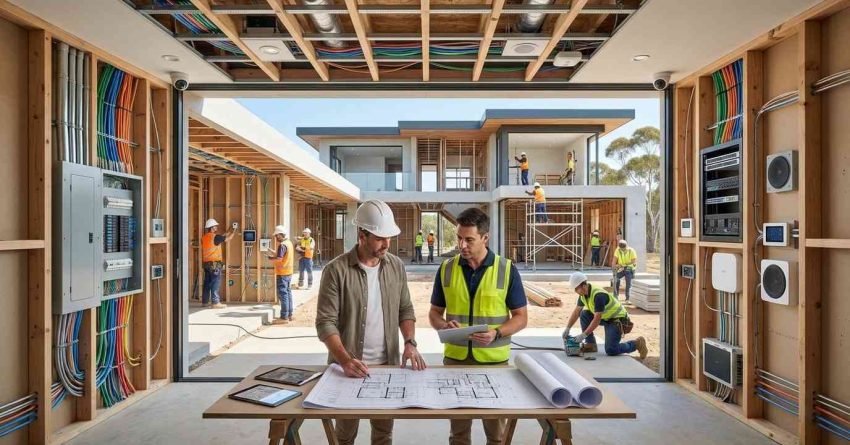
The construction phase offers access that simply does not exist in a finished home. Walls are open. Ceilings are exposed. Floors are bare. Every pathway for wiring, conduit, and infrastructure is accessible without demolition.
This access window is temporary. Once framing is complete and drywall goes up, the cost and complexity of running new wiring increases dramatically. Electricians who can route cable through open framing in an hour may need several hours — and significant patching work — to do the same job in a finished wall.
Smart home integration starts with the right electrical foundation — our electrical services planning explains how licensed electricians work with builders to pre-wire homes for automation, load management, and future-ready infrastructure before walls are closed.
Structural Access You Only Get Once
Open framing allows electricians and low-voltage contractors to run structured wiring — Cat6 ethernet, speaker wire, coaxial cable, security sensor wiring — through every room without cutting into finished surfaces. This is the only time in a home’s life when that work can be done cleanly and completely.
Once drywall is installed, every wire run requires either fishing cable through finished walls (which is difficult, time-consuming, and often impossible without damage) or running surface-mounted conduit that is visible and aesthetically compromising.
Cost Efficiency When Walls Are Still Open
Labor costs for smart home wiring during construction are a fraction of what the same work costs in a finished home. A structured wiring installation that takes a day during framing can take three to five days in a completed home — with additional costs for patching, painting, and repairing any surfaces disturbed during the process.
Material costs also differ. Wireless systems used to compensate for missing hardwired infrastructure cost more than the wired alternatives they replace, require ongoing battery maintenance, and introduce reliability variables that hardwired systems do not have.
What Gets Harder — and More Expensive — After Construction
Every smart home system that was not planned during construction becomes a retrofit project. Retrofit projects are not impossible, but they are consistently more expensive, more disruptive, and more limited in outcome than the same work done during the build.
Integrating climate control into a smart home is far simpler when HVAC systems are installed alongside automation wiring — our HVAC automation setup resource covers how smart thermostats, zoning systems, and ventilation controls are built in from the start rather than retrofitted later.
Retrofitting Challenges Homeowners Rarely Anticipate
The most common retrofitting challenges include running ethernet to rooms that were never wired for data, adding in-ceiling speakers to rooms with finished ceilings, installing motorized shades in windows that were not framed with pocket space for the hardware, and integrating security sensors into door and window frames that were not pre-drilled during installation.
Each of these projects is solvable. None of them are simple. All of them cost more than they would have during construction — and most of them leave some visible evidence of the work behind.
Smart Home Systems That Benefit Most From Early Integration
Not every smart home component requires construction-phase installation, but the systems that deliver the greatest performance and value difference are those that depend on hardwired infrastructure.
Electrical and Wiring Infrastructure
The entire smart home depends on the electrical and low-voltage wiring infrastructure. This includes dedicated circuits for high-draw devices, structured wiring panels for data and media distribution, conduit runs for future cable additions, and load management systems that allow automation controllers to monitor and manage power consumption across the home.
None of this infrastructure can be added cleanly to a finished home. It must be planned and installed during construction.
HVAC and Climate Control Automation
Smart HVAC integration — including multi-zone thermostats, automated dampers, ventilation controls, and air quality monitoring — requires that the HVAC system itself be designed for automation. Ductwork must be sized and routed for zoning. Sensor locations must be planned. Control wiring must be run during installation.
Adding zoning to an existing single-zone HVAC system after construction is a significant mechanical project. Building it in from the start is a straightforward design decision.
Security, Lighting, and Access Systems
Security systems, smart lighting, and automated access controls all depend on a properly planned wiring layout — the smart wiring installation details on our electrical services walk through exactly how these systems are structured during the build phase for reliable, code-compliant performance.
In-wall occupancy sensors, hardwired door and window contacts, recessed lighting circuits on smart dimmers, and electric door strikes for automated access all require wiring that must be in place before walls close. Wireless alternatives exist for all of these, but they introduce battery maintenance, signal reliability variables, and aesthetic compromises that hardwired systems avoid entirely.
How to Plan Smart Home Integration Before Breaking Ground
Planning smart home integration before construction begins requires three things: a clear list of the systems you want, a low-voltage contractor or smart home integrator involved in the design phase, and coordination between that contractor and your general contractor, electrician, and HVAC installer.
The earlier this planning happens, the better. Ideally, smart home infrastructure is included in the architectural drawings so that every trade knows what is expected of them before work begins.
For homeowners managing multiple trades during a build or renovation, coordinating smart home prep work alongside other tasks is easier with a single point of contact — our home project coordination outlines how handyman professionals support builders and contractors during pre-installation phases.
Working With Contractors and Electricians Early
The most important conversation to have early is with your electrician. Smart home infrastructure — structured wiring, dedicated circuits, conduit runs, and panel capacity for automation systems — is electrical work. Your electrician needs to know what systems are planned so they can size the panel correctly, run the right circuits, and leave the right infrastructure in place for low-voltage contractors to connect to.
A smart home integrator brought in during the design phase can produce a complete pre-wire specification that your electrician and low-voltage contractor can follow. This document eliminates guesswork, prevents missed runs, and ensures every system has the infrastructure it needs before the first sheet of drywall goes up.
Long-Term Value: What Early Integration Adds to Your Property
Smart home technology integrated during construction adds measurable value to a property in ways that retrofitted systems do not. Built-in systems are cleaner, more reliable, and more complete — and they are perceived as higher quality by buyers, appraisers, and property managers evaluating the home.
Homeowners who plan smart home systems during a remodel rather than after completion consistently see better outcomes in both functionality and resale value — our home remodeling upgrades explains how remodeling projects can be structured to include smart technology from the design stage forward.
Beyond resale value, early integration reduces the total cost of ownership. Systems that were designed to work together from the start require less troubleshooting, fewer workarounds, and less ongoing maintenance than systems assembled from components added at different times. The home functions as a unified system rather than a collection of independent devices.
For homeowners building new construction or undertaking a major renovation, the decision to integrate smart home technology during the build phase is not a luxury upgrade. It is the most practical, cost-effective, and performance-oriented approach available.
Conclusion
Smart home integration during construction delivers better performance, lower total cost, and cleaner results than any retrofit approach. The construction window is the only time the full infrastructure can be installed without compromise.
Planning early — before walls close — is what separates a truly integrated smart home from a collection of devices added after the fact. The difference is visible in every room.
At Mr. Local Services, our team connects homeowners with licensed electricians, HVAC professionals, and skilled contractors who coordinate smart home infrastructure from the ground up — so your home is built right the first time.
Frequently Asked Questions
Can smart home technology be added to a home after construction is complete?
Yes, smart home technology can be added after construction, but the options are more limited and the costs are higher. Wireless systems reduce the need for new wiring, but hardwired infrastructure — which delivers better reliability and performance — requires opening finished walls and ceilings.
How much more does smart home integration cost when done after construction?
Retrofit smart home installations typically cost two to four times more than the same work done during construction, primarily because of the additional labor required to run wiring through finished walls and repair surfaces afterward.
Which smart home systems are hardest to add after construction?
In-ceiling audio, hardwired security sensors, multi-zone HVAC controls, and structured wiring panels are the most difficult and expensive to add after construction because they all require access to spaces that are enclosed once the build is complete.
Do I need a smart home integrator, or can my electrician handle everything?
Your electrician handles the electrical infrastructure — circuits, panel capacity, and conduit. A smart home integrator or low-voltage contractor handles the data, audio, video, and control wiring. Both are needed, and both should be involved before construction begins.
What should I include in a smart home pre-wire plan?
A smart home pre-wire plan should include structured wiring for data and media, dedicated circuits for automation hubs and high-draw devices, conduit runs for future cable additions, sensor and speaker locations, and control panel placement. A low-voltage contractor can produce this specification from your system requirements.
Does smart home integration during construction increase resale value?
Built-in smart home systems consistently add to perceived and appraised home value, particularly when the systems are complete, professionally installed, and documented. Buyers and appraisers distinguish between integrated systems and add-on devices.
How early in the construction process should smart home planning begin?
Smart home planning should begin at the design phase — before architectural drawings are finalized. This ensures that structural elements like conduit pathways, panel sizing, and device mounting locations are built into the plans rather than accommodated after the fact.