Placing a tiny home on wheels in your backyard is legal in many parts of the USA — but only when you follow the right steps. Zoning classifications, permit requirements, utility connection rules, and HOA restrictions all determine whether your THOW can legally sit on your property. Skipping any one of these steps can result in fines, forced removal, or costly retrofits.
Understanding these requirements now protects your investment and keeps your project moving forward without costly legal setbacks or delays.
This guide covers every legal checkpoint — from zoning and permits to utility hookups and HOA approval — so you can place your THOW with confidence.
What Is a THOW and Why Backyard Placement Is Different
A THOW, or tiny home on wheels, is a small residential dwelling built on a trailer chassis rather than a permanent foundation. Because it retains its wheel assembly, a THOW is legally classified as a vehicle or recreational vehicle in most jurisdictions — not as a permanent structure. That classification changes everything about how local governments regulate it.
Backyard placement adds another layer of complexity. When a THOW sits on private residential property, it enters a gray zone between vehicle storage, accessory dwelling unit (ADU) regulations, and recreational vehicle parking rules. The legal path forward depends entirely on how your local jurisdiction categorizes the structure and what your property’s zoning designation allows.
How a THOW Differs from a Traditional ADU
A traditional ADU is a permitted, permanently attached or detached dwelling unit built to residential building codes. A THOW, by contrast, sits on a trailer and can be moved. That mobility means it typically does not qualify for ADU permits — but it also means it may fall under RV or vehicle codes instead. Some municipalities have created specific THOW ordinances that sit between these two categories, while others have no framework at all, making local research essential before you commit to a placement plan.
Understanding what makes a THOW unique is the first step — our tiny home placement guide covers every structural, site, and access requirement you need to evaluate before choosing a backyard location.
Zoning Laws That Govern Backyard THOWs in the USA
Zoning laws are the primary legal barrier for most THOW placements. Residential zones are typically classified as single-family (R-1), multi-family (R-2), or mixed-use, and each carries different rules about what structures or vehicles can occupy the property.
In many R-1 zones, a THOW is treated the same as an RV — meaning it can be stored on the property but cannot be used as a primary or secondary dwelling. Other municipalities have updated their zoning codes to explicitly permit THOWs as accessory structures, sometimes requiring a minimum lot size, setback distances from property lines, or a maximum number of occupants.
States like California, Oregon, and Texas have passed legislation encouraging local governments to accommodate THOWs, but implementation varies by city and county. In states without enabling legislation, local zoning boards have full discretion — and many still prohibit backyard THOW occupancy entirely.
Zoning rules vary significantly by municipality, and getting familiar with the broader regulatory landscape is essential — our tiny homes overview explains how local governments classify these structures and what that means for your property rights.
How to Read Your Local Zoning Code for THOW Eligibility
Start by identifying your property’s zoning designation through your county assessor’s website or local planning department portal. Once you have the designation, search the municipal code for terms like tiny home, recreational vehicle, accessory dwelling unit, and trailer. Look specifically for definitions, permitted uses by zone, and any conditional use permit (CUP) provisions. If the code is silent on THOWs, contact the planning department directly — verbal guidance from a planner is useful, but always request written confirmation before proceeding.
Permits and Approvals You May Need Before Placing a THOW
Even when zoning allows a THOW, placement typically requires one or more permits. The specific permits depend on your jurisdiction, the THOW’s intended use, and any site improvements needed to support it.
Common permit categories include:
- Zoning or land use permits — confirm the THOW use is allowed on your specific parcel
- Building permits — required if you construct a deck, foundation pad, or any permanent attachment to the THOW
- Electrical permits — required for any grid connection to the THOW’s electrical system
- Plumbing permits — required for water supply and sewer or septic connections
- Health department approvals — required in some jurisdictions when a THOW is used as a full-time dwelling
If your THOW placement requires structural site work such as a foundation pad, grading, or utility trenching, those improvements may fall under the same permit categories as major renovations — our home remodeling permits resource explains which projects trigger permit requirements and how to prepare your application.
Building Permits vs. Land Use Permits — What’s the Difference
A land use permit confirms that a specific activity — such as placing a THOW — is allowed on your property under current zoning. A building permit covers the physical construction or modification of structures and systems. You may need both, or only one, depending on your jurisdiction. In some cases, a conditional use permit (CUP) is required instead of a standard land use permit, which involves a public hearing and approval from a zoning board. Understanding which permit type applies to your situation before you begin saves significant time and avoids costly resubmissions.
Utility Hookups and Infrastructure Requirements
A THOW that will be occupied full-time or part-time needs access to water, electricity, and waste disposal. How those utilities are provided — and whether they are legally permitted — is one of the most scrutinized aspects of backyard THOW placement.
Grid-tied THOWs require licensed contractors to perform all connection work. Unpermitted utility connections are a common reason local authorities order THOW removal, and they can also create liability issues for the property owner.
Grid-tied THOWs require a licensed electrician to install a proper service panel connection and pass inspection — our electrical connection services outlines what that process involves and why permitted electrical work protects both your THOW and your primary home.
Connecting a THOW to an existing water supply or sewer line is not a DIY task — our plumbing hookup services explains what a licensed plumber needs to assess, connect, and inspect before your THOW can legally use residential water infrastructure.
Off-Grid vs. Grid-Connected THOWs — Legal Implications
Off-grid THOWs use solar panels, rainwater collection, composting toilets, and propane systems to operate independently. While this approach avoids the permit requirements tied to utility connections, it introduces its own legal considerations. Rainwater harvesting is regulated or restricted in several states. Composting toilets must meet health department standards in most jurisdictions. Solar installations above a certain wattage may still require an electrical permit. Off-grid does not mean permit-free — it simply shifts which permits and inspections apply.
HOA Rules and Deed Restrictions That Affect THOW Placement
If your property is governed by a homeowners association, HOA rules operate independently of local zoning laws. An HOA can prohibit THOW placement even when the municipality allows it. Common HOA restrictions include bans on RVs and trailers visible from the street, minimum aesthetic standards for accessory structures, and prohibitions on secondary dwelling units of any kind.
Deed restrictions are a separate but related issue. These are private agreements recorded against the property title that restrict how the land can be used. Unlike zoning laws, deed restrictions cannot be changed by local government action — they require agreement from all affected parties or a court order to modify.
Before placing a THOW, review your HOA’s CC&Rs (covenants, conditions, and restrictions) and request a copy of any recorded deed restrictions from your county recorder’s office. If your HOA requires modifications to your property before granting approval, a skilled handyman can handle those prep tasks efficiently — our property compliance handyman covers the types of work that help properties meet association standards.
How to Work With Local Authorities to Get Approval
Approaching local authorities proactively is the most effective strategy for THOW approval. Most planning departments offer pre-application meetings where you can present your project and receive informal guidance before submitting formal paperwork. This step alone can prevent weeks of back-and-forth.
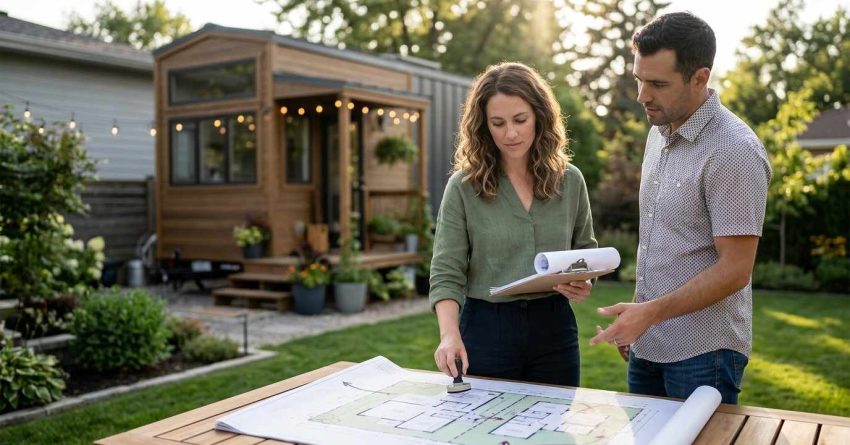
Prepare a clear site plan showing the THOW’s location on the property, setback distances, utility connection points, and access routes. Include the THOW’s specifications — dimensions, weight, wheel assembly details, and any certifications such as RVIA (Recreational Vehicle Industry Association) or state-specific tiny home certifications.
Be prepared to address neighbor notification requirements. Some jurisdictions require adjacent property owners to be notified of a THOW placement application, and neighbor objections can trigger a public hearing. Addressing potential concerns proactively — screening, landscaping, noise, and parking — strengthens your application.
Working with local authorities often requires demonstrating that your site meets specific physical standards — our THOW site preparation resource walks through the documentation, site assessments, and professional inspections that support a successful approval process.
Conclusion
Placing a THOW in your backyard legally requires navigating zoning classifications, permit requirements, utility connection rules, and HOA restrictions — each of which operates independently and must be addressed in sequence.
The legal path is manageable when approached systematically, starting with zoning research and ending with permitted utility connections and documented approvals from every relevant authority.
At Mr. Local Services, our team connects you with licensed plumbers, electricians, and skilled handymen who handle the site work, utility connections, and property modifications that support a compliant THOW placement — so your project moves forward without costly setbacks.
Frequently Asked Questions
Is a THOW considered a permanent structure?
No. A THOW is built on a trailer chassis and retains its wheel assembly, which means most jurisdictions classify it as a vehicle or recreational vehicle rather than a permanent structure. This classification affects which zoning rules, permits, and building codes apply to your placement.
Do I need a permit to put a tiny home on wheels in my backyard?
In most cases, yes. Even when zoning allows a THOW, you will likely need a land use or zoning permit, and additional permits for any utility connections or site improvements. Requirements vary by city and county, so contact your local planning department before beginning any site work.
Can my HOA prevent me from placing a THOW on my property?
Yes. HOA rules operate independently of local zoning laws and can prohibit THOW placement even when the municipality allows it. Review your CC&Rs and any recorded deed restrictions before purchasing or placing a THOW on an HOA-governed property.
What utilities can a THOW legally connect to?
A THOW can legally connect to water, sewer, and electrical systems when the work is performed by licensed contractors and inspected under the appropriate permits. Off-grid systems using solar, composting toilets, and rainwater collection are also options, but each carries its own regulatory requirements depending on your state and municipality.
What happens if I place a THOW without proper approval?
Placing a THOW without required permits or zoning approval can result in fines, a stop-work order, forced disconnection of utilities, or a mandatory removal order. In some jurisdictions, unpermitted placements also create title issues that complicate future property sales. Always secure written approval before placement.