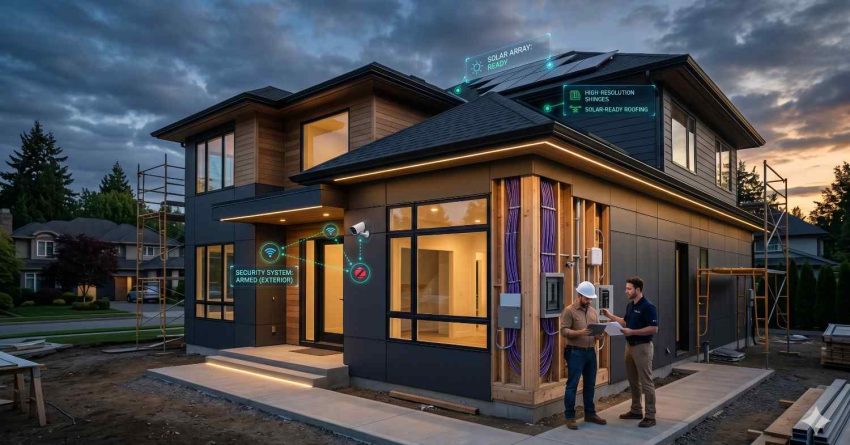
The building envelope is the complete system of exterior surfaces, including the roof, walls, windows, and doors, that separates conditioned interior space from the outdoors and governs how a home performs against weather, moisture, and heat for its entire service life.
Mistakes in the envelope cost far more to fix than prevent, because water intrusion, mold, structural rot, and elevated energy bills often trace back to a single failed installation detail.
This complete guide covers roofing systems, siding and cladding, windows, exterior doors, water barriers, air sealing, gutters, climate-specific envelope design, durability and maintenance, exterior color choices, permits, and contractor hiring.
What Is the Building Envelope?
The building envelope is the physical boundary between the conditioned interior of a home and the unconditioned exterior. It is not a single material. It is a layered system of interconnected assemblies that manages heat flow, moisture control, air movement, and structural weather resistance simultaneously.
Every component plays a defined role. The roof intercepts precipitation and thermal load from above. The wall cladding sheds water and provides weather resistance at the vertical surfaces. The windows and doors balance natural light and ventilation against thermal performance. And the underlying barriers, insulation, and air sealing layers coordinate the whole system from within the wall assembly.
The Roof as Primary Weather Defense
The roof system, from the structural deck through the surface cladding, intercepts precipitation, manages snow loads, reflects or absorbs solar heat, and exhausts moisture from the attic or roof assembly below. Roof pitch, material selection, ventilation strategy, and underlayment quality all determine whether a roof performs for its rated service life or begins failing within the first decade.
Siding and Cladding as the Weatherskin
The siding layer sheds bulk water away from the wall assembly and defines the aesthetic character of the home. But siding alone does not make a wall watertight. The water resistive barrier behind the cladding, proper flashing at all windows and penetrations, and a functional drainage path are equally essential components of a weather-resistant wall system.
Windows, Doors, and Penetrations
Every window, door, vent pipe, electrical penetration, and mechanical opening in the building envelope is a potential failure point. Proper flashing, air sealing, and insulation at each penetration determines whether the assembly performs as designed or slowly allows conditioned air to escape and moisture to accumulate inside wall cavities.
Why the Envelope Determines Energy and Durability Outcomes
A leaky, poorly insulated envelope forces HVAC systems to work harder, inflates utility bills, creates persistent comfort complaints, and accelerates structural degradation from moisture cycling. According to the U.S. Department of Energy, air leakage accounts for 25 to 40 percent of energy used for heating and cooling in a typical American home. That figure traces directly to envelope quality decisions made during design and construction. Every choice of roofing material, siding product, and wall assembly connects back to a broader framework of construction methodology, and our complete guide to building materials and construction methods covers how each exterior component fits into the full new-build system, from material selection benchmarks to assembly best practices and code compliance requirements.
Roofing Systems: Materials, Assembly & Climate Performance
The roofing system is the most exposure-intensive component of the building envelope. It faces UV radiation, thermal cycling, wind uplift, precipitation, and ice loading simultaneously. According to the National Roofing Contractors Association, roofing accounts for approximately 10 to 15 percent of total new residential construction cost, making material and system selection one of the highest-impact decisions in a new build or major renovation.
Asphalt Shingles
Asphalt shingles hold approximately 70 percent of the U.S. residential roofing market by installed square footage. Three-tab shingles have largely been replaced by architectural (dimensional) and designer products that offer better wind resistance, heavier weight, and longer warranties. Impact-resistant Class 4 shingles are available for hail-prone markets and may qualify for homeowner insurance premium reductions in eligible states. Architectural shingles dominate the U.S. residential roofing market and offer a strong balance of cost, durability, and visual variety for homeowners and builders in every climate zone, and our asphalt shingle roofing guide covers every grade, warranty tier, installation detail, and manufacturer comparison you need before specifying shingles for a new build or full re-roof.
Metal Roofing
Metal roofing has expanded significantly in residential applications over the past decade, particularly in coastal, mountain, and wildfire-interface zones where its Class A fire resistance, high wind resistance, and 40 to 70 year service life offer compelling lifecycle value. Standing seam metal with concealed fasteners and floating panels is the premium choice. Corrugated and exposed-fastener metal systems offer similar durability at lower installed cost and are widely used in barndominium and agricultural hybrid builds. Metal roofing, including standing seam, exposed fastener, and corrugated profiles, has grown from a niche premium option to a mainstream choice for homeowners seeking 40 to 70 years of service life and superior storm resistance, and our standing seam and metal roofing guide covers material types, profiles, fastening systems, cost ranges, and climate suitability in full detail.
Tile, Slate, and Premium Options
Clay tile, concrete tile, and natural slate offer service lives of 50 to 100 or more years when properly installed and maintained. Their weight, typically 600 to 1,500 pounds per roofing square versus 200 to 400 pounds for asphalt, requires structural engineering verification before specification. Solar roof tiles integrate photovoltaic generation directly into the surface cladding and are increasingly relevant in markets where solar mandates apply to new construction.
How Roof Assembly Layers Work Together
A complete roof assembly includes structural sheathing, ice and water shield at eaves and valleys, synthetic or felt underlayment across the full deck, and the surface cladding above. Each layer performs a specific function that the others cannot replace. The ice and water shield prevents ice dam infiltration in cold climates. The underlayment provides secondary moisture protection during and after installation. The surface material manages primary weather exposure over the rated service life. Understanding how each layer works together is the foundation of specifying a roof that performs for decades, which is why our complete guide to roof assembly layers and components walks through every element in sequence, covers inspection expectations at each phase, and explains which IRC sections govern installation.
Siding & Cladding: Materials, Installation & Longevity
Siding and cladding choices define both the visual character of a home and its long-term maintenance burden. Material selection must account for climate performance, regional aesthetic preferences, installed labor cost, lifecycle maintenance requirements, and HOA or local code restrictions.
Fiber Cement Siding
Fiber cement siding is a composite of Portland cement, sand, and cellulose fiber. It offers the appearance of wood lap, shingle, panel, and board-and-batten profiles with dramatically superior moisture resistance, dimensional stability, and fire rating. It requires repainting every 10 to 15 years and is significantly heavier than vinyl, which adds to labor cost during installation. Fiber cement siding has become the dominant cladding choice for homeowners who need the appearance of wood lap, shingle, or board-and-batten profiles combined with dramatically improved moisture resistance, dimensional stability, and Class A fire rating, and our fiber cement siding installation guide covers HardiePlank, HardiePanel, and HardieShingle product lines, exposure sizing, painting requirements, warranty terms, and installation standards in full.
Vinyl Siding
Vinyl remains the most widely installed residential siding type in the USA due to its low first cost, zero painting requirements, and wide color availability. Premium engineered vinyl with greater wall thickness (0.046 inch and above) and insulated foam backer panels offers meaningfully better performance than standard builder-grade products. Heat distortion near gas grills and fire pits is a real-world failure mode, and low-quality vinyl can crack in sustained cold. Proper installation of expansion and contraction gaps is essential. Our vinyl siding complete guide covers thickness grades, insulated vs standard panel options, installation tolerances, and regional performance considerations in detail.
Engineered Wood and Natural Wood Siding
LP SmartSide and similar engineered wood products offer wood aesthetics with improved moisture resistance through resin treatment and factory priming. Natural cedar, pine, and redwood siding is still widely used in custom residential construction where authentic wood grain and organic aging character are design priorities. Both product types require periodic painting or staining; maintenance intervals vary by exposure level and climate.
Brick, Stone Veneer, Stucco, and Metal
Brick and real stone veneer are long-lived cladding choices, commonly 50 or more years with proper maintenance, that require a drainage cavity behind the masonry, proper flashing at the base course and all openings, and weep holes at the bottom course to allow accumulated moisture to drain. Stucco systems, both three-coat traditional and EIFS one-coat approaches, are regionally prevalent across the Southwest and Florida; proper control joint placement, flashing integration, and drainage plane design are critical to avoiding the moisture failure patterns common in humid climates. Our stucco exterior complete guide covers three-coat vs EIFS systems, control joint placement, and wet climate installation requirements in full. Metal siding in steel, aluminum, and zinc profiles is gaining traction in contemporary, coastal, and commercial-adjacent residential builds for its durability, low maintenance burden, and strong fire resistance.
Rain Screen Wall Assemblies
A rain screen is a designed gap between the WRB and the back face of the cladding material, typically 3/8 to 3/4 inch, that allows liquid water bypassing the siding to drain down and exit the assembly while allowing the cavity to dry by ventilation. Rain screens are required by code in high-rainfall climates including the Pacific Northwest and parts of the Southeast and are considered best practice in nearly all residential climates. Our guide to rain screen cladding assemblies explains how to specify drainage mats, furring strip layouts, and drainage screen products for all major cladding types. Choosing the right siding material requires weighing first cost, lifecycle maintenance burden, regional climate performance, and resale value simultaneously, and our complete siding materials comparison covers all major cladding types, including vinyl, fiber cement, engineered wood, natural wood, brick, stucco, metal, and composite, head-to-head so you can make a fully informed decision for your specific climate and property type.
Windows: Performance Ratings & Installation
Windows are among the most critical nodes in the building envelope because they provide daylighting, ventilation, and views while simultaneously being the weakest thermal and air-infiltration points in the wall assembly. A well-insulated 2×6 framed wall may achieve R-20 or better. A standard double-pane window in that same wall may perform at R-3 to R-5, making window specification a pivotal energy performance decision.
Frame Materials Compared
Vinyl frames are the most widely installed choice, offering low maintenance and competitive thermal performance, though color options are limited and they expand and contract significantly with temperature changes. Fiberglass frames offer the best dimensional stability, paint-ability, and thermal performance of any frame material and hold up exceptionally well in extreme climates, at a higher price point. Wood frames provide unmatched aesthetics and good thermal performance but require regular painting or staining and perform less well in sustained high-humidity conditions. Thermally broken aluminum frames are used in contemporary and commercial-influenced applications; without a thermal break, aluminum conducts heat aggressively and is inappropriate for climate-performance applications.
Glazing Performance: U-Factor, SHGC, and Low-E Coatings
U-factor measures the rate of heat transfer through the entire window unit; lower is better for energy performance. ENERGY STAR requires U-factor of 0.30 or lower in northern climate zones. Solar Heat Gain Coefficient (SHGC) measures how much solar radiation passes through the glazing; lower values reduce cooling loads in hot climates while higher values capture passive solar warmth in cold climates. Low-E metallic coatings on the glass surface reduce infrared heat transfer in both directions and are now standard on virtually all residential window products above the entry tier.
Double Pane vs Triple Pane
Triple-pane windows add a third glass layer and additional inert gas fill, improving U-factor by approximately 30 to 40 percent over equivalent double-pane products and dramatically reducing interior glass surface condensation in cold climates. Their ROI depends on climate zone: clearly justified in IECC Zones 6 through 8 and increasingly standard in Zone 5 builds. In Zone 3 and Zone 2 climates (Texas, Georgia, Florida), properly specified double-pane units with climate-appropriate SHGC are typically cost-optimal.
Proper Window Flashing and Wall Integration
Even a high-performance window unit fails prematurely if the rough opening, flashing membrane, and sill pan assembly are not installed correctly, which is why our guide to window flashing and wall integration details every step from rough opening preparation through head flashing, sill pan design, and drainage gap requirements that satisfy IRC and most residential window manufacturer warranties.
Impact-Rated Windows for High-Wind Zones
Homes in coastal hurricane zones must comply with state and local wind-borne debris requirements that mandate impact-rated glazing or approved storm shutter systems. HVHZ (High Velocity Hurricane Zone) standards in Miami-Dade and Broward counties are among the most stringent in the nation, requiring Large Missile Impact certification on all fenestration. Selecting windows for a new build requires evaluating frame material, glazing performance ratings, style compatibility, lead time, and installation method as an integrated package rather than isolated decisions, and our window selection for new construction guide covers every decision point from U-factor and SHGC targets by climate zone through brand comparisons of Pella, Andersen, Marvin, Milgard, and others.
Exterior Doors: Materials, Energy Performance & Security
Entry doors, back doors, patio doors, and garage doors each represent an opening in the building envelope that must be sealed, insulated, and flashed with the same care as any other penetration. An uninsulated steel door may achieve R-5; a high-quality fiberglass door with a polyurethane foam core can reach R-8 to R-12, making door specification a meaningful energy and security decision.
Fiberglass vs Steel vs Wood Entry Doors
Fiberglass is the premium choice for most homeowners: it does not rust, does not warp, can be painted or stained to replicate wood grain, and achieves the best thermal performance of any door material. Steel offers excellent security and adequate thermal performance at a lower price point, but will rust at any paint scratch in humid coastal or wet climates without prompt maintenance. Solid wood is the traditional choice for custom architectural character and responds beautifully to staining, but requires more maintenance and can warp in high-humidity environments without adequate protective overhang coverage.
Sliding Patio, French, and Multi-Slide Doors
Patio doors are among the most complex envelope penetrations, combining large glass area with a sliding or hinged mechanism that requires precise weatherstripping, and a threshold condition that must integrate cleanly with the WRB and interior flooring system. Multi-slide and stacking systems from specialty manufacturers allow dramatic wall openings while meeting energy codes in most climate zones. The transition from exterior to interior at these openings must be engineered carefully to prevent water infiltration at the threshold.
Garage Door Selection
Garage doors are typically the largest single opening in a residential building envelope. R-values range from approximately R-6 for single-layer steel to R-18 for premium polyurethane-core insulated products. In hurricane zones, garage door structural integrity is a life-safety requirement. Reinforced doors and bracing kits are code-required in many coastal jurisdictions, and the garage door is often the first component to fail in a hurricane if undersized or improperly braced. Entry doors, back doors, and patio openings are simultaneously security, energy performance, and curb-appeal decisions that deserve rigorous evaluation, and our exterior door selection and performance guide covers every material option from fiberglass, steel, and solid wood through multi-slide and pocket door systems, with performance ratings, pricing benchmarks, weatherstripping standards, and installation requirements fully explained.
The WRB System: Insulation, Air Sealing & Water Barriers
Behind every layer of siding and cladding is a wall assembly that determines how much water can enter, whether moisture can exit, how much air infiltrates, and what the true thermal performance of the wall actually is. This system, comprising the water resistive barrier, continuous insulation, cavity insulation, and air sealing, is where the highest-impact engineering decisions are made for long-term building performance.
Water Resistive Barrier Selection
The WRB is applied to the structural sheathing before cladding is installed and serves as the primary defense against bulk water infiltration into the wall cavity. Options include traditional 15-lb. asphalt felt, housewrap products such as Tyvek HomeWrap, and integrated sheathing-plus-WRB systems like Huber ZIP System. ZIP System sheathing integrates structural sheathing and WRB into a single taped panel system that eliminates separate housewrap installation and has demonstrated exceptional air tightness performance in blower door testing on new construction. The WRB, whether house wrap, building paper, or an integrated sheathing system, is the last line of defense against bulk water infiltration into the wall cavity, and choosing the right product for your climate and cladding type has a direct impact on wall longevity and indoor air quality, which is why our guide to water resistive barrier selection compares ZIP System, Tyvek, HardieWrap, and other leading products with real performance and installation data.
Continuous Insulation and Thermal Bridges
Cavity insulation placed between studs, whether batt, blown cellulose, or spray foam, is bridged thermally by the wood framing members, which conduct heat at approximately R-1 per inch. Continuous rigid foam or mineral wool insulation installed over the structural sheathing and under the cladding eliminates stud bridging entirely and dramatically improves whole-wall R-value. IECC 2021 and many state building codes now require varying levels of continuous insulation depending on climate zone, making this a code compliance issue as well as a performance one.
Air Sealing Strategies and Blower Door Testing
Air sealing should be approached as a separate task from insulation installation, requiring a different mindset and different materials. Common air leakage pathways include the top plate-to-attic junction, rim joists at the foundation level, window and door rough openings, plumbing and electrical penetrations, and the WRB-to-foundation transition. Spray foam at critical structural transitions, careful tape application at all sheathing panel joints, and airtight electrical boxes together reduce ACH50, the primary metric for building envelope tightness verified by blower door test. Reducing uncontrolled air infiltration through the building envelope is one of the highest-ROI investments in any new home, directly improving HVAC efficiency, indoor air quality, and year-round occupant comfort, and our guide to air sealing strategies for new builds covers every critical penetration point from rim joists and top plates to window and door rough openings, along with blower door test targets organized by IRC and energy code tier.
Gutters, Downspouts & Exterior Drainage
Gutters and downspouts are the final-stage water management element in the building envelope, collecting roof runoff and directing it away from the foundation, landscaping, and siding base course. Undersized, clogged, or improperly located gutters are among the most common contributors to foundation damage, basement moisture, and siding base rot in American residential construction.
Gutter Materials and Sizing
Aluminum is the dominant residential gutter material, lightweight, corrosion-resistant, paintable, and available in continuous seamless lengths that eliminate mid-span joints prone to leaking. Copper gutters are the premium choice for custom architecture and last indefinitely when properly installed and maintained. Steel gutters offer durability but require prompt paint touch-up in humid climates to prevent rust. Sizing decisions, typically 5-inch or 6-inch K-style or half-round profiles depending on region, must account for roof area, slope, and local rainfall intensity data.
Downspout Placement and Drainage Plans
Downspout frequency, generally one per 30 to 40 linear feet of gutter run, placement at building corners, and discharge direction are all design decisions with real consequences. Extensions must discharge at least 4 feet from the foundation slab, and ideally tie into underground drainage systems that carry water to daylight or a properly engineered dry well in high-precipitation regions.
Ice Dam Prevention by Design
Ice dams form when heat escaping through the roof deck melts snow that refreezes at the cold, unheated roof overhang above the eave. Prevention requires a combination of continuous insulation at the roof-to-wall junction, proper attic ventilation ratios, and ice-and-water shield running a minimum of 24 inches inside the plane of the warm wall at the eaves. Our ice and water shield application guide details proper installation requirements, coverage minimums by climate zone, and the relationship between underlayment coverage and code compliance. Gutter sizing, profile, material, and downspout placement are engineering decisions that directly affect foundation drainage, landscaping erosion, and ice dam risk in cold climates, and our complete guide to gutter systems and drainage design covers K-style vs half-round profiles, aluminum vs copper vs steel materials, seamless gutter installation, and proper downspout outlet placement for each major regional climate.
Climate-Specific Envelope Design Strategies
The envelope assembly that performs optimally in Phoenix is not the same assembly that performs in Minneapolis or Miami. Climate-specific design is not a preference issue; it is the difference between a building that meets code minimums and one that provides occupant comfort, long service life, and genuine energy efficiency over its full lifespan.
Cold Climate and Snow Country
Cold-climate envelope priorities are maximum airtightness, continuous exterior insulation, vapor retarder strategy appropriate to the specific wall assembly, and high-performance windows. Snow country additionally requires engineered roof trusses rated for regional ground snow loads, steep enough pitch to shed accumulated snow, and extended ice-and-water shield coverage at the eaves. Unvented roof assemblies with spray foam applied to the underside of the roof deck are increasingly used in cold climates to eliminate the thermal bridging and attic ventilation complexity that causes ice dams.
Hot and Humid Climates
Hot and humid climates, primarily Climate Zones 1 and 2 covering most of Florida, coastal Gulf states, and Hawaii, require a fundamentally different vapor control strategy than cold climates. The vapor drive is inward during summer as humid exterior air attempts to diffuse into air-conditioned interior space. Vapor-open wall assemblies that allow outward drying, high-SHGC-management glazing, and ventilated attic assemblies with radiant barriers are standard best practices in these regions.
Hurricane and High-Wind Zones
Homes in hurricane-prone coastal regions require an integrated envelope approach that combines impact-rated windows, reinforced garage doors, secondary water barriers, and continuous load-path roof connections, and our complete guide to building envelope in hurricane zones explains the Florida Building Code and wind-speed zone requirements that govern every layer of the exterior assembly in hurricane country, from roof decking to siding fastening schedules.
Wildfire Interface Zones
Homes in Wildfire Urban Interface (WUI) zones must specify Class A roofing materials, fire-resistant cladding such as fiber cement, stucco, brick, or metal siding, ember-resistant vent covers, and noncombustible or fire-rated deck materials. California’s Chapter 7A and similar WUI codes in Oregon, Colorado, and other western states mandate specific envelope component performance ratings for all new construction in designated fire hazard severity zones. Our envelope design for wildfire zones guide covers all Chapter 7A and WUI code requirements alongside material selection guidance for fire-resistant exterior assemblies in every affected region.
Coastal and Salt Air Environments
Salt air corrosion is a primary durability concern within one mile of the ocean and in certain industrial environments. Aluminum, concrete, fiber cement, stucco, and factory-coated steel products tolerate salt air well. Raw mild steel, untreated wood, and standard zinc-galvanized fasteners degrade rapidly in marine environments and should be avoided in coastal construction. The combination of salt air and freeze-thaw cycling in northern coastal climates is particularly destructive to masonry construction. In hot humid climates, the building envelope that performs optimally in Phoenix is not the same assembly that performs in Minneapolis or Miami, and our complete guide to cold climate envelope design addresses every layer from slab edge insulation through roof venting strategy and unvented assembly options for homeowners building in northern and high-altitude markets.
Durability, Maintenance & Inspection of the Exterior
The building envelope requires systematic maintenance to achieve its rated service life. Neglected flashing, clogged gutters, failed caulk joints, and unrepaired shingle damage compound over time into expensive structural repairs. A proactive maintenance program costs a small fraction of the reactive repair bills it prevents.
Roof Maintenance by Material Type
Asphalt shingles need annual inspection for granule loss, lifted tabs, cracked sealant strips at penetrations, and algae or moss growth that accelerates shingle degradation. Metal roofs need sealant inspection at fasteners, cap flashing, and roof transitions every three to five years. Tile roofs require periodic inspection of ridgeline mortar condition, underlayment integrity, and individual tile for hairline cracks. Every roofing material has its own maintenance protocol, with asphalt shingles needing annual granule and sealant checks, metal roofs needing fastener and transition inspection every few years, and tile roofs needing periodic mortar and underlayment assessment, and our detailed guide to roof maintenance by material type provides the complete schedule for each material along with what to inspect, when to call a professional, and how to extend roof service life.
Siding Maintenance and Repair Cycles
Fiber cement siding requires repainting every 10 to 15 years and caulk reapplication at all horizontal trim and opening intersections every 5 to 7 years. Vinyl siding needs periodic cleaning with a pressure washer and inspection of expansion gap clearances and J-channel alignment. Wood siding requires the most active maintenance program, with repainting or re-staining every 4 to 7 years depending on sun exposure, climate, and topcoat quality. Stucco requires annual control joint inspection and crack repair to prevent water infiltration.
Caulking, Flashing, and Penetration Maintenance
Failed caulk at windows, doors, penetrations, and trim transitions is the most common source of progressive water damage in residential building envelopes. Polyurethane and modified-silicone caulks offer the best outdoor adhesion and durability for most exterior applications. All caulk joints should be inspected and refreshed on a 5 to 7 year cycle or immediately when visible cracking, shrinkage, or separation is observed. Our flashing best practices guide covers flashing material selection, installation sequencing, and long-term maintenance requirements at every critical transition point in the building envelope.
Annual Envelope Inspection Protocol
A systematic annual exterior inspection covers the roof surface and all penetrations, gutters and downspouts, flashing at chimneys and skylights, siding condition and paint integrity, caulk at all exterior joints, window and door weatherstripping, foundation clearance from soil and mulch, and attic inspection for any signs of moisture entry. Catching a failed caulk joint, lifted shingle, or clogged downspout before it allows water intrusion into the building assembly can save thousands in structural repair costs, and our annual exterior envelope inspection checklist gives homeowners and property managers a systematic, component-by-component exterior audit guide that covers everything from foundation clearance and gutter condition through ridge cap integrity and window seal failure signs.
Exterior Color, Style & Architectural Coordination
Exterior color, material texture, and architectural detail combine to create the first impression a home makes, which directly influences perceived value and resale desirability. Color and material selections must be made holistically, with consideration for how roof color, siding tone, trim, window frame, and door accent interact as a unified composition.
Roof Color and Energy Impact
Roof color has a meaningful effect on attic temperature and cooling load. Dark roofs absorb more solar radiation and can increase attic temperatures by 20 to 40 degrees Fahrenheit compared to light-colored products in direct sun, increasing cooling loads in warm climates. Cool roof products with high Solar Reflectance Index (SRI) ratings are required or financially incentivized in many hot-climate jurisdictions. In cold climates, a darker roof may modestly reduce snow load duration by absorbing more heat on clear winter days.
Siding and Trim Color Coordination
Classic residential color palettes use a dominant body color, a complementary trim color, and an accent applied to the front door and any shutters or corbels. The body-to-trim color relationship is the most impactful single color decision in exterior design. White, off-white, and cream trims remain perennially popular for their clean contrast against most body colors. Black window frame profiles have become a defining element of contemporary and modern farmhouse exterior design, adding visual definition at openings and working across a wide range of body color choices.
Matching Exterior Style to Architecture
Modern farmhouse homes pair well with board-and-batten vertical siding accents, white or black trim, and standing seam metal roofing profiles. Craftsman homes call for horizontal lap siding, substantial trim details, and exposed rafter tails at the eaves. Mediterranean and Spanish Colonial styles are defined by clay tile roofing, smooth stucco cladding, and arched openings. Applying materials that contradict the fundamental architectural vocabulary of a home reduces curb appeal and resale value regardless of material quality. Selecting an exterior color palette requires balancing homeowner preference, neighborhood context, architectural style compatibility, and long-term maintenance requirements into a cohesive scheme, and our guide to exterior color palette selection walks through how to coordinate roof color, siding tone, trim, door accent, and window frame colors into a visually unified result that adds measurable curb appeal and resale value.
Outdoor Structures & Envelope Extensions
Covered porches, decks, pergolas, freestanding garages, and ADUs all extend the building footprint beyond the primary dwelling and must be treated with the same envelope rigor as the main house. Each structure requires its own roofing specification, drainage planning, and material selection appropriate to its specific exposure conditions.
Covered Porches, Decks, and Ledger Connections
Covered porches that connect to the main house wall create a critical flashing condition at the intersection where the porch roof meets the house wall. This junction must be counter-flashed, step-flashed, or integrated with a continuous WRB membrane to prevent bulk water from entering the wall assembly at the connection point. Deck ledger board connections require through-flashing and code-compliant stainless or hot-dipped galvanized hardware to prevent water infiltration and corrosion failure behind the siding base.
Pergolas, Outdoor Kitchens, and Sunrooms
Freestanding pergolas and pavilions require proper footings, structural connections rated for local wind and snow loads, and material selection appropriate to long-term weather exposure. Outdoor kitchens require weather-resistant cabinet materials, properly sealed countertop surfaces, and appliance placement that protects equipment from rain intrusion and UV degradation. Sunroom additions create the full complexity of a permitted habitable addition, including foundation, wall framing, roof, glazing, and HVAC connection, and must be permitted and inspected accordingly.
Detached Garages and ADU Exteriors
Detached structures on your property, whether a guest cottage, garage apartment, or dedicated ADU, need the same rigorous attention to roofing, siding, and envelope performance as the main residence, and our ADU build and exterior envelope guide covers the full ADU construction process from material selection and code compliance through contractor coordination and inspection requirements for every structure type.
Building Permits & Code Requirements for Exterior Work
Roofing, siding, and window replacement projects are among the most commonly unpermitted renovation categories in residential construction, and among the most frequently flagged by home inspectors at resale. Permit requirements for exterior work vary substantially by jurisdiction but are generally required for structural changes, full re-roofs, complete siding replacements, and window or door replacements that alter rough opening dimensions.
What Permits Are Required
Most jurisdictions require a permit for tear-off and complete re-roof work, new roof framing or structural alterations, window installations that change rough opening dimensions, full siding replacement over the entire building skin, and structural changes to porches, decks, and overhangs. Like-for-like overlay of one additional shingle layer over an existing roof, minor caulking and repair, and painting projects are generally exempt, but the threshold varies by municipality.
IRC and Local Code for Roofing and Siding
The International Residential Code (IRC) establishes minimum standards for roofing installation in Section R905, exterior wall covering in Section R703, and flashing requirements in Section R703.4. Many states and municipalities amend the base IRC with higher local requirements. Florida’s wind speed map requirements, California’s Title 24 energy code mandates for cool roofs, and Oregon’s rain screen requirements for certain cladding applications are all examples of local standards that exceed IRC minimums and must be consulted during specification. Knowing which phases of exterior work require scheduled municipal inspections, and when to bring in an independent inspector for pre-drywall and pre-final walkthroughs, is critical to protecting your investment in roofing and siding work, and our complete guide to the inspection and quality control process explains every phase inspection checkpoint, pre-drywall checklist item, and final punch list strategy for new construction and renovation projects.
Inspection Phases for Exterior Systems
Exterior work requiring a permit typically involves an in-progress inspection when ice and water shield and underlayment are exposed (usually required for re-roofing projects), and a final inspection after completion verifying code-compliant installation, proper flashing, and correct ventilation. Every roofing replacement, full siding re-clad, and window replacement project may require a permit and inspection depending on your jurisdiction, and our comprehensive building permits and code compliance guide explains exactly what requires a permit, how to apply, typical approval timelines by city, plan check requirements, and the serious consequences of unpermitted exterior work when a property is sold or refinanced.
Working With Roofing and Siding Contractors
Exterior work involves elevated exposure to unqualified contractors. The barrier to advertising roofing and siding services is low, and storm-chasing operations following severe weather events routinely appear in affected markets with limited local accountability. Protecting your investment requires a systematic vetting process before signing any contract.
Vetting Exterior Contractors
Key verification steps include confirming a current state contractor’s license in good standing (check the state licensing board directly), verifying general liability insurance at minimum $1 million per occurrence and workers’ compensation coverage for all employees, checking the state licensing board and BBB for unresolved complaints, visiting at least one reference job site in person, and confirming manufacturer certification for any products carrying extended installation warranties.
Getting and Comparing Bids
Exterior bids must be compared on a strict apples-to-apples basis using the same underlayment specification, the same ice-and-water shield extent, the same drip edge material, the same waste factor, the same warranty terms, and the same removal and disposal scope. A bid that omits ice and water shield or reduces underlayment coverage may appear attractively priced while representing a materially inferior installation that will fail the product manufacturer’s warranty. Always request itemized bids that separate material costs from labor, and require each contractor to respond to a written scope of work document.
Contracts, Warranties, and Workmanship Standards
A properly structured exterior contract specifies materials by product name and grade, references installation per manufacturer specifications, assigns permit responsibility to the contractor, ties the payment schedule to verifiable completion milestones (never prepay more than 10 to 15 percent of the contract value before work begins), includes a written workmanship warranty of at least two years for roofing, and defines a clear dispute resolution pathway. Selecting a roofing or siding contractor requires the same systematic vetting process as hiring any major construction professional, including license verification, insurance confirmation, reference checks, and disciplined bid comparison, and our comprehensive guide to hiring and vetting exterior contractors provides the complete checklist, contract clause essentials, and red flag identification process that protects your budget and project outcome from start to final inspection.
Understanding Costs for Roofing, Siding & Envelope Projects
Exterior envelope systems represent a significant investment in property value and structural longevity. Understanding realistic cost ranges and the variables that drive them helps homeowners and property managers budget accurately and evaluate contractor bids with appropriate context.
Roofing Cost Ranges by Material
According to HomeAdvisor national cost data, average U.S. installed roofing costs range broadly by material:
- Architectural asphalt shingles: $3.50 to $6.50 per square foot installed, including tear-off
- Standing seam metal roofing: $8 to $16 per square foot installed
- Concrete tile: $10 to $18 per square foot installed
- Natural slate: $15 to $30 per square foot installed
Regional labor costs vary substantially. Coastal California and the Northeast typically run 30 to 50 percent higher than equivalent Midwest and South markets.
Siding Cost by Type
Installed siding costs, including removal of existing cladding, WRB replacement, and trim work, vary significantly by material:
- Vinyl siding: $2.50 to $5.50 per square foot
- Fiber cement siding: $5 to $12 per square foot
- Engineered wood siding: $4 to $9 per square foot
- Three-coat stucco: $7 to $14 per square foot
- Brick veneer: $9 to $22 per square foot
Substrate repair, WRB replacement, and window and door trim work add meaningfully to total project cost on older homes where prior moisture intrusion has damaged underlying framing or sheathing.
Total Envelope Budget for New Construction
In new residential construction, roofing, siding, windows, and exterior doors together typically represent 15 to 25 percent of total hard construction cost. On a $400,000 construction budget, that range translates to $60,000 to $100,000 for all exterior envelope components, a figure that demands careful material specification and contractor vetting to deliver the performance and aesthetic outcomes the design requires.
Lifecycle Cost and ROI
Metal roofing’s higher upfront cost relative to asphalt shingles is often offset over a 40 to 70 year service life by eliminating multiple re-roof cycles. Fiber cement siding’s lower 30-year lifecycle cost versus standard vinyl, due to better durability and fewer catastrophic failure modes, often justifies its higher first cost in high-precipitation climates. Homeowners upgrading to ENERGY STAR certified windows may qualify for the 25C federal tax credit of up to 30 percent of installation cost, capped annually per product category under the Inflation Reduction Act. Roofing, siding, and exterior envelope systems typically represent 15 to 25 percent of total new construction hard costs, and understanding how to budget, finance, and track these expenditures within a construction loan draw schedule is the difference between a smooth project and a painful overrun, which is why our home construction cost and financing guide covers every cost component from soft costs through hard costs, allowances, contingencies, and draw schedule management.
Conclusion
The building envelope spans roofing, siding, windows, and doors and determines how a home performs, conserves energy, and resists moisture damage over its service life.
Every layer, material, and connection within this system is interdependent, and the resources linked throughout this guide provide spoke-level depth for each major component decision.
At Mr. Local Services, our trusted contractor network connects you with vetted roofing, siding, and window specialists ready to deliver quality results on your project.
Frequently Asked Questions
What is the building envelope and why does it matter?
The building envelope is the complete system of exterior surfaces, including the roof, walls, windows, and doors, that separates conditioned interior space from the outdoors. It directly controls energy efficiency, moisture resistance, and structural durability for the entire life of the building.
How long does a typical asphalt shingle roof last?
Standard architectural asphalt shingles carry manufacturer warranties of 30 years to lifetime, but real-world service life in most U.S. climates ranges from 20 to 30 years depending on installation quality, attic ventilation performance, UV exposure level, and frequency of maintenance inspections.
What is the difference between a WRB and a vapor barrier?
A water resistive barrier (WRB) manages bulk liquid water infiltration into the wall assembly and is vapor-permeable, allowing moisture vapor to pass through and dry. A vapor retarder controls vapor diffusion through the assembly to prevent condensation within wall cavities. They serve different functions and are often two separate products in the same wall system.
Which siding material requires the least maintenance?
Vinyl and fiber cement are the lowest-maintenance residential siding options. Vinyl requires no painting and only periodic cleaning to maintain appearance. Fiber cement requires repainting every 10 to 15 years but will not rot, crack from insect damage, or degrade from moisture exposure when properly installed.
How do I know if my gutters are properly sized?
A practical rule of thumb is that 5-inch K-style gutters handle approximately 5,000 square feet of roof drainage area in low-rainfall regions, while 6-inch gutters are appropriate for larger roof areas or high-rainfall climates. Gutters overflowing during moderate rain events (not extreme storms) indicate undersized or clogged gutters that require attention.
Are impact-rated windows required in all coastal areas?
Impact-rated windows are legally required in designated wind-borne debris regions, primarily in Florida’s High Velocity Hurricane Zone (Broward and Miami-Dade counties), portions of the Gulf Coast, and any area where the design wind speed exceeds 130 mph under ASCE 7. Other coastal areas permit approved hurricane shutters as an alternative to impact glazing.
What permits are typically required for roofing and siding work?
Full roof tear-off and re-roofs generally require a permit in most U.S. jurisdictions. Full siding replacement over the entire building skin, structural changes to overhangs or porches, and window replacements that alter rough opening dimensions also typically require permits. Like-for-like repairs, overlay of a second shingle layer where permitted, and painting are generally exempt, but requirements vary by local jurisdiction and should always be verified before work begins.