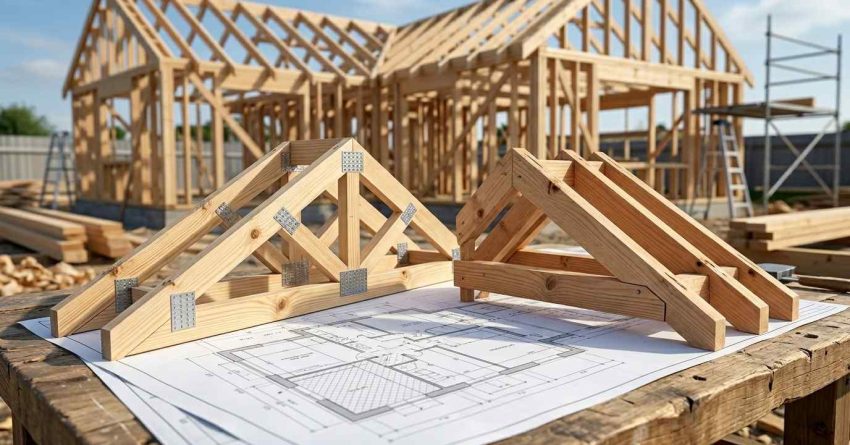
Roof trusses and stick-framed roofs are the two primary methods used to frame a residential roof, and choosing between them affects your project’s cost, timeline, structural performance, and long-term flexibility. Each method has clear advantages depending on your home’s design, your budget, and how you plan to use your attic space. Understanding the differences helps you make a confident, informed decision before construction begins.
This comparison matters now because framing decisions are made early in any roofing or new construction project, and reversing them later is costly.
This guide covers what each method involves, how they compare on key factors, and which option fits your specific situation best.
What Is a Roof Truss?
A roof truss is a pre-engineered, factory-built structural framework made from lumber and metal connector plates. Trusses are designed using engineering software to carry specific roof loads, then delivered to the job site ready to install. Because they are manufactured off-site under controlled conditions, trusses offer consistent quality and predictable performance across every unit.
Trusses are the dominant framing method in modern residential construction in the United States. Their popularity comes from speed, cost efficiency, and structural reliability — all of which matter to homeowners, builders, and property managers working within defined budgets and schedules.
How Roof Trusses Are Built
Each truss is assembled in a factory using dimensional lumber — typically 2×4 or 2×6 members — joined at connection points called nodes. Metal gang-nail plates press into the wood at each node, creating rigid, load-bearing joints without the need for complex carpentry cuts. Engineers calculate the exact geometry and load distribution for each truss design before production begins.
Once delivered, trusses are lifted into position using a crane or mechanical equipment and fastened to the top wall plates of the structure. A full set of trusses for a standard residential home can be installed in a single day by a small crew.
Common Truss Types Used in Residential Construction
The most widely used truss types include the Fink truss, which is the standard W-shaped design found in most tract homes; the Attic truss, which creates a usable room within the truss frame; the Hip truss, used for hip roof configurations; and the Scissor truss, which creates vaulted interior ceilings. Each type serves a specific structural and aesthetic purpose, and your choice depends on your roof pitch, span, and interior design goals.
For a deeper look at how each truss type performs across different roof configurations, our guide on types of roof trusses breaks down every residential option with span ratings, load capacities, and design applications.
Understanding how roof trusses fit into the broader scope of your project is easier when you explore our complete roofing services overview, which covers every structural and finishing option available for residential and commercial properties.
What Is Stick Framing a Roof?
Stick framing — also called conventional framing or cut framing — is the traditional method of building a roof structure entirely on-site using individual lumber pieces. Carpenters cut and assemble each rafter, ridge board, collar tie, and ceiling joist by hand, working directly from architectural plans or field measurements. The result is a fully custom roof frame built piece by piece.
Stick framing has been used in residential construction for centuries and remains the preferred method for complex roof designs, custom homes, and renovation projects where pre-engineered trusses cannot accommodate the required geometry.
How Stick-Framed Roofs Are Constructed
A stick-framed roof begins with the installation of a ridge board — the horizontal beam running along the peak of the roof. Rafters are then cut to the correct length and angle and fastened to the ridge board at the top and to the wall’s top plate at the bottom. Ceiling joists run horizontally between opposing walls to resist the outward thrust that rafters create under load. Each piece is measured, cut, and nailed individually by the framing crew.
Stick framing relies heavily on skilled on-site craftsmanship, and our carpentry and framing work explains how experienced carpenters approach custom cuts, ridge boards, and rafter assembly to deliver a structurally sound result.
When Stick Framing Is the Right Choice
Stick framing is the better choice when your roof design includes multiple intersecting planes, dormers, skylights, or irregular angles that factory trusses cannot accommodate. It is also the standard approach for additions and renovations where the existing structure limits truss delivery and crane access. Custom and luxury homes with complex architectural rooflines almost always use stick framing to achieve the design intent.
Roof Trusses vs Stick-Framed Roof: Key Differences
The comparison between trusses and stick framing comes down to five practical factors: cost, installation speed, structural performance, design flexibility, and attic usability. Neither method is universally superior — each performs better in specific situations.
Cost Comparison
Roof trusses are generally less expensive than stick framing for standard residential projects. The factory production process reduces material waste and eliminates the labor hours required for on-site cutting and fitting. For a typical single-family home, trusses can reduce framing labor costs significantly compared to a fully stick-framed roof of the same span.
Stick framing costs more in labor because it requires experienced carpenters working for multiple days rather than a crane crew working for one. However, for complex roof designs, stick framing may be the only viable option regardless of cost. A detailed breakdown of regional pricing and material estimates is available in our roof framing cost guide, which compares both methods across common home sizes and roof configurations.
Installation Time and Labor
Trusses install faster than stick framing in almost every scenario. A crane sets a full set of trusses in hours; stick framing the same roof takes days or weeks depending on complexity. Faster installation reduces weather exposure risk for the structure and shortens the overall construction timeline — both of which matter to homeowners managing project budgets and move-in schedules.
Stick framing requires a larger, more skilled crew working longer hours. Labor availability and local carpenter rates directly affect the final cost and timeline in ways that truss installation does not.
Structural Strength and Span Capability
Both methods produce structurally sound roofs when designed and installed correctly. Trusses are engineered to precise load specifications and can span long distances — often 40 feet or more — without interior load-bearing walls. This gives builders and homeowners greater flexibility in open floor plan design.
Stick-framed roofs rely on the skill of the framing crew and the quality of the lumber used. When built correctly, they perform equally well structurally. However, very long spans in stick framing require larger lumber members and additional support elements, which increases material costs.
If your framing decision is tied to a larger renovation, our home remodeling options outlines how structural changes — including roof framing upgrades — integrate with full-scale remodeling projects.
Attic Space and Interior Design Flexibility
This is one of the most important practical differences between the two methods. Standard roof trusses — particularly the common Fink truss — fill the attic space with a web of structural members that cannot be removed or modified. The result is an attic that works well for mechanical equipment and light storage but cannot be converted into living space without significant structural intervention.
Stick-framed roofs leave the attic open. Because the structural work happens at the rafters and ceiling joists rather than through a web of interior members, the attic space is fully accessible and can be finished as a bedroom, office, or bonus room. This is a major advantage for homeowners who want to maximize usable square footage.
Attic trusses — a specialized truss type — do create usable interior space, but they cost more than standard trusses and require precise planning before manufacturing. If attic conversion is a priority, this option bridges the gap between truss efficiency and stick-frame flexibility. Our guide on truss attic conversion explains what is structurally possible and what the process involves for homeowners considering this upgrade.
Once your roof framing is complete, finishing the interior properly is the next step — our drywall and ceiling work covers how ceiling installation and finishing connect directly to the framing method you choose.
Which Roofing Method Is Better for Your Home?
There is no single correct answer. The right framing method depends on your project type, roof design, budget, and long-term plans for the space.
Best Scenarios for Roof Trusses
Trusses are the better choice for new construction on standard residential homes with straightforward roof designs. They work well when the project requires fast installation, consistent structural performance, and cost efficiency. Builders working on production homes, spec homes, and multi-unit residential projects almost always choose trusses for these reasons. If your design does not require attic living space and the roof geometry is standard, trusses deliver the best value.
Best Scenarios for Stick Framing
Stick framing is the better choice for custom homes with complex rooflines, additions to existing structures, and renovation projects where truss delivery and crane access are not practical. It is also the right choice when you want to preserve or create usable attic space without the added cost of attic trusses. Homeowners working with architects on unique designs will almost always find that stick framing gives their builder the flexibility to execute the vision accurately.
Working With a Roofing Professional
Choosing between trusses and stick framing is a decision that should involve your contractor, structural engineer, and architect from the beginning. The framing method affects your building permit requirements, your structural drawings, your material orders, and your construction schedule. Making this decision late in the planning process creates delays and added costs.
A qualified roofing and framing contractor will assess your roof design, local building codes, site access, and budget to recommend the right method for your specific project. They will also coordinate with truss manufacturers if trusses are selected, or assign an experienced framing crew if stick framing is the better fit.
For smaller structural adjustments or repairs that arise during or after framing, our handyman repair services explains how skilled handymen support roofing projects with precision work that keeps timelines on track.
Choosing the right framing method is only the first decision — connecting with the right team makes all the difference, and our professional roofing help is the starting point for finding qualified contractors who handle both truss and stick-frame installations.
Conclusion
Roof trusses and stick-framed roofs each serve a distinct purpose in residential construction, and the right choice depends on your design requirements, budget, and how you plan to use your attic space. Trusses offer speed, cost efficiency, and engineered consistency for standard builds, while stick framing delivers the custom flexibility that complex designs and renovations demand.
Both methods produce durable, structurally sound roofs when installed by qualified professionals — the difference lies in which method fits your project’s specific conditions and long-term goals.
At Mr. Local Services, our roofing professionals help homeowners and property managers evaluate both options and connect with the right contractors to get the job done right the first time.
Frequently Asked Questions
Are roof trusses stronger than stick framing?
Not necessarily. Both methods produce structurally sound roofs when designed and installed correctly. Trusses are engineered to precise load specifications, while stick-framed roofs depend on skilled carpentry and quality lumber. Strength is determined by design and execution, not the method alone.
Can I use attic space with roof trusses?
Standard trusses fill the attic with structural webbing that limits usable space. Attic trusses are a specialized option that creates an open room within the truss frame, but they cost more and require advance planning before manufacturing. Stick framing naturally leaves attic space open.
How long does it take to install roof trusses vs stick framing?
Roof trusses can be set in a single day using a crane and a small crew. Stick framing the same roof typically takes several days to a week or more, depending on the complexity of the design and the size of the framing crew.
Which method costs more — trusses or stick framing?
Stick framing generally costs more in labor because it requires experienced carpenters working on-site for longer periods. Trusses reduce labor time significantly. However, for complex roof designs, stick framing may be the only viable option, making direct cost comparison less relevant.
Can stick framing be used on any roof shape?
Yes. Stick framing is the most flexible method and can accommodate virtually any roof shape, including complex intersecting planes, dormers, curved sections, and irregular pitches. This is one of its primary advantages over pre-engineered trusses.
Do roof trusses require special equipment to install?
Yes. Trusses are heavy and must be lifted into position, which typically requires a crane or boom truck. This equipment adds to the installation cost but also dramatically reduces the time required to frame the roof compared to stick framing.
Which roof framing method adds more home value?
Neither method inherently adds more value than the other. Home value is driven by the quality of the finished roof, the design of the home, and the local real estate market. Attic space created by stick framing or attic trusses can add usable square footage, which may increase appraised value depending on how it is finished.