Engineered lumber — including LVL, PSL, and Glulam — refers to manufactured wood products made by bonding wood fibers, veneers, or strands under heat and pressure to create structural members that outperform traditional solid wood in strength, consistency, and dimensional stability. These products are used in beams, headers, columns, and framing throughout residential and commercial construction across the USA.
Understanding which type fits your project can save time, money, and structural headaches down the road.
This guide explains what each engineered lumber type is, how they compare, and how to choose the right one for your specific renovation or construction need.
What Is Engineered Lumber and Why Does It Matter?
Engineered lumber is a category of wood-based building materials manufactured by combining wood elements — veneers, strands, fibers, or boards — with adhesives and pressing them into structural shapes. The result is a product that is stronger, more uniform, and more resistant to warping and shrinkage than natural solid wood cut from a single log.
For homeowners and property managers, engineered lumber matters because it directly affects the structural integrity of a building. When a contractor specifies a beam for a load-bearing wall, a header above a wide garage door, or a ridge beam in a roof system, they are almost always choosing from engineered lumber options. These materials carry predictable load ratings, which makes structural engineering calculations more reliable.
Engineered lumber also makes better use of available timber resources. Because it is manufactured from smaller wood pieces and fast-growing tree species, it reduces dependence on large, old-growth timber while delivering superior performance. Engineered lumber is a core material used across a wide range of structural work — our carpentry services cover everything from beam installation to custom framing using these advanced materials.
How Engineered Lumber Differs from Solid Wood
Solid wood beams are cut directly from a single log, which means their strength and stability depend entirely on the quality of that individual tree. Knots, grain irregularities, and moisture variations can all create weak points that are impossible to predict before installation.
Engineered lumber eliminates most of that variability. Because the manufacturing process distributes wood fibers or veneers in controlled orientations and bonds them under pressure, the finished product has consistent mechanical properties throughout its entire length. A 20-foot LVL beam will perform the same at both ends and in the middle — something a solid wood beam cannot guarantee.
Engineered lumber also holds fasteners more reliably, resists twisting and bowing over time, and can be manufactured in lengths and dimensions that are simply not available in solid wood.
LVL (Laminated Veneer Lumber) — Strength in Layers
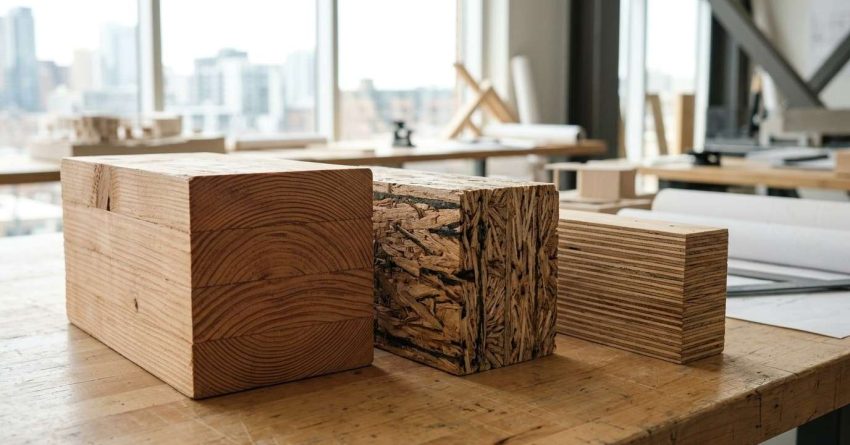
Laminated Veneer Lumber, or LVL, is made by bonding thin wood veneers together with their grain running parallel to the length of the beam. This parallel-grain construction is what gives LVL its exceptional bending strength and stiffness, making it one of the most widely used engineered lumber products in residential construction.
LVL is manufactured in standard thicknesses — typically 1.75 inches — and can be combined side by side to create beams of varying widths. This flexibility allows builders and engineers to specify exactly the load capacity needed for a given application without over-engineering the structure.
Because LVL is dimensionally stable and predictable, it is the go-to choice when precise load calculations are required. It is also relatively easy to cut and fasten on-site, which makes it practical for a wide range of framing applications.
Common Uses for LVL Beams in Residential Construction
LVL beams appear in several critical locations throughout a typical home. They are commonly used as headers above windows and doors, where they carry the load of the wall above the opening. They serve as ridge beams in roof systems, carrying the weight of rafters on both sides. They are also used as floor beams and girders in multi-story construction, where they span long distances between support points.
LVL beams are frequently specified during structural renovations and additions, making them a common material choice in home remodeling projects that require load-bearing upgrades. When a homeowner removes a load-bearing wall to create an open floor plan, an LVL beam is almost always the structural solution that makes it possible.
PSL (Parallel Strand Lumber) — Heavy-Load Performance
Parallel Strand Lumber, or PSL, is manufactured by bonding long strands of wood fiber — typically from Douglas fir or southern yellow pine — in a parallel orientation using a structural adhesive, then pressing and curing them under heat. The result is an extremely dense, high-strength product that excels in applications where heavy loads must be carried over long spans.
PSL has a higher load capacity per unit of cross-section than most other engineered lumber types, which makes it the preferred choice for columns, posts, and large beams where space is limited but structural demand is high. Its dense composition also gives it excellent resistance to moisture and decay, making it suitable for exposed or semi-exposed applications.
One visible characteristic of PSL is its distinctive appearance — the parallel strands create a textured, layered look that some architects and designers intentionally leave exposed as a design feature.
When to Choose PSL Over Other Engineered Options
PSL is the right choice when the structural load is high, the span is long, or the beam cross-section needs to stay compact. It is commonly specified for main carrying beams in floor systems, ridge beams in large roof structures, and columns supporting significant vertical loads.
PSL’s exceptional load capacity makes it a preferred structural choice in deck construction projects where posts and beams must support significant weight over time. It is also used in commercial construction for columns and transfer beams where steel would otherwise be required.
If your project involves a long clear span — such as an open-plan living area or a wide garage — and the engineer needs maximum strength in a manageable beam size, PSL is typically the specification.
Glulam (Glued Laminated Timber) — Structural Beauty
Glued Laminated Timber, or Glulam, is made by bonding multiple layers of dimension lumber — typically 2×4 or 2×6 boards — together with structural adhesive, with the grain of each layer running parallel to the length of the beam. Unlike LVL, which uses thin veneers, Glulam uses full-thickness lumber boards, giving it a distinctive layered appearance that is often left visible as an architectural feature.
Glulam can be manufactured in straight or curved forms, which makes it uniquely versatile among engineered lumber types. Curved Glulam beams are used in arched roofs, vaulted ceilings, and dramatic architectural spans where both structural performance and visual impact are priorities.
Glulam is available in a wide range of species, including Douglas fir, southern yellow pine, and western species blends, and can be finished to match interior design requirements. It is one of the few structural materials that genuinely improves the aesthetic of a space rather than being hidden inside walls and ceilings.
Glulam Applications in Residential and Commercial Projects
In residential construction, Glulam beams are commonly used for exposed ridge beams in cathedral ceilings, porch beams, floor beams in timber-frame homes, and decorative structural elements in great rooms and open living spaces. Their ability to span long distances without intermediate support makes them ideal for open-plan designs.
Glulam beams are increasingly specified in structural remodeling work where both load performance and architectural appearance are priorities for the finished space. In commercial construction, Glulam appears in churches, sports facilities, retail spaces, and public buildings where long spans and exposed timber aesthetics are design goals.
Comparing LVL, PSL, and Glulam Side by Side
Each engineered lumber type has a distinct performance profile and best-use application. The table below summarizes the key differences to help you and your contractor make an informed decision.
| Feature | LVL | PSL | Glulam |
| Primary material | Thin wood veneers | Long wood strands | Dimension lumber boards |
| Grain orientation | Parallel | Parallel | Parallel |
| Strength profile | High bending strength | Highest load capacity | High bending and shear |
| Typical sizes | 1.75″ thick, variable depth | Variable, compact sections | Wide range, custom sizes |
| Curved forms available | No | No | Yes |
| Exposed finish quality | Low — typically hidden | Medium — can be exposed | High — designed to be seen |
| Best applications | Headers, floor beams, ridge beams | Columns, heavy beams, long spans | Exposed beams, arched structures |
| Moisture resistance | Good | Excellent | Good (species-dependent) |
| Cost relative to solid wood | Moderate premium | Higher premium | Moderate to high premium |
The right choice depends on your specific structural requirements, span length, load conditions, and whether the beam will be visible in the finished space. A structural engineer or experienced contractor can specify the correct product for your project based on load calculations and building code requirements.
How Engineered Lumber Supports Home Renovation Projects
For homeowners planning renovations, engineered lumber is most relevant when the project involves structural changes — removing walls, adding openings, extending spans, or building additions. These are the moments when the right beam specification directly affects both safety and the long-term performance of the structure.
Understanding the three main types — LVL, PSL, and Glulam — helps you have more informed conversations with your contractor and understand why certain materials are specified over others. It also helps you evaluate quotes more accurately, since beam specifications significantly affect material costs.
Selecting the right engineered lumber type is only part of the equation — getting professional carpentry help ensures proper installation, code compliance, and long-term structural integrity. Engineered lumber must be installed according to manufacturer specifications and local building codes, and improper installation can compromise the structural performance these products are engineered to deliver.
For smaller renovation tasks that involve engineered lumber components, handyman support can handle installation, repairs, and finishing work without requiring a full contractor engagement. Whether your project is a major structural renovation or a targeted repair, having the right professional for the scope of work protects both your investment and your property.
Conclusion
Engineered lumber — LVL, PSL, and Glulam — gives builders and homeowners reliable, high-performance structural options that solid wood simply cannot match for consistency and load predictability.
Each type serves a distinct purpose: LVL for versatile framing, PSL for heavy-load applications, and Glulam where structural performance meets architectural visibility.
At Mr. Local Services, we connect you with skilled carpentry and remodeling professionals who understand engineered lumber specifications and deliver installations that meet code, perform as designed, and stand the test of time.
Frequently Asked Questions
What is the difference between LVL and Glulam?
LVL is made from thin wood veneers bonded in parallel and is typically hidden inside walls and ceilings. Glulam is made from full-thickness lumber boards and is designed to be left exposed as an architectural feature. LVL prioritizes structural efficiency; Glulam balances structure with aesthetics.
Is engineered lumber stronger than solid wood?
In most structural applications, yes. Engineered lumber products like LVL and PSL have consistent, predictable load ratings that exceed what solid wood can reliably deliver, because the manufacturing process eliminates the knots and grain irregularities that create weak points in natural timber.
Can engineered lumber be used outdoors?
Some engineered lumber products, particularly PSL, have good moisture resistance and can be used in semi-exposed applications. However, most engineered lumber is designed for protected interior use. Always confirm the product’s exposure rating and consult your contractor before specifying engineered lumber for outdoor or high-moisture environments.
How long does engineered lumber last?
When properly installed and protected from prolonged moisture exposure, engineered lumber can last the lifetime of the structure — 50 years or more. Its dimensional stability means it is less prone to the warping, twisting, and shrinkage that can shorten the effective life of solid wood framing.
Do I need a structural engineer to specify engineered lumber?
For any load-bearing application — beams, headers, columns, or ridge beams — a structural engineer or licensed contractor should specify the correct product, size, and installation method. Engineered lumber carries specific load ratings, and using the wrong product or size for a given application can create serious structural risks.
What does Glulam cost compared to solid wood beams?
Glulam typically costs more than standard solid wood beams of comparable size, but the premium reflects its superior performance, dimensional stability, and finished appearance. For exposed architectural applications, Glulam often eliminates the need for additional finishing materials, which can offset part of the cost difference.
Can engineered lumber be cut on-site?
Yes. LVL, PSL, and Glulam can all be cut to length on-site using standard woodworking tools. However, cuts must follow manufacturer guidelines — particularly for notching and drilling — to avoid compromising the structural integrity of the beam. Always consult the product’s installation specifications before making any field modifications.