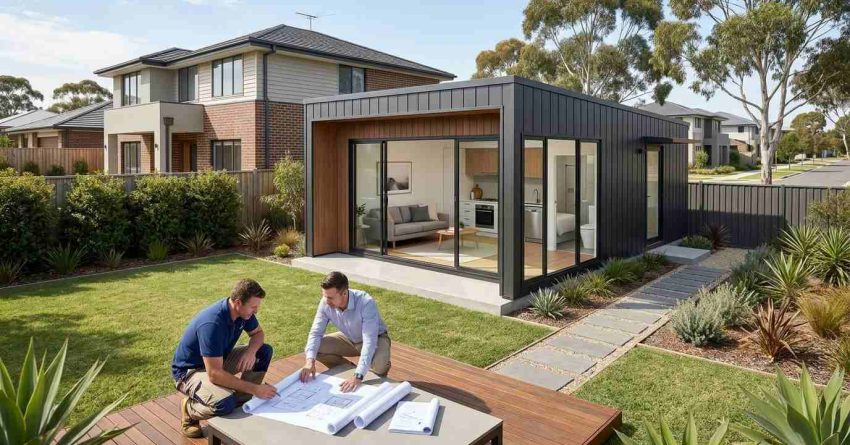
A prefab ADU is a factory-built accessory dwelling unit that is manufactured off-site and installed on your property as a fully functional, self-contained living space. These structures are used as rental units, guest houses, in-law suites, and home offices across the USA, and they are one of the most cost-effective ways to add livable square footage to a residential property.
Adding a prefab ADU to your property can increase rental income, improve property value, and provide flexible housing for family members or tenants.
This guide covers prefab ADU types, costs, site requirements, permits, and how to move forward with your project from start to finish.
What Is a Prefab ADU?
A prefab ADU — short for prefabricated accessory dwelling unit — is a secondary housing structure built in a controlled factory environment and then transported to your property for installation. Unlike a traditional ADU that is constructed entirely on-site, a prefab unit arrives largely complete, reducing build time and on-site labor significantly.
Prefab ADUs are classified as accessory dwelling units because they are secondary to the primary residence on the same lot. They must meet local building codes, zoning requirements, and utility connection standards just like any other permanent structure.
Prefab ADUs are one of the fastest-growing options in accessory dwelling unit construction — our ADU planning guide covers every ADU type, zoning consideration, and planning step you need before committing to a build.
How Prefab ADUs Differ from Site-Built ADUs
A site-built ADU is constructed entirely on your property using traditional framing, roofing, and finishing methods. A prefab ADU is built in a factory under controlled conditions and delivered as a complete or near-complete module.
The key differences are timeline and cost predictability. Site-built ADUs typically take six to twelve months to complete. Prefab ADUs can be installed in as little as one to three months from delivery, with fewer weather delays and more consistent quality control throughout the build process.
Common Prefab ADU Types
Prefab ADUs come in several configurations to suit different property sizes and budgets. The most common types include modular ADUs, panelized ADUs, and manufactured ADUs.
Modular ADUs are built in sections at a factory and assembled on-site. Panelized ADUs arrive as pre-built wall, floor, and roof panels that are assembled by a crew. Manufactured ADUs are fully built units transported on a chassis and placed on a prepared foundation.
Prefab ADUs share significant design and construction overlap with the tiny home movement — if you are exploring compact living structures, our tiny home construction resource explains how these builds compare in scope, cost, and livability.
Benefits of Choosing a Prefab ADU
Prefab ADUs offer a practical combination of speed, cost control, and quality that makes them an attractive option for homeowners, landlords, and property managers looking to add housing capacity without the unpredictability of traditional construction.
Cost and Timeline Advantages
Factory construction reduces material waste and labor costs compared to site-built alternatives. Because the build environment is controlled, there are fewer delays caused by weather, subcontractor scheduling, or material shortages.
Most prefab ADU projects move from permit approval to occupancy in two to four months, compared to six to twelve months for a comparable site-built unit. This faster timeline means lower carrying costs and earlier rental income for property owners.
Quality Control and Consistency
Factory-built units are constructed under consistent conditions with standardized processes and regular inspections at each stage of production. This reduces the variability that often affects site-built construction, where quality can depend heavily on individual subcontractor performance and weather conditions.
Prefab ADUs also undergo structural testing before they leave the factory, giving homeowners greater confidence in the finished product before it ever arrives on their property.
Prefab ADU Size Options and Floor Plans
Prefab ADUs are available in a wide range of sizes, typically starting at around 200 square feet for studio configurations and scaling up to 1,200 square feet or more for two-bedroom units. The right size depends on your lot dimensions, local zoning limits, intended use, and budget.
Common floor plan configurations include studio units, one-bedroom units, and two-bedroom units. Studios and one-bedroom units are the most popular for rental income and in-law suite applications. Two-bedroom units are better suited for long-term family housing or higher-rent markets.
Choosing the Right Size for Your Property
Before selecting a floor plan, confirm your local zoning code’s maximum ADU square footage allowance. Many jurisdictions in the USA cap ADU size at 850 to 1,200 square feet, though some states have removed size restrictions entirely for properties meeting specific criteria.
Lot coverage limits — the percentage of your lot that can be covered by structures — also affect how large your prefab ADU can be. A licensed contractor or permit specialist can review your property’s specific constraints before you commit to a floor plan.
Site Preparation and Installation Requirements
Installing a prefab ADU requires more than placing a unit on your property. The site must be properly graded, a foundation must be prepared, and utility connections must be planned before the unit arrives.
Site preparation for a prefab ADU often involves grading, drainage work, and structural modifications to the existing property — our home remodeling services team can assess your site and handle the preparation work before your unit arrives.
Foundation Types for Prefab ADUs
The three most common foundation types for prefab ADUs are concrete slab, pier and beam, and crawl space foundations. Concrete slab is the most common choice for modular and manufactured ADUs because it provides a stable, level surface and is cost-effective in most soil conditions.
Pier and beam foundations are used on sloped lots or in areas with expansive soils. Crawl space foundations provide access to plumbing and electrical systems beneath the unit, which can simplify future maintenance.
Certain foundation types require custom framing and structural carpentry to properly anchor a prefab unit — our structural carpentry work professionals ensure your foundation connection meets local building code requirements.
Utility Connections and Infrastructure
A prefab ADU requires connections to water, sewer or septic, and electrical systems. In most cases, these connections run from the main home’s existing infrastructure to the new unit, though capacity upgrades may be required depending on the age and condition of your current systems.
Connecting a prefab ADU to your property’s water supply and drainage system requires licensed plumbing work — our plumbing connection services team handles all hookups, inspections, and code compliance for new ADU installations.
Running a dedicated electrical circuit to your prefab ADU and upgrading your main panel to handle the added load is a job for a licensed electrician — our electrical panel upgrades professionals manage the full connection from panel to unit.
Permits and Zoning for Prefab ADUs in the USA
Every prefab ADU installation in the USA requires permits. The specific permits required vary by state and municipality, but most projects require a building permit, a grading or site permit, and separate permits for plumbing and electrical work.
Zoning laws determine whether an ADU is allowed on your property at all. Most single-family residential zones in the USA now permit ADUs following state-level legislation in California, Oregon, Washington, and other states that have expanded ADU rights. However, setback requirements, height limits, and owner-occupancy rules still vary significantly by jurisdiction.
While permits are handled by licensed contractors, smaller compliance tasks and property modifications during the approval process can be managed efficiently — our local handyman support team helps homeowners stay on schedule during the permitting phase.
How Local Regulations Affect Your Project
Local regulations can affect your prefab ADU project in several ways. Some jurisdictions require architectural drawings stamped by a licensed engineer. Others require a pre-application meeting with the planning department before a permit can be submitted.
Processing times for ADU permits range from two weeks in streamlined jurisdictions to six months or more in areas with high permit volume. Understanding your local timeline before you order your prefab unit is essential to avoid costly delays between delivery and installation.
If you need detailed guidance on the permitting process, our ADU permit process walks through every step from application to final inspection.
Prefab ADU Costs: What to Budget in 2025–2026
The total cost of a prefab ADU project in the USA typically ranges from $80,000 to $250,000, depending on unit size, foundation type, site conditions, utility connection complexity, and local labor rates. The unit itself — the factory-built structure — generally represents 40 to 60 percent of the total project cost.
Understanding the full cost of a prefab ADU means accounting for both the unit price and all site work involved — our ADU remodeling costs breakdown helps homeowners plan a realistic budget before the first shovel hits the ground.
Hidden Costs Homeowners Often Overlook
Several cost categories are frequently excluded from base prefab ADU quotes and catch homeowners off guard during the project.
Permit fees vary widely by jurisdiction but typically range from $3,000 to $15,000 for a complete ADU permit package. Site preparation — including grading, drainage, and foundation work — can add $15,000 to $40,000 depending on lot conditions. Utility connection costs depend on the distance from the main home and the capacity of existing systems.
Interior finishing — including drywall, ceiling installation, and insulation — is frequently excluded from base prefab ADU quotes, adding significant cost after delivery — our interior finishing work team provides transparent estimates so nothing catches you off guard.
Flooring is another line item often missing from prefab ADU base packages — our flooring installation services team can match your ADU interior to your main home’s aesthetic while staying within your renovation budget.
Prefab ADU vs. Traditional ADU Construction
Prefab ADUs and traditional site-built ADUs both result in a permanent, code-compliant accessory dwelling unit, but they differ significantly in how they are built, how long they take, and how predictable the final cost is.
Prefab ADUs offer faster timelines, more predictable pricing, and less on-site disruption. Traditional ADUs offer greater design flexibility and may be better suited to complex lots or highly customized floor plans. For most homeowners working with a standard residential lot and a defined budget, prefab construction delivers better value and a more manageable project experience.
Homeowners weighing prefab against site-built construction will find a detailed side-by-side breakdown of all ADU types, timelines, and cost structures in our traditional ADU options guide, which covers every build method available in the USA.
How to Get Started with a Prefab ADU
Starting a prefab ADU project involves four core steps: confirming zoning eligibility, selecting a unit and floor plan, completing site preparation, and managing permits and installation.
Begin by checking your local zoning code to confirm ADUs are permitted on your property and to identify any size, setback, or design restrictions. Next, select a prefab ADU manufacturer or supplier and choose a floor plan that fits your lot and budget. Once your unit is ordered, begin the permit application process — most manufacturers provide the documentation required for permit submission.
Site preparation and utility connections should be completed before your unit arrives so installation can proceed without delays. Taking the first step toward a prefab ADU is straightforward when you have the right team — our prefab ADU installation professionals guide you from site assessment through final inspection, handling every phase of the project.
Conclusion
Prefab ADUs offer homeowners, landlords, and property managers a faster, more cost-predictable path to adding livable space than traditional construction methods. Understanding the full scope of a prefab ADU project — from foundation type and utility connections to permits and interior finishing — is the key to a successful outcome.
Planning ahead for hidden costs, local zoning requirements, and site preparation needs prevents delays and budget overruns that derail many ADU projects before they reach completion.
At Mr. Local Services, our team handles every phase of your prefab ADU project — from site preparation and utility connections to interior finishing and final inspection — so you can move forward with confidence and get your unit occupied on schedule.
Frequently Asked Questions
How long does it take to install a prefab ADU?
Most prefab ADU projects move from permit approval to occupancy in two to four months. Site preparation and utility connections are completed before the unit arrives, and on-site installation typically takes one to two weeks once the foundation is ready.
Do prefab ADUs require a permit?
Yes. Every prefab ADU installation in the USA requires a building permit, and most projects also require separate permits for plumbing and electrical work. Permit requirements and processing times vary by jurisdiction, so confirming local requirements early is essential.
Can a prefab ADU be used as a rental unit?
Yes. Prefab ADUs are commonly used as long-term rental units, short-term rentals, and in-law suites. Local zoning laws and HOA rules may restrict rental use in some areas, so confirming your jurisdiction’s owner-occupancy and rental regulations before purchasing a unit is important.
What is the average cost of a prefab ADU?
The total cost of a prefab ADU project in the USA typically ranges from $80,000 to $250,000. The factory-built unit itself represents 40 to 60 percent of the total cost, with the remainder covering site preparation, foundation, utility connections, permits, and interior finishing.
Are prefab ADUs permanent structures?
Most prefab ADUs are designed and permitted as permanent structures. Modular and panelized ADUs are placed on permanent foundations and treated the same as site-built construction under most building codes. Manufactured ADUs may be classified differently depending on local regulations.
What utilities does a prefab ADU need?
A prefab ADU requires connections to water, sewer or septic, and electrical systems. Some units also include natural gas connections for heating or cooking. All utility connections must be installed by licensed professionals and inspected before the unit can be occupied.
Can I place a prefab ADU on any property?
Not every property is eligible for an ADU. Zoning laws, lot size minimums, setback requirements, and utility capacity all affect whether a prefab ADU can be installed on a specific property. Checking your local zoning code and consulting with a licensed contractor before ordering a unit is the recommended first step.