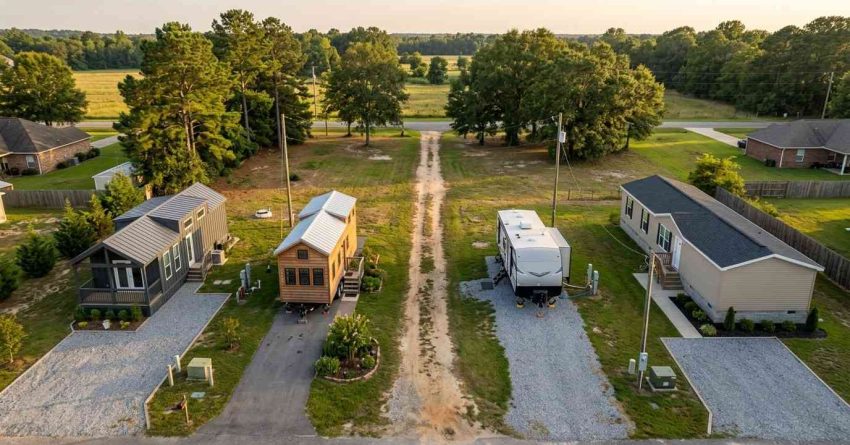
Choosing between a park model, a tiny house on wheels, an RV, and a manufactured home comes down to four factors: how you plan to use it, where you want to place it, what you can afford upfront, and how much ongoing maintenance you are prepared to handle. Each housing type looks similar from the outside but operates under completely different legal classifications, building codes, and ownership rules — and picking the wrong one can cost you thousands in relocation fees, permit violations, or unexpected repairs.
This comparison matters right now because alternative housing demand in the USA has surged, and buyers are making expensive decisions without a clear side-by-side breakdown.
This guide covers what each type actually is, how they compare on cost and mobility, which one fits your lifestyle, and what maintenance each one requires.
What Each Housing Type Actually Is
Before comparing costs or zoning rules, it helps to understand exactly what each housing type is — because the legal definitions determine everything from financing options to where you can legally park or place your home.
Park Model Homes
A park model home is a factory-built recreational unit designed for seasonal or permanent use, built to ANSI A119.5 standards, and measuring no more than 400 square feet. Park models are classified as recreational vehicles by the U.S. Department of Housing and Urban Development but are built with residential-grade materials, including full kitchens, bathrooms, and sleeping areas. They are designed to be placed in RV parks, campgrounds, or resort communities and are typically connected to permanent utility hookups. Unlike a standard RV, a park model is not designed for frequent road travel — it is moved once or twice at most and then treated as a semi-permanent structure.
Tiny Houses on Wheels (THOWs)
A tiny house on wheels is a custom or factory-built residential structure constructed on a trailer chassis, typically ranging from 100 to 400 square feet. THOWs are built to residential construction standards — not RV standards — which means they use standard insulation, framing, roofing materials, and fixtures. They are classified differently in every state, with some treating them as RVs, others as manufactured homes, and a growing number creating dedicated THOW classifications. The key distinction is intent: a THOW is designed for full-time residential living, not recreation. If you are exploring the THOW category in depth, our complete guide to tiny home options covers everything from construction standards and builder selection to placement rules and utility hookups across the USA.
Recreational Vehicles (RVs)
A recreational vehicle is a motorized or towable unit built to NFPA 1192 or ANSI A119.2 standards and classified primarily as a vehicle, not a dwelling. RVs include motorhomes, fifth wheels, travel trailers, and camper vans. They are designed for mobility and temporary occupancy, not permanent residence. RVs depreciate like vehicles, are financed like vehicles, and are taxed like vehicles in most states. While many Americans live in RVs full-time, doing so legally requires navigating a patchwork of state and local regulations that often prohibit permanent RV residency in standard residential zones.
Manufactured Homes
A manufactured home is a factory-built dwelling constructed entirely in a controlled environment and transported to a site on a permanent chassis. All manufactured homes built after June 15, 1976 must comply with the HUD Code — the federal building standard that governs structural integrity, fire resistance, energy efficiency, and installation. Manufactured homes range from single-wide units (roughly 600–1,300 square feet) to triple-wide configurations exceeding 2,500 square feet. Once installed, a manufactured home can be placed on a rented lot in a manufactured home community or on privately owned land, and it can be titled as real property if permanently affixed to a foundation.
Key Differences at a Glance
Comparison Table — Size, Cost, Mobility, and Zoning
| Feature | Park Model | THOW | RV | Manufactured Home |
| Typical size | Up to 400 sq ft | 100–400 sq ft | 150–400 sq ft | 600–2,500+ sq ft |
| Building standard | ANSI A119.5 | Varies by state | NFPA 1192 / ANSI A119.2 | HUD Code |
| Legal classification | Recreational vehicle | Varies (RV / dwelling) | Vehicle | HUD-regulated dwelling |
| Mobility | Low (semi-permanent) | Medium (road-capable) | High (designed for travel) | Very low (site-set) |
| Typical purchase cost | $50,000–$150,000 | $30,000–$120,000 | $20,000–$500,000+ | $60,000–$160,000+ |
| Financing options | RV loans, personal loans | Personal loans, RV loans | RV loans, auto loans | Chattel loans, mortgages |
| Zoning flexibility | RV parks, resorts | Limited, varies by state | Campgrounds, RV parks | Manufactured home communities, private land |
| Depreciation | Moderate | Low to moderate | High | Low (on owned land) |

Mobility and Placement — Where Can You Put Each One?
Permanent vs. Semi-Permanent vs. Fully Mobile
RVs offer the highest mobility — they are built to move frequently and can be driven or towed to any campground, RV park, or legal overnight location. Park models sit in the middle: they can be transported, but the process requires a professional transport company, permits, and significant setup time, so most owners move them once and leave them in place. THOWs are road-legal but are not designed for daily driving — most THOW owners move their home only when relocating permanently. Manufactured homes are the least mobile of the four. Once a manufactured home is installed on a site, moving it is expensive (typically $5,000–$15,000 or more depending on distance and size) and can damage the structure if not handled by a licensed transporter.
Zoning Laws and Land Requirements by Type
Zoning is where most buyers run into problems. RVs and park models are generally permitted in designated RV parks, campgrounds, and resort communities — but not in standard residential zones. THOWs face the most complex regulatory landscape: some counties allow them on agricultural land, others require a primary dwelling to be present on the property, and a growing number of municipalities have created specific THOW ordinances. Manufactured homes are the most broadly accepted of the four in terms of residential zoning — they are permitted in manufactured home communities and, in many states, on single-family residential lots when they meet local appearance standards. Zoning rules vary significantly by state and county, and our tiny home placement guide breaks down the specific land requirements, permit processes, and approved zones for each housing type so you can plan your setup with confidence.
Cost to Buy, Build, and Maintain
Upfront Purchase and Build Costs
Park models typically range from $50,000 to $150,000 depending on size, finish level, and manufacturer. THOWs vary widely — a basic shell from a production builder starts around $30,000, while a fully custom THOW with high-end finishes can reach $120,000 or more. RVs have the broadest price range of any category: a used travel trailer can be found for under $20,000, while a luxury Class A motorhome can exceed $500,000. Manufactured homes are generally the most cost-effective option for buyers who need more space — a new single-wide starts around $60,000 to $80,000, and a double-wide typically runs $100,000 to $160,000 before site preparation and installation costs.
Ongoing Maintenance and Utility Costs
Maintenance costs differ significantly across the four types. RVs require the most frequent mechanical attention — engine systems, slide-out mechanisms, roof seals, and holding tanks all need regular service. Park models and THOWs share similar maintenance profiles: roof inspections, HVAC servicing, plumbing checks, and exterior weatherproofing are the primary recurring needs. Manufactured homes require the most comprehensive maintenance program of the four because they function as full residential dwellings — HVAC systems, roofing, skirting, pier systems, plumbing, and electrical all need periodic inspection and upkeep. Keeping any small-footprint home in good condition requires consistent upkeep, and our tiny home maintenance resource outlines the most common service needs, seasonal tasks, and repair priorities for park models, THOWs, and manufactured homes alike.

Which Housing Type Is Right for You?
Best for Full-Time Living
Manufactured homes are the strongest choice for full-time residential living. They offer the most square footage, the broadest zoning acceptance, the most financing options, and the closest approximation to a traditional home ownership experience. THOWs are a viable full-time option for buyers who prioritize minimalism and mobility over space, but the regulatory complexity and limited financing options make them a more challenging path. Park models work well for full-time living in resort or RV park communities. RVs are the least practical for full-time living due to depreciation, mechanical maintenance demands, and the legal restrictions many jurisdictions place on permanent RV residency.
Best for Minimalist or Off-Grid Lifestyles
THOWs and park models are the strongest fit for buyers pursuing minimalist or off-grid living. THOWs can be outfitted with solar panels, composting toilets, rainwater collection systems, and propane appliances to operate entirely off-grid. Park models can also be configured for off-grid use but are more commonly connected to campground utilities. RVs are well-suited for nomadic off-grid living but require more mechanical knowledge to maintain. Manufactured homes are rarely used in off-grid configurations due to their size and utility infrastructure requirements.
Best for Investment or Rental Income
Park models have become a popular short-term rental investment, particularly in resort communities and glamping operations, where nightly rates can generate strong returns relative to purchase price. Manufactured homes on owned land offer stable long-term rental income with lower maintenance costs than traditional single-family homes. THOWs are increasingly used as accessory dwelling units (ADUs) or short-term rentals where local regulations permit. RVs can generate rental income through peer-to-peer platforms but depreciate quickly and require active mechanical management. Investors considering any of these four housing types for rental income will find detailed guidance on returns, regulations, and property management considerations in our tiny home investment guide.
Maintenance and Upkeep Across All Four Types
Every housing type in this comparison requires a consistent maintenance schedule to protect its value, ensure safety, and avoid costly emergency repairs. The specific service needs vary by type, but the categories are consistent: roofing and weatherproofing, HVAC and ventilation, plumbing and water systems, electrical systems, and structural integrity checks.
RVs require the most frequent attention to mechanical systems — roof seals, slide-out tracks, and holding tank valves should be inspected at least twice a year. Park models and THOWs need annual roof inspections, HVAC filter changes, and exterior caulking checks. Manufactured homes require the full range of residential maintenance services, including skirting inspection, pier and tie-down checks, and regular HVAC servicing to meet HUD installation standards.
Whether you own a park model, a THOW, an RV, or a manufactured home, routine service keeps your property safe and functional year-round — our tiny home upkeep section connects you with skilled professionals who handle everything from HVAC and plumbing to roofing and electrical across all four housing types.
Conclusion
Park models, THOWs, RVs, and manufactured homes each serve a distinct purpose — separated by legal classification, building standards, mobility, and long-term cost structure.
The right choice depends on how you plan to use the space, where you intend to place it, and what level of maintenance you are prepared to manage over time.
Mr. Local Services connects homeowners and property managers with skilled professionals who handle maintenance, repair, and upkeep across all four housing types — contact us today to keep your property safe, functional, and well-maintained year-round.
Frequently Asked Questions
What is the main difference between a park model and a manufactured home?
A park model is classified as a recreational vehicle, measures no more than 400 square feet, and is built to ANSI A119.5 standards. A manufactured home is a HUD-regulated dwelling, can exceed 2,500 square feet, and is designed for permanent residential use on a fixed site.
Can you live in a THOW full-time legally in the USA?
Full-time THOW living is legal in some counties and states but prohibited in others. Regulations vary widely — some jurisdictions allow THOWs on agricultural land or as ADUs, while others require a primary dwelling on the property. Always verify local zoning ordinances before purchasing.
Do RVs depreciate faster than manufactured homes?
Yes. RVs depreciate similarly to vehicles and can lose 20 to 30 percent of their value within the first few years of ownership. Manufactured homes on owned land tend to hold or appreciate in value over time, particularly when the land is included in the purchase.
Which housing type is easiest to finance?
Manufactured homes offer the broadest financing options, including FHA Title I and Title II loans, conventional mortgages when permanently affixed to land, and chattel loans for homes on leased lots. RVs are financed through standard RV or auto loans. THOWs and park models typically require personal loans or specialty RV financing.
What maintenance does a manufactured home require that an RV does not?
Manufactured homes require residential-grade maintenance including skirting inspection, pier and tie-down system checks, roof shingle or metal roof servicing, and full HVAC system maintenance. RVs require mechanical maintenance focused on engine systems, slide-out mechanisms, roof seals, and holding tanks — categories that do not apply to site-set manufactured homes.