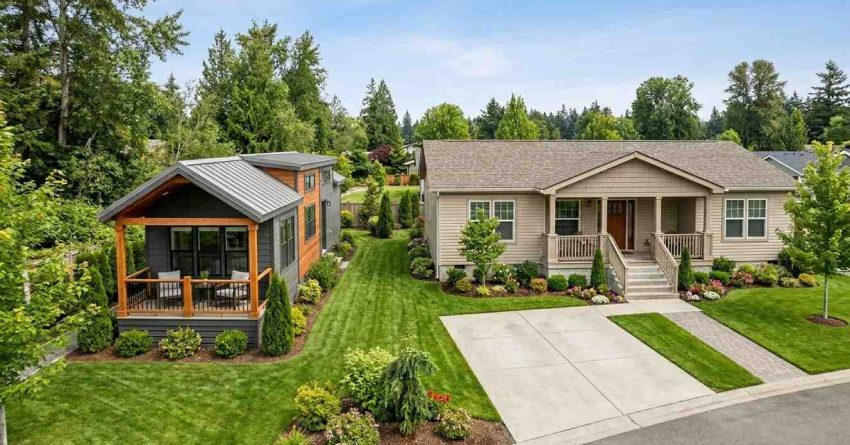
Park model homes and manufactured homes are both factory-built, affordable housing options — but they serve very different purposes, follow different regulations, and suit different lifestyles. Choosing between them means understanding how each is classified, what each costs, and where each can legally be placed.
This decision affects your daily life, your financing options, and your long-term property value. Getting it wrong can mean zoning violations, financing problems, or a home that simply does not fit how you live.
This guide breaks down both housing types clearly, compares them across the factors that matter most, and helps you identify which option fits your situation.
What Is a Park Model Home?
A park model home is a factory-built recreational unit designed for seasonal or part-time living. The U.S. Department of Housing and Urban Development (HUD) and the American National Standards Institute (ANSI) classify park models under the ANSI A119.5 standard, which limits them to a maximum of 400 square feet of living space. Because of this size restriction, park models are legally classified as recreational vehicles (RVs) in most states, not as permanent residences.
Park models are built on a permanent chassis with a hitch, which means they can be transported — though most owners place them in one location and rarely move them. They are designed to feel like a small home, often featuring full kitchens, sleeping lofts, covered porches, and residential-style finishes.
Size and Classification Standards
The 400-square-foot limit is the defining legal boundary for park model classification. Any factory-built unit exceeding that threshold falls into a different regulatory category. Within that footprint, manufacturers use lofts, slide-outs, and efficient layouts to maximize usable space. Park models are regulated as RVs at the federal level, which affects how they are titled, taxed, and financed.
Where Park Models Are Typically Used
Park models are most commonly placed in RV parks, campgrounds, resort communities, and seasonal recreational areas. Some states allow them in manufactured home communities, but zoning rules vary significantly by county and municipality. They are popular in retirement resort communities, lakefront properties, and mountain recreation areas where seasonal occupancy is the norm.
What Is a Manufactured Home?
A manufactured home is a factory-built residential structure constructed entirely in a controlled plant environment and then transported to a permanent or semi-permanent site. Unlike park models, manufactured homes are regulated under the federal HUD Manufactured Home Construction and Safety Standards — commonly called the HUD Code — which has governed their construction since June 15, 1976. Any factory-built home built to this standard is legally a manufactured home, regardless of size.
Manufactured homes range from compact single-section units to large multi-section homes exceeding 2,000 square feet. They are designed and legally classified as permanent or primary residences, which distinguishes them fundamentally from park models.
HUD Code Standards and Construction
The HUD Code sets mandatory standards for structural design, fire resistance, energy efficiency, plumbing, electrical systems, and thermal performance. Every manufactured home must display a red HUD certification label on its exterior, confirming it was built to federal standards. This label is critical for financing, insurance, and resale. Homes built before 1976 are called mobile homes and do not carry HUD certification — a distinction that significantly affects their marketability and financing eligibility.
Placement and Land Requirements
Manufactured homes can be placed on private land owned by the buyer, in manufactured home communities on leased lots, or on land purchased alongside the home. When a manufactured home is permanently affixed to a foundation and titled with the land, it may qualify as real property — which opens access to conventional mortgage financing. Understanding how land ownership and placement affect long-term value is explored in depth in our custom home investment analysis, which covers how site decisions shape financial outcomes across housing types.

Park Model vs Manufactured Home — Key Differences
The most important differences between park models and manufactured homes come down to size, legal classification, cost, and where each can be placed. These are not minor distinctions — they determine what you can do with the home, how you can finance it, and how it fits into your daily life.
Size, Square Footage, and Layout
Park models are capped at 400 square feet by federal classification standards. Manufactured homes have no upper size limit under the HUD Code and commonly range from 600 to over 2,500 square feet. A single-section manufactured home typically starts around 600–900 square feet, while double-section and triple-section homes offer layouts comparable to site-built houses. If square footage and full-time livability are priorities, manufactured homes offer significantly more flexibility.
Cost Comparison
Park models generally cost between $30,000 and $100,000 depending on size, finishes, and manufacturer. Manufactured homes range more widely — from approximately $50,000 for a basic single-section unit to $200,000 or more for a large multi-section home with upgraded features. Land costs, site preparation, utility hookups, and foundation work add to the total investment for both types. Park model lot rent in resort communities typically runs $400–$1,200 per month, while manufactured home community lot rent averages $300–$900 per month nationally.
Zoning, Permits, and Legal Classification
This is where the two housing types diverge most sharply. Park models are classified as RVs and are restricted to zones that permit RV or recreational use. They cannot legally be placed in most residential zones. Manufactured homes, by contrast, are classified as housing and are permitted in residential zones that specifically allow manufactured housing — which varies by state and municipality but is far broader than RV zoning. Before purchasing either type, verifying local zoning ordinances is essential. Zoning violations can result in forced removal, fines, and loss of investment.
Which Option Fits Your Lifestyle?
The right choice depends almost entirely on how you plan to use the home and where you plan to place it. Both housing types serve legitimate needs — they simply serve different ones.
Best Fit for Seasonal or Recreational Use
Park models are purpose-built for seasonal living. If you want a comfortable, home-like retreat at a lake, mountain, or resort community — and you plan to use it part of the year rather than full-time — a park model delivers that experience at a lower entry cost. The smaller footprint, RV classification, and resort community placement make park models ideal for vacation property buyers, retirees with a primary residence elsewhere, and recreational property investors.
Best Fit for Full-Time Primary Residence
Manufactured homes are the clear choice for full-time, year-round living. They offer the square footage, HUD-code construction standards, and legal residential classification needed to function as a primary home. They can be financed through FHA Title I and Title II loans, VA loans, and conventional mortgages when permanently affixed to land. For buyers seeking affordable homeownership with the features and durability of a permanent residence, manufactured homes provide a practical, well-regulated path.
Financing, Insurance, and Resale Considerations
Financing a park model follows RV lending rules, not mortgage rules. Most buyers use personal property loans or RV loans, which typically carry higher interest rates and shorter terms than home mortgages — commonly 10–20 year terms at rates ranging from 6% to 12% depending on credit profile and lender. Park models do not qualify for FHA or VA home loans because they are not classified as real property.
Manufactured homes have broader financing options. When titled as personal property, they qualify for FHA Title I loans. When permanently affixed to owned land and titled as real property, they may qualify for FHA Title II, VA, USDA, and conventional mortgage products — significantly expanding buyer access and reducing borrowing costs.
Insurance for park models is typically written as RV insurance or specialty recreational property coverage. Manufactured home insurance is written as homeowner’s insurance, with coverage options that parallel site-built home policies. Resale value for both types depends heavily on location, condition, and land ownership structure. Park models in desirable resort communities can hold value well, but their RV classification limits the buyer pool. Manufactured homes on owned land with real property titles have stronger resale trajectories and broader market appeal. Buyers weighing long-term financial commitment will find our home investment analysis useful for understanding how purchase structure, land ownership, and resale trajectory differ across alternative housing categories.

Maintenance and Upkeep for Each Home Type
Both park models and manufactured homes require regular maintenance to protect their value and ensure safe, comfortable living. Because both are factory-built on chassis systems, they share some common maintenance needs — but their differences in size, classification, and typical placement create distinct upkeep priorities.
Park models in resort communities often benefit from on-site management services that handle exterior maintenance, landscaping, and utility connections. Owners are typically responsible for interior systems, roof condition, skirting, and seasonal weatherization. Because park models are smaller, maintenance costs are generally lower in absolute terms — but the per-square-foot cost of repairs can be higher due to specialized components.
Manufactured homes require the same categories of maintenance as site-built homes: roofing, HVAC, plumbing, electrical, foundation or pier systems, skirting, and exterior weatherproofing. Owners on private land are fully responsible for all systems. Those in manufactured home communities may have shared responsibility for some exterior elements depending on lease terms. Owners of compact alternative housing — including those exploring tiny home options — can review our tiny home maintenance resource for service guidance that applies across small-footprint residential structures.
Regardless of housing type, routine inspections, prompt repairs, and seasonal preparation are the most effective ways to protect your investment and avoid costly emergency repairs.
Conclusion
Park models and manufactured homes both offer affordable, factory-built housing — but they are built for fundamentally different purposes, regulated under different standards, and suited to different buyers. Understanding the classification, size, zoning, and financing differences between them is the foundation of a sound housing decision.
The right choice depends on how you plan to live: seasonally in a resort setting, or full-time in a permanent residence. Each path has clear advantages when matched to the right lifestyle and location.
Mr. Local Services connects homeowners and property managers with skilled professionals who keep both park model and manufactured homes maintained, safe, and functioning year-round — contact us to find the right service team for your property.
Frequently Asked Questions
Is a park model home the same as a manufactured home?
No. Park models are classified as recreational vehicles under ANSI A119.5 and are limited to 400 square feet. Manufactured homes are built to the federal HUD Code and classified as residential housing with no upper size limit.
Can you live in a park model home full-time?
Some states and communities allow full-time occupancy in park models, but many restrict them to seasonal or recreational use. Local zoning laws and community rules govern whether full-time residency is permitted.
Are manufactured homes a good investment?
Manufactured homes on owned land with real property titles can appreciate in value and offer strong long-term investment potential. Homes on leased lots typically depreciate more like personal property, making land ownership a key factor in investment value.
What financing is available for park model homes?
Park models are financed through RV loans or personal property loans, not traditional mortgages. Loan terms are typically 10–20 years with interest rates higher than conventional home loans.
Can a manufactured home be placed on any land?
No. Manufactured homes must be placed in zones that permit manufactured housing. Local zoning ordinances, deed restrictions, and HOA rules all affect where a manufactured home can legally be sited.
What is the HUD Code and why does it matter?
The HUD Code is the federal construction and safety standard that all manufactured homes must meet. It governs structural integrity, fire resistance, energy efficiency, and mechanical systems. HUD certification is required for most financing and insurance products.
How do park model and manufactured home maintenance costs compare?
Park models have lower absolute maintenance costs due to their smaller size, but per-square-foot repair costs can be higher. Manufactured homes require the same maintenance categories as site-built homes and costs scale with size, age, and land placement.