The HERS inspection process is a standardized energy efficiency evaluation that assigns your home a numerical score — the lower the score, the more energy-efficient the home. Certified HERS raters test insulation, air leakage, HVAC performance, and other systems to produce a rating that reflects how your home performs against a reference standard. A score of 100 represents a code-built home from 2006, while a score of 0 represents a net-zero energy home.
For homeowners, landlords, and property managers, understanding this process helps you make smarter decisions about energy upgrades, property value, and financing options.
This guide covers every stage of the HERS inspection process — from what raters test on-site to what your score means and how to prepare your home before the visit.
What Is the HERS Inspection Process?
The HERS inspection process is a formal energy assessment conducted by a certified Home Energy Rating System rater who evaluates a home’s energy performance using a defined set of tests and calculations. HERS stands for Home Energy Rating System, and it is the nationally recognized standard for measuring residential energy efficiency in the United States.
The process produces a HERS Index Score — a single number that tells you how efficiently your home uses energy compared to a standardized reference home. The rating covers the building envelope, mechanical systems, and overall energy consumption patterns. It is used by homebuilders, lenders, real estate professionals, and homeowners to benchmark energy performance and identify improvement opportunities.
Understanding the HERS inspection process is especially valuable when evaluating new construction — our custom home investment analysis explains how energy ratings directly influence long-term build costs and resale positioning between custom and spec homes.
How HERS Ratings Are Calculated
HERS ratings are calculated using energy modeling software that compares your home’s actual performance data against a reference home of the same size and configuration. The rater inputs measurements and test results — including insulation R-values, window specifications, duct leakage rates, and blower door test results — into the modeling software. The software then generates a projected annual energy consumption figure and converts it into the HERS Index Score.
Every 1-point reduction in the HERS score represents approximately a 1% improvement in energy efficiency relative to the reference home. A score of 70 means the home uses 30% less energy than the reference standard. A score of 130 means it uses 30% more.
Who Performs a HERS Inspection?
A HERS inspection must be performed by a certified HERS rater — a professional who has completed accredited training and passed certification requirements through a RESNET-approved rating provider. RESNET, the Residential Energy Services Network, is the national standards body that governs HERS ratings in the United States.
Raters are independent third parties. They are not affiliated with the builder, contractor, or homeowner, which ensures the rating reflects an objective assessment of the home’s actual energy performance.
Step-by-Step Breakdown of the HERS Inspection Process
The HERS inspection process follows a structured sequence that moves from preparation through on-site testing to final score delivery. Each step builds on the previous one, and the accuracy of the final rating depends on thorough execution at every stage.
Step 1 — Pre-Inspection Preparation
Before the rater arrives, they review available documentation about the home. For new construction, this includes building plans, insulation specifications, window ratings, and mechanical system details. For existing homes, the rater may request utility bills, previous inspection reports, or renovation records.
Homeowners and property managers should gather any documentation related to HVAC equipment, insulation upgrades, window replacements, or recent weatherization work. Having this information ready reduces inspection time and improves the accuracy of the energy model.
Step 2 — On-Site Energy Testing
The on-site phase is the core of the HERS inspection process. The rater conducts a series of physical tests and measurements that cannot be replicated from documentation alone.
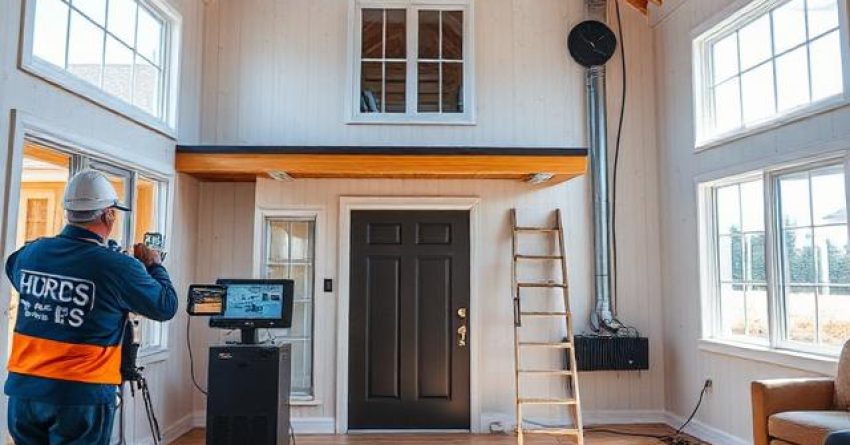
The primary tests include a blower door test, which measures the air leakage rate of the building envelope by depressurizing the home and calculating how much air infiltrates through gaps and cracks. The rater also performs a duct leakage test to measure how much conditioned air escapes through the duct system before reaching living spaces. Additional measurements cover insulation coverage and depth, window area and orientation, mechanical equipment efficiency ratings, and water heating system specifications.
Each measurement feeds directly into the energy model and affects the final HERS score.
Step 3 — HERS Score Assignment and Report Delivery
After completing on-site testing, the rater enters all collected data into RESNET-approved energy modeling software. The software calculates the projected annual energy use and generates the HERS Index Score. The rater then produces a formal rating report that includes the score, a breakdown of energy use by system, and recommendations for improvement where applicable.
The report is filed with the rater’s rating provider and is available to the homeowner, builder, or lender as needed. For new construction, the rating is typically required before a certificate of occupancy is issued in jurisdictions that mandate HERS compliance.
What Does a HERS Score Mean for Your Home?
Your HERS score is a direct measure of your home’s energy efficiency relative to a nationally standardized benchmark. It tells you — and anyone evaluating your property — how much energy your home consumes compared to a typical code-built home.
HERS Score Ranges and What They Indicate
The HERS Index operates on a scale where lower scores indicate better energy performance. A score of 100 is the baseline — it represents a home built to the 2006 International Energy Conservation Code. Scores below 100 indicate above-average efficiency, and scores above 100 indicate below-average efficiency.
Homes rated between 50 and 70 are considered highly efficient and typically qualify for ENERGY STAR certification. Homes rated below 50 represent exceptional performance, often achieved through advanced construction techniques, high-performance insulation, and renewable energy systems. Net-zero energy homes, which produce as much energy as they consume, target a score of 0.
Most existing homes in the United States score between 100 and 150, reflecting older construction standards and limited weatherization.
How HERS Scores Affect Home Value and Mortgage Eligibility
A strong HERS score has measurable financial implications beyond energy savings. Lenders and appraisers increasingly recognize energy efficiency as a value driver, and several mortgage programs use HERS scores as a qualification criterion.
A strong HERS score can unlock significant financing advantages — our guide to energy-efficient mortgage options explains the specific score thresholds lenders use and how homeowners can leverage their rating to qualify for better loan terms. From a resale perspective, homes with documented HERS ratings provide buyers with verifiable energy performance data, which reduces uncertainty and can support a stronger asking price in energy-conscious markets.
When Do You Need a HERS Inspection?
The circumstances that require or benefit from a HERS inspection vary depending on whether the home is new construction or an existing property.
For new construction, many states and local jurisdictions now require a HERS rating as part of the building permit and certificate of occupancy process. Builders working with energy-efficient mortgage programs, ENERGY STAR certification, or green building standards such as LEED also require a HERS rating to verify compliance.
For existing homes, a HERS inspection is typically voluntary but strategically valuable. Homeowners planning major energy upgrades — such as HVAC replacement, insulation improvements, or window replacement — benefit from a pre-upgrade rating that establishes a baseline and a post-upgrade rating that documents the improvement. Landlords and property managers use HERS ratings to benchmark properties, identify high-cost systems, and prioritize capital improvements.
For homeowners unsure whether a HERS inspection or a broader assessment is the right starting point, understanding the home energy audit process helps clarify which evaluation matches their goals, timeline, and budget. Real estate transactions are another common trigger. Buyers increasingly request HERS ratings as part of due diligence, and sellers with strong scores can use the rating as a marketing asset.
How to Prepare Your Home for a HERS Inspection
Preparing your home before the rater arrives helps ensure the inspection runs efficiently and that the final score accurately reflects your home’s current condition.
Start by locating documentation for all major systems — HVAC equipment model numbers and installation dates, insulation type and R-values in attic and wall cavities, window specifications, and any recent weatherization work. If you have had previous energy assessments or utility audits, gather those reports as well.
On inspection day, ensure the rater has clear access to the attic, crawl space, mechanical room, and all exterior walls. All doors and windows should be closed during the blower door test. Pets should be secured, and any portable fans or exhaust fans should be turned off before testing begins.
Homeowners who want to take targeted action before their inspection can follow a structured approach to improving your HERS score, covering insulation upgrades, air sealing, and HVAC efficiency improvements that have the greatest impact on the final rating.
Common Issues That Lower HERS Scores
Several recurring deficiencies consistently produce higher — less efficient — HERS scores. Inadequate attic insulation is among the most common, particularly in older homes where insulation has settled or was never installed to current standards. Duct leakage is another frequent finding, with studies showing that leaky duct systems can waste 20% to 30% of conditioned air before it reaches living spaces.
Air infiltration through gaps around windows, doors, electrical outlets, and plumbing penetrations also contributes significantly to poor scores. Older HVAC equipment operating below its rated efficiency, single-pane windows, and uninsulated crawl spaces are additional factors that raters commonly flag.
How HERS Inspections Connect to Home Improvement Services
The HERS inspection process does not end with a score — it produces a roadmap. The rating report identifies which systems are underperforming and quantifies the energy savings potential of specific improvements. That roadmap translates directly into a prioritized list of home improvement projects.
Common post-inspection projects include attic insulation upgrades, air sealing throughout the building envelope, duct sealing and balancing, HVAC system replacement, and window upgrades. Each of these services addresses a specific finding from the HERS report and moves the score in a measurable direction.
For homeowners and property managers working through a list of post-inspection improvements, having access to reliable, multi-service providers simplifies the process considerably. Buyers comparing build options will find that HERS scores play a measurable role in total ownership cost — our breakdown of spec home energy costs covers how energy efficiency ratings factor into the financial comparison between custom and spec construction.
Mr. Local Services connects homeowners and property managers with skilled professionals across every service category that HERS inspections commonly flag — from HVAC and insulation to air sealing and window replacement — providing a single, dependable source for the improvements that move your score and protect your property’s long-term value.
Conclusion
The HERS inspection process gives homeowners, landlords, and property managers a clear, standardized measure of energy performance — from the blower door test through score delivery and improvement recommendations. Understanding each stage helps you prepare effectively and act on results with confidence.
A strong HERS score connects directly to lower energy costs, better financing options, and stronger property value — outcomes that matter across every type of residential and commercial property.
When you are ready to act on your HERS report, Mr. Local Services provides the skilled professionals and multi-service support you need to make every improvement count.
Frequently Asked Questions
How long does a HERS inspection take?
A HERS inspection typically takes two to four hours for an average-sized home. Larger homes or properties with complex mechanical systems may require additional time to complete all required tests and measurements accurately.
How much does a HERS inspection cost?
HERS inspection costs generally range from $300 to $800 depending on home size, location, and whether the rating is for new construction or an existing home. New construction ratings are often bundled into builder contracts, while existing home ratings are typically paid directly by the homeowner.
What is a good HERS score for a home?
A HERS score below 70 is considered highly efficient and typically qualifies for ENERGY STAR certification. Scores between 50 and 70 represent strong performance, while scores below 50 indicate exceptional efficiency. Most existing homes score between 100 and 150.
Is a HERS inspection required by law?
HERS inspections are required by law in some states and jurisdictions for new construction as part of building code compliance. Requirements vary significantly by location. For existing homes, HERS ratings are generally voluntary unless required by a specific financing program or certification standard.
Can a HERS inspection help me qualify for energy-efficient mortgages?
Yes. Several mortgage programs, including FHA Energy Efficient Mortgages and Fannie Mae’s HomeStyle Energy loan, use HERS scores as a qualification criterion. A score below a defined threshold — typically 70 or lower — can help borrowers access better loan terms or additional financing for energy improvements.
What happens if my home fails a HERS inspection?
There is no pass or fail in a HERS inspection — the process produces a score, not a verdict. A high score simply indicates areas where energy performance can be improved. The rating report identifies specific deficiencies and provides a basis for prioritizing upgrades that will lower the score in subsequent ratings.
How often should a HERS inspection be done?
A HERS inspection is most valuable at key decision points — before purchasing a home, after completing major energy upgrades, or when preparing a property for sale or rental. There is no mandatory frequency for existing homes, but a new rating after significant improvements documents the performance gain and supports financing or certification applications.