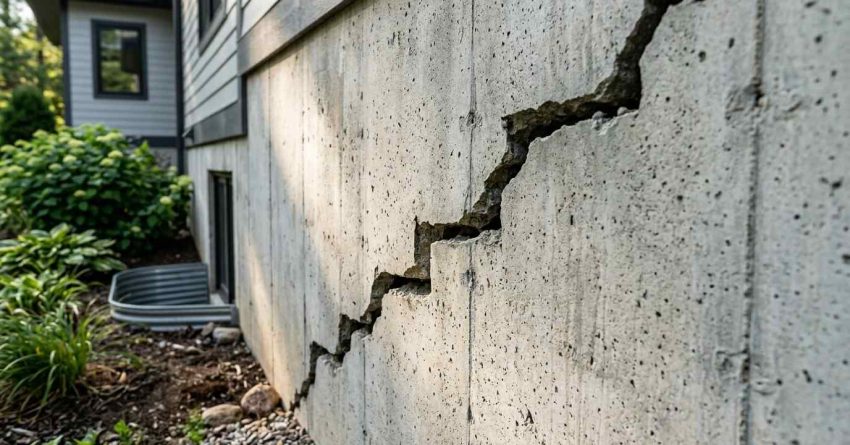
Foundation cracks fall into three main types — vertical, horizontal, and stair-step — and each one tells a different story about what is happening beneath your home. Knowing which type you are looking at helps you understand the severity, the likely cause, and the right repair approach before the problem gets worse.
Ignoring a foundation crack rarely makes it smaller. Moisture, soil pressure, and seasonal movement work against your home every day, turning minor cracks into costly structural problems.
This guide explains all three crack types clearly, compares their severity, covers repair options, and shows you how to slow or stop further damage to your foundation.
What Foundation Cracks Tell You About Your Home
A foundation crack is not just a cosmetic issue. It is a signal that something has changed in the relationship between your home’s structure and the soil beneath it. The shape, direction, width, and location of a crack each carry specific meaning that helps identify the cause and the appropriate response.
Most foundation cracks develop gradually over months or years. Some are the result of normal concrete curing and settling. Others reflect serious structural stress that requires professional intervention. The key is knowing which category your crack falls into.
How Cracks Form in Foundation Walls and Floors
Concrete and masonry are strong under compression but relatively weak under tension. When soil shifts, expands, contracts, or erodes, it applies uneven forces to your foundation. Those forces create tension in specific areas, and cracks form where the material cannot absorb the stress.
Common triggers include soil shrinkage during dry seasons, hydrostatic pressure from saturated soil after heavy rain, tree root intrusion, poor drainage around the foundation perimeter, and the natural settlement of a home over time.
When a Foundation Crack Becomes a Structural Problem
Width, depth, and movement are the three factors that determine whether a crack is a maintenance issue or a structural emergency. Hairline cracks under 1/16 of an inch wide and stable over time are generally low concern. Cracks wider than 1/4 inch, cracks that are actively growing, cracks accompanied by wall bowing or door and window misalignment, and cracks that allow water intrusion all require professional evaluation.
Understanding what each crack type signals is the first step toward protecting your home — our foundation repair services covers the full range of professional solutions available for homeowners across the USA.
Vertical Foundation Cracks
Vertical cracks run straight up and down or at a slight angle of no more than 30 degrees from vertical. They are the most common type of foundation crack and, in many cases, the least structurally alarming — though they still require monitoring and often repair.
What Causes Vertical Cracks in Foundations
The most frequent cause of vertical cracking is concrete curing shrinkage. As new concrete dries and cures, it contracts slightly, and that contraction can produce narrow vertical cracks within the first few years of a home’s life. Differential settlement — where one part of the foundation sinks slightly more than another — also produces vertical cracking, as does hydrostatic pressure from water-saturated soil pushing inward relatively evenly on both sides of a wall.
Vertical cracks are most common in poured concrete foundations and typically appear near the center of a wall where tension is highest.
Are Vertical Foundation Cracks Serious?
A hairline vertical crack that has remained stable for years is generally a low-priority concern. However, a vertical crack that is wider than 1/4 inch, shows signs of water seepage, or has grown since you first noticed it needs professional attention. Even structurally minor vertical cracks can allow moisture into your basement or crawl space, leading to mold, efflorescence, and interior damage over time.
If a vertical crack in your foundation is wider than a hairline or actively growing, a professional assessment is the safest next step — learn what vertical crack repair involves and when it is needed.
Horizontal Foundation Cracks
Horizontal cracks run parallel to the ground across a foundation wall. They are the most structurally serious type of foundation crack and should never be dismissed as cosmetic or minor, regardless of their width.
What Causes Horizontal Cracks in Foundation Walls
Horizontal cracking is almost always caused by lateral soil pressure — the force of soil pushing inward against the foundation wall from the outside. This pressure increases significantly when soil becomes saturated with water, when freeze-thaw cycles cause soil to expand and contract repeatedly, or when heavy loads such as vehicles, retaining walls, or large trees are placed close to the foundation.
Block and brick foundations are particularly vulnerable to horizontal cracking because the mortar joints between courses create natural weak points where lateral pressure concentrates. Poured concrete walls can also develop horizontal cracks, especially when drainage around the home is inadequate.
Why Horizontal Cracks Require Immediate Attention
A horizontal crack means your foundation wall is bending inward under pressure. Left unaddressed, that bending will continue. The wall can bow progressively inward, compromising the structural integrity of the entire foundation and the floors and walls above it. In severe cases, horizontal cracking can lead to partial or complete wall failure.
Any horizontal crack wider than 1/8 inch, any crack accompanied by visible wall bowing, or any crack that has appeared suddenly after heavy rain or a freeze-thaw event warrants an urgent professional inspection. Horizontal cracks are among the most structurally serious defects a foundation can develop, and addressing them quickly is critical — our foundation wall repair resource explains the methods professionals use to stabilize and restore damaged walls.
Stair-Step Foundation Cracks
Stair-step cracks follow a diagonal, staircase-like pattern along the mortar joints of brick or concrete block foundations. They are named for their resemblance to a flight of stairs and are one of the most recognizable signs of differential foundation settlement.
What Causes Stair-Step Cracks in Block and Brick Foundations
Stair-step cracks form when one section of a foundation moves or settles at a different rate than the adjacent section. Because mortar joints are the weakest point in a block or brick wall, the crack follows the path of least resistance — stepping diagonally from one joint to the next rather than cutting straight through the masonry units themselves.
The underlying causes include uneven soil compaction beneath the foundation, soil erosion from poor drainage or plumbing leaks, expansive clay soils that swell and shrink with moisture changes, and tree root activity that disrupts the soil structure beneath one section of the foundation.
How Serious Are Stair-Step Foundation Cracks?
The severity of a stair-step crack depends on its width, the degree of vertical displacement between the two sides of the crack, and whether it is actively growing. A narrow stair-step crack with no displacement and no growth may be a cosmetic issue related to normal settling. A crack wider than 1/4 inch, one where the blocks or bricks on either side of the crack are at noticeably different heights, or one that has appeared or grown rapidly indicates active differential settlement that requires professional structural assessment.
Stair-step cracking in brick or block foundations often signals differential settlement that will worsen without intervention — see how block foundation repair addresses the underlying soil and structural causes.
How to Compare All Three Foundation Crack Types
Understanding the differences between crack types at a glance helps homeowners make faster, more confident decisions about next steps.
| Crack Type | Direction | Most Common Cause | Foundation Type | Urgency Level |
| Vertical | Up and down | Curing shrinkage, settlement | Poured concrete | Low to moderate |
| Horizontal | Side to side | Lateral soil pressure | Block, brick, poured | High — act quickly |
| Stair-Step | Diagonal along joints | Differential settlement | Block, brick | Moderate to high |
Horizontal cracks are consistently the most urgent because they indicate active inward wall movement. Stair-step cracks signal differential settlement and can escalate quickly if the underlying soil issue is not addressed. Vertical cracks are the most common and often the least severe, but they still require monitoring and sealing to prevent moisture intrusion.
Width, growth rate, and accompanying symptoms — such as bowing walls, sticking doors, or water see— are always more important than crack direction alone when assessing severity.
Foundation Crack Repair Options for Homeowners
The right repair method depends on the crack type, its cause, its severity, and the foundation material. No single solution works for every situation.
Epoxy injection is commonly used for structural repair of narrow cracks in poured concrete walls. It bonds the two sides of the crack together and restores load-bearing capacity. Polyurethane foam injection is preferred when the primary concern is waterproofing rather than structural bonding — it remains flexible after curing and accommodates minor movement. Carbon fiber straps and wall anchors are used to stabilize bowing walls caused by horizontal cracking. Underpinning methods such as helical piers or push piers address differential settlement by transferring the foundation load to stable soil or bedrock below the problem zone.
Foundation cracks that allow moisture intrusion can lead to significant interior damage over time — if water has already entered your home, our water damage repair team can assess and restore affected areas alongside structural repairs.
Settlement-related foundation movement frequently causes interior drywall cracking and ceiling separation — if you are seeing those signs indoors, our drywall crack repair service can restore affected surfaces once the foundation issue is resolved.
When to Call a Professional for Foundation Crack Repair
Call a licensed foundation specialist immediately if you observe any of the following: a horizontal crack of any width, a crack wider than 1/4 inch, a crack accompanied by wall bowing or displacement, a crack that has grown noticeably over weeks or months, water actively entering through a crack, or multiple cracks appearing in a short period. These are not situations where a DIY patch will solve the underlying problem. Surface patching without addressing the root cause — whether that is soil pressure, drainage failure, or settlement — will not stop the crack from returning or worsening.
How to Prevent Foundation Cracks From Getting Worse
While some foundation movement is unavoidable, several practical steps significantly reduce the risk of new cracks forming and slow the progression of existing ones.
Maintain proper grading around your home so that the ground slopes away from the foundation at a rate of at least six inches over the first ten feet. Keep gutters clean and ensure downspouts discharge water at least five feet from the foundation. Avoid planting large trees or shrubs close to the foundation, as root systems can disrupt soil stability and draw moisture unevenly from the soil beneath the structure.
Proper grading and drainage around your home’s perimeter are among the most effective ways to reduce foundation stress — our landscape drainage solutions team can evaluate and improve water management around your property.
Monitor existing cracks by marking their ends with a pencil and date, or by applying a small patch of plaster across the crack. Check monthly. If the crack grows past your mark or the plaster patch breaks, the crack is active and needs professional evaluation.
Undetected plumbing leaks beneath or adjacent to a foundation can accelerate soil erosion and crack formation — our plumbing leak detection service identifies hidden leaks before they cause structural damage.
Conclusion
Vertical, horizontal, and stair-step foundation cracks each carry distinct structural meaning, and identifying the type you are dealing with is the foundation of any effective repair plan.
Horizontal cracks demand the fastest response, stair-step cracks signal settlement that compounds over time, and vertical cracks — while often less urgent — still require monitoring and sealing to protect your home from moisture damage.
At Mr. Local Services, our network of trusted foundation professionals is ready to assess your crack, explain your options clearly, and connect you with the right repair solution — so your home stays safe, stable, and protected year-round.
Frequently Asked Questions
What is the most dangerous type of foundation crack?
Horizontal foundation cracks are the most structurally dangerous. They indicate that lateral soil pressure is actively pushing the foundation wall inward, which can lead to progressive bowing and eventual wall failure if not addressed quickly.
Can I repair a foundation crack myself?
Minor hairline vertical cracks can be sealed with hydraulic cement or polyurethane caulk to prevent moisture entry. However, any crack wider than 1/4 inch, any horizontal crack, or any crack showing displacement or active growth requires a licensed foundation professional — DIY patching will not address the structural cause.
How do I know if a foundation crack is getting worse?
Mark both ends of the crack with a pencil and note the date. Apply a thin strip of plaster or tape across the crack. Check monthly. If the crack extends past your marks or the plaster breaks, the crack is actively growing and needs professional evaluation.
Do foundation cracks always mean the house is sinking?
Not always. Many foundation cracks result from concrete curing shrinkage or minor seasonal soil movement rather than significant settlement. However, stair-step cracks with vertical displacement and multiple cracks appearing together can indicate differential settlement that requires structural assessment.
How much does foundation crack repair typically cost?
Repair costs vary widely based on crack type, severity, and method. Simple epoxy or polyurethane injection for a single crack may range from a few hundred dollars, while full wall stabilization or underpinning for severe horizontal cracking or settlement can reach several thousand dollars. A professional inspection is the only way to get an accurate estimate for your specific situation.
Will homeowners insurance cover foundation crack repair?
Most standard homeowners insurance policies do not cover foundation cracks caused by settlement, soil movement, or gradual deterioration. Coverage may apply if the crack results from a sudden, covered event such as a burst pipe or specific natural disaster. Review your policy and consult your insurer for clarification.
How long does foundation crack repair last?
When performed correctly by a licensed professional using the appropriate method for the crack type and cause, foundation crack repairs are designed to be permanent. Epoxy injection restores structural integrity to the repaired area. However, if the underlying cause — such as drainage failure or soil instability — is not also addressed, new cracks can form in adjacent areas over time.