Drywall installation transforms bare wall frames into smooth, paint-ready surfaces — and with the right process, homeowners can achieve professional-quality results or know exactly what to expect when hiring a pro. Whether you are finishing a new room, repairing damaged panels, or upgrading an older space, understanding each phase of drywall work helps you plan accurately, avoid costly mistakes, and get lasting results.
This guide covers every stage of the process, from selecting the right drywall type to achieving a Level 5 finish ready for paint.
What Is Drywall and Why It Matters for Your Property
Drywall — also called gypsum board, wallboard, or sheetrock — is a panel made of calcium sulfate dihydrate pressed between two thick sheets of paper. It is the standard interior wall and ceiling material in nearly all residential and commercial construction across the United States because it installs quickly, resists fire, and creates a smooth surface ready for paint or texture.
For homeowners and property managers, drywall is not just a cosmetic material. It contributes to fire resistance, sound control, insulation performance, and the structural integrity of interior spaces. Damaged or poorly installed drywall affects property value, energy efficiency, and the appearance of every room it lines.
Drywall is one of the most widely used interior building materials in residential and commercial construction — our complete drywall and ceiling services covers every professional solution available, from new installations to full ceiling repairs, so you can find the right help for your property.
Common Drywall Types and When to Use Each
Not all drywall panels are the same. Choosing the correct type for each location prevents moisture damage, improves fire safety, and reduces sound transmission between rooms.
- Standard drywall (white board): Used in living rooms, bedrooms, and hallways where moisture is not a concern.
- Moisture-resistant drywall (green board): Designed for bathrooms, laundry rooms, and kitchens where humidity is elevated.
- Fire-rated drywall (Type X): Required in garages, utility rooms, and walls adjacent to mechanical spaces.
- Soundproof drywall: Used in home theaters, bedrooms, and shared walls in multi-unit properties.
- Ceiling drywall: Thicker panels (5/8 inch) used overhead to resist sagging under their own weight.
Selecting the wrong type for a location is one of the most common and costly drywall mistakes — one that leads to mold, structural failure, or failed inspections.
Tools and Materials You Need Before You Start
Gathering the right tools before starting saves time, reduces waste, and produces cleaner results. Attempting drywall work without proper equipment leads to uneven cuts, loose panels, and visible seams after painting.
Essential tools:
- Tape measure and pencil
- Drywall T-square or straightedge
- Utility knife with fresh blades
- Drywall saw for outlet and fixture cutouts
- Screw gun or drill with drywall bit
- Mud pan and 6-inch, 10-inch, and 12-inch taping knives
- Corner bead crimper or tin snips
- Sanding pole with 120-grit and 150-grit sanding screens
- Safety glasses and dust mask
Essential materials:
- Drywall panels (correct type and thickness for location)
- Drywall screws (1-5/8 inch for walls, 1-5/8 to 2 inch for ceilings)
- Paper joint tape or fiberglass mesh tape
- All-purpose joint compound (pre-mixed) and setting compound
- Corner bead (metal or vinyl)
- Primer and paint (applied after finishing is complete)
If gathering the right tools feels overwhelming or you are missing key equipment, our handyman services team arrives fully equipped to handle drywall prep, installation, and finishing tasks without requiring you to purchase or rent specialized tools.
How to Install Drywall Step by Step
Drywall installation follows a specific sequence. Skipping steps or rushing the process creates problems that are difficult and expensive to correct after panels are fastened.
Measuring, Cutting, and Fitting Drywall Panels
Start by measuring each wall section from floor to ceiling and from corner to corner. Mark your measurements on the drywall panel face using a pencil and T-square. Score the face paper firmly with a utility knife along the marked line, then snap the panel away from you to break the gypsum core. Cut through the back paper to separate the piece cleanly.
For outlets, switches, and fixtures, measure the location of each box relative to the panel edge and transfer those measurements to the panel face. Use a drywall saw or rotary tool to cut the opening. Fit each panel before fastening — gaps larger than 1/8 inch at seams require adjustment before screwing panels in place.
Stagger vertical seams between rows so no two seams align on the same stud. This distributes stress across the wall and prevents cracking along seam lines over time.
Fastening Drywall to Studs Correctly
Fasten panels to studs using drywall screws spaced 12 inches apart in the field and 8 inches apart along edges. Drive each screw until the head sits just below the surface of the paper — creating a slight dimple — without breaking through the paper face. Broken paper around a screw head loses holding strength and must be corrected with an additional screw placed 2 inches away.
On ceilings, fasten panels perpendicular to joists and use a drywall lift or T-brace to hold panels in position while fastening. Ceiling work requires two people for safe and accurate installation.
For larger renovation projects where drywall installation is part of a broader room transformation, our remodeling services coordinate every phase of the work — from framing and insulation to drywall, painting, and final finishes — under one reliable team.
How to Tape and Mud Drywall Joints
Taping and mudding is the phase that determines whether your finished walls look professional or amateur. Rushing this stage or skipping coats produces visible seams, ridges, and cracks after painting.
Applying Joint Compound the Right Way
Begin with setting compound (hot mud) for the first coat on butt joints and any areas with significant gaps. Setting compound hardens chemically rather than by drying, which reduces shrinkage and provides a stronger base.
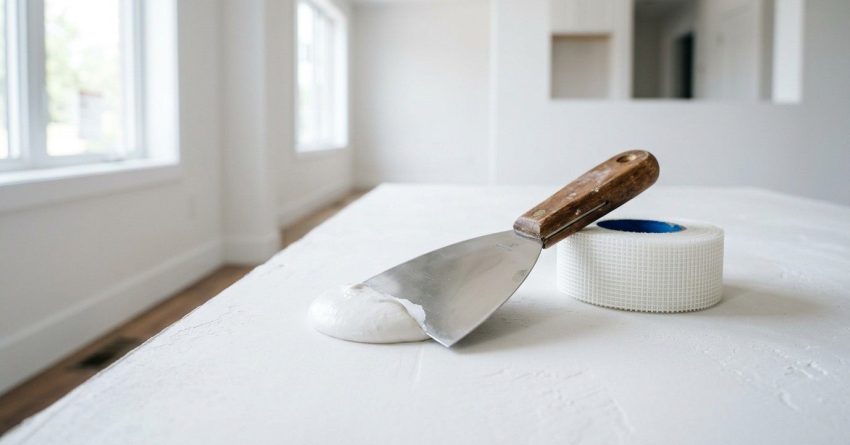
For tapered seams — the factory-beveled edges of drywall panels — apply a thin bed coat of all-purpose compound using a 6-inch knife. Embed paper tape into the wet compound, pressing it flat with the knife to remove air bubbles. Apply a thin skim coat over the tape immediately and feather the edges outward. Allow to dry completely before applying the second coat.
The second coat uses a 10-inch knife and extends 2 to 3 inches beyond the first coat on each side. The third and final coat uses a 12-inch knife and feathers even further, blending the seam invisibly into the surrounding wall surface.
Apply compound to all screw dimples in thin coats, allowing each coat to dry before adding the next.
Sanding Between Coats for a Smooth Surface
Sand lightly between each coat using 120-grit sanding screen on a pole sander. The goal is to knock down ridges and tool marks — not to remove compound. Over-sanding damages the paper face of the drywall and creates fuzzy patches that show through paint.
After the final coat, sand with 150-grit screen until the surface feels smooth to the touch and transitions invisibly from compound to drywall. Wipe the surface with a damp cloth to remove dust before priming.
Drywall Finishing Levels Explained (Levels 0–5)
The construction industry uses a standardized system to define how thoroughly drywall is finished before paint or texture is applied. Specifying the correct level for each space prevents disputes, sets clear expectations, and ensures the surface is appropriate for its final application.
| Level | Description | Typical Application |
| Level 0 | No taping, finishing, or accessories | Temporary construction only |
| Level 1 | Tape embedded in compound, tool marks acceptable | Fire-rated assemblies, above ceilings |
| Level 2 | Tape embedded, one coat over tape and fasteners | Tile substrate, garages, storage areas |
| Level 3 | Two coats over tape and fasteners, sanded | Walls receiving heavy texture |
| Level 4 | Three coats, sanded smooth | Flat or low-sheen paint, light texture |
| Level 5 | Level 4 plus skim coat over entire surface | Gloss or semi-gloss paint, critical lighting |
Most residential living spaces require a Level 4 finish. Level 5 is specified for high-end applications where raking light would reveal any surface imperfection. Understanding which level your project requires before work begins prevents the need for costly rework.
For a deeper breakdown of each finishing level and how to specify the right one for your project, explore our dedicated drywall finishing levels guide which walks through every specification, application scenario, and quality checkpoint in detail.
Common Drywall Problems and How to Fix Them
Even well-installed drywall develops problems over time. Knowing how to identify and address common issues early prevents minor damage from becoming a major repair.
Repairing Cracks, Holes, and Water Damage
Hairline cracks along seams typically indicate settling or seasonal movement. Clean the crack, apply a thin layer of joint compound, embed paper tape, and finish with two additional coats. Sand smooth after drying.
Small holes (under 6 inches) can be repaired using a patch kit with a self-adhesive mesh backing. Apply joint compound over the mesh in thin coats, feathering outward with each layer. Three coats are typically required for a smooth, invisible repair.
Large holes (over 6 inches) require a California patch or a backing board cut to fit behind the opening. Secure the patch panel to the backing, tape all seams, and finish with three coats of compound.
When drywall damage is caused by a leak or flood rather than everyday wear, the underlying moisture problem must be resolved before any repair — our water damage services team identifies the source, dries the affected area, and prepares the surface so drywall repairs hold long-term.
Nail pops occur when fasteners push through the surface as framing lumber dries and shrinks. Drive a new screw 2 inches above and below the popped nail, then drive the nail back below the surface. Apply two coats of compound over both the nail and the new screws, sand, and prime.
When to Hire a Professional for Drywall Work
DIY drywall installation is achievable for motivated homeowners tackling small repairs or single-room projects. However, several situations call for professional expertise to avoid structural problems, failed inspections, or finishes that require complete rework.
Hire a professional when:
- The project involves ceiling installation, which requires specialized equipment and two-person coordination
- Fire-rated assemblies are required by local building code
- Water damage has affected the framing or insulation behind the drywall
- The project scope covers multiple rooms or an entire floor
- A Level 5 finish is required for high-gloss paint or critical lighting conditions
- Existing drywall contains asbestos (common in homes built before 1980)
- Permits are required for the scope of work in your jurisdiction
Professional drywall installers bring the tools, experience, and material knowledge to complete work efficiently, meet code requirements, and deliver a finish that holds up over time. The cost of professional installation is often offset by avoiding the expense of correcting DIY mistakes.
Knowing when a project exceeds DIY scope is one of the most valuable decisions a homeowner can make — explore our professional drywall installation options to get an accurate assessment, skilled labor, and a finished result that meets building standards without the guesswork.
Conclusion
Drywall installation and finishing is a multi-phase process where each step builds directly on the one before it. Selecting the right panel type, fastening correctly, and applying compound in proper coats determines whether the finished surface holds up and looks professional.
Understanding finishing levels, common repair methods, and the limits of DIY work gives homeowners and property managers the knowledge to plan accurately and set realistic expectations for any drywall project.
At Mr. Local Services, our skilled drywall professionals handle every phase — from panel installation to final finishing — so your walls are smooth, code-compliant, and ready for paint. Contact us today to get started.
Frequently Asked Questions
How thick should drywall be for interior walls?
Standard interior walls use 1/2-inch drywall in most residential applications. Ceilings typically require 5/8-inch panels to prevent sagging, and fire-rated assemblies specify Type X panels at 5/8 inch minimum.
How many coats of joint compound does drywall need?
Most drywall seams require three coats of joint compound — a bed coat with tape, a second coat feathered wider, and a finish coat feathered even further. Each coat must dry completely before the next is applied.
Can I install drywall by myself?
Single-person drywall installation is possible for wall panels in small rooms. Ceiling installation requires at least two people and a drywall lift for safe and accurate work. Large projects benefit significantly from professional installation.
How long does drywall compound take to dry between coats?
All-purpose joint compound typically dries in 24 hours under normal temperature and humidity conditions. Setting compound (hot mud) hardens in 20 to 90 minutes depending on the product. Do not apply the next coat until the previous one is fully dry and no longer cool to the touch.
What causes drywall seams to show through paint?
Visible seams after painting are caused by insufficient coats of compound, inadequate feathering, skipping primer, or applying paint before compound is fully cured. A proper Level 4 finish with a drywall primer applied before paint prevents seam telegraphing.
How do I know if drywall damage requires professional repair?
Damage covering more than a few square feet, damage near electrical panels or plumbing, any discoloration suggesting moisture, or soft or crumbling drywall that indicates ongoing water intrusion all require professional assessment before repair begins.
Is drywall repair covered by homeowners insurance?
Drywall damage caused by a covered peril — such as a burst pipe, storm, or fire — is typically covered by homeowners insurance. Damage from gradual wear, neglect, or deferred maintenance is generally excluded. Contact your insurer to confirm coverage before beginning repairs.