
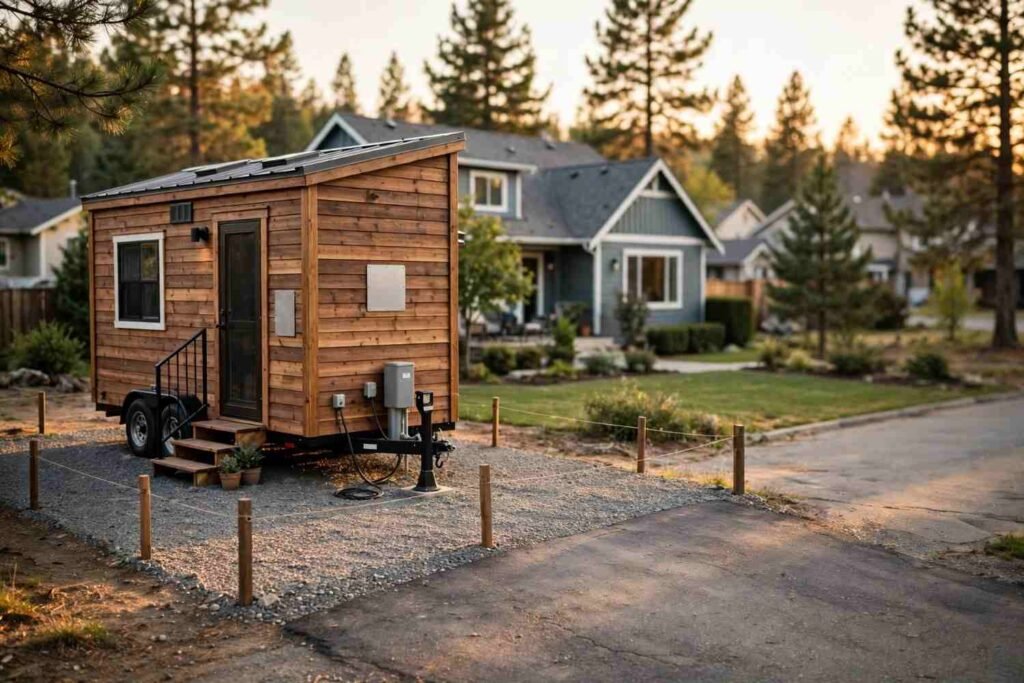
I get this question constantly: tiny homes on wheels are legal to build, but parking one legally is a completely different puzzle. The short answer is that legal parking depends on how your local jurisdiction classifies your home, and it almost never fits into one clean category.
Zoning laws were written decades before tiny homes existed. Most counties have no dedicated tiny home ordinance, so your options get filtered through RV codes, ADU rules, or agricultural exceptions instead.
This guide breaks down how tiny homes get classified, where you can legally park one on private or family land, what parks and communities offer as alternatives, and which zoning and permit rules trip people up most. I also cover the states making this process genuinely easier right now.
What Counts as a Tiny Home on Wheels (Legally Speaking)
A tiny home on wheels is a dwelling built on a trailer chassis that meets specific towing and size requirements rather than traditional building code. Most jurisdictions treat it as either a recreational vehicle or a non-conforming structure, and that single classification decision shapes every parking rule that follows.
I’ve watched homeowners get tripped up here more than anywhere else. The home might look permanent, but the way your county’s code officer classifies it determines whether you’re governed by RV parking rules, building codes, or something in between.
RV Certification vs. Site-Built Classification
A tiny home certified under RVIA or NOAH standards gets treated like a recreational vehicle for legal purposes, which opens the door to RV parks and RV zoning. A home built without that certification often falls into a legal gray zone that many counties simply haven’t addressed.
I always tell people to get their certification paperwork sorted before shopping for land. It changes everything downstream, from insurance to where you’re allowed to park overnight.
Why Location Rules Are So Complicated for Tiny Homes
Three separate legal systems govern where you park, and they rarely agree with each other. That overlap is the actual reason this topic feels so confusing.
Zoning Codes vs. Building Codes vs. RV Codes
Zoning codes control land use and decide whether a dwelling is even allowed on a specific parcel. Building codes govern structural safety standards, and most tiny homes on wheels are explicitly exempt because they’re not permanently affixed to a foundation.
RV codes are the third layer, and they usually cap how long any vehicle-classified dwelling can stay parked in one spot. I’ve seen homeowners assume zoning approval covers them, only to find out their county’s RV code limits stays to 30 days per year on residential land.
Getting all three checked at once, before you sign a lease or buy land, saves you from a very expensive surprise.
Parking on Private Land You Own
Owning land outright gives you the most control, but it doesn’t automatically mean you can park a tiny home there. Zoning classification of the parcel decides everything, and residential-only zones frequently restrict any dwelling that isn’t permanently foundation-mounted.
I recommend calling your county planning office before closing on land, not after. A five-minute phone call at this stage prevents months of frustration later.
Minimum Lot Size and Setback Requirements
Many counties require a minimum lot size before any dwelling, including a tiny home, can be placed on the property. Setback requirements then dictate how far your home must sit from property lines, roads, and neighboring structures.
Rural and agricultural-zoned parcels tend to have more flexibility here than dense residential zones. A parcel zoned agricultural often allows a tiny home as a secondary dwelling with far fewer restrictions than a standard suburban lot.
Parking on a Family Member’s or Friend’s Property
Setting up on a relative’s land feels like the simplest option, and sometimes it is. But the property still falls under the same zoning rules as any other parcel, so ownership by someone you trust doesn’t bypass local code.
Guest house and accessory dwelling unit rules are usually your best path here. Many jurisdictions permit a second small dwelling on a residential lot specifically for family members, provided it meets utility and setback standards.
Guest House and ADU Ordinances
An accessory dwelling unit ordinance typically allows one secondary structure per lot, capped at a certain square footage, and often requires it to connect to the main home’s utilities. Some counties draw a hard line between a foundation-based ADU and a wheeled tiny home, excluding the latter entirely.
I always suggest asking the local planning department directly whether a wheeled unit qualifies as an ADU in that specific county. The answer varies enormously even between neighboring towns.
RV Parks and Campgrounds as a Legal Option
RV parks are one of the most straightforward legal parking paths, provided your tiny home carries RV certification. Most parks accept certified units the same way they’d accept a travel trailer or fifth wheel.
The tradeoff is permanence. Parks are built around transient stays, so pulling off a genuinely long-term setup takes some negotiation with park management.
Long-Term Stay Restrictions
Many RV parks cap stays at anywhere from a few weeks to a few months before requiring the resident to leave or reapply. A smaller number of parks specifically market themselves as long-term or extended-stay, and those tend to be the better fit for tiny home living.
I’ve found calling ahead and asking directly about “extended stay” or “annual lease” options gets a much clearer answer than browsing a park’s website. Policies shift often and aren’t always posted.
Tiny Home Communities and Dedicated Villages
Purpose-built tiny home communities have grown fast over the last several years, and they solve the zoning problem by design. The International Code Council developed Appendix Q specifically to give tiny homes a recognized building code path, and many of these communities were built around that standard.
These developments are zoned specifically for tiny homes from the start, which removes most of the guesswork buyers face elsewhere.
HOA Rules Inside Tiny Home Developments
Even inside a dedicated community, a homeowners association can impose its own rules on top of local zoning. Exterior finishes, lot placement, skirting requirements, and even paint colors sometimes fall under HOA review before you move in.
I recommend reading the HOA covenant in full before signing anything, not just the marketing brochure. The gap between what’s advertised and what’s enforced can be significant.
Renting Land Through a Lease Agreement
Leasing a parcel from a private landowner gives you flexibility without the upfront cost of buying land. It’s become a popular route, especially in rural areas where owners have unused acreage.
The lease itself needs to spell out zoning compliance, utility access, and what happens if the property sells. A handshake agreement leaves you exposed in ways a written lease does not.
What to Confirm With a Landowner Before Moving In
Confirm the parcel’s zoning classification, whether the landowner has verified that a tiny home is legally allowed there, and who’s responsible for utility hookups. Get all of it in writing before you move a single box onto the property.
I also suggest asking how long the landowner intends to keep the property, since a sale mid-lease can force a sudden, costly relocation.
County and City Zoning Codes to Check Before You Move
Zoning codes vary wildly not just state to state but county to county, and sometimes town to town within the same county. Reading the actual ordinance language, not a summary from a forum or blog, is the only reliable way to know your options.
Agricultural, Residential, and Mixed-Use Zones
Agricultural zones tend to offer the most flexibility, often permitting secondary dwellings for farm workers or family members with minimal red tape. Residential zones are usually the strictest, since they’re built around single-family, foundation-based homes.
Mixed-use zones fall somewhere in between and increasingly include language specifically addressing tiny homes as cities update older codes. A 2025 American Planning Association survey found that roughly 28% of surveyed municipalities have updated or begun updating zoning code specifically to address tiny homes on wheels.
Permits, Inspections, and Utility Hookup Requirements
Even once you’ve found a legal spot, most jurisdictions require permits before you connect water, power, or septic service. Skipping this step is one of the fastest ways to get a stop-work order or a fine.
Septic, Water, and Electrical Connection Rules
A septic permit typically requires a site evaluation to confirm the soil can handle wastewater treatment, and this step alone can take weeks in rural counties. Electrical hookups usually need an inspection to confirm the connection meets local code, even for a temporary RV-style hookup.
I tell people to budget both time and money for this stage. It’s rarely instant, and rushing it risks a failed inspection that pushes your move-in date back further.
States and Cities With the Most Tiny-Home-Friendly Laws

Some states have moved faster than others to update code specifically around tiny homes. Appendix Q adoption by a state or county is usually the clearest signal that tiny homes have an established legal path there.
States like California, Oregon, Colorado, and Texas have multiple counties that have adopted Appendix Q or created their own tiny-home-specific ordinances.
What Makes a Jurisdiction Easier to Work With
The friendliest jurisdictions share a few traits: they’ve adopted Appendix Q, they have clear ADU ordinances that explicitly include wheeled units, and their planning departments respond to questions rather than defaulting to “that’s not addressed.” Rural counties in tiny-home-friendly states tend to be the most flexible overall.
I always recommend calling the planning department directly and asking pointed questions before you commit to a move. A jurisdiction’s reputation online doesn’t always match how it’s currently enforced.
Conclusion
Legally parking a tiny home on wheels comes down to matching your home’s classification with the right land, zoning, and permit path. Private land, family property, RV parks, and dedicated communities each solve this differently.
The rules shift constantly as more counties adopt Appendix Q and update outdated codes. Staying current with your specific jurisdiction protects your investment long term.
We connect homeowners with trusted professionals who understand local permitting and utility hookup requirements. Reach out to Mr. Local Services when you’re ready to get your property move-in ready.
Frequently Asked Questions
Is it legal to park a tiny home on wheels in my backyard?
It depends on your local zoning and whether an accessory dwelling unit ordinance covers wheeled structures. Many residential zones restrict this, while agricultural zones often allow it.
Can I live in a tiny home on wheels full-time legally?
Full-time living is legal in RV parks that permit extended stays, dedicated tiny home communities, and properties zoned to allow a secondary dwelling. Standard residential zoning frequently limits or prohibits full-time occupancy.
Do I need a permit to park a tiny home on wheels?
Most jurisdictions require a permit for utility hookups like water, electrical, and septic, even if the home itself doesn’t need a building permit. Check with your local planning department before connecting any utilities.
What is Appendix Q for tiny homes?
Appendix Q is an addition to the International Residential Code that creates specific building standards for tiny homes under 400 square feet. Counties that adopt it gain a clearer legal path for permitting tiny homes.
Can I park a tiny home on wheels on agricultural land?
Agricultural zoning often permits a tiny home as a secondary dwelling for family or farm workers, typically with fewer restrictions than residential zones. Confirm the specific ordinance with your county, since rules vary widely.
How long can I park a tiny home in an RV park?
Stay limits vary by park, ranging from a few weeks to indefinite extended-stay arrangements. Parks that specifically advertise long-term or annual leases are built for tiny home residents.
What happens if I park a tiny home illegally?
Local code enforcement can issue fines, require you to relocate the home, or in some cases force removal from the property entirely. Confirming zoning compliance before moving in avoids this risk completely.