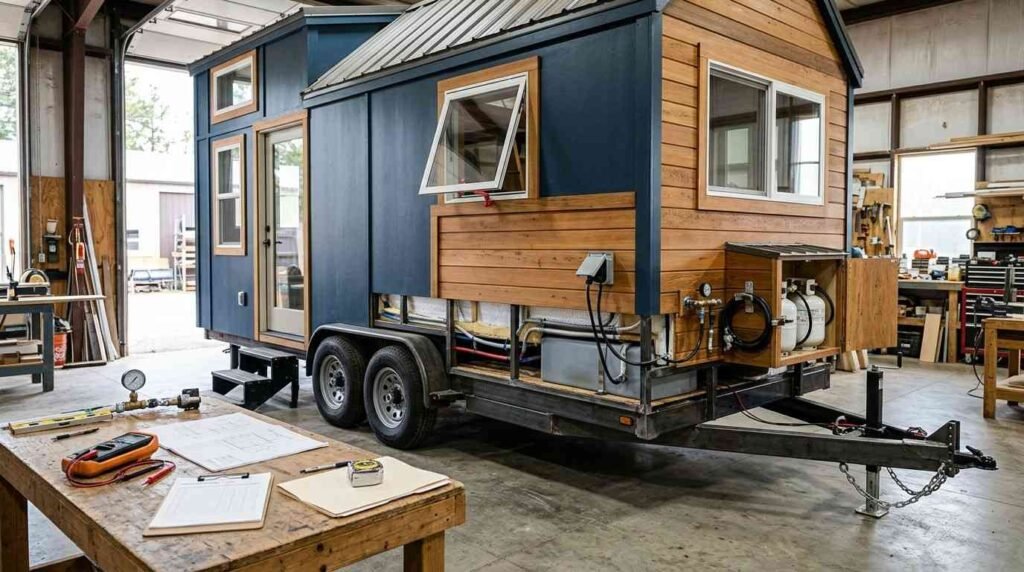
A tiny house on wheels, or THOW, is a permanently chassis-mounted dwelling that most U.S. jurisdictions classify as a recreational vehicle rather than a house. That single classification decision controls your insurance, your financing, and where you are legally allowed to park it.
I have watched too many owners buy first and ask questions later. The wheels under the floor change everything about how a code official, an underwriter, and a lender see your property.
This guide covers legal classification, RV and manufactured housing status, ADU pathways, RVIA and NOAH certification, insurance and financing effects, titling, state variation, and buyer checklists.
What a Tiny House on Wheels Is in Legal Terms
A tiny house on wheels sits in a strange legal space. It looks like a house, functions like a house, and gets treated by almost every code body as a vehicle.
The core issue comes down to permanence. Building codes govern structures attached to land. Vehicle codes govern things that roll. A THOW built on a trailer chassis falls into the second bucket by default, and that default drives every downstream decision you make.
THOW vs. Tiny House on a Foundation
A tiny house on a permanent foundation is real property. It gets a building permit, a certificate of occupancy, and a property tax bill. It follows the International Residential Code, and since the 2018 IRC added Appendix Q, houses under 400 square feet have their own recognized code path for stairs, lofts, and ceiling heights.
A THOW gets none of that. It gets a VIN, a title, and a registration. The same 300 square feet of living space lands in a completely different regulatory universe based on one thing: whether it is bolted to concrete or bolted to axles.
Why Wheels Change the Legal Category
Wheels signal mobility, and mobility triggers vehicle law. Once your dwelling registers as a vehicle, local building departments generally lose jurisdiction over its construction, and state motor vehicle departments pick it up.
That trade sounds like freedom. It comes with a cost. Vehicles are rarely permitted as permanent residences on residential lots, which is exactly why so many THOW owners hit a wall when they try to park long term.
The Three Classifications That Matter Most
Three legal buckets cover nearly every THOW in the country. Recreational vehicle status is the most common. Manufactured or modular housing status is possible but rare. Accessory dwelling unit or permanent structure status requires giving up the wheels.
Each path opens some doors and closes others. I walk through all three below so you can see which one matches your actual living plan, not just your build budget.
Recreational Vehicle Classification for THOWs
Most THOWs land here. The RV Industry Association defines a recreational vehicle as a vehicle designed for temporary living quarters, and a chassis-built tiny house fits that description on paper.
RV status is the fastest route to legal legitimacy. You get a title, you get registration, and you get access to insurance products and RV parks that simply do not exist for uncertified builds.
The tradeoff is the word “temporary.” RV classification carries an implicit assumption that nobody lives in the unit full time, and many jurisdictions enforce that assumption through occupancy limits.
Park Model RVs vs. Travel Trailers
A park model RV is built to ANSI A119.5, runs up to 400 square feet, and is designed to be moved rarely and connected to full utilities. A travel trailer is built to NFPA 1192, stays narrower and lighter, and is designed to be towed regularly.
Most THOWs resemble park models in size and finish but resemble travel trailers in how they are towed. Knowing which standard your build follows determines which certification you can actually obtain.
What RV Status Means for Where You Can Park
RV classification opens RV parks, campgrounds, and tiny house communities. It generally closes standard residential lots, at least without a variance or a temporary use permit.
Some cities allow RV occupancy on private land for a limited number of days per year. Others allow it only during active construction of a primary home. The rules shift by municipality, and I cover verification steps further down.
Manufactured and Modular Home Classification
A small number of THOWs pursue manufactured or modular housing status instead. This path treats the unit as housing rather than a vehicle, which unlocks mortgage products and permanent placement.
It also imposes far heavier construction requirements. Most tiny house builders cannot meet them, and most existing THOWs cannot be retrofitted to comply.
HUD Code Basics for Property Owners
The federal HUD Code governs manufactured homes and sets nationwide standards for design, construction, fire safety, and energy efficiency. A HUD-certified home carries a red certification label and can be financed and placed like conventional housing in most jurisdictions.
Qualifying requires factory production in a HUD-approved plant with third-party inspection at every stage. That infrastructure exists for manufactured home producers. It rarely exists for small tiny house shops.
When a THOW Cannot Qualify as Manufactured Housing
HUD standards require a minimum size in most configurations and a permanent chassis designed to HUD specifications rather than a standard utility trailer. A THOW built on an off-the-shelf trailer fails that test immediately.
I tell owners to treat this path as a builder decision, not an owner decision. You choose manufactured housing status before construction begins, or you do not get it at all.
Accessory Dwelling Unit and Permanent Structure Pathways
The third route converts your THOW into real property. You remove the wheels, set the unit on an approved foundation, and pursue permitting as an accessory dwelling unit or a primary residence.
This is the only path that reliably delivers permanent legal residency on a standard residential lot. It is also the path that requires the most local coordination.
More than a dozen states now have statewide ADU enabling laws, and cities across the country have loosened lot-size and owner-occupancy restrictions to expand housing supply. That momentum works in your favor.
Removing the Wheels and Adding a Foundation
Converting a THOW means surrendering the vehicle title and submitting the structure for building inspection. Inspectors examine framing, insulation values, egress windows, ceiling heights, electrical work, and plumbing.
Many THOWs fail on egress or insulation because they were built to RV standards, not residential ones. A pre-conversion inspection by a licensed general contractor saves you from discovering that during a formal review.
Local Zoning, Setbacks, and Utility Hookups
Zoning governs whether an ADU is allowed on your lot at all. Setbacks govern where it sits. Utility connections govern whether it functions.
Permanent water, sewer, and electrical connections require licensed trades and inspected work. Scheduling a licensed electrician for the panel and service connection early prevents the most common delay I see in these projects.
RVIA Certification Explained
RVIA certification is the industry standard seal for recreational vehicles in the United States. The RV Industry Association represents manufacturers that build the overwhelming majority of RVs sold in North America, and its seal signals that a unit meets recognized safety standards.
For a THOW, the RVIA seal is often the difference between an insurable, financeable, park-accepted dwelling and a homemade trailer that nobody will touch.
What the RVIA Seal Actually Certifies
The seal certifies that the unit was built to applicable ANSI and NFPA standards covering electrical systems, plumbing, propane, fire safety, egress, and structural integrity. RVIA conducts unannounced plant inspections to verify ongoing compliance.
The seal does not certify build quality, finish level, or livability. It certifies safety-system compliance, and that distinction matters when you evaluate a used unit.
NFPA 1192 and the Standards Behind the Seal
NFPA 1192 is the Standard on Recreational Vehicles, and it governs the life-safety requirements behind RVIA certification. It addresses 12-volt and 120-volt electrical systems, LP gas installation, heating appliance clearances, smoke and carbon monoxide alarms, and emergency exits.
Park model units follow ANSI A119.5 instead. Both standards exist to prevent fires, gas leaks, and entrapment, which are the three failure modes that kill people in small mobile dwellings.
Who Can and Cannot Obtain RVIA Certification
RVIA certification goes to member manufacturers, not individuals. You join as a manufacturer, submit to plant inspections, and certify units you produce.
Owner builders cannot get it. Small shops that build a handful of units per year often find membership and inspection costs impractical. That gap is exactly the reason NOAH exists.
NOAH Certification Explained
NOAH stands for the National Organization of Alternative Housing. It provides third-party inspection and certification for tiny homes, park models, and alternative dwellings that fall outside the traditional RV manufacturing pipeline.
I recommend NOAH constantly to small builders and owner builders. It delivers a recognized compliance credential without requiring you to become a full RV manufacturer.
What NOAH Inspects and Verifies
NOAH inspectors review electrical rough-in and finish, plumbing systems, propane installation, framing and structural connections, insulation, egress, and fire safety devices. Inspections happen during construction, not just at the end.
A completed unit receives a NOAH certification label and documentation package. That package is what insurance underwriters and park managers actually want to see.
ANSI 119.5 and Third Party Inspection
NOAH certifies to ANSI A119.5 for park model units and to NFPA 1192 for travel-trailer-style builds, matching the same technical standards behind RVIA. The difference sits in the delivery model, not the underlying code.
Third-party inspection means an independent party verifies the work. That independence is what gives the certification weight with insurers who have never heard of your builder.
NOAH for Owner Builders and Small Builders
NOAH accepts individual builders and small shops. You schedule inspections at defined construction milestones and correct any deficiencies before proceeding.
The practical requirement is planning. You cannot certify a finished, fully clad tiny house because the inspector cannot see the wiring, plumbing, or framing. Book your inspection schedule before you close the walls.
RVIA vs. NOAH: How the Two Certifications Compare
Both certifications verify the same core safety standards. They differ in who can obtain them, how inspection works, and how widely they are recognized.
Neither one is universally better. The right choice depends on whether you are a manufacturer, a small builder, or an individual building for yourself.
Side by Side Comparison Table
| Factor | RVIA | NOAH |
| Issuing body | RV Industry Association | National Organization of Alternative Housing |
| Who qualifies | Member manufacturers only | Manufacturers, small builders, owner builders |
| Standards applied | NFPA 1192, ANSI A119.5 | NFPA 1192, ANSI A119.5 |
| Inspection model | Unannounced plant inspections | Scheduled milestone inspections per unit |
| Membership required | Yes | No |
| Typical recognition | Broadest, including most RV parks and lenders | Widely accepted by insurers and most parks |
| Best fit | Production manufacturers | Custom, small batch, and owner builds |
Choosing the Right Certification for Your Situation
Buy from an RVIA member manufacturer when you want maximum acceptance and plan to finance through an RV lender. Choose NOAH when you are building yourself, buying from a custom shop, or certifying a one-off unit.
Buying used changes the calculus. Verify the seal, request the documentation package, and confirm the certification transfers with the unit before money moves.
Why Certification Affects Insurance, Financing, and Parking
Certification is not a formality. It is the gatekeeper for the three things that make a THOW livable long term.
Uncertified units get denied constantly. I have seen owners with beautiful builds discover they cannot insure, finance, or legally park them anywhere within fifty miles.
Insurance Underwriting Requirements
Most RV insurers require a VIN, a title, and evidence of safety-standard compliance. Without a seal, underwriters treat the unit as a homemade trailer with unknown electrical and propane systems.
That risk profile produces denials or restrictive cargo-trailer policies with no contents or liability coverage. Certification moves you into standard RV product tiers.
Lender and Loan Product Eligibility
RV lenders finance certified units. They generally decline uncertified builds because the collateral cannot be valued or resold reliably.
Certification also protects resale value. A buyer three years from now faces the same insurance and parking barriers you do, and the seal is what removes them.
RV Parks, Communities, and Private Land
Most established RV parks require certification and a current registration before accepting a unit. Tiny house communities apply similar standards.
Private land is more flexible and more variable. Some counties allow certified RVs on private property with a permit. Others prohibit occupancy entirely, regardless of your seal.
Titling, Registration, and Road Legal Requirements
A THOW is a vehicle on the road, and vehicle rules apply the moment you hitch it up. Titling and registration establish ownership and legal status.
Skipping this step creates problems you cannot fix later. Retroactive titling of an uncertified homemade trailer is a slow, documentation-heavy process in most states.
VIN Assignment and State Titling
A commercially purchased trailer arrives with a VIN and a manufacturer’s certificate of origin. That document converts into a state title when you register.
Homemade or heavily modified trailers usually require a state inspection and assignment of a new VIN. Requirements vary widely, so contact your state motor vehicle agency before construction rather than after.
Width, Height, Weight, and Transport Limits
Federal guidance and most states permit a maximum trailer width of 8 feet 6 inches and a height of 13 feet 6 inches without a special permit. Exceeding either triggers oversize load permits, escort requirements, and route restrictions.
Weight matters just as much. Know your gross vehicle weight rating, match it to your tow vehicle, and confirm your axle rating supports the finished build with water tanks full.
State and Local Variation Across the USA
There is no national THOW law. Classification, occupancy rules, and certification acceptance are decided at the state and municipal level.
That fragmentation is the single biggest source of confusion I encounter. A build that is fully legal in one county is unlawful to occupy twenty miles away.
States With Defined THOW Rules
Several states have adopted explicit tiny house provisions. California recognizes movable tiny houses as ADUs in many jurisdictions. Maine, Oregon, and Colorado have adopted tiny-house-specific code language or appendix provisions.
Other states remain silent, which pushes the decision to county and city officials. Silence is not permission, and it usually means stricter interpretation, not looser.
How to Verify Rules in Your Jurisdiction
Call three offices before you commit: the county planning department, the local building department, and the state motor vehicle agency. Ask about RV occupancy limits on private land, ADU eligibility, and titling requirements for your build type.
Get answers in writing. Verbal approvals disappear when staff turns over, and a written determination protects you during code enforcement.
Certification and Compliance Checklist Before You Buy
Every purchase deserves a documentation review before an aesthetic review. The paperwork tells you whether the unit is actually usable.
Verify the certification seal and confirm it matches the builder on record. Request the full inspection documentation package. Confirm the VIN, the title status, and any existing lien.
Check the gross vehicle weight rating against your tow vehicle capacity. Confirm dimensions fall within legal transport limits for your route. Ask whether the electrical system was inspected at rough-in, and whether the propane installation was pressure tested.
Then confirm your destination accepts the unit. A certified THOW parked somewhere that prohibits RV occupancy is still a problem, and pre-purchase confirmation costs nothing.
Common Legal Mistakes THOW Owners Make
The most expensive mistake is building first and researching zoning second. Owners spend a year on construction, then discover their county prohibits RV occupancy on residential land.
The second mistake is closing the walls before inspection. Once drywall and siding go up, no third-party inspector can verify wiring, plumbing, or framing connections without demolition.
The third is assuming a certification transfers automatically. Some documentation packages are tied to the original owner or require formal transfer, and buyers discover the gap at the insurance application stage.
The fourth is treating the build as permanent while registering it as a vehicle. Permanent utility connections, decks, and skirting can trigger reclassification as a structure, which pulls building codes back into play.
Ongoing Maintenance and Compliance Responsibilities
Certification is a snapshot. Compliance is continuous, and a THOW demands more upkeep than a conventional home because it moves and flexes.
Registration renews annually in most states. Insurance requires current documentation. Modifications to electrical, plumbing, or propane systems can void a certification unless reinspected.
Physical maintenance protects both the structure and the seal. Roof and seam sealing prevents the water intrusion that destroys small dwellings fastest, and scheduled roof inspection and repair work keeps envelope failures from becoming framing failures. Wheel bearings, tires, brakes, and safety chains need inspection before every tow.
Interior systems age faster in a small envelope. Smoke and carbon monoxide alarms need annual testing, propane connections need leak checks, and plumbing lines need winterization in cold climates. Bringing in a licensed plumbing professional for winterization and system checks protects the unit through freeze cycles.
Conclusion
You now understand THOW classification, RV and manufactured housing status, ADU pathways, RVIA and NOAH certification, and how each affects insurance, financing, and parking.
Classification decisions ripple across your entire ownership experience. Dedicated guides on zoning, titling, and certification transfer take each subtopic much deeper.
We help owners verify compliance and maintain their properties correctly. Contact Mr. Local Services to connect with vetted professionals in your area today.
Frequently Asked Questions
Is a tiny house on wheels legally an RV?
In most U.S. jurisdictions, yes. A chassis-mounted tiny house registers as a recreational vehicle, which places it under vehicle law rather than residential building codes.
Do I need RVIA certification to live in a THOW?
Not legally, but practically it helps enormously. Certification unlocks insurance, financing, and RV park access that uncertified units are routinely denied.
Is NOAH certification as good as RVIA?
Both certify to the same NFPA and ANSI safety standards. NOAH accepts owner builders and small shops, while RVIA requires manufacturer membership.
Can I insure an uncertified tiny house on wheels?
Rarely with full coverage. Most insurers require a seal, VIN, and title, and uncertified units typically qualify only for limited cargo trailer policies.
Can I finance a THOW like a mortgage?
No. Certified THOWs qualify for RV loans instead. Mortgage financing requires manufactured housing status or conversion to a permanent foundation structure.
Do I need a special license to tow a THOW?
Most states allow standard licenses under a combined weight threshold. Heavier units require a non-commercial Class A or equivalent endorsement.
Can a THOW be permanently placed on my property?
Sometimes. Permanent placement usually requires removing the wheels, adding an approved foundation, and permitting the unit as an accessory dwelling unit.