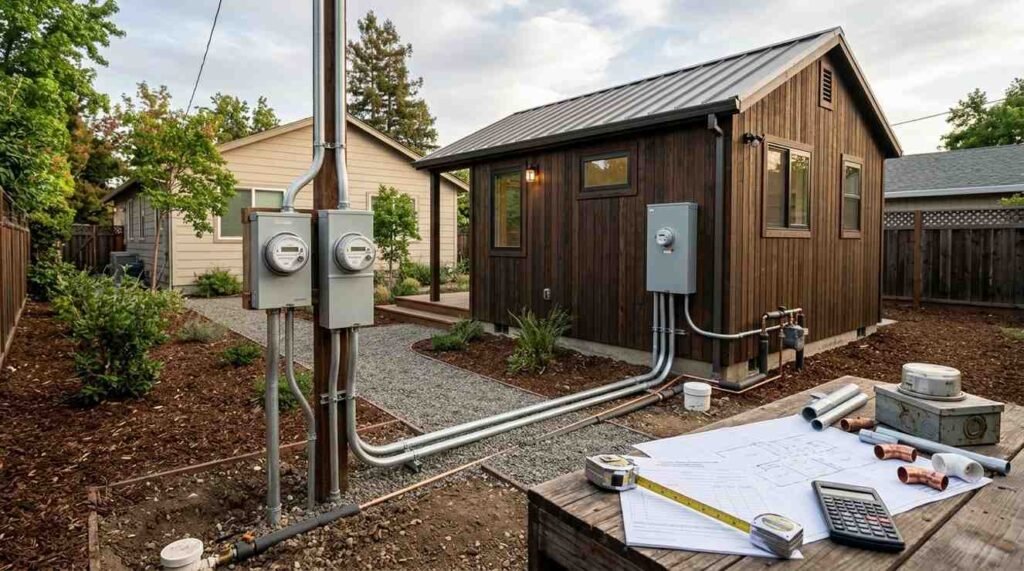
An ADU utility hookup is the physical and administrative process of connecting an accessory dwelling unit to electricity, water, sewer, and gas service. Separate metering decides whether that unit gets its own utility account or shares the main home’s. Both choices shape cost, billing, and resale.
I see owners commit to a floor plan before they check the panel, the water tap, or the sewer lateral. That single order of operations drives most ADU budget overruns I encounter.
Here I cover electrical service, water, sewer and septic, gas, connection and impact fees, permits, the separate-meter decision, tenant billing, future loads, and maintenance.
What Utility Hookups and Separate Metering Mean for an ADU
A utility hookup is the physical connection between an ADU and a service source. Separate metering is the administrative layer on top of it: whose name the account sits in, and who gets the bill.
Those two things get confused constantly. A unit can have its own dedicated water line and still sit on the main house’s water meter. It can also share a trench with the main house and still carry its own utility-owned electric meter.
I treat the hookup as an engineering question and the metering as an ownership question. Keeping them separate in your head makes every later decision cleaner.
Shared (Sub-Metered) vs. Separate (Utility-Owned) Service
Shared service means the ADU draws from the primary residence’s existing connections. One meter, one bill, one account holder. Any split between the main house and the ADU tenant utility billing happens privately, through a sub-meter or an allowance.
Separate service means the utility installs a dedicated meter for the ADU. The unit becomes its own customer of record with its own account number and its own monthly statement.
Sub-metering sits between the two. The ADU shares the utility connection, but a privately owned meter measures its usage so the owner can bill accurately.
The Four Utility Systems Every ADU Needs
Every ADU touches four systems: electrical, potable water, wastewater, and in many builds, natural gas. Each has its own hookup path, its own fee schedule, and its own metering rules.
Electrical is the one that drives the most rework, because panel capacity limits everything downstream. Wastewater is the one that surprises people most, since a sewer lateral or septic field carries fixed capacity you cannot negotiate.
Data and telecom ride along separately. Those connect on a private contract with a provider and carry no utility meter.
Who Owns, Bills, and Maintains Each Connection
Ownership usually splits at the meter. The utility owns and maintains everything upstream of the meter. The property owner owns and maintains everything downstream, including the service entrance, the panel, and the interior distribution.
That split matters when something fails. A leak on the utility side gets repaired by the utility. A leak between the meter and the ADU falls to the owner, which is where emergency plumbing repair services become a landlord expense rather than a utility ticket.
I tell owners to photograph and document every buried line before backfill. That record saves real money five years later.
Electrical Service for an ADU: Panels, Subpanels, and Meters
Electrical service is where ADU utility planning either goes smoothly or falls apart. The existing home’s service capacity sets a hard ceiling on what you add without an upgrade.
Most older single-family homes carry 100-amp or 125-amp service. A modern ADU with a heat pump, an induction range, and a dryer pushes that ceiling fast.
Load Calculation and Existing Service Capacity
An electrician runs a load calculation under NEC Article 220 to determine whether the existing service supports the added dwelling. That calculation accounts for square footage, fixed appliances, HVAC, and any EV charging.
The answer arrives as a number in amps. It either fits inside your existing service or it does not, and that single number reshapes the budget.
Get this done before design lock. A load calculation costs a fraction of a service upgrade discovered mid-build.
Subpanel Feed vs. Separate Meter Socket
A subpanel feed runs a dedicated circuit from the main panel to a panel inside the ADU. It is the cheaper path, and it keeps everything on one utility account.
A separate meter socket creates an independent service point. The utility sets a second meter, and the ADU becomes its own account. That path costs more upfront and takes longer to coordinate, but it produces clean billing separation.
Some jurisdictions and utilities require separate meters for rented units. Others prohibit them on the same parcel. Confirm the local rule before you price anything, and expect electrical panel upgrade work to enter the conversation either way.
Service Upgrades, Trenching, and Utility Coordination
A service upgrade replaces the main panel and often the service drop or lateral. Overhead upgrades move quickly. Underground upgrades involve trenching, conduit, and utility scheduling, which stretches the timeline.
Trench length drives cost more than almost any other variable. Every extra foot of conduit between the meter and the ADU adds labor, material, and restoration.
I plan trench routes to share paths with water and sewer where code allows separation distances. One open trench beats three.
Water Supply and Sub-Metering Options for ADUs
Water is usually the simplest hookup and the easiest metering decision. Most ADUs tap the existing water service rather than pull a new one from the main.
The exception is capacity. An undersized existing service, typically a 3/4-inch line already serving a full house, sometimes cannot carry a second dwelling at acceptable pressure.
Tapping the Existing Service vs. a New Water Tap
Tapping the existing service means branching off the private line downstream of the current meter. It is fast, inexpensive, and keeps one water account.
A new water tap means the utility cuts into the main in the street and sets a second meter. That triggers a tap fee, a meter fee, street restoration, and often a capacity charge.
I recommend a pressure test on the existing service first. A quick static and flow reading tells you whether a branch works before you spend anything, and it flags whether whole-house repiping belongs in scope.
Private Sub-Meters and Billing Pass-Through
A private sub-meter measures ADU water use without involving the utility. The owner reads it, calculates the tenant’s share, and bills accordingly.
Sub-meters install on the branch line serving the ADU and cost far less than a utility tap. They also require the owner to handle reading, invoicing, and dispute resolution.
Many states regulate how landlords pass water charges to tenants. Check your state’s rules before you build the billing method into a lease.
Sewer, Septic, and Wastewater Connections
Wastewater carries the most fixed constraints of any ADU utility. You cannot expand a municipal lateral’s slope or a septic field’s absorption capacity by spending more.
This is the system I investigate first on any lot outside a dense urban core.
Lateral Tie-In, Cleanouts, and Backwater Valves
A lateral tie-in connects the ADU’s drain line to the existing sewer lateral. The connection needs proper slope, typically a quarter inch per foot on smaller lines, plus an accessible cleanout.
Backwater valves protect against municipal backups pushing into the lower fixture. Many jurisdictions require one on any new connection below the upstream manhole rim.
An older clay or cast-iron lateral raises the stakes. I run a camera inspection before tying in, because sewer line repair and replacement discovered after the ADU is framed costs multiples of what it costs before.
Septic Capacity, Perc Testing, and System Expansion
Septic systems get sized by bedroom count, not square footage. Adding an ADU adds bedrooms, which usually means the county requires a capacity review.
A percolation test measures how fast soil absorbs water and determines whether the existing drain field handles the load. A failed perc test forces either a system upgrade, an alternative treatment unit, or a smaller ADU.
Separate metering does not apply to septic. There is no meter, so tenant cost-sharing happens through rent or a flat allowance.
Gas Service, All-Electric Design, and Fuel Choice
Gas is the one utility many ADUs skip entirely now. The decision affects appliance selection, venting, and the size of the electrical service.
Fuel choice locks in early. Switching after rough-in means new lines, new appliances, and often a new load calculation.
Extending an Existing Gas Line vs. a New Gas Meter
Extending the existing line means running a branch from the current meter to the ADU, with a pressure and capacity check on the existing regulator. One meter, one bill.
A new gas meter means the utility sets a second service point. Gas utilities often charge a service extension fee based on distance from the main, and some waive it when projected usage clears a threshold.
Gas appliances need combustion air and venting. That constraint shapes ADU floor plans in ways electric appliances do not, and it pulls HVAC installation and replacement into the design conversation early.
Why Many ADUs Now Skip Gas Entirely
All-electric ADUs eliminate a meter, a trench, a permit path, and a set of venting requirements. Heat pumps handle space conditioning and water heating efficiently in most US climates.
Dozens of California cities and a growing number elsewhere restrict new gas connections outright. All-electric design sidesteps that regulatory risk completely.
The tradeoff lands on the electrical side. An all-electric ADU pushes more load onto the panel, which makes the load calculation even more decisive.
Utility Connection Fees, Impact Fees, and Total Cost Drivers
Utility costs on an ADU split into two buckets: fees the jurisdiction and utility charge, and construction costs your contractor charges. Owners routinely budget the second and forget the first.
The fee side varies enormously by location. Two identical ADUs a county line apart carry wildly different fee totals.
Connection Fees vs. Capacity and Impact Fees
A connection fee covers the physical act of connecting: the tap, the meter, the inspection. It is generally modest and predictable.
A capacity or impact fee covers the ADU’s share of system-wide infrastructure. These run far higher and get assessed per dwelling unit or per fixture count.
Many states now cap or waive impact fees for smaller ADUs. California waives them entirely for units under 750 square feet under state ADU law, which changes the math on unit sizing.
Cost Drivers: Distance, Trenching, and Site Conditions
Distance from the ADU to each connection point drives the largest variable cost. A unit sited fifteen feet from the main panel and the sewer cleanout costs a fraction of one sited eighty feet back.
Site conditions compound it. Rock, high water table, mature tree roots, existing hardscape, and driveway crossings each add cost and time.
I walk the trench route before siting the unit. Moving an ADU ten feet on paper saves thousands in the ground, and it reduces the amount of driveway and concrete restoration needed after backfill.
Cost Comparison Table: Shared vs. Separate Metering
| Factor | Shared Service + Sub-Meter | Separate Utility Meters |
| Upfront cost | Lower | Higher |
| Fee exposure | Fewer connection and capacity fees | Full fee schedule per utility |
| Timeline | Shorter, fewer utility approvals | Longer, utility scheduling dependent |
| Billing clarity | Owner-managed, requires reading | Fully automatic, tenant-direct |
| Tenant disputes | Possible over allocation | Rare |
| Resale flexibility | Limited for future condo split | Strong |
| Ongoing owner effort | Monthly reading and invoicing | None |
Permits, Inspections, and Utility Approval Sequence
Utility approvals run on a different track than building permits, and they rarely move at the same speed. Understanding the sequence prevents idle crews and expired approvals.
Each utility maintains its own application, its own review queue, and its own inspection requirements.
The Typical Approval Order
The usual order runs: building permit application, utility will-serve letters, plan review, permit issuance, trenching and rough-in, utility inspection, meter set, then final inspection and certificate of occupancy.
Will-serve letters matter more than owners expect. That letter is the utility confirming it has capacity and will provide service, and many jurisdictions refuse to issue a building permit without it.
Meter sets happen near the end. The utility schedules that visit after passing inspection, and the wait varies from days to months.
Common Delays and How Timelines Stack
Utility scheduling is the most common delay I see. Service upgrades and new meter sets queue behind whatever the utility already has booked.
Failed inspections compound it. A rejected trench inspection means re-scheduling both the correction and the utility follow-up, and those queues rarely align.
I submit utility applications the same week the building permit application goes in. Parallel tracks beat sequential ones every time.
How to Decide: Separate Meters or Shared Service
The right answer depends on what you plan to do with the property, not on which option costs less today. I frame it around a single question: who pays the utility bill in five years?
Get that answer right and the metering choice follows naturally.
Decision Factors by Owner Goal
Renting to an unrelated tenant favors separate meters or at minimum a sub-meter. Clean billing separation removes the most common landlord-tenant friction point.
Housing family members usually favors shared service. The administrative simplicity outweighs the billing precision when nobody is invoicing anybody.
Planning a future condo conversion or lot split strongly favors separate meters. Retrofitting them later costs far more than installing them during construction.
Decision Matrix: Rental, Family, or Future Sale
| Owner Goal | Recommended Approach | Primary Reason |
| Long-term rental to a tenant | Separate meters | Automatic billing, no disputes |
| Short-term rental | Shared service | Utilities bundled into nightly rate |
| Family member housing | Shared service | Lowest cost, simplest setup |
| Home office or studio | Shared service | Usage is minor and irregular |
| Future condo split or sale | Separate meters | Required for independent title |
| Uncertain future use | Shared service + sub-meter | Preserves options, moderate cost |
Does an ADU need its own utility meters, or is sub-metering enough? Most ADUs function fine on shared service with a sub-meter. Separate meters become necessary when local code requires them or when the property will eventually be sold or titled independently.
Landlord Billing, Tenant Metering, and Legal Considerations
Once the ADU is occupied by a paying tenant, utility billing becomes a legal question as much as a technical one. States regulate how landlords recover utility costs, and the rules vary widely.
I keep this simple: measure what you bill, and disclose the method in writing before move-in.
RUBS, Sub-Metering, and Flat Utility Allowances
RUBS stands for Ratio Utility Billing System. It allocates a shared bill by square footage, occupancy, or fixture count rather than by measured usage.
Sub-metering measures actual consumption and bills accordingly. It is the most defensible method and the one tenants dispute least.
A flat allowance folds a fixed utility amount into rent. It is the simplest option and works well when usage is predictable and modest.
Disclosure and Lease Language Basics
The lease needs to state which utilities the tenant pays, how the amount gets calculated, and when the bill arrives. Vagueness here creates disputes.
Several states require landlords to disclose sub-metering arrangements and cap administrative markups. Some prohibit charging tenants more than the utility charges the owner.
I have an attorney review utility billing language once, then reuse it. That one review pays for itself across every lease that follows.
Solar, Batteries, EV Charging, and Future Utility Loads
An ADU changes the property’s electrical profile permanently. Planning for future loads during the initial hookup costs a fraction of retrofitting later.
I size conduit and panel space for what the property needs in ten years, not what it needs on move-in day.
Solar interacts directly with metering. A shared meter lets one solar array offset both dwellings under net metering. Separate meters require the array to be assigned to one account, which complicates the economics considerably.
EV charging deserves specific attention. A Level 2 charger adds a substantial continuous load, and tenants increasingly expect one. Adding capacity during the initial electrical wiring and circuit installation costs far less than a second trench.
Battery storage adds another consideration. Backup systems need dedicated panel space and a defined critical-load subpanel, which is a design decision, not an afterthought.
Maintenance, Shutoffs, and Emergency Access After Hookup
Hookup day is the beginning of the relationship, not the end. Every connection you install becomes something someone maintains.
Label every shutoff clearly and permanently. Water main, ADU branch valve, gas shutoff, main breaker, and ADU breaker each need a visible, weather-resistant tag.
Tenants need access to their own shutoffs. A water valve locked behind the main house’s gate is a liability during a burst-pipe event at two in the morning.
Seasonal maintenance matters more on shared systems. A clogged shared sewer lateral affects both dwellings at once, and annual attention from drain cleaning services prevents the failure that displaces two households instead of one.
I keep a laminated utility map in the ADU’s electrical panel door. Every technician who opens that panel finds the whole system documented.
Working With Licensed Trades on ADU Utility Work
ADU utility work touches licensed electrical, plumbing, and mechanical trades, and most jurisdictions require licensed contractors to pull those permits. Unpermitted utility work fails at inspection and creates disclosure problems at sale.
Coordination is the real challenge. The electrician, the plumber, and the excavator all need the same trench at different times, and a missed handoff costs a week.
I hire trades that have completed ADU projects specifically. ADU utility work carries jurisdiction-specific quirks that a contractor learns by doing it repeatedly, and a general handyman service handles the finish work while licensed trades handle the connections.
Ask for the license number, the utility coordination experience, and two references from ADU projects in the same jurisdiction. That three-part check filters out most of the risk.
Conclusion
I covered ADU electrical service, water and sub-metering, sewer and septic, gas, connection and impact fees, permit sequencing, and the separate-meter decision framework.
Each of these subtopics runs deeper than a hub page allows, and dedicated guides on panel upgrades, sewer connections, and tenant billing carry that detail.
We match homeowners with licensed, ADU-experienced trades. Contact Mr. Local Services to plan your utility hookups before the first shovel moves.
Frequently Asked Questions
Does an ADU require its own electric meter?
It depends on local code and utility policy. Many jurisdictions allow a subpanel fed from the main house, while others require a dedicated utility-owned meter for rented units.
How much does it cost to connect utilities to an ADU?
Costs vary widely by location, distance, and site conditions. Fees, trenching, and any required service upgrades drive the total far more than the meters themselves.
Can an ADU share a water meter with the main house?
Yes, in most jurisdictions. The ADU branches off the existing service, and owners use a private sub-meter when they need to measure and bill tenant usage separately.
Do I need a new sewer connection for an ADU?
Usually not. Most ADUs tie into the existing sewer lateral, provided that lateral has adequate slope, sound condition, and an accessible cleanout for maintenance.
Are impact fees charged on ADU utility connections?
Sometimes. Many states now waive or cap impact fees for smaller ADUs, so the fee schedule depends entirely on unit size and local jurisdiction rules.
What happens if my electrical panel is too small for an ADU?
You upgrade the service. A load calculation determines the required capacity, and the upgrade replaces the main panel and often the service drop or lateral.
Should I build an all-electric ADU?
All-electric design removes a gas meter, trench, and venting requirements. It shifts more demand onto the electrical service, which makes the load calculation more important.