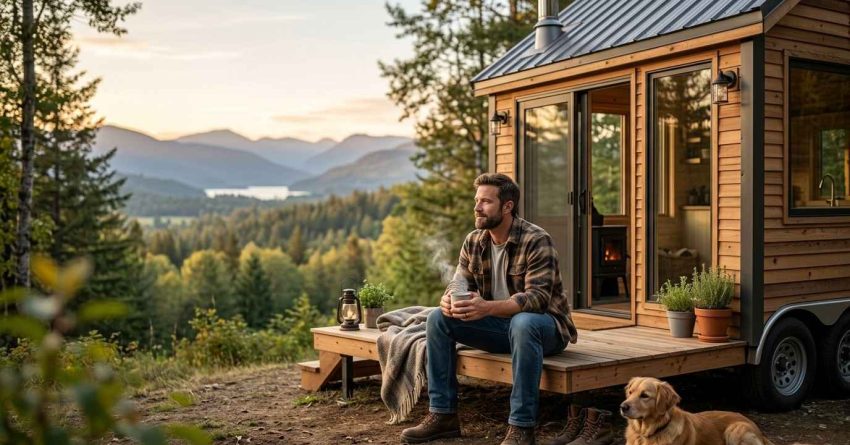
Texas, Colorado, Tennessee, Oregon, Florida, and New Mexico consistently rank as the best states for full-time THOW living — offering a combination of flexible zoning laws, affordable land access, and year-round livability that makes permanent tiny home life genuinely practical.
Choosing the wrong state can mean fines, forced relocation, or costly retrofits before you ever settle in.
This guide breaks down the top states for THOW living, what makes each one work, where to be cautious, and how to find legal land so you can make a confident, informed decision.
What Makes a State Ideal for Full-Time THOW Living?
Not every state treats a tiny home on wheels the same way. Some classify THOWs as recreational vehicles. Others treat them as manufactured housing. A few have no clear classification at all — which creates both opportunity and risk for full-time residents.
Three factors determine whether a state is genuinely livable for THOW owners.
Zoning and Land Use Laws
Zoning is the single biggest barrier to full-time THOW living. Most residential zones in the United States prohibit placing a THOW on a lot as a primary dwelling. The states that work best for THOW residents have either passed zoning reform legislation, allow agricultural or rural land use with minimal restrictions, or have counties that simply do not enforce residential zoning at the same level as urban areas.
Understanding how zoning affects placement is just one part of the equation — our tiny home regulations guide covers the full legal landscape for building, placing, and living in a THOW across the United States.
RV and Tiny Home Registration Requirements
Most THOWs are registered as RVs through the DMV, which means they fall under vehicle law rather than building code in many states. States with straightforward RV titling processes, low registration fees, and no mandatory annual inspections make ownership significantly easier. Some states — particularly those with active tiny home advocacy communities — have created hybrid classifications that give THOW owners more legal clarity.
Climate and Year-Round Livability
A THOW is a small structure. Extreme heat, hard freezes, and high humidity all create maintenance challenges that compound over time. The best states for full-time THOW living offer mild winters, manageable summers, or at minimum, a climate your specific build can handle with reasonable insulation and HVAC investment.
Top States for Full-Time THOW Living in 2025
The following states offer the strongest combination of legal access, land availability, community support, and livability for full-time THOW residents.
Texas
Texas is one of the most THOW-friendly states in the country. The state has no income tax, a large rural land market with relatively affordable per-acre prices, and county-level zoning that is often minimal or nonexistent outside city limits. Many Texas counties allow THOWs on private land with no permit required beyond standard RV registration.
The challenge in Texas is heat. Summers in central and south Texas regularly exceed 100°F, which demands serious insulation, a high-capacity mini-split system, and careful attention to roof ventilation. The Gulf Coast also carries hurricane risk that requires storm preparation planning.
Before committing to a Texas location, reviewing a complete tiny home setup guide will help you understand what infrastructure, permits, and utility connections your THOW will need on arrival.
Colorado
Colorado has become a hub for the tiny home movement, driven partly by its housing affordability crisis and partly by a culture that embraces alternative living. The state passed legislation encouraging accessory dwelling units and has several counties — including Costilla and Huerfano — that are known for welcoming off-grid and alternative housing.
The trade-off is altitude and winter. Mountain living in a THOW requires serious cold-weather preparation: spray foam insulation, a propane or wood backup heat source, and pipe freeze protection. At elevations above 7,000 feet, solar generation is excellent but wind loads on a small structure can be significant.
Oregon
Oregon passed HB 2001 in 2019, which required cities to allow more housing types in residential zones — a shift that opened doors for tiny home advocates across the state. Several Oregon counties have since adopted explicit THOW-friendly ordinances, and the state has an active tiny home community with established networks for land access and legal guidance.
The Pacific Northwest climate is mild but wet. Moisture management is the primary maintenance concern for THOW owners in Oregon — proper roof sealing, ventilation, and mold prevention are non-negotiable in a high-rainfall environment.
Tennessee
Tennessee offers low property taxes, no state income tax, and a rural land market that gives THOW owners genuine options for affordable long-term placement. The state has seen significant tiny home community development, particularly in the eastern mountain regions and around Nashville’s outer counties.
Zoning in Tennessee varies significantly by county. Some counties have embraced tiny home development; others have not updated their codes in decades, which can work in your favor in rural areas or create unexpected barriers in semi-rural ones. Research at the county level before purchasing land.
Florida
Florida’s appeal for THOW living is its climate — mild winters, no state income tax, and a massive network of RV parks and campgrounds that accept long-term residents. For THOW owners who prefer a community setting over private land, Florida offers more established options than almost any other state.
The concerns are real: hurricane season runs June through November, and coastal humidity accelerates wear on roofing, siding, and mechanical systems. Interior Florida offers more stability, but even there, summer heat and humidity demand a reliable HVAC system and consistent maintenance attention.
New Mexico
New Mexico is one of the most accessible states for off-grid THOW living. Large portions of the state have minimal zoning enforcement, land prices in rural areas remain low, and the high desert climate offers abundant solar potential with low humidity. Several intentional communities and off-grid homesteads in New Mexico have established legal frameworks that welcome THOW residents.
Water access is the primary challenge. New Mexico is an arid state, and water rights, well drilling, and rainwater collection laws all require research before committing to a location. The state does allow rainwater harvesting, which is a meaningful advantage for off-grid setups.
States With the Most THOW-Friendly Zoning Laws
Beyond the top six, several states have made legislative progress that benefits THOW owners specifically.
California has passed significant ADU and tiny home legislation, though high land costs and strict building codes in many counties offset the legal gains. Washington state has followed Oregon’s lead with zoning reform in several counties. Arizona offers rural land access similar to New Mexico with slightly more water availability in some regions.
The common thread in THOW-friendly states is county-level flexibility. State law sets the floor, but counties set the practical rules. Always verify zoning at the county and municipality level — not just the state level — before making any land or placement decision.
States to Approach With Caution for THOW Living
Some states present consistent barriers for full-time THOW residents. These are not impossible — but they require significantly more legal navigation.
Massachusetts, New Jersey, and Connecticut have dense populations, high land costs, and restrictive local zoning that rarely accommodates THOWs as primary dwellings. HOA prevalence in these states adds another layer of restriction.
Hawaii has strong appeal but extremely limited land availability, high cost of living, and strict agricultural land use laws that make THOW placement difficult outside of designated RV areas.
Illinois and Michigan have cold winters that demand serious cold-weather builds, combined with zoning environments that vary widely and often default to restrictive in suburban and semi-rural areas.
None of these states are impossible for THOW living — but they require more legal groundwork, more community research, and often more investment in your build before you can live comfortably and legally.
How to Find Legal Parking and Land for Your THOW
Finding a legal, long-term home for your THOW is often harder than choosing a state. The options fall into three main categories.
Private Land Agreements
Renting or purchasing a small parcel of private land gives you the most control over your living situation. In rural counties with minimal zoning, this is often the most straightforward path. A written land lease or purchase agreement protects both parties and establishes your legal right to occupy the land with your THOW.
Agreements should specify utility access, duration, termination terms, and any restrictions on structures or improvements. Verbal agreements are common in rural areas but create significant legal risk.
RV Parks and Tiny Home Communities
Established RV parks and purpose-built tiny home communities offer immediate infrastructure — water, sewer, and electrical hookups — along with a legal framework that already accommodates THOW residents. Monthly costs vary widely by location and amenity level, but this option eliminates most of the zoning research burden.
For a deeper look at how to evaluate and choose the right placement option, our resource on tiny home communities outlines what to look for in RV parks, land-lease arrangements, and purpose-built THOW neighborhoods.
Agricultural and Rural Zoning Options
Agricultural-zoned land in many states allows accessory structures and alternative housing with fewer restrictions than residential zones. Some states explicitly allow a THOW as a caretaker dwelling on agricultural land. This option often provides the most space and privacy at the lowest cost, but requires careful zoning verification and sometimes a formal agricultural use plan.
Utility Hookups and Off-Grid Living by State
Your utility strategy depends heavily on where you land. States with strong rural infrastructure — Texas, Tennessee, Florida — make grid-tied hookups relatively accessible even on private land. States with large off-grid communities — New Mexico, Colorado, Oregon — have established solar, rainwater, and composting toilet frameworks that make off-grid living more practical.
Key considerations by approach:
Grid-tied living requires proximity to utility infrastructure, an electrician to run service to your THOW, and in some cases a permit for the hookup itself. Water and sewer connections follow similar permitting requirements.
Off-grid living requires a solar array sized to your actual consumption, a battery storage system, a water source (well, cistern, or delivery), and a waste management solution (composting toilet, septic, or holding tank with pump-out service). State laws on rainwater collection, greywater disposal, and composting toilets vary — verify before building your system.
Cost of Full-Time THOW Living Across States
Monthly costs for full-time THOW living vary significantly by state, land arrangement, and utility setup. A realistic budget includes land or site rent, utilities, insurance, maintenance, and registration.
In low-cost states like Tennessee, New Mexico, and rural Texas, total monthly costs for a THOW owner on private land can range from $600 to $1,200 depending on utility setup and land rent. RV park living in Florida or Colorado typically runs $500 to $1,500 per month for a full-hookup site. California and the Pacific Northwest carry higher land costs that push monthly totals significantly higher.
Budgeting accurately for life on the road starts with understanding every expense category — our breakdown of full-time THOW costs covers land rent, utility hookups, insurance, and ongoing maintenance across different states.
THOW Maintenance Considerations by Climate
Every climate creates specific maintenance demands for a tiny home on wheels. Addressing these proactively protects your investment and prevents costly repairs.
Hot and humid climates (Florida, Gulf Coast Texas) require consistent HVAC maintenance, roof inspection for heat damage and moisture intrusion, and attention to siding and window seals that expand and contract with temperature swings.
Cold and mountain climates (Colorado, northern Tennessee, Oregon highlands) demand pipe insulation, skirting to protect the undercarriage from freeze damage, and roof load management during heavy snow seasons.
Arid climates (New Mexico, Arizona) create UV degradation on roofing materials and exterior finishes faster than humid climates. Roof coatings and exterior paint need more frequent attention, and dust infiltration into mechanical systems is a real concern.
Keeping your tiny home in top condition regardless of where you land requires consistent upkeep — our THOW maintenance tips section walks through the most common climate-related repairs and seasonal service needs.
Conclusion
The best state for full-time THOW living depends on your priorities — whether that is zoning flexibility, climate comfort, land affordability, or access to established tiny home communities. Texas, Colorado, Oregon, Tennessee, Florida, and New Mexico each offer a distinct combination of advantages that suit different lifestyles and budgets.
Researching at the county level, understanding your utility options, and building a realistic monthly budget before you commit will save you significant time, money, and frustration down the road.
At Mr. Local Services, we connect THOW owners with skilled professionals for everything from initial setup and utility hookups to ongoing maintenance — so your tiny home stays safe, functional, and ready for wherever life takes you.
Frequently Asked Questions
What is a THOW and how is it different from an RV?
A THOW, or tiny home on wheels, is a custom-built residential structure on a trailer chassis designed for full-time living. Unlike a standard RV, a THOW is typically built to residential construction standards with higher-quality insulation, finishes, and systems, though it is usually registered as an RV for legal purposes.
Do I need a permit to live in a THOW full time?
Permit requirements depend entirely on your state and county. Some rural counties require no permit beyond standard RV registration. Others require a land use permit, a septic permit, or a building inspection. Always verify requirements at the county level before placing your THOW on any land.
Can I park my THOW on my own property?
In many rural and agricultural zones, yes. In most residential zones, no — local zoning codes typically prohibit using a THOW as a primary dwelling on a residential lot. Some states have passed legislation creating exceptions, but enforcement and interpretation vary by municipality.
What is the cheapest state to live in a tiny home on wheels?
Tennessee, New Mexico, and rural Texas consistently offer the lowest combined costs for THOW living, including land access, registration fees, and overall cost of living. Monthly totals on private land in these states can fall between $600 and $1,200 depending on utility setup.
How do I find land to park my THOW legally?
The most reliable approaches are private land leases in rural counties with minimal zoning, established RV parks and tiny home communities that accept long-term residents, and agricultural-zoned land where caretaker dwellings are permitted. Online platforms, local tiny home Facebook groups, and state tiny home advocacy organizations are practical starting points for finding available land.