
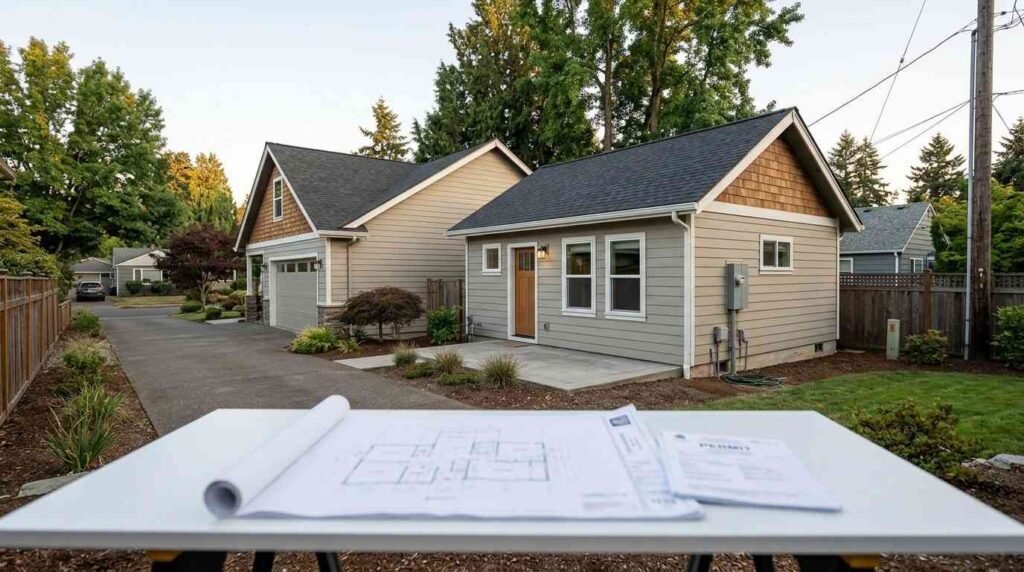
An accessory dwelling unit is a secondary, self-contained home on a lot that already holds a primary residence. Its legal classification decides your permit path, your zoning limits, your financing, and whether you can rent it at all.
ADU rules changed fast across the country. I watch owners lose months and thousands of dollars because they built first and checked classification second.
This guide covers definitions, classification types, zoning, permits, state-by-state law, utilities, rental rules, taxes, compliance mistakes, and the service roadmap to build legally.
What an ADU Is and How the Law Defines It
An accessory dwelling unit is a legally recognized housing type that sits secondary to a primary dwelling on the same parcel. Every state that regulates ADUs uses that same core idea: independent living, subordinate status, one lot.
The word “independent” does the heavy lifting. To count as a dwelling unit, the space needs its own sleeping area, its own cooking facilities, and its own bathroom.
Strip out the kitchen and you no longer have an ADU. You have a bedroom addition, a guest suite, or a home office.
The Legal Definition of an Accessory Dwelling Unit
Most codes phrase it this way: an ADU is an attached or detached residential dwelling unit that provides complete independent living facilities for one or more persons on a lot with a proposed or existing primary dwelling.
That definition comes almost verbatim from California Government Code Section 66313, which many other states copied. The language matters because permit reviewers read it literally.
I tell owners to underline three phrases: complete independent living facilities, same lot, existing primary dwelling. Miss one and the classification collapses.
Why Legal Classification Determines Everything Else
Classification is not paperwork trivia. It sets the code chapter your project falls under, the fees you pay, the setbacks you honor, and the loan products you qualify for.
A detached ADU and a junior ADU on the same street follow different rules entirely. One triggers a full permit and inspection process, the other often moves through a streamlined review.
Get the classification right on day one and the rest of the project follows a predictable path.
Common Terms: ADU, Granny Flat, In-Law Suite, Casita
Homeowners use casual names. Granny flat, in-law suite, casita, backyard cottage, carriage house, laneway house, secondary suite.
None of those terms appear in most building codes. They describe the same legal object with regional flavor.
I use the local code term on every application. Plan reviewers respond to their own vocabulary, and using it removes a round of correction letters.
The Main ADU Classifications Explained
There are five classifications that cover nearly every ADU built in the United States. Each one carries a different cost profile, a different permit path, and a different set of zoning limits.
Knowing which bucket your project lands in tells you almost everything about your timeline. The national ADU inventory tracked by Freddie Mac identified more than 1.4 million properties with ADU characteristics, and detached units dominate that count.
Detached ADUs
A detached ADU stands as its own structure, separated from the primary home. Backyard cottages, converted standalone garages, and purpose-built small homes all land here.
Detached units carry the highest build cost because they need their own foundation, roof, and utility runs. They also deliver the most privacy and the strongest resale contribution.
Setback rules govern how close the structure sits to your rear and side property lines.
Attached ADUs
An attached ADU shares at least one wall with the primary residence but keeps a separate entrance and complete independent facilities. Think of a bump-out addition with its own door.
Fire separation between the two units becomes the central code issue. Shared walls typically need a one-hour rated assembly.
Attached units cost less than detached builds because they piggyback on existing structure and utility infrastructure.
Interior / Conversion ADUs
Interior ADUs carve living space out of what already exists. Basements, attics, and unused first-floor wings convert into legal units without expanding the building footprint.
Ceiling height, egress windows, and moisture control drive most basement conversion failures. A basement ADU needs a legal exit that a person can climb through in an emergency.
These conversions often need drywall and ceiling work plus significant electrical upgrades before they pass inspection.
Garage Conversion ADUs
Garage conversions are the most common ADU project I see, and the most commonly done wrong. An attached garage becomes an attached ADU; a detached garage becomes a detached ADU.
The conversion trades parking for living space, which older zoning codes penalized. Statewide reform laws in California, Oregon, and Washington stripped most replacement-parking mandates out of the picture.
Slab insulation, headroom, and the old garage door opening are the three technical hurdles.
Junior ADUs (JADUs)
A junior ADU is a distinct legal class, not a small ADU. California caps a JADU at 500 square feet, requires it to be carved from the existing walls of the primary home, and permits a shared bathroom with the main house.
JADUs allow an efficiency kitchen instead of a full one. That lowers plumbing and electrical demand dramatically.
Many jurisdictions let an owner build one ADU and one JADU on the same single-family lot.
How Zoning Codes Classify ADUs
Zoning answers a different question than building code. Building code asks whether the structure is safe; zoning asks whether it belongs on this lot at all.
Every ADU project passes through both. Zoning review comes first, and it kills more projects than any inspector does.
Single-Family vs. Multifamily Zoning
Traditional single-family zoning banned second units outright. Statewide reform laws rewrote that in a wave of legislation beginning around 2016.
Multifamily-zoned parcels get their own treatment. California allows ADUs inside existing multifamily buildings plus detached units on the same lot, scaled to the number of existing apartments.
Confirm your parcel’s zoning designation before drawing anything.
Lot Size, Setbacks, and Height Limits
Minimum lot size requirements largely disappeared in reform states. What remains are setbacks, height caps, and lot coverage limits.
Four-foot rear and side setbacks became the reform-state standard for detached units. Height caps typically land between 16 and 25 feet depending on unit type and proximity to transit.
Lot coverage limits still bite on small urban parcels where the primary home already fills most of the buildable area.
Owner-Occupancy and Deed Restrictions
Owner-occupancy requirements force the property owner to live in one of the units. These rules gutted ADU production wherever they applied.
California suspended owner-occupancy requirements for standard ADUs, though JADUs still carry them. Other states kept the requirement, and some cities enforce it through a recorded deed restriction.
A deed restriction follows the property through sale, so I check the title before any renovation planning begins.
Building Codes, Permits, and Inspections
Building code compliance is where classification turns into concrete requirements. Insulation values, egress dimensions, smoke and carbon monoxide alarms, and electrical service capacity all get verified here.
The International Residential Code governs most ADU construction, adopted with state and local amendments. Your jurisdiction publishes which edition it enforces.
Residential Code vs. Commercial Code Triggers
One and two-family dwellings fall under the residential code. Add a third unit or cross certain occupancy thresholds and the commercial code takes over, which raises cost substantially.
Most single-family ADU projects stay comfortably in residential territory. Multifamily lots and multi-unit conversions need a code check early.
Sprinkler requirements are the usual trigger point worth confirming in writing.
The Permit Path from Plan Review to Final Sign-Off
The sequence runs consistently: zoning verification, plan submittal, plan review and correction cycles, permit issuance, staged inspections, then final certificate of occupancy.
Reform states impose statutory review deadlines. California requires ministerial approval within 60 days of a complete application for qualifying ADUs.
Inspections stack in order: foundation, framing, rough electrical and plumbing, insulation, then final. Each one gates the next, and rework at any stage stalls the schedule.
Unpermitted ADUs and Legalization Pathways
Unpermitted units exist in enormous numbers, especially in older housing stock. Selling a property with one creates disclosure problems, appraisal gaps, and insurance exposure.
Many jurisdictions opened amnesty programs that legalize existing units under the code in effect when they were built. That concession avoids full teardown-and-rebuild scenarios.
Legalization usually starts with an as-built survey, then targeted electrical service upgrades and life-safety corrections.
State-by-State ADU Law: How the Map Breaks Down
ADU law splits into three regulatory tiers. Where your state falls determines whether your city can say no.
I group states by how much authority the legislature stripped from local jurisdictions. That framing predicts your experience better than any single statute.
Statewide Mandate States
California, Oregon, Washington, Maine, Montana, Vermont, and New Hampshire preempt local bans and require ministerial approval for qualifying ADUs. Discretionary review, public hearings, and neighbor objections drop out of the process.
California moves the most volume by a wide margin, with the California Department of Housing and Community Development reporting ADUs as a substantial share of all new housing permits statewide.
These states also cap fees, limit parking mandates, and set maximum review timelines.
Partial-Reform and Incentive States
Massachusetts, Connecticut, Rhode Island, Utah, Arizona, Colorado, and Virginia occupy the middle ground. Some mandate ADUs only in certain zones, some allow local opt-outs, some fund grant programs instead of preempting local control.
Massachusetts passed statewide by-right protected ADU allowances in single-family zones through its 2024 housing legislation.
The middle tier changes fast. I verify current statute before quoting timelines in these markets.
Local-Control States
Most of the remaining states leave ADU authority entirely with cities and counties. Outcomes vary block by block within a single metro area.
Texas has no statewide ADU statute, yet Austin runs one of the most permissive local programs in the country. Georgia, Alabama, and much of the Midwest follow similar patchwork logic.
In these markets, the municipal code is the only document that matters.
State Comparison Table
| Tier | Representative States | Local Ban Allowed? | Approval Type | Owner-Occupancy |
| Statewide Mandate | CA, OR, WA, ME, MT, VT, NH | No | Ministerial | Mostly removed |
| Partial Reform | MA, CT, RI, UT, AZ, CO, VA | Limited | Mixed | Varies |
| Local Control | TX, GA, AL, OH, IN, MO | Yes | Discretionary | Common |
Statutes shift every legislative session. I treat this table as a starting map, not a final answer.
Utilities, Addressing, and Impact Fees
Utility classification quietly drives a large share of ADU budget. Whether the unit needs its own meter changes the cost by tens of thousands of dollars.
Address assignment matters too. A separate address supports independent mail, emergency response, and rental listings.
Separate vs. Shared Meters
Detached ADUs on their own service typically need separate electric and water meters. Interior conversions and JADUs usually share the primary home’s service.
California prohibits utilities from requiring a new connection for ADUs contained within an existing structure. That single rule saves owners substantial money on conversions.
Panel capacity is the practical constraint. A 100-amp service rarely supports a second full kitchen plus HVAC without an upgrade.
Impact Fee Waivers and Connection Costs
Impact fees fund schools, parks, and infrastructure, and they historically made ADUs unaffordable. Reform statutes waived them for smaller units.
California waives all impact fees for ADUs under 750 square feet and prorates them above that threshold. Oregon and Washington adopted comparable limits.
Connection fees for sewer and water remain separate from impact fees, and cities charge them differently.
Rental, Occupancy, and Short-Term Rental Rules
ADUs generate income, which is why most owners build them. Rental classification determines what kind of income is legal.
Long-term and short-term rentals sit under completely different regulatory regimes. Conflating them creates violations.
Long-Term Rental Classification
Long-term ADU rental is broadly permitted in reform states. Standard landlord-tenant law applies: lease terms, habitability standards, security deposit rules, and notice requirements.
Occupancy limits follow the local code, generally two persons per bedroom plus one. Rent control ordinances sometimes exempt newly built ADUs for a defined period.
Landlords benefit from documented routine property maintenance that keeps the unit habitable and defensible.
Short-Term Rental Restrictions by Jurisdiction
Short-term rental rules are the strictest layer of ADU law. California bars ADU rentals shorter than 30 days as a condition of the streamlined approval framework.
Cities layer on registration requirements, night caps, and primary-residence conditions. Some ban STR use in ADUs entirely.
I verify short-term rules before an owner builds a business model around nightly rates.
Financing, Appraisal, and Property Tax Impact
Financing an ADU differs from financing a primary home. Lenders and appraisers apply their own classification logic on top of the legal one.
Tax treatment follows construction, and the reassessment rules surprise people.
How Appraisers Classify an ADU
Appraisers evaluate whether the unit is legal, legal-nonconforming, or unpermitted. That status drives the value contribution directly.
Fannie Mae’s selling guide allows a one-unit property with an ADU to be financed as single-family, with rental income counted toward qualification under specific conditions. Renovation loan products fund ADU construction on the same principle.
An unpermitted unit typically receives no value credit. Legalization converts dead square footage into appraised value.
Reassessment and Tax Treatment
Property tax reassessment applies to the new construction only, not the whole property, in most states. The existing home keeps its established assessed value.
California adds the ADU’s assessed value to the base under a blended assessment approach. Owners see a tax increase proportional to the addition, not a full reset.
Rental income becomes reportable, and depreciation plus operating expenses offset it.
Compliance Red Flags and Common Legal Mistakes
I see the same errors repeat across every market. Each one is avoidable with a check performed before construction starts.
The most expensive mistake is building from a contractor’s assurance instead of a written zoning determination.
Kitchen omission is the second. Owners build a “guest suite” without cooking facilities, then discover the space fails ADU classification and cannot be rented as an independent unit.
Setback encroachment ranks third, usually because someone measured from the fence instead of the surveyed property line. Fences sit off the line more often than not.
HOA restrictions catch people late. Reform statutes preempt many HOA ADU bans, though architectural review requirements survive.
Undersized electrical service and inadequate egress round out the list. Both surface at inspection, when correction costs the most.
Building a Legally Compliant ADU: Service Roadmap
A compliant ADU is a coordinated sequence of trades, each gated by an inspection. The order rarely changes.
Site preparation and utility trenching come first, followed by foundation and framing. Rough-in trades follow: plumbing, electrical, and HVAC, each inspected before anything gets covered.
Then insulation, drywall, flooring installation, and interior finish work. Painting, fixtures, and appliance connection close out the build before final inspection.
Conversions run a shorter sequence but add remediation. Basement units frequently need water damage restoration and moisture control before framing begins.
We coordinate licensed, insured, and permit-experienced professionals across every one of these trades. That coordination is what keeps a project on schedule and inside code.
Conclusion
ADU legal classification connects definition, zoning, permits, utilities, rental rules, and tax treatment into one dependent chain that governs the entire project.
State law keeps expanding ADU rights, and dedicated guides on permits, conversions, and financing go deeper on each stage covered here.
We help homeowners and property managers build compliant, inspection-ready ADUs. Contact Mr. Local Services to connect with vetted professionals near you.
Frequently Asked Questions
What makes an ADU legal versus illegal?
A legal ADU has permits, passes inspections, and meets local zoning and building code. Without approved permits and a final sign-off, the unit is unpermitted.
Do all ADUs need a kitchen to qualify?
Yes. Complete independent living facilities require cooking facilities. Junior ADUs allow an efficiency kitchen, but a space with no kitchen fails ADU classification entirely.
Can my city ban ADUs completely?
That depends on your state tier. Statewide mandate states prohibit outright bans, while local-control states let cities restrict or forbid ADUs.
How long does ADU permit approval take?
Reform states cap ministerial review near 60 days from a complete application. Local-control jurisdictions with discretionary review often take several months longer.
Will an ADU increase my property taxes?
Yes, on the new construction value only. Assessors add the ADU’s value to your existing assessment rather than reassessing the whole property.
Is a garage conversion classified as its own ADU type?
It classifies by structure. An attached garage conversion becomes an attached ADU, and a detached garage conversion becomes a detached ADU.
Can I rent my ADU on Airbnb?
Often no. Many jurisdictions require rentals of 30 days or longer in ADUs, and cities layer additional short-term rental registration rules on top.