Choosing the right gutter system during new construction protects your home’s foundation, siding, and landscaping from day one — and getting it right from the start is far less costly than correcting drainage problems after the fact.
New builds offer a rare opportunity to design a complete water management system before walls are finished and landscaping is in place, making material and sizing decisions far more straightforward than retrofitting an existing home.
This guide covers gutter types, materials, sizing, installation, and maintenance so you can make confident decisions for your new home.
What Are Gutter Systems and Why New Builds Need Them
A gutter system is a channel-and-downspout assembly installed along a roof’s edge to collect rainwater and direct it away from the home’s foundation, walls, and landscaping. On a new build, gutters are not optional — they are a structural water management component that prevents erosion, basement flooding, siding deterioration, and foundation settlement.
New construction creates a specific window of opportunity. Before landscaping is established and grading is finalized, contractors can position downspouts and drainage outlets precisely where water needs to go. This coordination is far more difficult after a home is occupied.
Gutter systems are one component of a complete exterior protection plan — our roofing services overview explains how gutters, fascia, soffits, and roofing materials work together to shield a new home from water damage.
How Gutters Protect a New Home’s Foundation
Water that falls from a roofline without gutters concentrates at the base of the home. Over time, this saturates the soil around the foundation, increases hydrostatic pressure against basement walls, and accelerates settling. In new construction, where soil is already disturbed and compacted unevenly, unmanaged runoff compounds these risks significantly.
Properly installed gutters move water at least six feet from the foundation through downspout extensions or underground drainage systems, keeping the soil moisture level stable and the foundation load-bearing capacity intact.
Consequences of Skipping Gutters on New Construction
Omitting gutters from a new build is a common cost-cutting decision that creates expensive problems within the first few years. Fascia boards rot when water runs behind the roofline. Siding stains and warps from splash-back. Landscaping erodes. Basement walls develop moisture intrusion. Each of these issues costs significantly more to repair than the original gutter installation would have.
Types of Gutter Systems for New Construction
New builds can accommodate any gutter profile because fascia boards and rooflines are fresh and unobstructed. The three most common systems used in residential new construction are K-style, half-round, and seamless gutters.
Choosing the right gutter profile is only the first step — our gutter installation options guide covers how each system type is fitted, fastened, and sealed during new construction.
K-Style Gutters
K-style gutters are the most widely installed profile in American residential construction. Their flat back and decorative ogee-shaped front face allow them to mount flush against fascia boards, and their angular interior holds more water volume than a half-round profile of the same width. Standard sizes are 5-inch and 6-inch, with 6-inch recommended for roofs with larger surface areas or steeper pitches.
Half-Round Gutters
Half-round gutters have a curved, semicircular profile that was standard on homes built before the 1950s. They are still specified on craftsman, colonial, and historically styled new builds where architectural authenticity matters. They are slightly less efficient at water volume than K-style but are easier to clean and less prone to corrosion buildup at seams.
Seamless vs. Sectional Gutters
Seamless gutters are fabricated on-site from a continuous coil of metal, cut to the exact length of each roofline run. Because they have no mid-run joints, they eliminate the most common source of gutter leaks. Sectional gutters are pre-cut in standard lengths and joined with connectors, making them a DIY-friendly option but one that requires regular joint maintenance. For new builds, seamless gutters are the professional standard.
Gutter Materials Used in New Home Construction
Material selection affects longevity, maintenance requirements, appearance, and cost. Each material performs differently depending on climate, roof pitch, and architectural style.
Material selection for gutters should align with your roofing and cladding choices — our roofing and exterior materials resource helps homeowners match gutter materials to the full exterior system.
Aluminum Gutters
Aluminum is the most common gutter material in new residential construction across the United States. It is lightweight, rust-resistant, available in a wide range of colors, and compatible with seamless fabrication. Aluminum gutters typically last 20 years with proper maintenance and are cost-effective for most new build budgets.
Vinyl Gutters
Vinyl gutters are the most affordable option and are sold in sectional form at home improvement retailers. They are lightweight and easy to install but become brittle in cold climates and fade with prolonged UV exposure. Vinyl is generally not recommended for new builds in regions with significant temperature swings or heavy snowfall.
Copper Gutters
Copper gutters are a premium choice for high-end new construction. They develop a natural patina over time, require no painting, and can last 50 years or more with minimal maintenance. Copper is significantly more expensive than aluminum or vinyl and requires skilled installation to avoid galvanic corrosion where it contacts other metals.
Steel Gutters
Galvanized and stainless steel gutters offer exceptional strength and are well-suited to new builds in areas with heavy snow loads or high wind exposure. Galvanized steel can rust at cut edges and joints over time, while stainless steel eliminates this risk at a higher cost. Steel gutters are heavier than aluminum and require more robust fascia attachment.
Gutter Sizing and Capacity for New Builds
Gutter sizing is determined by the roof’s drainage area — the square footage of roof surface that directs water toward a given gutter run — combined with the local rainfall intensity. Undersized gutters overflow during heavy rain events, defeating their purpose and directing water exactly where it should not go.
The standard sizing formula used by contractors accounts for roof pitch, drainage area in square feet, and the regional rainfall rate measured in inches per hour. For most single-family new builds, 5-inch K-style gutters handle standard roof sections, while 6-inch gutters are specified for larger roof planes, steeper pitches, or high-rainfall regions.
Downspout Placement and Drainage Planning
Downspouts should be placed at the low end of each gutter run, with one downspout for every 30 to 40 linear feet of gutter as a general guideline. On a new build, downspout locations can be coordinated with underground drainage systems, dry wells, or graded swales before landscaping is installed — a significant advantage over retrofitting. Extensions should direct water at least six feet from the foundation, or connect to a buried drainage pipe that carries runoff to a safe discharge point.
For a dedicated breakdown of downspout sizing and placement rules, our downspout installation guide covers drainage planning specific to new construction. <!–NEW PAGE NEEDED–>
Gutter Guards and Add-Ons for New Construction
Installing gutter guards during new construction is more cost-effective than adding them later because scaffolding and labor are already on-site. Guards reduce the frequency of cleaning and prevent debris accumulation that leads to overflow and ice dam formation in colder climates.
Leaf Guards, Screens, and Covers
Micro-mesh guards are the highest-performing option, blocking fine debris including pine needles and shingle granules while allowing water to pass freely. Screen guards are less expensive and effective against larger debris like leaves and twigs. Solid-cover reverse-curve systems redirect water into the gutter through surface tension but can struggle in heavy downpours. For a full comparison of guard types and performance by climate, our gutter guard options guide covers each system in detail.
How Gutter Installation Works on a New Build
Gutter installation on a new build is typically scheduled after roofing is complete and fascia boards are installed but before exterior painting and landscaping begin. This sequencing protects the fascia from water exposure during the construction period and allows painters to finish around installed gutters cleanly.
For smaller gutter-related tasks after the main installation is complete, such as bracket adjustments or downspout extensions, our handyman installation support team can handle the finishing details.
Coordinating Gutters with Roofing and Fascia
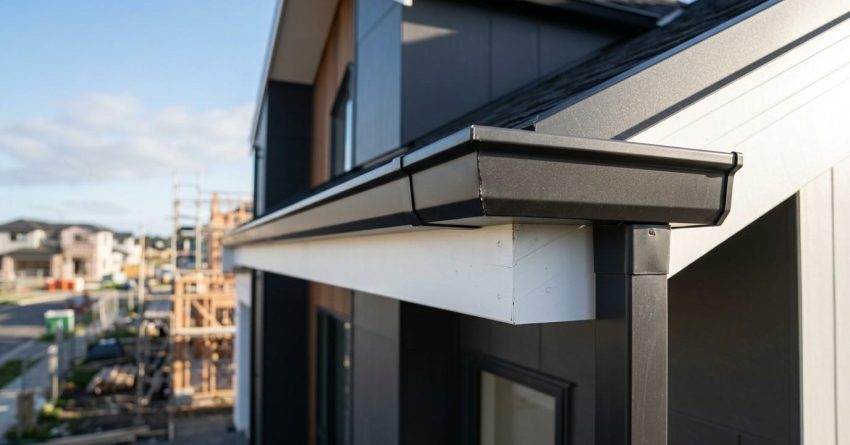
Gutters must be positioned so the back edge sits beneath the first course of roofing material, allowing water to flow off the roof and into the gutter channel without running behind it. The front edge of the gutter should sit below the roofline by approximately one inch to prevent overflow from backing up under the shingles. Fascia boards must be straight, sound, and properly primed before gutters are attached, as any irregularity in the fascia transfers directly to the gutter alignment.
What to Expect During Installation
A professional gutter installation crew will measure each roofline run, fabricate seamless sections on-site using a portable roll-forming machine, and attach gutters using hidden hangers spaced every 24 to 36 inches. Downspouts are cut, fitted with elbows to clear the fascia, and secured to the wall with brackets. End caps and mitered corners are sealed with gutter sealant. A completed installation on a standard single-family new build typically takes one day.
Gutter Maintenance After New Build Installation
New gutters on a new build require less immediate maintenance than gutters on older homes, but establishing a maintenance routine from the first year protects the investment and prevents problems from developing unnoticed.
When gutters fail or are neglected, the resulting moisture intrusion can escalate quickly — our water damage repair specialists help homeowners address leaks, rot, and structural damage before they spread.
Inspect gutters twice per year — once in late spring after pollen and seed season and once in late fall after leaves have dropped. Check for debris accumulation, sagging sections, separated joints, and downspout blockages. Clear any buildup and flush the system with a garden hose to confirm water flows freely to each downspout outlet.
Keeping gutters free of debris is easier with professional equipment — our gutter cleaning and washing service removes buildup from gutters, downspouts, and fascia boards efficiently.
How to Choose the Right Gutter System for Your New Home
Selecting a gutter system for a new build comes down to four decisions: profile, material, size, and add-ons. Start with the architectural style of the home — K-style suits most contemporary and traditional designs, while half-round fits craftsman and colonial styles. Match the material to your climate and budget, with aluminum as the reliable default and copper or steel for specific performance or aesthetic requirements. Size the system to your roof’s drainage area using local rainfall data, and plan downspout locations before grading and landscaping are finalized.
Making the right choice before construction begins saves time and money — our new build gutter planning walks through sizing, material, and style decisions specific to new construction projects.
Work with your builder and gutter contractor together during the framing and roofing phase so that fascia dimensions, roofline overhangs, and downspout discharge points are all coordinated before installation day.
Conclusion
Gutter systems on new builds are a foundational water management decision that affects the home’s foundation, exterior, and landscaping for decades. Selecting the right profile, material, and size during construction — rather than after — produces a better outcome at lower cost.
The coordination advantage of new construction is significant: downspouts, drainage outlets, and guard systems can all be planned before the site is finished, eliminating the compromises that come with retrofitting.
At Mr. Local Services, our team connects new build homeowners with experienced gutter professionals who handle sizing, material selection, and installation from the ground up — contact us today to get your new home’s water management right from day one.
Frequently Asked Questions
Do new builds always need gutters installed?
Most new builds require gutters to protect the foundation, siding, and landscaping from rainwater runoff. Some homes in very arid climates or with specific site grading may manage without them, but gutters are standard practice in the vast majority of U.S. residential construction.
What is the best gutter material for a new home?
Aluminum is the most widely recommended material for new residential construction. It is rust-resistant, lightweight, available in seamless form, and cost-effective. Copper is the premium alternative for high-end builds where longevity and appearance are priorities.
How much does gutter installation cost on a new build?
Gutter installation costs vary by material, linear footage, and region. Aluminum seamless gutters typically range from $6 to $12 per linear foot installed. Copper gutters can range from $25 to $40 per linear foot. A full installation on a standard single-family home generally falls between $1,000 and $3,500.
What size gutters do I need for my new home?
Most new single-family homes use 5-inch K-style gutters for standard roof sections and 6-inch gutters for larger roof planes, steeper pitches, or high-rainfall areas. Your gutter contractor will calculate the correct size based on your roof’s drainage area and local rainfall intensity data.
Should I install gutter guards on a new build?
Installing gutter guards during new construction is cost-effective because labor and equipment are already on-site. Micro-mesh guards offer the best debris protection and are worth the investment, particularly in areas with heavy tree coverage or significant seasonal debris.
How long do gutters last on a new home?
Aluminum gutters typically last 20 years with proper maintenance. Copper gutters can last 50 years or more. Vinyl gutters have the shortest lifespan at 10 to 15 years, particularly in climates with temperature extremes.
When during construction should gutters be installed?
Gutters are installed after roofing and fascia work are complete but before exterior painting and landscaping begin. This sequencing protects the fascia from water exposure and allows painters to finish cleanly around the installed system.