Selecting the right water resistive barrier protects your home’s wall assembly from moisture intrusion, air leakage, and long-term structural damage. WRBs sit behind your exterior cladding and act as the last line of defense against wind-driven rain, condensation, and bulk water that penetrates the outer surface. Choosing the wrong product — or installing the right one incorrectly — leads to mold growth, rot, and expensive repairs that could have been avoided from the start.
Every wall system faces a different combination of climate conditions, vapor pressure, and construction details. Understanding those variables before selecting a WRB saves time, money, and significant headaches down the road.
This guide covers WRB types, key performance properties, climate-based selection criteria, installation requirements, and code compliance standards to help you make a confident, informed decision.
What Is a Water Resistive Barrier?
A water resistive barrier is a material installed over the structural sheathing of an exterior wall, beneath the cladding, that resists liquid water penetration while allowing water vapor to pass through. The distinction between resisting liquid water and allowing vapor transmission is what separates a WRB from a fully waterproof membrane. WRBs are designed to manage incidental moisture — the water that gets past siding, stucco, or brick — not to stop bulk water from a flood or standing water event.
The International Residential Code (IRC) and International Building Code (IBC) require a WRB on most exterior wall assemblies. The requirement exists because no cladding system is perfectly watertight. Wind-driven rain, capillary action, and condensation all introduce moisture into the wall cavity, and without a properly installed WRB, that moisture has nowhere to go except into the framing, insulation, and interior finishes.
WRBs are a foundational component of any well-built exterior wall system — our roofing services overview covers how WRBs integrate with the full roofing and cladding assembly to protect your property from the outside in.
How WRBs Differ from Waterproofing Membranes
A waterproofing membrane is fully impermeable — it stops both liquid water and water vapor. WRBs are water-resistive, not waterproof. They are vapor-permeable, meaning they allow moisture vapor to escape from the wall cavity to the exterior. This permeability is intentional. Trapping vapor inside a wall assembly causes condensation, which leads to the same moisture damage the WRB is meant to prevent. Waterproofing membranes are used in below-grade applications, wet areas, and roofing systems where full impermeability is required. WRBs are used in above-grade exterior wall assemblies where vapor management is just as important as water resistance.
Types of Water Resistive Barriers
Three primary WRB types are used in residential and light commercial construction. Each has distinct performance characteristics, installation requirements, and cost profiles. Selecting the right type depends on your wall assembly, climate zone, budget, and the complexity of the building’s geometry.
Housewrap WRBs
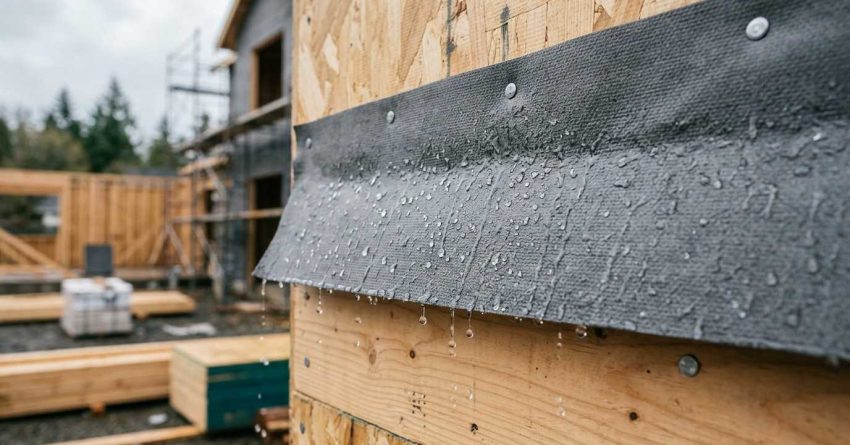
Housewrap is a synthetic, nonwoven or woven polyolefin sheet product that is mechanically fastened over the sheathing before cladding is installed. It is the most widely used WRB type in residential construction because it is lightweight, easy to handle, and available in large rolls that cover significant wall area quickly. Housewrap products vary significantly in vapor permeability, tensile strength, and resistance to UV degradation during the construction window before cladding is applied.
Common housewrap products include spunbonded polyolefin wraps and perforated film wraps. Perforated products offer higher vapor permeability but lower resistance to liquid water under sustained pressure. Spunbonded products generally offer better balance between water resistance and vapor transmission. Housewrap is well-suited to standard stud-framed walls with simple geometry and is the most cost-effective WRB option for most residential projects.
Housewrap is the most widely used WRB type in residential construction, and understanding how it is properly installed is just as important as choosing the right product — our housewrap installation guide walks through every step of the process from substrate prep to final sealing. Felt Paper (Asphalt-Saturated)
Asphalt-saturated felt, commonly called building paper or tar paper, is the traditional WRB used in construction for over a century. It is made from a cellulose or fiberglass mat saturated with asphalt. No. 15 felt and No. 30 felt are the two standard grades, with No. 30 offering greater thickness and water resistance. Felt paper is vapor-permeable when dry and provides good water resistance under normal conditions, but it can absorb water and temporarily lose its water-resistive properties when saturated.
Felt paper remains a code-compliant WRB option and is still widely used under wood siding, stucco, and masonry cladding systems. It is less resistant to tearing during installation than modern housewraps and has a shorter UV exposure tolerance. For complex wall geometries or high-wind exposure zones, felt paper requires more careful installation to maintain lap integrity.
Fluid-Applied WRBs
Fluid-applied WRBs are liquid coatings — typically acrylic, silyl-terminated polyether (STPE), or vapor-permeable elastomeric compounds — that are sprayed, rolled, or brushed directly onto the sheathing surface and cure to form a seamless, monolithic barrier. Because they are applied as a liquid, fluid-applied WRBs conform perfectly to irregular surfaces, penetrations, and transitions that are difficult to detail with sheet products.
Fluid-applied systems eliminate the lapping, seaming, and mechanical fastening required by sheet WRBs, which reduces the number of potential failure points. They are particularly well-suited to complex building geometries, continuous insulation assemblies, and projects where airtightness is a primary performance goal. Fluid-applied WRBs are generally more expensive than sheet products and require trained applicators to achieve consistent film thickness and coverage.
Key Performance Properties to Evaluate
Selecting a WRB requires evaluating several performance properties that determine how the product will behave in your specific wall assembly and climate. No single property defines a good WRB — the right balance depends on your building’s conditions.
Water Resistance and Vapor Permeability
Water resistance is measured by hydrostatic resistance — how much water pressure the WRB can withstand before water penetrates. Higher hydrostatic resistance is better for high-wind-driven rain exposure. Vapor permeability is measured in perms. A higher perm rating means more vapor can pass through the material. Most building codes require a WRB with a minimum perm rating of 1.0, but the ideal perm rating for your assembly depends on your climate zone and whether vapor control is handled elsewhere in the wall.
Vapor permeability is one of the most misunderstood properties in WRB selection, and confusing a vapor barrier with a vapor retarder can lead to costly moisture problems — our vapor barrier comparison explains the critical differences and when each is appropriate for your wall assembly.
Air Barrier Integration
Many modern WRBs are designed to function as both a water-resistive barrier and an air barrier when properly installed and detailed. An air barrier controls the movement of air through the building envelope, which affects both energy performance and moisture management. Air movement carries far more moisture into wall cavities than vapor diffusion alone. A WRB that functions as an air barrier must be continuous, properly lapped, and sealed at all penetrations, seams, and transitions to deliver meaningful air control performance. Not all WRBs qualify as air barriers — check the product’s air permeance rating against ASTM E2178 requirements if air barrier performance is a project goal.
WRB Selection by Climate and Wall Assembly
Climate zone is the single most important variable in WRB selection. The wrong WRB for your climate can trap moisture inside the wall assembly, leading to condensation, mold, and structural damage over time.
Hot-Humid Climates
In hot-humid climates (IECC Climate Zones 1 and 2), the primary moisture drive is from the exterior to the interior. Warm, humid outdoor air pushes moisture inward through the wall assembly. WRBs in these climates should have high vapor permeability to allow any moisture that enters the wall to dry toward the exterior. Vapor-impermeable or low-perm WRBs can trap moisture in the wall cavity in hot-humid conditions. Housewraps with high perm ratings or fluid-applied products with vapor-open formulations are generally appropriate for these zones.
Cold and Mixed Climates
In cold climates (IECC Climate Zones 5 through 8), the primary moisture drive reverses — interior moisture pushes outward through the wall during heating season. The WRB in these climates must resist bulk water from the exterior while allowing the wall to dry toward the outside. Vapor permeability requirements are moderate to high. In mixed climates (Zones 3 and 4), the moisture drive changes direction seasonally, which makes vapor management more complex. Smart vapor retarders or variable-perm WRBs are sometimes used in mixed climates to adapt to seasonal conditions.
Mixed-Dry and Marine Climates
Mixed-dry climates (Zone 3B and 4B) have low annual humidity but can experience significant wind-driven rain events. WRBs in these zones prioritize water resistance over vapor permeability. Marine climates (Zone 4C) combine moderate temperatures with high rainfall and humidity, requiring WRBs with strong water resistance and adequate vapor permeability to manage the persistent moisture exposure.
Choosing the wrong WRB for your climate zone is one of the leading causes of moisture intrusion and structural damage — if your property has already experienced water infiltration, our water damage repair services can assess the extent of the damage and restore affected areas.
Installation Requirements That Affect Selection
The best WRB product will fail if it is not installed correctly. Installation requirements vary by product type and directly influence which WRB is practical for a given project.
Flashing, Lapping, and Seam Sealing
All sheet WRBs must be installed with proper horizontal and vertical laps. Horizontal laps require the upper course to overlap the lower course by a minimum of 2 inches, ensuring water sheds away from the wall rather than behind the barrier. Vertical laps require a minimum 6-inch overlap. All seams, penetrations, and transitions — including window and door rough openings, pipe penetrations, and inside and outside corners — must be flashed and sealed with compatible tape or flashing membrane.
Window and door rough openings are the most common WRB failure point. Improper flashing at these locations allows water to bypass the WRB and enter the wall cavity directly. Sill pan flashing, head flashing, and jamb integration must be detailed correctly for the WRB to perform as intended.
Proper WRB installation requires precise lapping, flashing integration, and seam sealing that go beyond basic DIY capability — our handyman installation services connect you with skilled professionals who handle these details correctly the first time.
Code Compliance and Building Standards
WRB requirements in the United States are governed primarily by the International Residential Code (IRC) Section R703.2 and the International Building Code (IBC) Section 1404. Both codes require a water-resistive barrier on exterior walls beneath the cladding, with specific requirements for material performance, installation method, and flashing integration.
The IRC requires WRBs to comply with ASTM E2556 (Standard Specification for Vapor Permeable Flexible Sheet Water-Resistive Barriers) or to be equivalent in performance to No. 15 asphalt-saturated felt. Products must be installed per manufacturer instructions and applicable code provisions. Local jurisdictions may adopt amendments to the base IRC or IBC that impose additional requirements — always verify local code requirements before specifying a WRB product.
Energy codes, including the IECC, impose additional requirements related to air barrier continuity that affect WRB selection and installation in many jurisdictions. Projects involving additions, renovations, or re-cladding of existing buildings must also comply with current code requirements for the new work.
WRB code compliance is especially critical during renovation and addition projects where existing wall assemblies are opened and rebuilt — our remodeling and renovation services ensure every project meets current IRC and IBC requirements from the start.
Common WRB Failures and How to Avoid Them
Understanding where WRBs fail helps you select a product and installation approach that avoids the most common problems.
Improper lapping is the most frequent installation error. Reverse laps — where the lower course overlaps the upper course — allow water to run behind the WRB rather than over it. Always install WRBs from the bottom up, shingle-style.
Unsealed penetrations at pipes, conduit, hose bibs, and mechanical equipment create direct pathways for water entry. Every penetration through the WRB must be sealed with compatible flashing tape or a pre-formed flashing boot.
Torn or damaged material during the construction window is common with housewrap products. UV degradation, wind damage, and mechanical damage from other trades can compromise the WRB before cladding is installed. Inspect the WRB before cladding and repair any damage with compatible tape.
Incompatible materials — using tape, sealants, or flashing products that are not compatible with the WRB — can cause adhesion failure, delamination, or chemical degradation over time. Always use manufacturer-approved accessories.
One of the most frequent WRB failure points occurs at window and door rough openings where improper flashing allows water to bypass the barrier entirely — our window installation services include proper WRB integration and flashing at every opening.
Conclusion
Selecting the right water resistive barrier requires matching product type, vapor permeability, and water resistance to your specific climate zone, wall assembly, and installation conditions. No single WRB product is right for every project — the decision depends on a combination of performance properties, code requirements, and practical installation factors.
Getting the WRB selection and installation right from the start protects your property’s structural integrity, energy performance, and indoor air quality for decades. A failed WRB is rarely visible until significant damage has already occurred inside the wall.
At Mr. Local Services, our skilled professionals handle WRB selection, installation, and flashing details correctly — contact us today to protect your property with a properly installed, code-compliant water resistive barrier.
Frequently Asked Questions
What is the difference between a WRB and a vapor barrier?
A WRB resists liquid water while allowing water vapor to pass through the wall assembly. A vapor barrier blocks both liquid water and vapor movement. Most exterior wall assemblies require a vapor-permeable WRB, not a vapor barrier, to allow the wall to dry and prevent moisture buildup.
Can I use felt paper instead of housewrap?
Yes. Asphalt-saturated felt paper (No. 15 or No. 30) is a code-compliant WRB alternative to housewrap in most jurisdictions. Felt paper performs well under many cladding types but is more susceptible to tearing during installation and has a shorter UV exposure tolerance than modern synthetic housewraps.
How many layers of WRB are required by code?
The IRC requires a minimum of one layer of WRB on exterior walls. Some cladding systems — including stucco and adhered masonry veneer — require two layers of WRB or a drainage mat to create a drainage plane behind the cladding. Always verify requirements for your specific cladding system.
Does a WRB also function as an air barrier?
Some WRBs are designed and tested to function as both a water-resistive barrier and an air barrier when properly installed and sealed. Not all WRBs meet air barrier performance requirements. Check the product’s air permeance rating against ASTM E2178 if air barrier performance is required for your project.
How long can a WRB be exposed before cladding is installed?
Exposure limits vary by product. Most housewrap products are rated for 60 to 180 days of UV exposure before cladding must be installed. Felt paper has a much shorter exposure tolerance — typically 30 days or less. Always follow the manufacturer’s stated exposure limit to avoid material degradation.
What causes WRBs to fail at windows and doors?
Most WRB failures at windows and doors result from improper flashing sequence, missing sill pan flashing, or the use of incompatible tape and sealant products. The WRB must be integrated with the window flashing in the correct order — sill first, then jambs, then head — to ensure water sheds away from the opening rather than into the wall cavity.
Is a WRB required on all exterior walls?
The IRC requires a WRB on all exterior walls of residential buildings. Limited exceptions exist for certain cladding systems that are tested and approved as water-resistive assemblies without a separate WRB layer. These exceptions are product-specific and must be verified against the applicable code and local jurisdiction requirements.