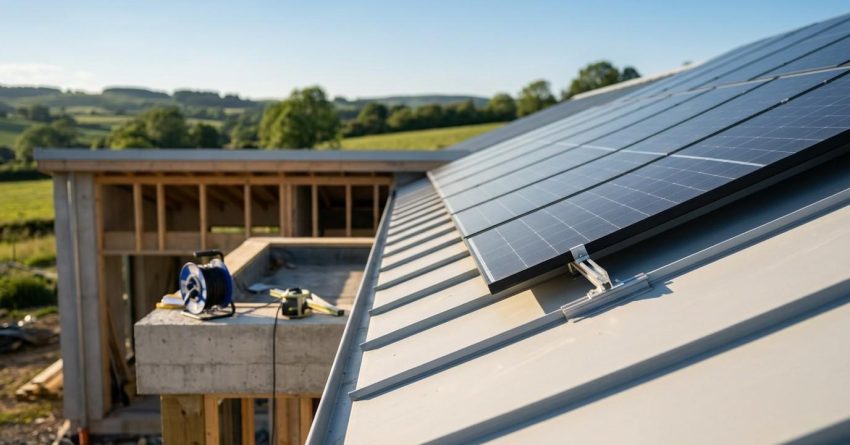
Getting solar PV sizing right during a new build is one of the most cost-effective decisions a homeowner can make. Size the system too small and you will rely heavily on grid power for years. Size it too large and you will overpay upfront for capacity you never use. The right system size is calculated from your actual energy needs, your roof’s physical characteristics, your local climate, and how you plan to connect to the grid or store power on-site.
New builds offer a rare advantage: you can design the solar system into the structure from day one, avoiding the retrofitting costs and compromises that come with adding panels to an existing home.
This guide covers every factor that determines the right solar PV system size for a new build — from load calculations and roof design to battery storage, permits, and the mistakes that cost homeowners the most.
What Does Solar PV Sizing Mean for a New Build?
Solar PV sizing is the process of determining how many solar panels, what total wattage, and what supporting equipment a home needs to meet its electricity demand reliably. For a new build, sizing happens before construction is complete, which means decisions are based on projected energy consumption rather than historical utility bills.
The goal is to match system output to household load as closely as possible. A correctly sized system covers the majority of your annual electricity use, minimizes grid dependence, and delivers the strongest return on your solar investment over time.
Sizing is not a single number. It is a set of interconnected decisions — panel count, inverter capacity, battery storage, and roof layout — that must work together as a complete system.
Key Components That Affect System Size
Four primary variables determine the size of a solar PV system for a new build:
Annual energy consumption is the total kilowatt-hours (kWh) your household is projected to use each year. For a new build, this is estimated from the home’s square footage, planned appliances, HVAC system type, number of occupants, and local climate data.
Peak sun hours refers to the average number of hours per day that solar irradiance in your location reaches 1,000 watts per square meter. This varies significantly across the US — locations in Arizona and New Mexico receive 6–7 peak sun hours daily, while the Pacific Northwest averages closer to 3.5–4.
Panel efficiency and wattage determines how much power each panel produces per square foot of roof space. Standard residential panels in 2025 range from 370W to 430W per panel, with premium monocrystalline panels reaching higher efficiency ratings.
System losses account for real-world inefficiencies including inverter conversion losses, wiring resistance, shading, and temperature effects. A standard derating factor of 75–80% is applied to account for these losses in sizing calculations.
How to Calculate the Right Solar PV System Size
The standard sizing formula for a residential solar PV system is:
System size (kW) = Annual kWh needed / (Peak sun hours per day x 365 days x System efficiency)
For example: a new build projected to consume 10,000 kWh per year in a location with 5 peak sun hours daily, using a 78% efficiency factor, would require approximately a 7.0 kW system.
10,000 / (5 x 365 x 0.78) = 7.02 kW
At an average panel wattage of 400W, that translates to roughly 18 panels. This is a starting point — roof constraints, shading, and storage goals will refine the final number.
Solar PV sizing is one of the most consequential decisions in new construction planning — our new build investment analysis covers how energy infrastructure choices like solar affect total build cost, long-term value, and return on investment for custom and spec homes.
Using Load Calculations to Guide Your Design
A load calculation for a new build starts with the home’s energy model. Your builder or energy consultant will estimate consumption based on:
The home’s conditioned square footage and insulation rating, the HVAC system type (heat pump systems consume significantly less energy than gas-electric hybrid systems), planned electric vehicle charging, water heating method (heat pump water heaters vs. standard electric), and major appliance loads including washer, dryer, dishwasher, and refrigeration.
For new builds targeting net-zero energy performance, the load calculation also factors in passive design elements — window placement, thermal mass, and air sealing — that reduce the total load the solar system needs to offset.
Working with a certified energy auditor or solar designer at the design phase, rather than after framing, gives you the most accurate load estimate and the most flexibility in system design.
Roof Area, Orientation, and Panel Placement
A solar PV system is only as good as the roof it sits on. For new builds, roof design is one of the most controllable variables in the entire sizing process — and one of the most frequently overlooked.
Each 400W panel requires approximately 17–22 square feet of unobstructed roof space. A 7 kW system with 18 panels needs roughly 300–400 square feet of usable south-facing roof area. If your roof design does not accommodate that footprint, your system size is constrained regardless of your energy needs.
How Roof Design in New Builds Affects Solar Output
Orientation is the single most important roof variable. South-facing roof planes in the northern hemisphere receive the most direct sunlight throughout the day. A true south orientation at the correct pitch can produce 15–25% more annual energy than an east- or west-facing installation.
Pitch affects both output and installation cost. Roof pitches between 15 and 40 degrees are optimal for most US locations. Flat or very low-pitch roofs require tilt mounting hardware to achieve the correct angle, adding cost and wind load considerations.
Obstructions including dormers, skylights, chimneys, HVAC equipment, and roof vents reduce usable panel area and create shading that disproportionately reduces output. In new builds, these elements can be positioned deliberately to protect solar zones.
Structural load capacity must be confirmed by the structural engineer during design. Solar panels add approximately 2.5–4 pounds per square foot of dead load. Most standard residential roof structures accommodate this without modification, but confirmation is required before permitting.
Battery Storage and Grid Connection Decisions
Sizing a solar PV system for a new build also requires a decision about how excess energy is handled. There are three primary configurations:
Grid-tied without storage is the most common and lowest-cost configuration. Excess solar production is exported to the utility grid, and the homeowner receives a credit through net metering. The system provides no backup power during outages.
Grid-tied with battery backup adds a battery storage system that captures excess solar production for use during evenings, cloudy periods, or grid outages. This configuration is increasingly popular as battery costs have declined and grid reliability concerns have grown.
Off-grid systems are sized to meet 100% of the home’s energy needs without any grid connection. These require significantly larger solar arrays and battery banks and are typically only cost-effective in locations where grid connection costs are prohibitive.
Sizing Your Battery Bank Alongside Your Solar Array
Battery storage sizing is calculated separately from panel sizing but must be coordinated with it. The key metric is usable storage capacity in kilowatt-hours (kWh).
A common starting point for a grid-tied backup system is 1–2 days of critical load coverage. For a home with 30 kWh of daily consumption, a battery system providing 10–15 kWh of usable storage covers overnight needs and short outages without requiring an oversized solar array.
The most widely installed residential battery systems in 2025 — including the Tesla Powerwall 3 and Enphase IQ Battery 5P — offer 13–15 kWh of usable capacity per unit. Many new builds install two units to provide meaningful backup coverage.
Battery sizing also affects inverter selection. Hybrid inverters that manage both solar input and battery charging are required for storage-integrated systems and must be specified during the electrical design phase.
Working With Builders and Electricians During Construction
Solar PV integration in a new build is a coordination exercise as much as a technical one. The solar system touches the structural, electrical, and roofing trades — and decisions made early in construction directly affect what is possible at installation.
The most important integration points are:
Conduit rough-in during framing. Running conduit from the roof penetration point to the main electrical panel before drywall is installed eliminates the need for surface-mounted conduit runs later, which are more expensive and less aesthetically clean.
Main panel sizing must account for the solar system’s inverter output. A 200-amp main panel is standard for most new builds and accommodates most residential solar systems. Homes with EV charging, large battery systems, or all-electric appliances may require a 400-amp service.
Roof penetration planning with the roofing contractor ensures that flashing and waterproofing are installed correctly the first time. Retrofitted roof penetrations are a leading cause of solar-related roof leaks.
Utility interconnection application should be submitted as early as possible. In many US markets, utility approval for grid-tied solar systems takes 4–12 weeks. Submitting the application during construction rather than after completion prevents delays in system activation.
Integrating Solar Into the Build Schedule
The optimal sequence for solar integration in a new build is:
- Solar system design completed during architectural design phase
- Conduit rough-in completed during framing
- Main panel and subpanel sized and installed during electrical rough-in
- Utility interconnection application submitted during framing or rough-in
- Roof penetrations and flashing installed during roofing
- Panel mounting hardware installed after roofing is complete
- Panels, inverter, and battery installed after exterior is weathertight
- Final electrical connections and commissioning after utility approval
Working with a solar contractor who has experience on new build projects — rather than retrofit-only installers — significantly reduces coordination friction and scheduling delays.
Permits, Incentives, and Net Metering for New Build Solar
Every grid-tied solar PV installation in the US requires permits and utility approval before the system can be energized. For new builds, solar permits are typically filed alongside the building permit, which streamlines the approval process in most jurisdictions.
The primary permits required are a building permit covering structural and electrical work, an electrical permit for the inverter and panel connections, and a utility interconnection agreement for grid-tied systems.
The federal Investment Tax Credit (ITC) currently allows homeowners to deduct 30% of the total solar system cost from their federal income taxes. For a $25,000 solar installation, that represents a $7,500 tax credit. The ITC applies to both the solar array and battery storage systems when the battery is charged primarily by solar.
Many states offer additional incentives including state tax credits, property tax exemptions on the added home value from solar, and sales tax exemptions on solar equipment purchases. Net metering policies — which determine how utilities compensate homeowners for exported solar energy — vary by state and utility, and should be confirmed before finalizing system size.
Navigating permits and utility interconnection agreements requires licensed electrical expertise — our solar electrical services explains how our electricians handle permitting, inspection, and grid-tie work for new build solar installations from start to finish.
Common Sizing Mistakes Homeowners Make
Understanding what goes wrong in solar PV sizing helps new build homeowners avoid the most expensive errors.
Undersizing for future load growth is the most common mistake. Homeowners who do not account for electric vehicle charging, future battery storage, or additional occupants often find their system insufficient within 3–5 years of move-in. Building in 10–15% additional capacity at the design stage costs far less than adding panels later.
Ignoring shading analysis leads to systems that underperform significantly. Even partial shading from a single tree or rooftop obstruction can reduce whole-string output by 20–40% in systems without module-level power electronics. A shading analysis using tools like the Solar Pathfinder or software-based modeling should be completed before panel placement is finalized.
Oversizing without storage creates a system that exports large amounts of energy to the grid at low compensation rates. In states with reduced net metering compensation, oversizing without battery storage can extend payback periods significantly.
Choosing the wrong inverter type for the system configuration is a costly error. String inverters are cost-effective for unshaded, uniform roof planes. Microinverters or DC optimizers are required for roofs with shading, multiple orientations, or complex layouts. Specifying the wrong type at the design stage requires expensive replacement later.
Failing to confirm utility interconnection requirements before finalizing system design can result in a system that does not meet the utility’s technical specifications, requiring redesign and re-permitting.
Avoiding solar sizing errors is part of a broader set of financial decisions that shape a new build’s value — the custom home investment guide outlines how upfront infrastructure choices, including solar, affect resale value and long-term ownership costs.
Conclusion
Solar PV sizing for a new build is a technical process with significant financial consequences. The right system size is determined by projected energy consumption, local solar resources, roof design, storage goals, and utility interconnection requirements — all of which can be optimized when solar is planned from the start of construction.
New builds offer the best possible conditions for solar integration: clean roof planes, correctly sized electrical infrastructure, and the ability to coordinate across all trades before walls are closed. That advantage is only realized when sizing decisions are made early and deliberately.
At Mr. Local Services, our electrical professionals work directly with builders and homeowners to design, permit, and install solar PV systems that are sized correctly from day one — delivering reliable performance, maximum incentive capture, and long-term energy savings.
Frequently Asked Questions
What size solar system does a typical new build home need?
Most new build homes in the US require a solar PV system between 6 kW and 10 kW to offset the majority of their annual electricity consumption. The exact size depends on projected energy use, local peak sun hours, and roof area available for panels.
How many solar panels does a 7 kW system require?
A 7 kW solar system typically requires 17 to 19 panels, depending on individual panel wattage. At 400W per panel, 18 panels produce approximately 7.2 kW of installed capacity, which is a common configuration for mid-sized new build homes.
Can I add more solar panels to my new build after construction?
Yes, but adding panels after construction is more expensive than sizing correctly upfront. Retrofitting requires additional roof penetrations, potential conduit work, and possibly inverter upgrades. Building in 10–15% extra capacity during the initial installation is almost always more cost-effective.
Does solar PV sizing change if I plan to add an electric vehicle?
Yes. EV charging adds 1,500–3,000 kWh or more to annual household consumption depending on driving habits and charger type. If you plan to charge an EV at home, this load must be included in your initial sizing calculation to avoid undersizing the system.
What is the difference between system size and panel count?
System size refers to the total installed wattage or kilowatts of the solar array. Panel count is the number of individual panels needed to reach that wattage. A 7 kW system made up of 400W panels requires 17–18 panels, while the same 7 kW system using 350W panels would require 20 panels.
How does roof orientation affect how many panels I need?
A south-facing roof at optimal pitch produces the most energy per panel, meaning fewer panels are needed to meet a given load. East- or west-facing roofs produce 15–25% less energy per panel annually, which means a larger panel count is required to achieve the same annual output.
Do I need battery storage to size my solar system correctly?
Battery storage is not required for correct solar sizing, but it changes how the system is sized. Grid-tied systems without storage are sized to match annual consumption. Systems with battery storage may be sized slightly smaller because stored energy reduces grid dependence during non-generating hours, improving overall system efficiency.