OSB and plywood are the two most widely used structural sheathing panels in residential construction — and choosing the wrong one can affect your home’s durability, moisture resistance, and long-term repair costs. Both materials meet building code requirements across the USA, but they perform differently depending on where they are installed, what climate you live in, and how your budget is structured.
Understanding the difference matters now because sheathing decisions made during a roof replacement, wall assembly, or subfloor installation are difficult and expensive to reverse once framing is complete.
This guide compares OSB and plywood sheathing across strength, moisture performance, cost, and application so you can make a confident, informed choice for your property.
What Is OSB and What Is Plywood Sheathing?
Structural sheathing is the rigid panel layer attached to wall studs, roof rafters, or floor joists. It provides the structural backbone that holds a building together, resists racking forces from wind and seismic loads, and creates the nailing surface for exterior cladding, roofing materials, and flooring systems. OSB and plywood are the two dominant panel types used for this purpose in residential and light commercial construction across the USA.
How OSB Is Made and What It Contains
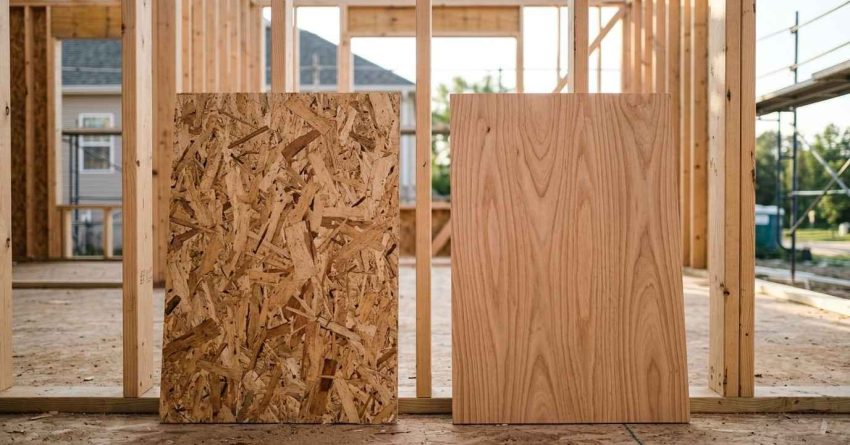
OSB stands for oriented strand board. It is an engineered wood panel manufactured by compressing and bonding wood strands — typically from fast-growing species like aspen or southern yellow pine — with waterproof resin adhesives under high heat and pressure. The strands are layered in alternating orientations, which gives OSB its cross-directional strength. OSB is produced in large, continuous mats and cut to standard panel sizes, making it highly consistent in thickness and density with minimal waste.
How Plywood Is Made and What Sets It Apart
Plywood is manufactured by bonding thin wood veneers — called plies — together with adhesive, with each layer’s grain running perpendicular to the one above and below it. This cross-grain construction gives plywood its dimensional stability and resistance to splitting. Structural plywood panels used for sheathing are graded by the American Plywood Association (APA) and rated for specific span and load applications. Plywood has been used in residential construction for over a century and remains the benchmark against which engineered panels are measured.
Understanding which sheathing material suits your project is the first step — our roofing sheathing services cover installation, replacement, and inspection for both OSB and plywood across residential and commercial properties.
OSB vs Plywood Sheathing — Key Differences at a Glance
| Feature | OSB | Plywood |
| Composition | Compressed wood strands + resin | Cross-laminated wood veneers |
| Weight | Heavier per panel | Lighter per panel |
| Moisture resistance | Absorbs moisture at edges; swells | Dries more evenly; less edge swelling |
| Strength (structural) | Comparable to plywood for most uses | Slightly superior in some load scenarios |
| Cost | Lower — typically 15–25% less | Higher — premium for quality grades |
| Availability | Widely available nationwide | Widely available; some grades less common |
| Best use | Roof decking, wall sheathing, subfloor | Roof, wall, subfloor, high-moisture areas |
| APA rating | Yes — rated for structural use | Yes — rated for structural use |
Both panels are APA-rated and accepted by the International Residential Code (IRC) for structural sheathing applications. The differences between them are real but context-dependent — neither material is universally superior.
Strength and Structural Performance Compared
For most residential sheathing applications, OSB and plywood deliver comparable structural performance. Both panels are manufactured to meet the same APA performance standards, and both are accepted by building codes for wall, roof, and floor sheathing when installed at the correct thickness and span rating.
Load-Bearing Capacity and Racking Strength
Racking strength — the panel’s ability to resist lateral forces from wind and seismic activity — is one of the most critical performance metrics for wall sheathing. OSB and plywood panels of equivalent thickness and span rating perform similarly in racking resistance tests. In some standardized shear wall tests, OSB has demonstrated slightly higher racking values than equivalent plywood panels, which is why many production builders default to OSB for wall sheathing in high-wind zones.
Nail-Holding and Fastener Performance
Plywood holds nails and screws slightly better than OSB, particularly at panel edges. OSB’s compressed strand structure can fracture around fasteners when panels are over-driven or installed too close to the edge. This is a practical consideration during installation — proper fastener spacing and depth are more critical with OSB than with plywood. For applications where fastener performance is a priority, such as hurricane straps or structural connectors, plywood’s edge-holding advantage is worth factoring into your material decision.
When sheathing decisions are part of a larger renovation, our structural remodeling services connect you with professionals who assess load requirements and recommend the right panel system for your build.
Moisture Resistance and Weather Exposure
Moisture performance is the most significant practical difference between OSB and plywood, and it is the factor most likely to affect long-term durability in real-world conditions.
How OSB Handles Moisture
OSB is more susceptible to moisture damage than plywood, particularly at panel edges. When OSB absorbs water, the edges swell and can delaminate — a condition called edge swell or telegraphing, which can show through finished roofing or flooring surfaces. OSB also takes longer to dry once saturated, which increases the risk of mold growth and structural degradation if panels are exposed to rain during construction or if a roof leak goes undetected. Many OSB panels are manufactured with a moisture-resistant edge seal, but this protection is compromised when panels are cut on site.
How Plywood Handles Moisture
Plywood dries more evenly and recovers better from moisture exposure than OSB. Its veneer construction allows moisture to move through the panel more uniformly, reducing the risk of localized swelling and delamination. Marine-grade and exterior-grade plywood panels are available for applications where moisture exposure is a consistent concern, such as roof sheathing in high-rainfall climates or subfloor panels in bathrooms and laundry rooms. For properties in humid coastal regions or areas with frequent freeze-thaw cycles, plywood’s moisture performance advantage is a meaningful factor.
Choosing the wrong sheathing for a moisture-prone environment can lead to costly structural failures — our water damage repair team helps homeowners address sheathing deterioration before it spreads to framing and insulation.
Cost Comparison — OSB vs Plywood Sheathing
OSB is consistently less expensive than plywood. For a standard 4×8 panel at 7/16-inch thickness — the most common wall sheathing dimension — OSB typically costs 15 to 25 percent less than equivalent-rated plywood. On a full roof or wall sheathing project covering several hundred square feet, that cost difference adds up to a meaningful budget impact.
The price gap narrows when comparing higher-grade OSB products — such as tongue-and-groove OSB subfloor panels or ZIP System sheathing — against standard plywood. Specialty plywood grades, including marine-grade or sanded plywood, carry a significant premium over both standard plywood and OSB. For budget-conscious projects where moisture exposure is limited and structural demands are standard, OSB delivers equivalent code-compliant performance at a lower material cost.
For smaller sheathing repairs or panel replacements that do not require a full roofing crew, our handyman installation help provides a cost-effective option for homeowners managing targeted fixes.
Where Each Material Is Best Used
Best Applications for OSB Sheathing
OSB performs well and is cost-effective in the following applications:
- Roof decking in climates with moderate rainfall and good attic ventilation, where panels are protected quickly by roofing underlayment and shingles
- Wall sheathing in new construction where panels are wrapped with a weather-resistant barrier (WRB) immediately after installation
- Subfloor panels in dry climates or interior areas away from plumbing fixtures, particularly tongue-and-groove OSB rated for floor span applications
- Garage walls and utility structures where appearance is not a concern and moisture exposure is controlled
Best Applications for Plywood Sheathing
Plywood is the preferred choice in the following scenarios:
- Roof sheathing in high-moisture or coastal climates where panels may be exposed to rain during construction or where roof leaks are a recurring risk
- Subfloor in bathrooms, kitchens, and laundry rooms where moisture from plumbing, appliances, or cleaning is ongoing
- Remodeling and repair projects where panels must be cut to fit irregular spaces and edge integrity is critical
- Applications requiring superior fastener holding such as structural connectors, hurricane clips, or heavy tile roofing systems
When sheathing is part of a new wall assembly or structural addition, our carpentry and framing services ensure panels are cut, fitted, and fastened to code for lasting performance.
Which Sheathing Material Should You Choose?
For most standard residential construction projects in the USA — new roof decking, wall sheathing on a new build, or subfloor replacement in a dry interior space — OSB is a practical, code-compliant, and cost-effective choice. It performs comparably to plywood in structural tests, is widely available, and costs less per panel.
Choose plywood when moisture exposure is a consistent concern, when you are working in a high-humidity or coastal climate, when the application involves direct or repeated water contact, or when fastener performance at panel edges is critical to the structural system. Plywood’s higher cost is justified in these scenarios by its superior moisture recovery and edge integrity.
If you are unsure which panel is right for your specific roof pitch, climate zone, or building code requirements, a professional roofing assessment from our team gives you a clear, site-specific recommendation before any material is purchased.
Conclusion
OSB and plywood sheathing both meet residential building code requirements and deliver reliable structural performance when installed correctly. The right choice depends on your climate, application, moisture exposure, and budget — not on a single universal answer.
For moisture-sensitive applications or high-performance structural systems, plywood’s edge integrity and drying characteristics give it a meaningful advantage. For standard new construction where cost efficiency matters and panels are protected quickly, OSB is a proven, code-accepted solution.
At Mr. Local Services, our team connects you with skilled professionals who assess your specific project conditions and recommend the right sheathing material — so your roof, walls, and floors are built to last from the panel up.
Frequently Asked Questions
Is OSB stronger than plywood for roof sheathing?
OSB and plywood of equivalent thickness and span rating perform comparably for roof sheathing under standard load conditions. In some racking tests, OSB shows slightly higher lateral resistance, but plywood holds fasteners better at panel edges, which matters for certain roofing systems.
Does OSB swell when wet?
Yes. OSB is more prone to edge swelling when exposed to moisture than plywood. The compressed strand structure absorbs water at cut edges and can delaminate or telegraph through finished surfaces. Moisture-resistant edge seals help, but protection is reduced when panels are cut on site.
Can you use OSB for exterior wall sheathing?
Yes. OSB is widely used and code-accepted for exterior wall sheathing across the USA. It must be covered with a weather-resistant barrier promptly after installation to prevent moisture absorption and edge swelling before cladding is applied.
Which is better for subflooring — OSB or plywood?
For dry interior areas, tongue-and-groove OSB subfloor panels are a cost-effective and structurally sound choice. For bathrooms, kitchens, and laundry rooms where moisture exposure is ongoing, plywood is the better option due to its superior moisture recovery and edge performance.
How long does OSB sheathing last?
When properly installed and protected from sustained moisture exposure, OSB sheathing can last the lifetime of the structure — typically 50 years or more. Longevity depends on adequate ventilation, a properly maintained weather barrier, and prompt repair of any roof or wall leaks.
Is plywood worth the extra cost over OSB?
In moisture-prone applications, coastal climates, or projects requiring superior fastener performance, plywood’s higher cost is justified by its durability advantage. For standard new construction in moderate climates with quick weather protection, OSB delivers equivalent performance at a lower price point.
What thickness of sheathing do I need for walls and roofs?
The most common wall sheathing thickness is 7/16 inch for OSB and 3/8 to 1/2 inch for plywood. Roof sheathing typically requires 7/16 to 5/8 inch depending on rafter spacing. Always verify thickness requirements against your local building code and the APA span rating for your specific application. Learn more about sheathing thickness requirements