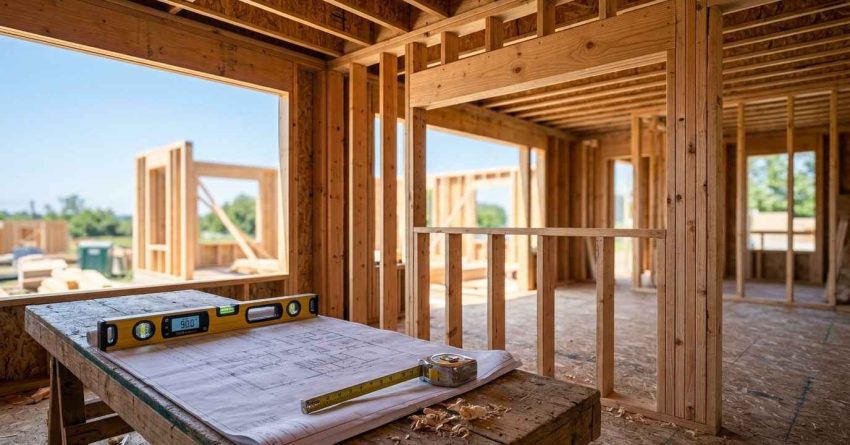
Advanced framing with 2×6 lumber spaced 24 inches on center is a construction method that reduces material use, increases wall insulation depth, and meets modern energy code requirements — making it one of the most efficient structural wall systems available for residential construction in the USA.
Choosing the right framing method affects your home’s energy performance, structural integrity, and long-term maintenance costs for decades.
This guide explains what 2×6, 24″ OC framing is, how it works, when to use it, and what the installation process involves from start to finish.
What Is 2×6 Framing and How Does It Differ from 2×4 Construction?
Standard residential framing in the United States has historically used 2×4 lumber placed 16 inches on center. Advanced framing replaces that system with 2×6 lumber placed 24 inches on center, reducing the number of studs in a wall while increasing the depth of each stud cavity.
The term “advanced framing” refers to a set of building practices also known as Optimum Value Engineering (OVE). The goal is to use less wood without sacrificing structural performance — and to create deeper wall cavities that hold more insulation. Understanding 2×6 framing starts with a solid foundation in structural carpentry — our carpentry services guide covers the full range of framing, finishing, and structural work available for residential and commercial properties.
Lumber Dimensions and Structural Properties of 2×6 Members
A 2×6 stud measures approximately 1.5 inches by 5.5 inches in actual dimension. That extra 1.5 inches of depth compared to a 2×4 stud creates a wall cavity that is 40% deeper, allowing for significantly more insulation without adding exterior thickness to the building envelope.
2×6 lumber also carries greater bending strength per member, which is why fewer studs are needed at 24″ spacing without compromising wall stability.
Load-Bearing Capacity and Span Differences
At 24 inches on center, 2×6 studs carry comparable loads to 2×4 studs at 16 inches on center in most single-story and two-story residential applications. Structural engineers and building codes in most U.S. jurisdictions recognize this equivalency, provided headers, corners, and connection points are designed to match the reduced stud count.
Why Builders Choose 2×6, 24″ OC Framing for Modern Construction
The shift toward 2×6, 24″ OC framing is driven by two primary forces: tightening energy codes and rising material costs. Both push builders toward systems that do more with less.
Energy Efficiency and Insulation Depth Advantages
A 2×6 wall cavity accommodates R-19 to R-21 batt insulation, compared to R-13 to R-15 in a standard 2×4 wall. This improvement in thermal resistance directly reduces heating and cooling loads, which lowers utility costs for homeowners over the life of the building.
Continuous insulation can also be added to the exterior of a 2×6 wall more effectively than a 2×4 wall, because the structural depth already reduces thermal bridging through the studs. Because 2×6 walls create deeper cavities, they directly affect how drywall and ceiling systems are installed and finished — our drywall and ceiling work explains how wall depth influences finishing requirements and material choices.
Structural Strength and Code Compliance Benefits
Most U.S. residential building codes now accept 2×6, 24″ OC framing as a compliant structural system when designed according to the International Residential Code (IRC) or applicable state amendments. In high-wind and seismic zones, engineering review may be required, but the system is widely accepted across the country.
The deeper wall section also provides better resistance to racking forces — the lateral loads that walls experience during wind events or seismic activity — when properly sheathed with structural panels.
How 24″ On-Center Spacing Works in Advanced Framing
On-center spacing refers to the distance measured from the center of one stud to the center of the next. At 24 inches on center, a standard 8-foot wall section contains four stud bays instead of the six bays found in 16″ OC framing. This reduction in stud count is the primary source of material savings in advanced framing systems.
Stud Layout and Material Reduction Principles
In a typical 2,000-square-foot home, switching from 16″ OC to 24″ OC framing can reduce stud count by 30% or more. That reduction translates directly into lower lumber costs, less labor for cutting and fastening, and fewer thermal bridges through the wall assembly.
Layout begins at a consistent reference point — typically a corner or a door opening — and proceeds in 24-inch increments across the full length of each wall plate. Accurate layout is critical because floor, wall, and roof framing members must stack vertically to transfer loads efficiently.
Header Sizing and Corner Framing in OVE Systems
Advanced framing also changes how headers and corners are built. In traditional framing, headers over windows and doors are often oversized and supported by cripple studs. In OVE systems, headers are sized to carry only the actual load above the opening, and insulated headers replace solid lumber to reduce thermal bridging.
Corner assemblies in advanced framing use two-stud corners instead of three-stud corners, eliminating a stud that serves no structural purpose and replacing it with insulation. Accurate 24″ OC stud layout is especially critical around window openings, where rough opening dimensions must align precisely with framing — our window installation guide details how proper framing supports correct window fit and long-term performance.
Step-by-Step Process for Installing 2×6 Framing at 24″ OC
Installing 2×6, 24″ OC framing follows the same general sequence as standard wall framing, with specific adjustments for stud spacing, header sizing, and corner construction.
Planning, Layout, and Plate Marking
Begin by marking the bottom plate at 24-inch intervals, starting from a consistent reference point. Mark stud locations with an X on the layout side and a C for cripple locations. Transfer the same layout to the top plate so studs align perfectly when the wall is assembled flat and then raised into position.
Account for all rough openings — windows, doors, and mechanical penetrations — before cutting any lumber. Rough opening dimensions must be confirmed against the actual window and door units being installed.
Stud Placement, Alignment, and Fastening
With plates marked, lay studs flat between the top and bottom plates and fasten with two 16d nails or approved structural screws at each end. Check for crown — the natural bow in a piece of lumber — and orient all studs with the crown facing the same direction to produce a flat, plumb wall surface.
Raise the wall, brace it temporarily, and check for plumb before fastening to the floor system. Structural sheathing is applied to the exterior face to provide racking resistance before the wall is considered complete.
Window and Door Rough Opening Framing
Rough openings in 2×6, 24″ OC walls use king studs, jack studs, and a header sized for the actual load above the opening. In advanced framing, headers are often built as insulated box headers — two pieces of 2x lumber with rigid foam insulation sandwiched between them — rather than solid LVL or doubled 2x lumber.
This approach reduces thermal bridging at every opening while maintaining the required structural capacity. Rough opening framing for doors follows the same 24″ OC principles covered in this section — our door framing and installation walks through how door openings are sized, framed, and finished within advanced framing systems.
Common Mistakes to Avoid with Advanced Framing Techniques
Advanced framing requires more precise planning than traditional 16″ OC framing because the reduced stud count leaves less margin for error. The most common mistakes fall into three categories: layout errors, header oversizing, and sheathing gaps.
Layout errors occur when stud spacing drifts from the 24-inch module, causing misalignment between wall, floor, and roof framing. This breaks the load path and can require costly corrections before sheathing is applied.
Header oversizing is a holdover from traditional framing habits. Builders accustomed to using large headers for every opening sometimes apply the same approach in advanced framing, eliminating the thermal performance benefit of insulated headers.
Sheathing gaps at corners and around openings reduce racking resistance. In a 24″ OC system with fewer studs, every sheathing fastener and every edge nail matters more than in a 16″ OC wall. When framing errors are caught after the fact, a skilled handyman can often correct minor structural issues before they escalate — our handyman repair services outlines the types of structural corrections and carpentry repairs available.
When to Use Advanced Framing vs. Traditional 16″ OC Methods
Advanced framing is the right choice for new construction projects where energy performance is a priority, lumber costs are a concern, or local energy codes require higher wall R-values than 2×4 framing can achieve.
Traditional 16″ OC framing remains appropriate for projects where existing plans are designed around that system, where local code requires it, or where the wall height or load conditions exceed what 24″ OC spacing can handle without engineering review.
In remodel and addition work, the choice depends on what the existing structure uses. Mixing framing systems in the same wall plane creates alignment problems at connections and should be avoided unless a structural engineer has reviewed the design.
The decision also affects finish work. Drywall, trim, and cabinet installation all assume a consistent stud layout, and switching from 16″ to 24″ OC mid-project creates complications for subcontractors working from standard assumptions.
Costs, Material Savings, and ROI of 2×6, 24″ OC Framing
The upfront cost of 2×6 framing is higher than 2×4 framing on a per-stud basis because 2×6 lumber costs more per linear foot. However, the reduced stud count at 24″ OC spacing partially offsets that premium. In most markets, the net lumber cost difference between 2×6, 24″ OC and 2×4, 16″ OC framing is modest — often 3% to 8% more for the framing package alone.
The real financial return comes from insulation and energy savings. A wall framed at 2×6, 24″ OC can achieve R-values that reduce heating and cooling costs by 15% to 25% compared to a minimally insulated 2×4 wall, depending on climate zone and insulation type.
Over a 10-year period, those energy savings typically exceed the additional framing cost by a significant margin, making advanced framing one of the higher-ROI structural decisions available in new home construction. Advanced framing is frequently incorporated into full renovation projects where energy efficiency and structural upgrades are combined — our home remodeling options explains how framing upgrades fit within broader remodel scopes and budgets.
Additionally, homes built with advanced framing and higher insulation values often qualify for energy efficiency incentives, green building certifications, and in some cases, favorable mortgage products tied to energy performance ratings.
Conclusion
Advanced framing with 2×6 lumber at 24 inches on center delivers measurable improvements in energy efficiency, material use, and long-term structural performance for residential construction.
Understanding the method — from stud layout to header sizing to corner construction — helps homeowners and property managers make informed decisions about new builds and major renovations.
At Mr. Local Services, our carpentry and framing professionals bring the expertise needed to plan and execute advanced framing systems correctly, ensuring your project meets code, performs efficiently, and holds up for the long term.
Frequently Asked Questions
Is 2×6, 24″ OC framing stronger than 2×4, 16″ OC framing?
2×6 studs are individually stronger than 2×4 studs due to their greater cross-sectional depth. At 24″ OC spacing, the wall system carries comparable loads to 2×4 framing at 16″ OC in most residential applications, and the deeper wall section provides better resistance to lateral forces when properly sheathed.
Does advanced framing meet building code requirements in the USA?
Yes. The International Residential Code (IRC) and most state building codes accept 2×6, 24″ OC framing as a compliant structural system for residential construction. Some high-wind or seismic zones may require engineering review, but the system is widely permitted across the country.
How much insulation can I fit in a 2×6 wall?
A 2×6 wall cavity accommodates R-19 to R-21 batt insulation, compared to R-13 to R-15 in a standard 2×4 wall. Adding continuous exterior insulation to a 2×6 wall can push total wall R-values to R-25 or higher, depending on the insulation type and thickness used.
What is the difference between advanced framing and OVE framing?
Advanced framing and Optimum Value Engineering (OVE) refer to the same system. OVE is the technical term used by engineers and building scientists, while advanced framing is the more common term used in construction and building trades. Both describe the practice of using 2×6 studs at 24″ OC with insulated headers and two-stud corners.
Can advanced framing be used for load-bearing walls?
Yes. Advanced framing is used for both load-bearing and non-load-bearing walls in residential construction. Load-bearing applications require that headers, connections, and stud sizing are designed to carry the actual loads above, which is standard practice in any properly engineered framing system.
How does 24″ OC spacing affect drywall installation?
Drywall installed over 24″ OC framing must be at least 1/2-inch thick when applied horizontally, and 5/8-inch thick is often recommended for ceilings. The wider stud spacing requires careful fastening at panel edges and fields to prevent sagging or surface irregularities, particularly on ceilings.
Is advanced framing a good choice for a home addition or remodel?
Advanced framing works well for additions where new walls are being built from scratch. In remodel work, it is best used when the addition is structurally independent from the existing framing, since mixing 16″ OC and 24″ OC systems in the same wall plane creates alignment complications for finish work and mechanical rough-ins.