Structural insulated panels (SIPs) are a high-performance building system used in walls, roofs, and floors of residential and commercial structures, offering superior insulation, structural strength, and faster construction timelines compared to traditional framing methods.
SIPs construction is gaining traction across the USA as homeowners and builders look for energy-efficient, cost-effective alternatives to conventional stick framing. Understanding how this system works helps you make smarter decisions about your next build or renovation.
This guide covers what SIPs are, how they perform, the types available, their costs, and how to choose the right contractor for your project.
What Are Structural Insulated Panels?
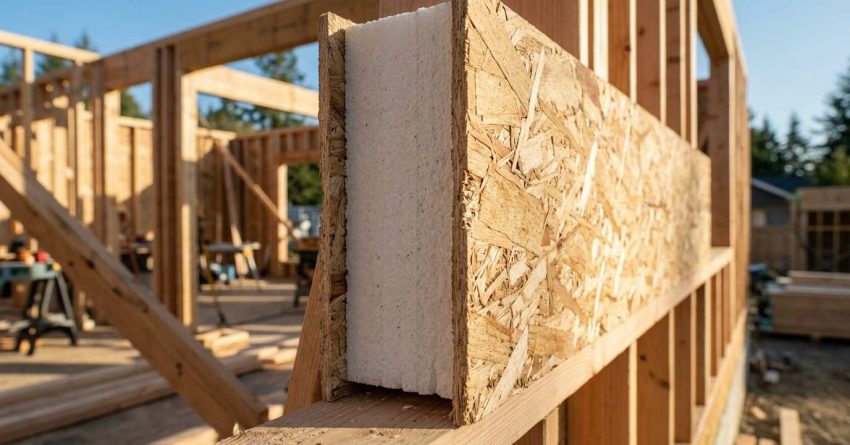
Structural insulated panels are prefabricated building components made from a rigid foam insulation core sandwiched between two structural facing boards, typically oriented strand board (OSB). The result is a single panel that handles both structural load-bearing and thermal insulation in one integrated unit.
Unlike traditional wood framing, which requires separate insulation installation after the frame is built, SIPs combine structure and insulation into a factory-manufactured component. This integration reduces on-site labor, minimizes thermal bridging, and creates a tighter building envelope from the start.
How SIPs Are Made
SIPs are manufactured in controlled factory environments where foam cores — most commonly expanded polystyrene (EPS) or polyurethane — are bonded under pressure to OSB facing panels. Factory production ensures consistent thickness, density, and adhesion quality that field-assembled insulation systems cannot reliably replicate.
Standard panel sizes range from 4×8 feet to 8×24 feet, with thicknesses from 3.5 inches to 12.25 inches depending on the application and required R-value. Panels are cut to project specifications before delivery, reducing on-site waste and cutting time significantly.
SIPs vs. Traditional Framing
Traditional stick framing uses dimensional lumber studs placed at regular intervals, with insulation batts or spray foam added separately. This method creates thermal bridges at every stud location, where heat transfers through the wood rather than through the insulation.
SIPs eliminate most thermal bridging by replacing the stud cavity system with a continuous insulated core. The result is a more consistent R-value across the entire wall or roof surface. Understanding how SIPs compare to conventional framing is especially relevant for buyers weighing build options — our custom home investment analysis breaks down how construction method choices affect long-term property value and upfront costs.
How SIPs Work as a Building System
SIPs function as a structural and thermal system simultaneously. Each panel carries vertical and lateral loads while also acting as the primary insulation and air barrier for the building envelope.
Structural Performance
SIPs panels are engineered to carry roof loads, resist wind pressure, and support floor systems. The OSB facing layers act as the structural skin, while the foam core keeps the facings separated and working together as a composite unit — similar in principle to an I-beam, where the separation between flanges creates bending resistance.
This composite action gives SIPs panels a high strength-to-weight ratio. A 6.5-inch SIP wall panel can carry significant structural loads while weighing far less than an equivalent concrete or masonry wall.
Thermal and Air Barrier Function
The continuous foam core in a SIPs panel provides both insulation and air resistance. Because the core has no gaps, seams, or stud cavities, air infiltration is dramatically reduced compared to batt-insulated stud walls.
Proper sealing at panel joints — typically with expanding foam sealant and SIPs tape — creates a near-continuous air barrier around the building. This tight envelope reduces heating and cooling loads, which directly lowers energy bills year-round.
Types of SIPs Panels Available
Not all SIPs panels use the same core material or facing configuration. The right type depends on your climate zone, budget, and structural requirements.
EPS Core SIPs
Expanded polystyrene (EPS) is the most widely used SIPs core material in the USA. EPS panels offer R-values ranging from approximately R-14 for a 3.5-inch panel to R-40 or higher for thicker roof panels. EPS is moisture-resistant, dimensionally stable, and widely available from multiple manufacturers.
EPS core SIPs are the standard choice for most residential wall and roof applications and represent the most cost-competitive option in the market.
Polyurethane Core SIPs
Polyurethane foam cores deliver higher R-values per inch than EPS, making them useful in applications where panel thickness is constrained but insulation performance must remain high. A 3.5-inch polyurethane SIP can achieve R-values approaching R-25, compared to approximately R-14 for an EPS panel of the same thickness.
Polyurethane SIPs typically carry a higher material cost but may reduce overall wall thickness in designs where interior square footage is a priority.
OSB Facing Variations
Standard SIPs use OSB on both faces. Some specialty panels substitute one or both OSB faces with fiber cement, magnesium oxide board, or structural plywood for specific applications such as high-humidity environments, fire-rated assemblies, or exterior finish compatibility.
The facing material affects both the structural capacity and the attachment options for interior finishes and exterior cladding systems.
Benefits of Building with SIPs
SIPs offer measurable advantages over conventional framing across energy performance, construction speed, and long-term durability.
Energy Efficiency Gains
The continuous insulation and reduced air infiltration in SIPs construction translate directly into lower heating and cooling costs. Homes built with SIPs consistently outperform code-minimum stick-framed homes on energy use metrics, and many SIPs homes qualify for energy-efficient mortgage programs and utility rebates.
The tight building envelope also improves indoor air quality by reducing uncontrolled air infiltration, which carries dust, allergens, and moisture into the living space.
Construction Speed and Labor Savings
Because SIPs panels arrive pre-cut and pre-sized from the factory, wall and roof assemblies can be erected significantly faster than equivalent stick-framed structures. A crew experienced with SIPs can often enclose a residential structure in days rather than weeks.
Faster enclosure means earlier protection from weather, reduced exposure of materials to moisture damage during construction, and lower overall labor costs on the framing phase of the project.
Durability and Structural Strength
SIPs panels are engineered structural components tested to meet or exceed building code requirements for load-bearing capacity, wind resistance, and seismic performance. The composite panel construction resists racking forces that can compromise conventional framed walls in high-wind or seismic zones.
When properly installed and sealed, SIPs assemblies also resist moisture accumulation within the wall cavity — a common source of mold, rot, and structural degradation in batt-insulated stud walls.
Common Applications for SIPs in Residential Construction
SIPs are used across a wide range of residential building types, from standard single-family homes to specialized structures.
Walls, Roofs, and Floors
SIPs are most commonly used for exterior walls and roof panels in residential construction. Wall panels typically range from 4.5 to 6.5 inches thick, while roof panels are often 8 to 12 inches thick to achieve higher R-values required for ceiling assemblies.
SIPs floor panels are less common but are used in elevated floor systems, particularly in crawl space or pier-and-beam foundations where a high-performance floor assembly is needed.
SIPs in Tiny Homes and Custom Builds
SIPs are particularly well-suited to tiny homes, accessory dwelling units (ADUs), and owner-directed custom builds where maximizing interior space, minimizing construction time, and achieving high energy performance are all priorities. The thin wall profile of SIPs compared to thick batt-insulated stud walls reclaims usable interior square footage in compact structures.
SIPs are increasingly popular in owner-directed construction projects, and if you are deciding between building from scratch or buying move-in ready, our guide to spec vs custom builds covers the financial and structural trade-offs in detail.
SIPs Installation Process
Proper installation is critical to realizing the full performance benefits of SIPs construction. Errors in panel assembly or sealing can compromise both structural integrity and thermal performance.
Site Preparation and Panel Delivery
SIPs panels are delivered to the job site pre-cut and labeled according to the project’s panel layout drawings. The foundation or floor system must be complete and level before panel delivery, as panels are typically erected immediately upon arrival to minimize on-site storage and handling.
A crane or panel lift is often used for larger panels, particularly roof panels, which can be heavy and awkward to position manually.
Panel Assembly and Sealing
Panels are connected using splines — either solid lumber, LVL, or SIP splines — inserted into routed channels along panel edges. All joints are sealed with expanding foam sealant before panels are fastened together, and SIPs tape is applied over exterior joints to complete the air barrier.
Proper sealing at every joint is the single most important quality control step in SIPs installation. Unsealed or poorly sealed joints are the primary source of air leakage and moisture problems in SIPs buildings.
Mechanical, Electrical, and Plumbing Integration
SIPs panels do not have stud cavities for routing wiring and pipes. Electrical chases are either pre-cut at the factory or field-cut using a hot knife or router. Wiring is pulled through these chases after panel erection.
Plumbing is typically routed through interior partition walls rather than exterior SIPs panels to avoid penetrating the thermal envelope. HVAC systems in SIPs homes often use smaller, more efficient equipment because the tight envelope reduces heating and cooling loads significantly.
Cost of SIPs Construction in the USA
SIPs panels carry a higher upfront material cost than conventional lumber framing, but the total installed cost comparison is more nuanced when labor savings, construction speed, and long-term energy savings are factored in.
Material Costs vs. Conventional Framing
SIPs panel material costs in the USA typically range from $7 to $12 per square foot of panel area, depending on panel thickness, core type, and manufacturer. Conventional OSB sheathing and framing lumber for an equivalent wall assembly typically costs less per square foot in materials alone.
However, SIPs reduce or eliminate several line items that add cost to stick-framed projects: separate insulation installation, air barrier materials, and extended framing labor. When these savings are applied, the total installed cost difference between SIPs and conventional framing narrows considerably.
Long-Term Savings and ROI
The energy savings from a SIPs home compound over time. Homeowners in SIPs-built homes consistently report lower monthly utility bills compared to equivalent stick-framed homes, and the tight building envelope reduces HVAC equipment wear by reducing runtime hours.
Material and labor costs for SIPs construction feed directly into the broader question of what a custom build actually costs — our home construction costs comparison gives homeowners a full picture of where SIPs fit within total project budgets.
SIPs and Home Energy Performance Standards
SIPs construction aligns naturally with increasingly stringent energy codes across the USA. The 2021 and 2024 International Energy Conservation Code (IECC) updates have raised minimum insulation requirements in most climate zones, and SIPs panels often meet or exceed these requirements without additional insulation layers.
Homes built to ENERGY STAR or DOE Zero Energy Ready Home standards benefit from the continuous insulation and air tightness that SIPs provide. Builders pursuing these certifications often find SIPs simplify compliance compared to achieving equivalent performance with conventional framing and added insulation layers.
Choosing a SIPs Contractor or Builder
Not every general contractor has experience with SIPs construction. The panel layout process, sealing requirements, and mechanical integration details require familiarity with the system to execute correctly.
Look for builders who have completed multiple SIPs projects and can provide references from past clients. Ask specifically about their experience with panel layout drawings, joint sealing procedures, and coordination with mechanical subcontractors on SIPs-specific chase routing.
Finding a builder with hands-on SIPs experience is one of the most important decisions in the process — our guide to SIPs certified contractors explains what credentials to look for, what questions to ask, and how to verify a builder’s panel construction track record. <!–NEW PAGE NEEDED–>
Working with an experienced SIPs contractor reduces the risk of installation errors that can compromise the building envelope and negate the energy performance advantages the system is designed to deliver.
Conclusion
Structural insulated panels offer homeowners and builders a proven path to energy-efficient, structurally sound, and faster-to-build residential construction. The combination of continuous insulation, reduced air infiltration, and composite structural performance makes SIPs a compelling alternative to conventional framing across a wide range of project types.
As energy codes tighten and construction labor costs rise, SIPs become an increasingly practical choice for custom homes, ADUs, and owner-directed builds where performance and efficiency matter.
At Mr. Local Services, our network of skilled professionals can help you evaluate SIPs construction for your project, connect you with experienced builders, and support every phase of your property improvement journey with reliable, transparent service.
Frequently Asked Questions
Are SIPs panels stronger than traditional wood framing?
Yes. SIPs panels function as composite structural units, combining OSB facing layers with a rigid foam core to resist vertical loads, wind pressure, and racking forces. In many applications, SIPs outperform equivalent stick-framed walls in structural testing.
How long do SIPs buildings last?
SIPs buildings are designed to last as long as conventionally framed structures — typically 50 to 100 years or more — when properly installed and maintained. The key factor is moisture management: keeping the panel core dry through proper sealing and flashing prevents long-term degradation.
Can SIPs be used for renovations or additions, not just new construction?
Yes. SIPs panels can be used for room additions, garage conversions, and accessory dwelling units. They are particularly useful in additions where maximizing insulation performance within a thin wall profile is a priority.
Do SIPs panels require special permits or inspections?
SIPs construction is covered under standard residential building codes in most USA jurisdictions. Permits are required as with any structural construction. Some inspectors may request engineering documentation for the panel system, which reputable SIPs manufacturers provide as part of their product package.
What is the R-value of a typical SIPs wall panel?
A standard 4.5-inch EPS core SIPs wall panel delivers approximately R-15 to R-17. A 6.5-inch panel achieves approximately R-23 to R-25. Polyurethane core panels of the same thickness deliver higher R-values, typically 20 to 30 percent above equivalent EPS panels.
Are SIPs panels fire-resistant?
SIPs panels must be covered with a thermal barrier — typically 1/2-inch drywall — on interior surfaces to meet fire code requirements. The OSB facing and foam core are combustible, but when properly covered, SIPs assemblies meet standard residential fire resistance requirements.
How do SIPs handle moisture and humidity?
SIPs panels are not inherently waterproof, but EPS and polyurethane foam cores are moisture-resistant and do not support mold growth when kept dry. Proper installation — including sealed joints, correct flashing at openings, and appropriate vapor control — is essential to preventing moisture accumulation within the panel assembly.