Stick framing is the most widely used structural building method in the United States, forming the walls, floors, and roofs of the vast majority of residential homes built today. It uses dimensional lumber assembled on-site into a network of studs, joists, rafters, and plates that carry the full weight of the structure. Whether you are planning a new build, a major addition, or a remodel that involves moving walls, understanding how stick framing works helps you make better decisions, communicate clearly with contractors, and protect your investment at every stage of the project.
Knowing the basics of stick framing saves homeowners and property managers from costly surprises during construction, renovation, or repair work.
This guide covers every aspect of stick framing — from structural principles and material choices to costs, building codes, common problems, and how to hire the right framing crew.
What Is Stick Framing?
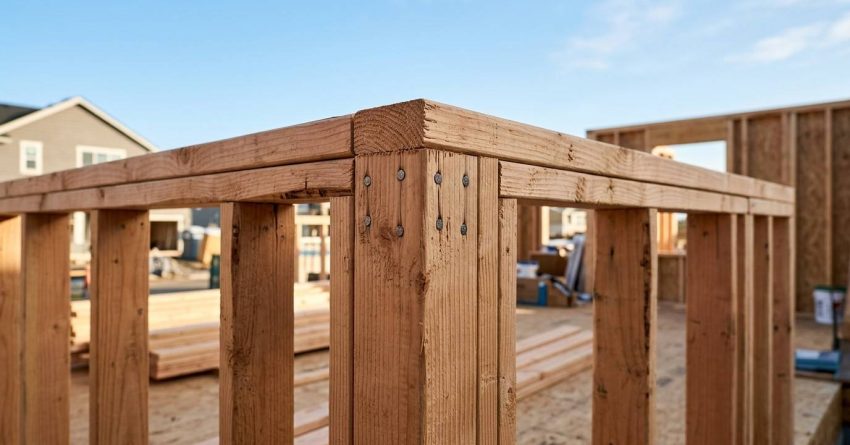
Stick framing is a construction method that assembles a building’s structural skeleton from individual pieces of dimensional lumber — the “sticks” — cut and nailed together on-site. Each piece serves a specific structural role: studs form vertical wall supports, joists carry floor and ceiling loads, rafters or trusses define the roof shape, and plates tie everything together at the top and bottom of each wall.
The method became the dominant residential construction approach in the United States during the mid-20th century because it is flexible, cost-effective, and compatible with virtually any floor plan or architectural design. Unlike prefabricated systems, stick framing is built entirely on location, which allows contractors to adapt to site conditions, design changes, and custom layouts in real time.
Stick framing is also called “conventional framing” or “wood frame construction” in building codes and contractor terminology. The International Residential Code (IRC) governs most stick-framed residential construction in the United States, setting minimum standards for lumber size, spacing, fastening, and structural connections.
Stick framing connects directly to broader carpentry work — our carpentry framing services explains how skilled carpenters support framing, structural repairs, and custom woodwork across residential and commercial properties.
How Stick Framing Differs from Other Framing Methods
Stick framing differs from other construction methods primarily in where and how the structure is assembled. In modular construction, wall panels and floor sections are built in a factory and shipped to the site for assembly. In post-and-beam construction, large timber members carry the structural load rather than a network of closely spaced smaller members. In steel framing, metal studs replace wood entirely.
Stick framing’s key advantage over these alternatives is on-site adaptability. A framing crew can adjust dimensions, add openings, and respond to design changes without factory lead times or specialized equipment. This flexibility makes it the preferred method for custom homes, additions, and remodeling projects where the final layout may evolve during construction.
The primary disadvantage compared to factory-built systems is labor time. Assembling a structure stick by stick takes longer than installing prefabricated panels, which is one reason panelized construction has grown in popularity for production homebuilding.
Key Components of a Stick Frame Structure
A stick frame structure consists of several interconnected systems, each serving a distinct structural function.
The sill plate is the lowest horizontal lumber member, anchored directly to the foundation. The floor joists span between the sill plates and carry the weight of the floor system. The subfloor sheathing — typically oriented strand board (OSB) or plywood — is nailed to the joists to create a rigid floor platform.
Wall studs are the vertical members that form the wall skeleton, typically spaced 16 or 24 inches on center. The top plate and bottom plate run horizontally at the top and bottom of each wall, tying the studs together. Headers span above door and window openings to transfer loads around the opening to the studs on either side.
Roof rafters or roof trusses form the roof structure, supported by the top plates of the exterior walls. Ridge boards or ridge beams run along the peak of the roof, connecting the upper ends of opposing rafters.
Once the stick frame is complete, the interior finish work begins — drywall and ceiling work is the next critical phase that encloses the framed walls and creates the finished surfaces homeowners see every day.
Types of Stick Framing Systems
Three distinct stick framing systems are used in residential and light commercial construction in the United States. Each has different structural characteristics, historical origins, and practical applications.
Platform Framing (Western Framing)
Platform framing is the standard method used in virtually all new residential construction today. In platform framing, each floor level is built as a complete platform before the walls of the next story are erected on top of it. The floor system — joists and subfloor sheathing — forms a flat working platform, and the wall frames for that story are assembled and raised on top of it.
This approach has several practical advantages. Workers always have a solid, level surface to work from. Each floor level is structurally independent, which simplifies construction sequencing and reduces the risk of structural movement during the build. Fire blocking is also easier to achieve in platform framing because the floor platform itself acts as a natural fire stop between stories.
Platform framing is the method specified in the IRC for most residential applications and is the default system used by framing contractors across the United States.
Balloon Framing
Balloon framing was the dominant residential construction method from the mid-1800s through the early 20th century. In balloon framing, the wall studs run continuously from the foundation sill plate to the roof, spanning the full height of the building without interruption at each floor level. Floor joists are attached to the studs at intermediate heights using a horizontal member called a ribbon board or ledger.
Balloon framing is rarely used in new construction today because it requires very long lumber members that are difficult to source and handle, and because the continuous wall cavities create fire spread risks that require extensive blocking to mitigate. However, balloon framing is still encountered in older homes during renovation and remodeling work, and understanding its structure is important for contractors working on pre-1950s residential properties.
Advanced Framing (Optimum Value Engineering)
Advanced framing, also called Optimum Value Engineering (OVE), is a modified stick framing approach designed to reduce lumber use, lower material costs, and improve the thermal performance of the building envelope. Key features include 24-inch on-center stud spacing instead of the standard 16 inches, single top plates instead of double top plates, two-stud corner assemblies instead of three-stud corners, and insulated headers sized to the actual structural load rather than oversized as a default.
Advanced framing reduces the amount of wood in the wall assembly, which increases the proportion of insulation relative to thermal bridging through the studs. This improves the wall’s effective R-value and reduces heating and cooling loads. Advanced framing is increasingly specified in energy-efficient residential construction and is recognized by the U.S. Department of Energy as a best practice for reducing material waste without compromising structural performance.
Advanced framing and optimum value engineering are especially common in compact construction projects — homeowners exploring smaller builds can learn how these framing methods apply directly to tiny home framing and the unique structural requirements of small-footprint residential construction.
Stick Framing Materials and Lumber Specifications
The quality and specification of materials used in stick framing directly affect the structural performance, durability, and code compliance of the finished building. Selecting the right lumber grade, species, and engineered products for each application is a critical part of the framing process.
Dimensional Lumber Grades and Sizes
Dimensional lumber used in stick framing is graded by the American Lumber Standard Committee (ALSC) and assigned a structural value based on species, grain characteristics, and defect limits. The most common grades used in residential framing are No. 2 and Better, which provide the minimum structural values required by the IRC for most applications.
Common framing lumber species in the United States include Douglas Fir-Larch, Hem-Fir, Southern Yellow Pine, and Spruce-Pine-Fir. Each species group has different structural values for bending, compression, and tension, which affect the allowable spans and load capacities specified in the IRC span tables.
Standard dimensional lumber sizes used in framing include 2×4 and 2×6 for wall studs, 2×8 through 2×12 for floor and ceiling joists, and 2×6 through 2×12 for roof rafters. Actual dimensions are smaller than nominal dimensions — a 2×4 measures 1.5 inches by 3.5 inches in actual cross-section.
Engineered Wood Products Used in Stick Framing
Engineered wood products have become standard components in modern stick framing because they offer greater dimensional stability, longer allowable spans, and more consistent structural performance than solid sawn lumber.
Laminated Veneer Lumber (LVL) is manufactured by bonding thin wood veneers under heat and pressure, producing a beam with predictable structural properties and no natural defects. LVL is commonly used for headers over large openings, ridge beams, and flush beams in floor systems.
I-joists (also called TJI joists or wood I-beams) consist of a top and bottom flange of solid lumber or LVL connected by a vertical web of OSB. I-joists are lighter than solid lumber joists of equivalent span capacity, resist warping and shrinkage, and allow longer clear spans with shallower depth.
Parallel Strand Lumber (PSL) and Laminated Strand Lumber (LSL) are used for columns, posts, and beams where high compressive and bending strength are required in a compact cross-section.
Fasteners, Connectors, and Hardware
Structural fasteners and metal connectors are as important to the integrity of a stick frame as the lumber itself. The IRC specifies minimum nailing schedules for every framing connection — the number, size, and pattern of nails required to achieve the design load transfer at each joint.
Common framing fasteners include 16d common nails (3.5 inches) for stud-to-plate connections, 8d nails for sheathing attachment, and structural screws for specific engineered lumber connections. Pneumatic nail guns are standard on modern framing crews, but the nail schedule requirements remain the same regardless of the fastening method.
Metal connectors manufactured by companies such as Simpson Strong-Tie and MiTek are required at critical structural connections including joist hangers, hurricane ties, hold-downs, post caps, and beam seats. These connectors are specified by engineers and inspectors and must be installed with the correct fastener type and quantity to achieve their rated load capacity.
For smaller framing repairs, lumber replacements, and structural patch work that do not require a full framing crew, handyman repair services provide a practical and cost-effective solution for homeowners managing minor structural maintenance.
The Stick Framing Process Step by Step
Stick framing follows a defined sequence that builds the structural system from the ground up. Each phase must be completed and inspected before the next phase begins.
Site Preparation and Foundation Readiness
Before framing begins, the foundation must be complete, cured, and inspected. For slab-on-grade construction, the concrete slab must reach design strength — typically 28 days for full cure, though framing often begins after 7 days when the slab reaches adequate early strength. For crawl space and basement foundations, the foundation walls must be complete, waterproofed, and backfilled before the floor framing begins.
The framing crew verifies that the foundation is square, level, and dimensionally accurate before laying out the sill plates. Any foundation irregularities must be corrected at this stage because errors in the foundation translate directly into errors in the framing above.
Anchor bolts or post-installed anchors connect the sill plates to the foundation. The IRC specifies minimum anchor bolt diameter, embedment depth, and spacing for different seismic and wind exposure categories.
Sill Plate and Floor Framing
The sill plate is the first piece of lumber installed in the framing sequence. It is pressure-treated to resist moisture and decay because it sits directly on the concrete foundation. A sill seal gasket is installed between the sill plate and the foundation to prevent air infiltration and moisture wicking.
Floor joists span between the sill plates on opposite foundation walls, or between the sill plate and a center beam. Joist spacing — typically 12, 16, or 24 inches on center — is determined by the joist size, species, grade, and the required floor span. Blocking or bridging is installed between joists at mid-span and at bearing points to prevent rotation and distribute loads.
After the floor joists are in place, the subfloor sheathing — typically 3/4-inch tongue-and-groove OSB or plywood — is glued and nailed to the joists to create the floor platform. After the floor framing system is in place, the subfloor and finished flooring layers follow — flooring installation services covers every flooring type, installation method, and material option that sits on top of the framed floor system.
Wall Framing Layout and Assembly
Wall framing begins with a layout process called “snapping lines” — chalk lines are snapped on the subfloor to mark the exact position of every wall in the floor plan. The framing crew then cuts and assembles the wall components — bottom plate, studs, top plate, headers, king studs, jack studs, and cripple studs — flat on the subfloor before raising the assembled wall into position.
Standard wall stud spacing is 16 inches on center for most residential applications, though 24-inch spacing is used in advanced framing and some single-story applications. Stud height is determined by the ceiling height — 8-foot ceilings use 92-5/8-inch precut studs, while 9-foot and 10-foot ceilings use correspondingly taller studs.
After the walls are raised and plumbed, a second top plate — called the double top plate or cap plate — is nailed over the first top plate with lapped joints at corners and intersections. This ties the wall frames together and provides a continuous bearing surface for the floor or roof system above.
Roof Framing Basics
Roof framing is the most complex phase of stick framing because it requires cutting lumber members at precise angles to achieve the correct roof pitch, span, and geometry. The two primary roof framing methods are rafter framing and truss framing.
In rafter framing, individual rafters are cut on-site and installed one at a time, spanning from the top plate of the exterior wall to the ridge board at the peak. Rafter framing allows for vaulted ceilings and attic living space because the roof cavity is open. It requires more skilled labor and more time than truss installation.
In truss framing, engineered roof trusses are manufactured off-site and delivered to the job site for installation. Trusses are faster to install, structurally engineered for the specific roof loads, and typically less expensive than site-cut rafters for standard roof geometries. However, trusses create a web of structural members in the attic that limits usable attic space.
Roof framing creates the structural skeleton that every roofing system depends on — roofing installation services explains how roofing materials, underlayment, and weatherproofing systems are applied over the framed roof structure to protect the home.
Sheathing and Structural Bracing
Structural sheathing — typically 7/16-inch or 15/32-inch OSB or plywood — is applied to the exterior face of the wall framing and the roof framing after the structural skeleton is complete. Wall sheathing serves two functions: it provides a nailing base for exterior cladding, and it acts as a structural diaphragm that resists lateral loads from wind and seismic forces.
The nailing pattern for structural sheathing is specified by the engineer of record or by the IRC prescriptive tables and must be followed exactly. Closer nail spacing at panel edges — typically 6 inches on center — provides greater shear resistance than field nailing at 12 inches on center.
After sheathing is applied, a weather-resistive barrier (house wrap or building paper) is installed over the sheathing before exterior cladding is applied. This layer manages moisture that penetrates the cladding and directs it away from the sheathing and framing.
Framing is the structural backbone of every remodeling project — whether expanding a room, opening a floor plan, or adding a new addition — and our home remodeling services covers how framing integrates with the full scope of residential renovation work.
Structural Principles Behind Stick Framing
Understanding the structural principles that govern stick framing helps homeowners and property managers make informed decisions about renovations, additions, and repairs that affect the building’s load-carrying system.
Load Paths and Weight Distribution
Every load applied to a building — the weight of the roof, floors, occupants, furniture, snow, and wind — must travel through a continuous path of structural members from the point of application to the foundation. This concept is called the load path, and maintaining an uninterrupted load path is the fundamental requirement of structural framing.
In a stick-framed building, gravity loads travel downward through the roof framing to the top plates of the exterior walls, then through the wall studs to the bottom plates, then through the floor system to the foundation. Lateral loads from wind and seismic forces travel through the roof and floor diaphragms to the shear walls, then down through the shear wall framing to the foundation.
Any modification to the framing — removing a wall, cutting a joist, enlarging an opening — interrupts the load path and must be compensated for with a properly sized header, beam, or post. Failing to maintain the load path is the most common cause of structural problems in renovated homes.
Understanding bearing walls and load paths is essential before cutting any opening in a framed wall — window installation services explains how window openings are properly framed, headed, and supported to maintain structural integrity during installation.
Bearing Walls vs. Non-Bearing Walls
A bearing wall carries structural loads from above and transfers them to the foundation. A non-bearing wall carries only its own weight and provides no structural support to the floors or roof above it. Identifying which walls are bearing and which are non-bearing is essential before any wall removal or modification.
Bearing walls are typically located at the exterior perimeter of the building and at the center of the building where they support the midspan of floor joists or roof rafters. Interior bearing walls often run perpendicular to the floor joists above them. Non-bearing walls typically run parallel to the floor joists and can be removed without structural consequence, provided the wall does not contain plumbing, electrical, or HVAC systems that must be rerouted.
Determining whether a wall is bearing requires examining the framing above and below it. In many cases, a structural engineer’s assessment is required before a wall removal can be permitted and inspected. The same structural principles that govern window openings apply to door rough openings — door framing and installation covers how door frames are built into the stick frame wall system, including header sizing and king stud requirements.
Span Tables and Spacing Requirements
The IRC publishes span tables that specify the maximum allowable span for floor joists, ceiling joists, and roof rafters based on lumber species, grade, size, and spacing. These tables are the primary reference for framing contractors and building inspectors when verifying that the framing meets minimum structural requirements.
Span tables account for the design loads specified for the building’s location — including live loads (occupants and furniture), dead loads (the weight of the structure itself), snow loads, and wind loads. Using a lumber member that does not meet the span table requirements for the applied loads is a code violation that will be flagged during framing inspection.
Stick Framing for Residential vs. Commercial Applications
Stick framing is used across a wide range of building types, from single-family homes to multi-family residential buildings and light commercial structures. The principles are the same, but the scale, code requirements, and structural demands differ significantly.
Single-Family Home Framing
Single-family home framing is the most common application of stick framing in the United States. The IRC governs single-family residential construction and provides prescriptive framing requirements that allow contractors to build without a site-specific structural engineering stamp for most standard designs.
A typical single-family home framing package includes the floor system, exterior and interior wall framing, and roof framing. Framing a standard 2,000-square-foot single-story home typically takes a crew of 3 to 5 framers 5 to 10 working days, depending on design complexity, site conditions, and crew experience.
Multi-Family and Light Commercial Framing
Multi-family residential buildings — duplexes, triplexes, townhomes, and apartment buildings up to five stories — can be stick-framed under the International Building Code (IBC) using Type V-A or Type V-B construction classifications. These buildings require fire-rated assemblies at unit separations, corridor walls, and floor-ceiling assemblies, which adds complexity to the framing design and inspection requirements.
Light commercial buildings such as retail spaces, offices, and small mixed-use structures are also commonly stick-framed. Commercial framing projects typically require a licensed structural engineer to design and stamp the framing plans, and inspections are more frequent and detailed than in residential construction.
Additions, Garages, and Accessory Structures
Residential additions, detached garages, and accessory dwelling units (ADUs) are among the most common stick framing projects for existing homeowners and property managers. These projects require permits, inspections, and compliance with current code requirements — even when the existing home was built under older code editions.
Connecting a new addition to an existing stick-framed structure requires careful attention to the load path at the connection point, proper flashing and moisture management at the junction, and matching the existing floor and ceiling heights. Detached garages and ADUs are typically simpler framing projects because they are structurally independent of the existing home.
Building Codes, Permits, and Inspections for Stick Framing
Building codes, permits, and inspections are not optional for stick framing projects. They exist to protect the safety of occupants and future owners, and skipping them creates legal liability, insurance complications, and costly corrections when the work is eventually discovered.
IRC and IBC Requirements
The International Residential Code (IRC) is the primary code governing stick-framed single-family and two-family residential construction in the United States. Most states and municipalities have adopted the IRC with local amendments. The IRC provides prescriptive framing requirements — specific lumber sizes, spans, spacings, and fastening schedules — that allow contractors to build without custom engineering for standard designs.
The International Building Code (IBC) governs commercial buildings and multi-family residential buildings of three or more units. IBC projects require engineered framing plans and more rigorous inspection protocols than IRC projects.
Both codes are updated on a three-year cycle. The 2021 IRC and 2021 IBC are the most widely adopted editions as of 2026, though some jurisdictions are still enforcing the 2018 editions.
Permit Process and What Inspectors Check
A building permit for a stick framing project is obtained from the local building department before work begins. The permit application typically requires a site plan, floor plan, and framing plan showing the structural layout, lumber specifications, and connection details. For engineered designs, the stamped structural drawings must be submitted with the permit application.
Framing inspections occur after the framing is complete but before insulation and drywall are installed. The inspector verifies that the framing matches the approved plans, that lumber sizes and grades meet the specified requirements, that the nailing schedule has been followed, that headers are correctly sized, that structural connectors are installed, and that fire blocking is in place at required locations.
Framing inspections and electrical rough-in inspections are often scheduled together because wiring runs through the framed wall cavities before insulation and drywall close them in — electrical rough-in services explains what electricians do inside the framed structure before walls are closed.
Plumbing rough-in work also happens inside the framed wall and floor cavities before inspections close the structure — plumbing rough-in services covers how pipes, drains, and supply lines are run through the framed system during new construction and remodeling.
Common Code Violations and How to Avoid Them
The most frequently cited framing code violations include missing or incorrect fire blocking, undersized headers over openings, incorrect nailing schedules on structural sheathing, missing structural connectors at critical connections, and framing members notched or bored beyond the limits specified in the IRC.
Avoiding these violations requires using the correct code edition for the jurisdiction, following the approved framing plans exactly, and having the framing inspected before closing the walls. Contractors who are unfamiliar with local code amendments should consult with the building department before starting work.
Stick Framing Costs and Project Timelines
Framing costs and timelines vary significantly based on project size, design complexity, lumber prices, and local labor rates. Understanding the key cost drivers helps homeowners and property managers budget accurately and evaluate contractor bids.
Cost Factors That Affect Stick Framing Projects
The primary cost drivers in stick framing are lumber material costs, labor costs, and project complexity. Lumber prices are volatile and have fluctuated significantly in recent years due to supply chain disruptions and demand cycles. Labor costs vary by region, with framing labor rates generally higher in coastal markets and lower in the interior United States.
Design complexity adds cost in several ways. Complex roof geometries — hip roofs, intersecting gables, dormers — require more skilled labor and more material waste than simple gable roofs. Multi-story buildings require more time and equipment than single-story structures. Custom floor plans with many interior walls, large openings, and non-standard dimensions take longer to frame than simple rectangular layouts.
Engineered lumber products — LVL beams, I-joists, and PSL columns — cost more per linear foot than dimensional lumber but often reduce overall project cost by enabling longer spans with fewer support points, which simplifies the floor plan and reduces foundation costs.
Average Cost Ranges by Project Type
Framing costs are typically quoted per square foot of floor area or as a lump sum for the complete framing package. As a general reference, residential framing labor costs in the United States range from approximately $7 to $16 per square foot of floor area, with material costs adding $3 to $10 per square foot depending on lumber prices at the time of construction.
A complete framing package for a 2,000-square-foot single-story home — including labor and materials for floor, wall, and roof framing — typically ranges from $20,000 to $50,000, with significant variation based on location, design, and market conditions. Additions and accessory structures are generally priced at the higher end of the per-square-foot range because of the additional complexity of connecting to or working around existing construction.
Deck construction uses the same stick framing principles as interior floor systems, and cost and timeline factors are similar — deck framing services covers how decks are framed, permitted, and built as structural extensions of the home.
Typical Timeline from Framing Start to Dry-In
The timeline from the start of framing to dry-in — the point at which the building is enclosed with sheathing and weather-resistive barrier and protected from rain — depends on building size, crew size, and weather conditions.
A standard 2,000-square-foot single-story home typically reaches dry-in within 2 to 4 weeks of framing start with a crew of 4 to 6 framers. A two-story home of similar floor area typically takes 3 to 5 weeks. Large custom homes and multi-family buildings take proportionally longer.
Weather delays are the most common cause of framing schedule extensions. Framing crews cannot work safely in high winds, and wet lumber is difficult to handle and may not meet moisture content requirements for insulation installation. Scheduling framing during dry seasons reduces weather-related delays.
Common Stick Framing Problems and How to Fix Them
Even well-executed framing projects can develop problems over time or reveal issues during renovation work. Recognizing common framing problems early reduces repair costs and prevents structural deterioration.
Warped or Twisted Lumber
Lumber warps and twists when it dries unevenly after installation. Green lumber — lumber with high moisture content at the time of installation — is particularly prone to warping as it dries to equilibrium moisture content in service. Warped studs create wavy walls that are difficult to finish with drywall, and twisted joists create uneven floors.
Preventing warp starts with specifying kiln-dried lumber (KD or KDAT) for framing, which has been dried to a moisture content of 19 percent or less before delivery. Storing lumber off the ground and covered on the job site prevents re-wetting before installation. Severely warped studs should be replaced before drywall installation because shimming and furring are temporary fixes that do not address the underlying problem.
Improper Nailing Patterns
Incorrect nailing is one of the most common framing deficiencies found during inspections and renovation work. Under-nailed connections — too few nails, wrong nail size, or nails driven at incorrect angles — reduce the load transfer capacity of the joint and can cause structural movement or failure under design loads.
The IRC nailing schedule specifies the exact number, size, and pattern of nails required for every framing connection. Common errors include using 8d nails where 16d nails are required, skipping nails at stud-to-plate connections, and failing to nail structural sheathing at the specified edge and field spacing. Correcting improper nailing requires adding the missing fasteners before the framing is covered.
Moisture Damage and Rot in Framed Walls
Moisture infiltration is the most serious long-term threat to stick-framed structures. When water enters the wall cavity through roof leaks, window and door flashing failures, or condensation, it saturates the framing lumber and creates conditions for wood rot and mold growth. Rotted framing members lose structural capacity and must be replaced.
Identifying moisture damage in framed walls requires opening the wall surface — either by removing drywall from the interior or siding from the exterior. Signs of moisture damage include staining, soft or spongy wood, visible mold, and a musty odor. When moisture infiltrates a framed wall system and causes rot or structural damage, professional intervention is required — water damage restoration explains how water-damaged framing members are identified, dried, and replaced to restore structural integrity.
Stick Framing vs. Modular and Panelized Construction
Stick framing is not the only option for residential and light commercial construction. Modular and panelized construction methods offer different trade-offs in cost, speed, quality control, and design flexibility.
On-Site vs. Off-Site Framing Compared
Stick framing is assembled entirely on-site, which gives the framing crew maximum flexibility to adapt to site conditions, design changes, and custom layouts. The trade-off is that on-site assembly is slower and more dependent on weather conditions and crew skill than factory production.
Panelized construction builds wall panels, floor cassettes, and roof panels in a factory under controlled conditions, then ships them to the site for assembly. Factory production reduces material waste, improves dimensional accuracy, and shortens on-site assembly time. However, panelized systems require detailed engineering and manufacturing drawings before production begins, which reduces design flexibility during construction.
Modular construction takes factory production further, assembling complete three-dimensional building modules — including framing, insulation, wiring, and plumbing rough-in — in the factory before shipping to the site. Modular construction offers the fastest on-site assembly time and the highest level of factory quality control, but it requires the most detailed upfront design work and is less adaptable to custom or complex designs.
Choosing between stick framing and panelized systems is a decision that affects the entire construction plan — remodeling project planning helps homeowners and property managers understand which construction method best fits their project scope, budget, and timeline.
When Stick Framing Is the Better Choice
Stick framing is the better choice when design flexibility is a priority, when the project involves complex geometry or custom details that are difficult to prefabricate, when the site has access limitations that make large panel or module delivery impractical, or when the project is a renovation or addition to an existing structure.
For new construction on accessible sites with straightforward designs, panelized or modular systems may offer cost and schedule advantages. For custom homes, additions, renovations, and projects in tight urban sites, stick framing remains the most practical and widely supported construction method.
Hiring a Stick Framing Contractor
Choosing the right framing contractor is one of the most important decisions in any construction or renovation project. The framing crew’s skill and attention to detail affect every subsequent phase of construction.
What to Look for in a Framing Crew
A qualified framing contractor should hold a valid contractor’s license in the state where the work is performed, carry general liability insurance and workers’ compensation coverage, and have verifiable experience with projects of similar size and complexity. Ask for references from recent projects and, if possible, visit a completed project to assess the quality of the framing work.
Look for a crew that uses kiln-dried lumber, follows the IRC nailing schedule consistently, installs structural connectors correctly, and maintains a clean and organized job site. Framing quality is difficult to assess after drywall is installed, so the time to evaluate the crew’s work is during the framing phase, before the walls are closed.
Questions to Ask Before Hiring
Before signing a framing contract, ask the contractor to provide a detailed scope of work that specifies the lumber species and grade, the engineered lumber products to be used, the nailing schedule to be followed, and the structural connectors to be installed. Ask who will pull the building permit and who will be on-site to manage the framing inspection.
Ask about the crew’s experience with the specific framing system your project requires — platform framing, advanced framing, or engineered lumber systems. Ask how the contractor handles lumber defects and substitutions if specified materials are unavailable. Ask for a written timeline with milestones and a clear process for managing change orders.
For smaller framing tasks that fall below the threshold of a full framing contractor, local handyman professionals can handle structural patch work, blocking installation, and minor framing repairs with the same quality standards.
How Mr. Local Services Connects You with Framing Professionals
Finding a qualified framing contractor on your own requires significant research, vetting, and comparison. Mr. Local Services simplifies this process by connecting homeowners and property managers with trusted framing professionals who are vetted, experienced, and ready to handle residential and commercial stick framing projects of any size.
Whether you are planning a new build, a room addition, a garage, or a structural repair, Mr. Local Services matches you with framing professionals who understand local code requirements, work with transparent pricing, and deliver consistent results. Contact Mr. Local Services today to get connected with a qualified framing crew in your area.
Conclusion
Stick framing is the structural foundation of most homes and light commercial buildings in the United States, combining flexibility, cost-effectiveness, and code-supported design into a proven construction system.
Understanding the types, materials, process, and structural principles behind stick framing helps homeowners and property managers make better decisions about new construction, renovations, and repairs that affect the building’s structural integrity.
When your project requires skilled framing work, Mr. Local Services connects you with vetted professionals who deliver quality workmanship, transparent pricing, and dependable results — keeping your property safe, functional, and built to last.
Frequently Asked Questions About Stick Framing
What is the difference between stick framing and timber framing?
Stick framing uses closely spaced dimensional lumber members — typically 2×4 or 2×6 studs at 16 or 24 inches on center — to distribute structural loads across many small members. Timber framing uses large, heavy timber posts and beams to carry loads through fewer, larger structural members. Stick framing is faster and less expensive for standard residential construction, while timber framing is used for custom aesthetic applications and traditional barn-style structures.
How long does stick framing last?
A properly built stick-framed structure can last 100 years or more when the framing is protected from moisture, insects, and physical damage. The primary threats to framing longevity are water infiltration that causes rot, termite and carpenter ant infestations, and structural modifications that compromise the load path. Regular maintenance of the building envelope — roofing, siding, windows, and flashing — is the most effective way to protect the framing from moisture damage.
Can I remove a wall in a stick-framed house myself?
Removing a wall in a stick-framed house requires determining whether the wall is load-bearing before any work begins. Removing a bearing wall without installing a properly sized beam and support posts to carry the load above can cause serious structural damage. Most jurisdictions require a permit and structural engineering review for bearing wall removal. Non-bearing wall removal is simpler but still requires rerouting any electrical, plumbing, or HVAC systems in the wall cavity.
What size lumber is used for wall framing?
Standard residential wall framing uses 2×4 lumber for interior walls and for exterior walls in mild climates. 2×6 lumber is used for exterior walls in cold climates because the wider cavity allows for more insulation — typically R-19 or R-21 batts compared to R-13 or R-15 in a 2×4 wall. Advanced framing uses 2×6 studs at 24 inches on center to maximize insulation value while reducing lumber use.
How much does it cost to frame a 1,000-square-foot addition?
Framing a 1,000-square-foot addition typically costs between $15,000 and $35,000 for labor and materials, depending on the design complexity, local labor rates, and current lumber prices. Single-story additions with simple roof geometry are at the lower end of this range. Two-story additions or those with complex roof lines, large openings, or engineered lumber requirements are at the higher end. These figures do not include foundation work, permits, or subsequent trades.
What is fire blocking in stick framing?
Fire blocking is horizontal framing material installed in wall cavities to slow the spread of fire through concealed spaces in the framing. The IRC requires fire blocking at specific locations including the top and bottom of wall cavities, at floor and ceiling lines, and at horizontal intervals not exceeding 10 feet in vertical wall cavities. Fire blocking is typically made from 2x lumber cut to fit between studs and nailed in place. Missing fire blocking is one of the most common framing inspection failures.
Do I need a permit to reframe a wall in my home?
Yes, in most jurisdictions a permit is required for any work that involves structural framing, including removing or modifying walls, adding new openings, or repairing damaged framing members. Permit requirements vary by municipality, but the general rule is that any work affecting the structural system of the building requires a permit and inspection. Working without a permit creates liability issues when selling the property and may require the work to be opened up and re-inspected at the homeowner’s expense.
What is the difference between a king stud and a jack stud?
A king stud is a full-height stud that runs from the bottom plate to the top plate on either side of a door or window opening. A jack stud (also called a trimmer stud) is a shorter stud that runs from the bottom plate to the underside of the header, supporting the header at each end of the opening. Together, the king stud and jack stud form the structural frame of the rough opening and transfer the header load to the bottom plate and foundation below.