The foundation your home sits on determines everything from structural stability to long-term maintenance costs. Slab, crawlspace, basement, and pier foundations each serve different climates, soil conditions, and budgets — and choosing or understanding the wrong one can lead to costly repairs down the road.
Knowing which foundation type your property has helps you make smarter maintenance decisions and catch problems before they escalate into serious structural damage.
This guide compares all four foundation types side by side, covering costs, pros and cons, best use cases, and what each type means for your home’s long-term value.
What Is a Foundation and Why Does the Type Matter?
A foundation is the structural base that transfers the weight of your home into the ground beneath it. It keeps the structure level, stable, and protected from moisture, soil movement, and temperature changes. Without a properly functioning foundation, walls crack, floors shift, and doors stop closing correctly.
How Foundation Type Affects Your Home’s Structure
The type of foundation under your home directly affects how it responds to soil movement, water pressure, and seasonal temperature changes. A slab foundation behaves very differently from a pier system when the ground shifts — and those differences determine what kinds of repairs become necessary over time.
Key Factors That Determine Foundation Choice
Builders and engineers select foundation types based on local climate, soil composition, frost depth, water table level, and construction budget. Regional building codes also play a significant role. Understanding what type of foundation your home sits on is the first step toward protecting it — our foundation repair services covers every repair method, warning sign, and professional solution available to homeowners across the USA.
Slab Foundation: Pros, Cons, and Best Use Cases
What Is a Slab Foundation?
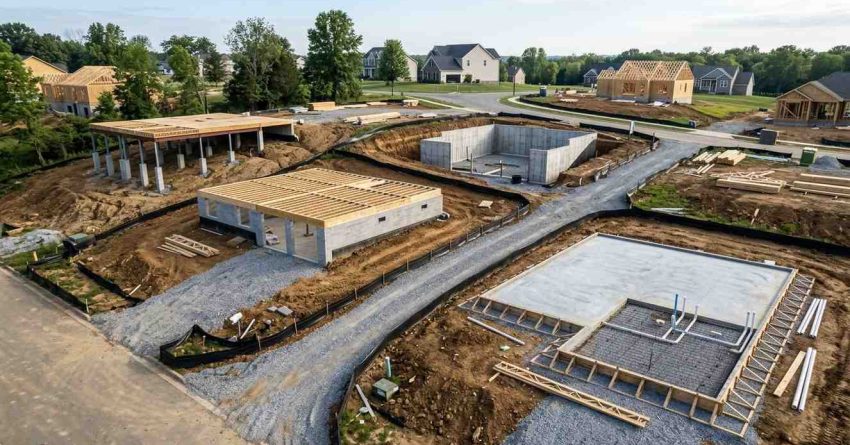
A slab foundation is a single, flat layer of poured concrete — typically 4 to 6 inches thick — placed directly on prepared ground. Plumbing and electrical conduits are embedded within or beneath the slab before it cures. There is no space between the floor and the ground.
Pros:
- Lower upfront construction cost
- Faster to build than other foundation types
- No crawlspace or basement for pests or moisture to enter
- Minimal maintenance under normal conditions
Cons:
- Plumbing repairs require cutting through the concrete
- Vulnerable to cracking from soil movement or tree roots
- Poor insulation from ground-level temperature changes
- Not suitable for areas with significant frost heave
When a Slab Foundation Makes Sense
Slab foundations work best in warm, dry climates where the ground does not freeze deeply. They are common across the southern and southwestern United States, where flat terrain and stable soil conditions make them a cost-effective and durable choice. If your home has a slab foundation and you notice cracking or uneven floors, learning about slab foundation repair options can help you act before minor issues become costly structural problems.
Crawlspace Foundation: Pros, Cons, and Best Use Cases
What Is a Crawlspace Foundation?
A crawlspace foundation raises the home off the ground on short perimeter walls, creating a shallow open space — typically 18 to 36 inches high — between the floor joists and the soil below. This space allows access to plumbing, electrical systems, and structural components without excavating.
Pros:
- Easier access to plumbing and electrical systems
- Provides some insulation from ground temperature
- Less expensive than a full basement
- Allows for ventilation beneath the home
Cons:
- Prone to moisture accumulation and mold growth
- Requires regular inspection and vapor barrier maintenance
- Can attract pests including rodents and insects
- Insulation can degrade over time if moisture is present
When a Crawlspace Foundation Makes Sense
Crawlspace foundations are common in the southeastern United States and in areas with moderate moisture levels and sloped terrain. They offer a practical middle ground between the cost of a slab and the excavation required for a basement. Moisture intrusion and wood rot are the most common threats to a crawlspace foundation — our guide to crawlspace repair options explains the full range of solutions, from vapor barriers to structural reinforcement.
Basement Foundation: Pros, Cons, and Best Use Cases
What Is a Basement Foundation?
A basement foundation extends the structure below grade — typically 8 feet or more — creating a full underground level beneath the home. The basement walls are poured concrete or concrete block, and the space can be finished for living use or left unfinished for storage and mechanical systems.
Pros:
- Adds significant usable square footage
- Provides excellent protection from severe weather and tornadoes
- Increases overall property value
- Keeps mechanical systems accessible and protected
Cons:
- Highest upfront construction cost of all four types
- Requires waterproofing and drainage systems
- Vulnerable to water intrusion and flooding
- Not feasible in areas with high water tables or rocky soil
When a Basement Foundation Makes Sense
Basement foundations are most common in the Midwest and Northeast, where frost lines run deep and excavation is already required. They add long-term value and livable space, making them a strong investment in the right climate. Basement foundations are especially vulnerable to water intrusion, and when flooding or see occurs, understanding water damage restoration helps homeowners respond quickly and limit structural damage.
Pier Foundation: Pros, Cons, and Best Use Cases
What Is a Pier Foundation?
A pier foundation supports the home on a series of vertical columns — concrete, steel, or wood — driven or poured into the ground to reach stable soil or bedrock below. The home’s floor system rests on beams that span between the piers, elevating the structure above grade.
Pros:
- Ideal for unstable, soft, or flood-prone soil
- Allows airflow beneath the home
- Easier to adjust or repair individual piers
- Works well on sloped or uneven terrain
Cons:
- Susceptible to shifting and settling over time
- Requires periodic leveling and inspection
- Exposed beams and joists can be damaged by moisture and pests
- Not suitable for areas with extreme cold without proper insulation
When a Pier Foundation Makes Sense
Pier foundations are widely used along the Gulf Coast, in flood zones, and in areas with expansive clay soils that shift significantly with moisture changes. They are also common under manufactured homes and older residential structures. Homes built on pier foundations require specialized inspection and leveling techniques — our resource on pier and beam repair walks through the full process, from identifying settlement to restoring structural integrity.
Side-by-Side Comparison: Slab vs. Crawlspace vs. Basement vs. Pier
Cost Comparison by Foundation Type
| Foundation Type | Average Construction Cost | Typical Repair Cost Range |
| Slab | $4,500–$12,000 | $500–$10,000+ |
| Crawlspace | $8,000–$21,000 | $1,500–$15,000 |
| Basement | $18,000–$40,000+ | $2,000–$25,000+ |
| Pier | $7,000–$18,000 | $1,000–$12,000 |
Each foundation type carries different long-term maintenance costs, and understanding those differences is essential — our foundation type costs breakdown helps homeowners plan budgets and prioritize repairs.
Maintenance Requirements by Foundation Type
| Foundation Type | Primary Maintenance Needs | Inspection Frequency |
| Slab | Crack monitoring, drainage management | Every 2–3 years |
| Crawlspace | Vapor barrier, ventilation, pest control | Annually |
| Basement | Waterproofing, sump pump, drainage | Annually |
| Pier | Leveling checks, beam and joist inspection | Every 1–2 years |
How to Choose the Right Foundation Type for Your Property
Climate and Soil Conditions
Climate is the single most important factor in foundation selection. Deep frost lines in northern states require foundations that extend below the freeze depth — making basements and deep footings necessary. Expansive clay soils in Texas and Oklahoma shift dramatically with moisture changes, making pier systems or reinforced slabs more appropriate. Sandy or soft coastal soils often require deep piers to reach stable bearing capacity.
Budget, Timeline, and Long-Term Value
Slab foundations offer the lowest upfront cost and fastest construction timeline. Basements carry the highest initial investment but add the most long-term value through usable square footage. Crawlspace and pier foundations fall in the middle range for both cost and complexity. Foundation choice directly affects future renovation possibilities, and homeowners planning additions or major upgrades will find that home remodeling planning resources help align structural decisions with long-term property goals.
Foundation Maintenance and Repair: What Every Homeowner Should Know
Signs Your Foundation Needs Attention
Foundation problems rarely appear suddenly. Most develop gradually over months or years, giving homeowners time to act if they know what to look for. Common warning signs include:
- Horizontal or diagonal cracks in walls or floors
- Doors and windows that stick or no longer close properly
- Uneven or sloping floors
- Gaps between walls and ceilings or floors
- Water intrusion in basements or crawlspaces
- Visible bowing or leaning in foundation walls
Catching foundation problems early saves thousands in repair costs — scheduling a professional foundation inspection with a qualified contractor is the most reliable way to assess your home’s structural health before issues escalate.
Conclusion
Slab, crawlspace, basement, and pier foundations each serve distinct structural purposes, and the right choice depends on climate, soil, and budget. Understanding the differences helps homeowners make informed decisions about maintenance, repairs, and long-term property investment.
Each foundation type carries unique vulnerabilities — from slab cracking to basement water intrusion — and recognizing early warning signs is the most effective way to protect your home’s structural integrity over time.
At Mr. Local Services, our network of skilled foundation professionals is ready to inspect, repair, and maintain any foundation type — giving you the confidence that your home is built on solid ground.
Frequently Asked Questions
What is the cheapest foundation type to build?
A slab foundation is typically the least expensive option, with average construction costs ranging from $4,500 to $12,000. It requires less labor and material than crawlspace, basement, or pier systems, making it the most budget-friendly choice for flat, stable terrain.
Which foundation type lasts the longest?
A properly constructed and maintained concrete slab or poured concrete basement can last 50 to 100 years or more. Longevity depends heavily on soil conditions, drainage quality, and how consistently the foundation is inspected and repaired when minor issues arise.
Can a foundation type be changed after a home is built?
Changing a foundation type after construction is extremely complex and expensive, often costing more than the original foundation. In most cases, contractors reinforce or repair the existing foundation rather than replace it with a different type entirely.
What foundation type is best for areas with heavy rain?
Pier foundations and properly waterproofed basements perform best in high-rainfall areas. Pier systems elevate the home above flood risk, while basements with interior drainage systems and sump pumps can manage significant water pressure when properly maintained.
How do I know what type of foundation my home has?
The easiest way to identify your foundation type is to inspect the exterior perimeter of your home and check for a crawlspace access door, basement entry, or a concrete slab at grade level. A home inspector or foundation contractor can confirm the type and assess its current condition.
What causes foundation problems in all four types?
Soil movement is the leading cause of foundation problems across all four types. Expansive clay soils, poor drainage, tree root intrusion, and freeze-thaw cycles all create pressure and shifting that leads to cracking, settling, and structural misalignment over time.
How often should a foundation be inspected?
Most foundation professionals recommend a professional inspection every one to three years, depending on the foundation type and local soil conditions. Crawlspace and pier foundations benefit from annual checks, while slab foundations in stable climates can be inspected every two to three years.