The right foundation for your home depends heavily on where you live. Climate determines frost depth, soil behavior, moisture levels, and wind exposure — all of which directly influence which foundation type will keep your structure safe, stable, and code-compliant for decades.
Choosing the wrong foundation for your climate zone leads to cracking, settling, water intrusion, and costly structural repairs that could have been avoided from the start.
This guide covers every major climate zone in the USA, explains how each affects foundation performance, and helps you match the right foundation type to your property’s specific conditions.
Why Climate Matters When Choosing a Foundation
A foundation does one job: transfer the weight of your home safely into the ground. But the ground behaves very differently depending on where you live. Temperature swings, rainfall, humidity, soil composition, and wind exposure all place different stresses on a foundation over time.
In cold northern states, the ground freezes and thaws repeatedly each winter. In hot southern states, clay-heavy soils expand and contract with seasonal moisture changes. In coastal regions, flood risk and high winds demand elevated, anchored designs. None of these conditions are interchangeable, and a foundation designed for one climate can fail quickly in another.
Understanding how climate affects your foundation starts with the ground beneath it — our guide to soil type compatibility explains how different soil compositions respond to moisture, temperature, and load, giving you the full picture before any foundation decision is made.
Freeze-Thaw Cycles and Frost Depth
When water in the soil freezes, it expands. When it thaws, it contracts. This repeated movement — called frost heave — pushes upward against anything in its path, including foundation footings. If footings are not placed below the local frost line, the foundation will shift, crack, and eventually fail.
Frost depth varies significantly across the USA. In Minnesota and Maine, the frost line can reach 60 inches or deeper. In Virginia, it may be only 15 inches. Local building codes specify the minimum footing depth for every region, and compliance is not optional.
Soil Moisture and Drainage Patterns
Soil that holds water creates hydrostatic pressure against foundation walls. Soil that drains quickly can shrink and leave voids beneath a slab. Both conditions cause structural problems over time. Understanding your site’s natural drainage pattern before construction is one of the most important steps in foundation planning.
Foundation Types and How They Perform in Different Climates
There are three primary residential foundation types used across the USA: slab-on-grade, crawl space, and full basement. Each has a climate profile where it performs well and conditions where it creates problems.
Slab Foundations: Best Climates and Limitations
A slab foundation is a single concrete pad poured directly on prepared ground. It works best in warm climates with stable, well-draining soil and minimal frost risk. States like Florida, Texas, Arizona, and Southern California use slab construction extensively because the ground rarely freezes and drainage conditions are manageable.
Slabs are cost-effective, fast to build, and eliminate the moisture risks associated with crawl spaces. However, in cold climates, a slab poured above the frost line will heave and crack. In clay-heavy soils, seasonal soil movement can crack a slab repeatedly regardless of climate.
Our slab foundation guide breaks down exactly where slab construction excels, where it struggles, and what homeowners in warm and transitional climates need to know before committing to this option.
Crawl Space Foundations: When Climate Makes Them Work
A crawl space foundation raises the home 18 to 36 inches above grade on perimeter walls or piers. This design works well in moderate climates where full basement excavation is impractical but a slab creates moisture risk. It also allows access to plumbing, electrical, and HVAC systems without major demolition.
The challenge with crawl spaces is moisture. In humid climates, an unencapsulated crawl space becomes a breeding ground for mold, wood rot, and pest activity. Proper ventilation or full encapsulation is essential in any region with significant humidity or rainfall.
Our resource on crawl space foundations covers ventilation, moisture barriers, and the climate conditions where this design performs best.
Full Basement Foundations: Cold-Climate Advantages
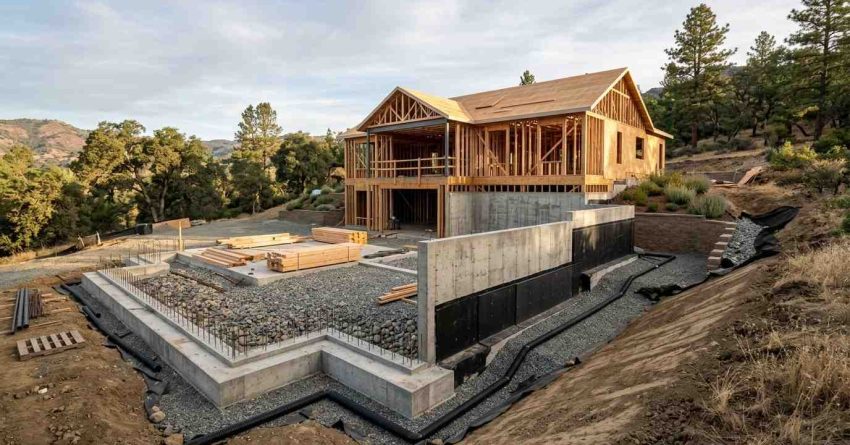
A full basement requires excavating below the frost line — which in cold climates means going deep anyway. Since the excavation is already necessary, extending it to create usable living or storage space adds relatively modest cost for significant benefit.
Basements are common in the Midwest, Northeast, and upper Plains states precisely because frost depth requirements make deep excavation unavoidable. They also provide natural insulation against temperature extremes and offer a safe refuge during severe weather events.
If you are considering a full basement, our content gap on full basement foundations covers costs, structural requirements, and the climate conditions where this option delivers the best long-term value.
Cold Climate Foundation Requirements
Cold climates — generally defined as USDA Hardiness Zones 3 through 6, covering states like Minnesota, Wisconsin, Michigan, New York, and Montana — impose the most demanding foundation requirements of any climate type in the USA.
Frost Line Depth and Footing Placement
Every foundation footing must be placed below the local frost line to prevent frost heave. This is a non-negotiable building code requirement in cold-climate states. Footings placed above the frost line will move with the freezing and thawing soil, causing the foundation to crack, shift, and eventually compromise the structure above.
Our reference on frost line depth provides state-by-state data so homeowners and contractors can confirm the minimum excavation depth required to prevent frost heave damage before breaking ground.
Insulation and Moisture Control in Freezing Conditions
Deep footings alone are not enough. Foundation walls in cold climates must be insulated to prevent heat loss from the conditioned space above and to reduce the risk of condensation forming on cold concrete surfaces. Rigid foam insulation applied to the exterior of foundation walls is the most effective method, keeping the wall temperature above the dew point and reducing thermal bridging.
Interior drainage systems and sump pumps are also standard in cold-climate basements, where spring snowmelt creates significant hydrostatic pressure against foundation walls.
Our overview of foundation insulation methods explains the materials, placement strategies, and R-value requirements that protect foundations in freezing conditions year-round.
Hot and Arid Climate Foundation Considerations
Hot and arid climates — including the desert Southwest, parts of Texas, and the Central Valley of California — present a different set of foundation challenges. The primary threat is not frost but expansive soil behavior driven by extreme moisture fluctuation.
Expansive Soil and Slab Movement
Many arid regions contain high concentrations of clay minerals, particularly montmorillonite, which absorbs water and swells dramatically when wet, then shrinks and cracks when dry. This expansion and contraction cycle exerts enormous pressure on slab foundations, causing cracking, heaving, and differential settlement.
Post-tensioned slabs — reinforced with high-strength steel cables tensioned after the concrete cures — are widely used in Texas and other expansive soil regions because they resist the bending forces that clay soil movement creates. Standard slab construction without post-tensioning is often inadequate in these conditions.
When clay-heavy soils expand and contract with seasonal moisture changes, slab foundations in hot climates are especially vulnerable to cracking and shifting — our on expansive soil repair covers the warning signs, repair methods, and preventive measures every homeowner in arid regions should understand.
Drainage Design in Low-Rainfall Regions
Even in dry climates, episodic heavy rainfall events can saturate soil rapidly, creating sudden hydrostatic pressure against foundations that are not designed for water management. Proper grading, French drains, and downspout extensions are essential even in regions that receive relatively little annual rainfall.
Irrigation systems around the home’s perimeter also contribute to soil moisture fluctuation in arid climates. Consistent, controlled watering around the foundation perimeter — rather than allowing soil to dry out completely between irrigation cycles — helps reduce the severity of expansion and contraction cycles.
Humid and High-Rainfall Climate Foundation Needs
The southeastern USA — including Florida, Georgia, Louisiana, Mississippi, and the Carolinas — receives some of the highest annual rainfall in the country. Foundations in these regions face persistent moisture pressure from above, below, and through the soil.
Waterproofing and Drainage Systems
In high-rainfall climates, water management is the central foundation challenge. Exterior waterproofing membranes applied to foundation walls prevent water from penetrating the concrete. Interior drainage channels and sump systems collect and redirect water that does enter the foundation perimeter. Both systems working together provide the most reliable protection.
Surface grading is equally important. The ground around a home should slope away from the foundation at a minimum of 6 inches over the first 10 feet to direct surface water away from the structure. Gutters and downspouts must discharge water at least 4 to 6 feet from the foundation.
In high-rainfall climates, water intrusion is the leading cause of foundation deterioration — our detailed resource on foundation waterproofing outlines interior and exterior drainage systems, membrane applications, and the professional services that keep wet-climate foundations dry and structurally sound.
Crawl Space Encapsulation in Wet Climates
Homes with crawl spaces in humid regions face a specific and serious problem: warm, moist outdoor air enters the crawl space through foundation vents, contacts cooler surfaces, and condenses. This moisture feeds mold growth, accelerates wood rot in floor joists and beams, and creates conditions that attract termites and other pests.
Crawl space encapsulation — sealing the crawl space with a heavy-duty vapor barrier on the floor and walls, combined with a dehumidifier — eliminates this moisture cycle. It is one of the highest-return foundation investments available to homeowners in humid climates.
Homes with crawl spaces in humid regions face persistent moisture infiltration that accelerates wood rot, mold growth, and structural weakening — our crawl space encapsulation guide explains the full process, materials, and long-term benefits of sealing a crawl space against moisture in wet climates.
Coastal and High-Wind Climate Foundation Standards
Coastal properties along the Atlantic, Gulf, and Pacific coasts face a combination of flood risk, high wind loads, storm surge, and salt air corrosion that demands specialized foundation design. FEMA flood zone designations and local building codes impose specific requirements that go well beyond standard residential construction.
Pier and Beam Foundations for Flood Zones
In FEMA-designated Special Flood Hazard Areas (SFHAs), homes must be elevated above the Base Flood Elevation (BFE) — the height floodwaters are expected to reach during a 100-year flood event. Pier and beam foundations accomplish this by raising the structure on concrete or steel piers driven deep into stable soil below the flood-prone surface layers.
This design allows floodwaters to pass beneath the structure rather than against it, dramatically reducing hydrostatic pressure and flood damage. It also reduces the risk of foundation undermining, where floodwaters erode soil from beneath a slab or perimeter wall foundation.
Coastal properties in flood zones require foundations that elevate the structure above base flood elevation — our resource on pier and beam foundations covers design requirements, material selection, and the building code standards that apply in FEMA-designated flood zones.
Anchor Systems and Wind Load Requirements
High-wind zones — including hurricane-prone coastal areas and tornado-risk regions of the central USA — require foundations to be mechanically anchored to the structure above. Anchor bolts embedded in the foundation connect to the wall framing, and hurricane straps or clips connect the wall framing to the roof structure, creating a continuous load path from roof to foundation.
Without proper anchoring, high winds can separate a structure from its foundation even when the foundation itself remains intact. Building codes in wind-exposure categories C and D (the highest risk designations) specify anchor bolt spacing, embedment depth, and strap requirements that must be met for a structure to receive a certificate of occupancy.
How to Match Your Foundation to Your Local Climate
Selecting the right foundation is not a decision that should be made from a general guide alone. Local soil conditions, drainage patterns, frost depth, flood zone status, and municipal building codes all influence which foundation type is appropriate — and which will fail.
The most reliable process starts with a professional site assessment. A geotechnical soil report identifies soil type, bearing capacity, and moisture behavior. A structural engineer uses that data to specify the appropriate foundation type, footing depth, reinforcement, and drainage requirements for your specific site and climate zone.
Working With a Structural Engineer or Contractor
For new construction, a structural engineer should be involved before any foundation design is finalized. For existing homes, a foundation inspection by a qualified professional is the starting point for identifying climate-related deterioration and planning appropriate repairs or upgrades.
Before selecting a foundation type, a professional site assessment is the most reliable way to confirm soil conditions, drainage patterns, and local code requirements — our foundation inspection services explains what a structural evaluation includes and how to schedule one for your property.
Understanding regional foundation cost differences is also essential for accurate budgeting — our content gap on foundation cost by climate zone breaks down what homeowners in different regions typically spend on foundation construction, from frost-depth excavation in cold climates to post-tensioned slabs in expansive soil regions.
Foundation Maintenance by Climate Zone
Every foundation requires ongoing maintenance, but the specific tasks and inspection priorities differ by climate. A homeowner in Minnesota needs to check for frost heave damage every spring. A homeowner in Florida needs to monitor for moisture intrusion and crawl space conditions year-round. A homeowner in Arizona needs to watch for slab cracking after dry spells.
Seasonal Inspection Checklist
Regardless of climate, a twice-yearly foundation inspection — once in spring after the wet season and once in fall before winter — catches developing problems before they become structural failures. Key items to check include:
Exterior: grading slope away from the foundation, condition of window wells, visible cracks in foundation walls or exposed footings, downspout discharge locations, and signs of soil erosion or settlement near the perimeter.
Interior: basement or crawl space walls for cracks, efflorescence (white mineral deposits indicating water movement), moisture staining, mold growth, and the condition of any existing drainage or sump systems.
Doors and windows that stick or no longer close properly are often early indicators of foundation movement and should prompt a professional evaluation.
When to Call a Professional
Some foundation conditions are normal and manageable. Hairline cracks in poured concrete walls, minor efflorescence, and small gaps around window frames are common and often cosmetic. Other conditions require immediate professional attention.
Call a foundation specialist when you observe: horizontal cracks in basement walls (indicating lateral soil pressure), stair-step cracking in block or brick foundations, cracks wider than 1/4 inch, floors that slope noticeably, or doors and windows that have suddenly become difficult to operate after years of normal function.
When seasonal inspections reveal cracks, settling, or moisture intrusion, prompt professional attention prevents minor issues from becoming structural failures — our foundation repair services outlines the most common repair methods, expected timelines, and how Mr. Local Services connects homeowners with qualified foundation specialists.
Conclusion
Foundation choice is one of the most consequential decisions in residential construction, and climate is the single most important variable in making it correctly. Frost depth, soil behavior, rainfall, humidity, and wind exposure each demand specific design responses that cannot be substituted or ignored.
Matching your foundation to your climate zone protects your investment, keeps your home structurally sound, and prevents the expensive repairs that result from mismatched design. The right foundation, properly maintained, performs reliably for the life of the structure.
At Mr. Local Services, we connect homeowners and property managers with qualified foundation specialists who understand local climate conditions, soil types, and building code requirements — reach out today to schedule a professional foundation assessment for your property.
Frequently Asked Questions
What foundation type is best for cold climates?
Full basement foundations are generally the best choice for cold climates because frost line requirements already necessitate deep excavation. Extending that excavation to create a full basement adds usable space at relatively modest additional cost while keeping footings safely below the frost line.
Can I build a basement in a hot, dry climate?
Basements are uncommon in hot, arid climates primarily because frost depth requirements do not necessitate deep excavation, making the cost harder to justify. Expansive clay soils in many arid regions also create significant lateral pressure against basement walls, increasing construction complexity and cost.
How does soil type affect foundation choice?
Soil type determines bearing capacity, drainage behavior, and susceptibility to expansion and contraction. Clay-heavy soils in hot climates require post-tensioned slabs or deep piers to manage movement. Sandy, well-draining soils support a wider range of foundation types with fewer complications.
What is the frost line and why does it matter?
The frost line is the maximum depth at which soil freezes during winter in a given location. Foundation footings must be placed below this depth to prevent frost heave — the upward movement of soil as water freezes and expands — which can crack and shift foundations that are not deep enough.
How do I protect a slab foundation in a humid climate?
Protecting a slab in a humid climate requires proper site grading to direct surface water away from the structure, functional gutters and downspouts that discharge water well away from the foundation, and sealing any cracks promptly to prevent water infiltration that can erode the soil beneath the slab.
What foundation is best for a flood-prone area?
Pier and beam foundations are the standard choice for FEMA-designated flood zones because they elevate the structure above the Base Flood Elevation, allowing floodwaters to pass beneath the home rather than against it. The specific design must comply with local flood zone building codes and FEMA guidelines.
How often should I inspect my foundation?
A professional foundation inspection is recommended every one to three years for most homes, with homeowner visual inspections twice yearly — once in spring and once in fall. Homes in high-risk climate zones, such as areas with expansive soil, high rainfall, or significant freeze-thaw cycles, benefit from annual professional evaluations.