Park model financing options include personal loans, chattel loans, RV loans, and land-home package financing — each with different eligibility rules, interest rates, and term lengths that directly affect your total purchase cost.
Choosing the wrong loan type can cost thousands of dollars over the life of your financing, and many buyers don’t realize that standard mortgages rarely apply to park model homes. Understanding your options before you shop puts you in a stronger position with lenders.
This guide covers every major financing type available for park model homes in the USA, explains how to qualify, compares loan structures, and outlines the full costs buyers need to budget for before signing.
What Are Park Model Homes and Why Financing Matters
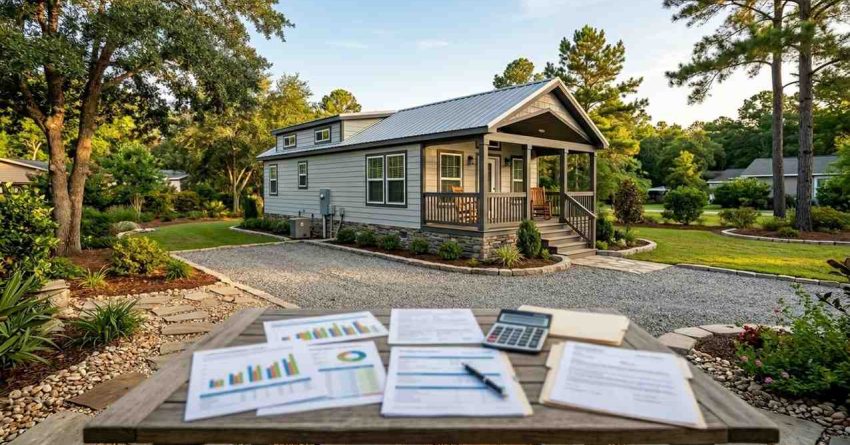
Park model homes are factory-built recreational units that typically measure between 400 and 500 square feet. They are built on a permanent chassis, classified under ANSI A119.5 standards, and most commonly placed in RV parks, campgrounds, or private land. Because they sit on a chassis rather than a permanent foundation, they are rarely classified as real property — and that classification determines which financing products are available to you.
This distinction matters enormously when you start shopping for a loan. Traditional mortgage lenders require real property classification, which most park models do not meet. Buyers who walk into a bank expecting a standard home loan often leave empty-handed. Knowing the classification upfront helps you target the right lenders and the right loan products from the start.
Park model homes are a subset of the broader compact housing category — our guide to tiny home options covers the full range of small-footprint housing types, their classifications, and how each one fits different living situations and budgets.

Types of Park Model Financing Options Available
There is no single loan product designed exclusively for park model homes. Instead, buyers choose from several existing loan categories based on how their unit is classified, where it will be placed, and their personal financial profile. Understanding how park models are defined, titled, and placed is essential before selecting a loan type — the park model homes overview explains the classifications that directly affect which financing products apply to your situation.
Personal Loans for Park Model Homes
Personal loans are unsecured financing products available through banks, credit unions, and online lenders. Because they are not tied to the property itself, approval is based entirely on your creditworthiness. Personal loans typically carry higher interest rates than secured loans — often ranging from 7% to 36% depending on your credit profile — but they offer faster approval timelines and fewer restrictions on how the funds are used. They work best for buyers purchasing lower-cost units or those who cannot qualify for secured financing.
Chattel Loans Explained
A chattel loan is a secured loan where the park model home itself serves as collateral, similar to how an auto loan works. The lender holds a lien on the unit rather than the land. Chattel loans are one of the most common financing tools for manufactured and park model homes because they do not require real property classification. Interest rates are typically higher than conventional mortgages but lower than personal loans, and terms generally range from 15 to 25 years. Lenders specializing in manufactured housing are the most reliable source for chattel products.
RV Loans for Park Model Units
Many park model homes carry an RVIA (Recreational Vehicle Industry Association) certification, which makes them eligible for RV financing. RV loans are offered by banks, credit unions, and specialty lenders, with terms typically ranging from 10 to 20 years. Interest rates are competitive, and the application process is often faster than chattel lending. The key eligibility requirement is that the unit must carry a valid RVIA seal — buyers should confirm this with the manufacturer before assuming RV financing is available.
Land-Home Package Financing
If you are purchasing both a park model home and the land it sits on, some lenders offer combined land-home financing. This product treats the purchase more like a traditional real estate transaction, which can unlock better interest rates and longer terms. However, it requires that the land be included in the purchase and that the unit be permanently affixed to a foundation. This option is less common but worth exploring if you are buying private land alongside the home.
How to Qualify for Park Model Home Financing
Qualifying for park model financing follows many of the same principles as other consumer lending, but lenders in this space apply their criteria with some variation depending on the loan type. Lenders evaluate park model applicants using many of the same benchmarks applied to conventional borrowers — our home loan qualification resource walks through every factor lenders weigh, from debt-to-income ratios to employment history.
Credit Score Requirements
Most chattel and RV lenders require a minimum credit score between 620 and 660 for standard approval. Borrowers with scores above 700 typically access the most competitive rates. Personal loan lenders vary more widely — some work with scores as low as 580, though rates increase significantly below 650. Checking your credit report before applying allows you to address errors or pay down balances that could improve your score before a lender pulls your file.
Down Payment Expectations
Down payment requirements for park model financing typically range from 5% to 20% of the purchase price, depending on the loan type and lender. RV loans often require 10% to 20% down. Chattel lenders may accept as little as 5% for well-qualified borrowers. Personal loans require no down payment since they are unsecured, but the full purchase amount must fall within the lender’s maximum loan limit. Buyers with larger down payments generally receive better interest rates and lower monthly payments.
Park Model Financing vs. Traditional Mortgage
Traditional mortgages are designed for real property — homes permanently affixed to land that the buyer owns. Park model homes almost never meet this definition because they are built on a chassis and classified as personal property or recreational vehicles. This means conventional mortgage products from Fannie Mae or Freddie Mac are typically not available for park model purchases.
The practical difference is significant. Mortgage rates are generally lower than chattel or RV loan rates, and mortgage terms can extend to 30 years. Chattel and RV loans carry higher rates and shorter terms, which results in higher monthly payments for the same purchase price. Buyers who want mortgage-like terms should explore land-home package financing or look for lenders who offer Title I manufactured housing loans through the FHA, which can apply to certain park model configurations.
Buyers who choose a park model over a site-built home often redirect savings toward interior upgrades — our remodeling services outlines the improvement options available once your home is in place and your financing is settled.
Where to Find Park Model Lenders in the USA
Finding a lender who understands park model financing requires targeting institutions that specialize in manufactured housing, RV lending, or alternative housing products. General retail banks often lack the product knowledge or loan programs to serve park model buyers effectively.
The most reliable sources for park model financing include:
- Manufactured housing lenders such as 21st Mortgage Corporation and Triad Financial Services, which specialize in chattel and land-home products
- Credit unions that offer RV loan programs, particularly those with recreational vehicle or manufactured housing divisions
- Online lenders that provide personal loans with fast approval timelines for buyers who need flexibility
- RV dealership financing offered through the manufacturer or dealer, which sometimes includes promotional rates for RVIA-certified units
- FHA Title I lenders for buyers whose units qualify under manufactured housing guidelines
Once financing is secured and your park model is installed, ongoing upkeep becomes the priority — our handyman services covers the routine maintenance and repair tasks that keep compact homes in top condition year-round.
Costs to Factor Into Your Park Model Budget
The purchase price of the unit is only one part of the total cost of owning a park model home. Buyers who budget only for the home itself often face unexpected expenses that strain their finances after closing.
Key costs to include in your budget:
- Delivery and transport fees: Moving the unit from the manufacturer or dealer to your site typically costs between $1,000 and $5,000 depending on distance
- Site preparation: Grading, clearing, and utility hookups can add $3,000 to $15,000 or more depending on the condition of the lot
- Lot rent or land purchase: If placing in a park, monthly lot rent typically ranges from $300 to $800 in most US markets
- Setup and installation: Skirting, steps, tie-downs, and utility connections are often not included in the base price
- Insurance: Park model insurance is required by most lenders and parks, with annual premiums typically ranging from $500 to $1,500
- Taxes and registration: Depending on your state, park models may be subject to personal property tax or vehicle registration fees
Site preparation and lot improvements are common budget items for park model buyers — our landscape services explains what professional grading, clearing, and outdoor setup typically involves and what to budget for.
Tips for Getting the Best Park Model Loan Terms
Securing favorable financing terms requires preparation before you contact a lender. Buyers who approach lenders with strong financial profiles and clear documentation consistently receive better offers.
Practical steps to improve your loan terms:
- Check and improve your credit score at least 90 days before applying — even a 20-point improvement can lower your rate meaningfully
- Save a larger down payment — lenders reward lower loan-to-value ratios with better rates and reduced fees
- Compare at least three lenders — rates and terms vary significantly across chattel, RV, and personal loan products
- Confirm RVIA certification before assuming RV financing is available — missing certification eliminates an entire loan category
- Get pre-qualified before shopping — knowing your budget prevents you from falling in love with a unit you cannot finance
- Ask about prepayment penalties — some chattel lenders charge fees for early payoff, which limits your flexibility
Buyers exploring compact housing broadly will find that loan strategies for park models share significant overlap with other small-footprint options — the tiny home financing section of our guide covers how lenders approach the full spectrum of alternative housing products.
Conclusion
Park model financing options span personal loans, chattel loans, RV loans, and land-home packages — each suited to different buyer profiles, unit classifications, and placement scenarios. Understanding how your unit is classified before you apply is the single most important step in matching yourself to the right loan product.
Lenders, rates, and eligibility requirements vary widely across this space, and buyers who prepare their credit, savings, and documentation in advance consistently secure better terms. The total cost of ownership extends well beyond the purchase price, making early budget planning essential.
At Mr. Local Services, we support park model owners with the maintenance, repair, and improvement services that protect their investment long after the financing is settled — contact us today to connect with skilled professionals who understand compact home care.
Frequently Asked Questions
Can I get a mortgage for a park model home?
Standard mortgages are rarely available for park model homes because most units are classified as personal property rather than real property. FHA Title I loans and land-home package financing are the closest alternatives for buyers seeking mortgage-like terms.
What credit score do I need for park model financing?
Most chattel and RV lenders require a minimum credit score of 620 to 660 for standard approval. Borrowers with scores above 700 typically qualify for the most competitive interest rates and loan terms available in this market.
How much down payment is required for a park model?
Down payment requirements typically range from 5% to 20% depending on the loan type. RV loans often require 10% to 20% down, while some chattel lenders accept as little as 5% for well-qualified borrowers with strong credit profiles.
Are park model homes considered real property?
Most park model homes are not classified as real property because they are built on a chassis rather than a permanent foundation. This classification determines which loan products are available and whether standard mortgage financing applies to your purchase.
Can I finance a park model home on rented land?
Yes, chattel loans and RV loans are available for park models placed on rented land. These products use the unit itself as collateral rather than the land, making them the most common financing solution for buyers in RV parks and campgrounds.
What is the typical loan term for a park model?
Loan terms vary by product. Chattel loans typically range from 15 to 25 years. RV loans generally run 10 to 20 years. Personal loans are shorter, usually 2 to 7 years. Longer terms lower monthly payments but increase total interest paid over the life of the loan.
Do park model homes qualify for FHA loans?
Some park model homes may qualify for FHA Title I manufactured housing loans if they meet specific size, construction, and placement requirements. Standard FHA mortgage programs do not apply. Buyers should confirm eligibility directly with an FHA-approved lender before assuming qualification.