Prefab home permit requirements vary by state, and skipping or misunderstanding them can delay your build by weeks or cost thousands in fines. Every state has its own rules governing whether a prefab home needs a building permit, what inspections are required, and which codes apply — and those rules differ significantly depending on whether your home is modular, manufactured, or panelized. This guide breaks down what permits are required, how the process works, and what homeowners across the country need to know before breaking ground.
Getting the permits right protects your investment, keeps your build on schedule, and ensures your home meets safety and habitability standards.
This guide covers permit types, state-by-state requirements, common approval challenges, realistic timelines, and how to work with the right professionals.
What Is a Prefab Home Permit and Why Do You Need One?
A prefab home permit is an official authorization issued by a local or state government agency that allows construction, placement, or installation of a prefabricated home on a specific piece of land. Without it, your home cannot legally be occupied, financed, or insured in most states.
Permits exist to ensure that prefab homes meet local building codes, zoning regulations, and safety standards. They protect homeowners from structural defects, fire hazards, and utility failures that could go undetected without formal inspection. They also protect property values in the surrounding area.
There are three main permit categories that apply to prefab homes. A building permit covers the structural installation of the home itself. A site permit covers land preparation, grading, and foundation work. Utility permits cover electrical, plumbing, and HVAC connections. Most prefab builds require all three, though the specific requirements depend on your state and local jurisdiction.
Understanding permits starts with knowing what prefab homes are — our prefab home overview covers every type, construction method, and key consideration for buyers planning a new build.
How Prefab Home Permitting Works: The General Process
The permitting process for a prefab home follows a predictable sequence, though the timeline and complexity vary by location. Understanding the steps in advance prevents costly surprises.
The process typically begins with a site evaluation. Your local building department reviews the land for zoning compliance, setback requirements, and utility access before any permits are issued. If the land does not meet zoning requirements for a prefab home, you may need a variance or rezoning approval before proceeding.
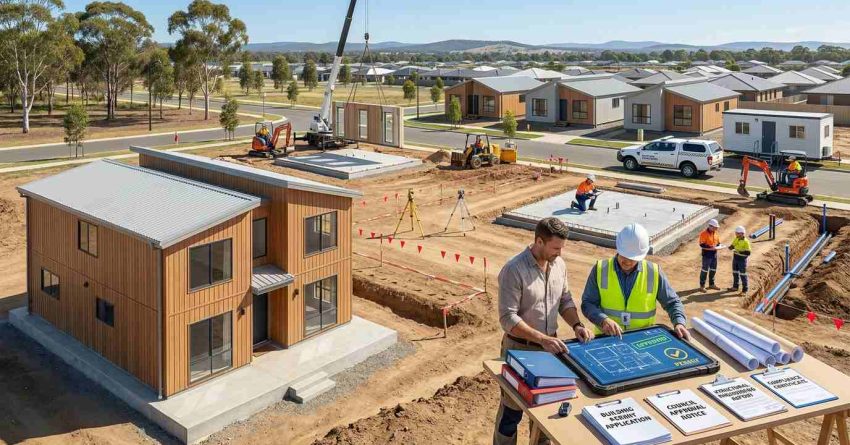
Next, you submit permit applications along with construction drawings, site plans, and manufacturer specifications. For manufactured homes, the home must carry a HUD certification label confirming it was built to federal standards. For modular homes, the manufacturer typically provides state-certified documentation that the factory-built sections meet local building codes.
Once applications are reviewed and approved, construction begins. Inspections occur at multiple stages — foundation, framing, electrical rough-in, plumbing rough-in, and final occupancy. Each inspection must pass before the next phase can proceed.
The final step is a certificate of occupancy, which confirms the home meets all applicable codes and is safe to live in. Without this certificate, most mortgage lenders will not release final funding.
Tiny homes follow a closely related permitting path, and our guide to tiny home permit rules explains how zoning classifications affect approval timelines across different jurisdictions.
Prefab Home Permit Requirements by State
Permit requirements for prefab homes are not uniform across the United States. Each state sets its own standards, and local counties and municipalities often add additional layers of requirements on top of state rules. The sections below outline the key requirements and considerations by region.
State permit requirements connect directly to how your home is installed and inspected — our prefab home installation guide walks through every step from site prep to final sign-off.
Northeast States
States in the Northeast — including New York, Massachusetts, Connecticut, New Jersey, and Pennsylvania — generally apply strict building codes to prefab homes. Modular homes in this region must meet state-adopted versions of the International Building Code (IBC) or International Residential Code (IRC). Manufactured homes must comply with HUD standards and are subject to additional state installation standards.
New York requires modular homes to be certified by the state’s Department of State before installation. Massachusetts requires a third-party inspection agency to certify factory construction. Local zoning restrictions in many Northeast communities can limit where manufactured homes are permitted, particularly in areas with historic preservation overlays or minimum square footage requirements.
Southeast States
The Southeast — including Florida, Georgia, North Carolina, South Carolina, Tennessee, and Alabama — has a more varied regulatory landscape. Florida has one of the most comprehensive manufactured home installation standards in the country, governed by the Florida Department of Highway Safety and Motor Vehicles. All manufactured homes in Florida must be installed by a licensed installer and meet the Florida Building Code.
North Carolina and Georgia require modular homes to carry a state seal of approval issued after factory inspection. Many rural counties in the Southeast have fewer zoning restrictions, which can simplify the permit process for manufactured homes on private land.
Midwest States
Midwest states — including Ohio, Michigan, Illinois, Indiana, and Minnesota — generally follow the IRC for modular homes and HUD standards for manufactured homes. Illinois requires modular homes to be inspected by a state-approved third-party agency during factory construction. Ohio requires a residential building permit from the local building department for all prefab home installations.
Minnesota has a state-administered manufactured home installation program that sets standards for anchoring, skirting, and utility connections. Many Midwest counties have adopted zoning ordinances that treat modular homes the same as site-built homes, which simplifies the permitting process considerably.
Southwest States
Texas, Arizona, New Mexico, and Nevada make up the core of the Southwest permitting landscape. Texas is notable for having no statewide building code for residential construction in unincorporated areas, which means permit requirements vary significantly by county. In many rural Texas counties, manufactured homes can be placed with minimal permitting requirements. In incorporated cities, local codes apply.
Arizona requires manufactured homes to meet HUD standards and be installed by a licensed contractor. The Arizona Department of Housing oversees the manufactured housing program and issues installation permits. Nevada requires a building permit for all prefab home installations, and Clark County (Las Vegas area) has its own detailed requirements for manufactured home parks and subdivisions.
West Coast States
California, Oregon, and Washington have some of the most rigorous permitting requirements in the country. California requires all manufactured homes to be approved by the California Department of Housing and Community Development (HCD). Modular homes must meet California’s Title 24 energy efficiency standards, which are among the strictest in the nation.
Oregon requires a state-issued insignia on all factory-built structures, confirming compliance with Oregon building codes. Washington State requires modular homes to carry a label from the Washington State Department of Labor and Industries. Both states have active seismic zones, which add structural requirements for foundation anchoring and lateral bracing that affect the permitting process.
Common Permit Challenges for Prefab Homeowners
Even with thorough preparation, prefab home permit applications encounter obstacles. Knowing the most common challenges helps homeowners plan around them.
Zoning conflicts are the most frequent issue. Many municipalities have zoning ordinances that restrict or prohibit manufactured homes in certain districts, even when the land is privately owned. Homeowners who purchase land without first verifying zoning compatibility can face significant delays or be forced to seek a variance, which adds time and cost.
Incomplete documentation is another common cause of permit delays. Building departments require detailed site plans, foundation engineering drawings, manufacturer specifications, and energy compliance documentation. Missing any one of these items results in an application being placed on hold until the information is provided.
Utility connection approvals can also slow the process. Connecting a prefab home to water, sewer, and electrical systems requires separate permits from utility providers and local authorities. In rural areas, well and septic permits add another layer of approval that must be coordinated with the building permit timeline.
When permit complications arise during a prefab build, remodeling work often follows — our home remodeling permits explains how permit requirements apply to additions and structural changes after installation.
How Long Does It Take to Get a Prefab Home Permit?
Permit timelines for prefab homes range from a few weeks to several months, depending on the state, county, and complexity of the project. Understanding what drives timeline variation helps homeowners set realistic expectations.
In rural areas with limited zoning restrictions and smaller building departments, permits for manufactured homes can be issued in two to four weeks. In urban and suburban areas with high permit volumes and stricter code requirements, the same process can take three to six months. California, New York, and Massachusetts consistently have the longest permit timelines due to the volume of applications and the complexity of their code requirements.
The type of prefab home also affects timing. Manufactured homes that carry a valid HUD label typically move through the permit process faster because the factory construction has already been certified. Modular homes require local inspections of the installed structure, which adds time to the final approval stage.
Submitting a complete, accurate application at the outset is the single most effective way to reduce permit timelines. Applications with missing documents or incorrect information are placed in a correction queue, which can add weeks to the process.
Permit timelines directly affect your overall project budget and financing schedule — our resource on prefab home costs breaks down how delays and approval fees factor into total build expenses.
Working With Professionals to Navigate Prefab Permits
Navigating prefab home permits is manageable with the right team in place. Most homeowners benefit from working with professionals who understand both the construction requirements and the local permitting process.
A licensed general contractor or prefab home dealer typically handles permit applications as part of their service. They know which documents are required, which local officials to contact, and how to respond to correction notices efficiently. Working with a contractor who has experience in your specific state and county reduces the risk of delays caused by unfamiliarity with local requirements.
For complex projects — particularly those involving custom foundations, utility extensions, or zoning variances — an architect or civil engineer may be needed to prepare the required drawings and calculations. Their documentation carries more weight with building departments and reduces the likelihood of plan check corrections.
Home inspectors familiar with prefab construction can also be valuable during the inspection phase. They can identify potential issues before the official inspection, giving you the opportunity to address them without triggering a failed inspection that resets the timeline.
Once permits are approved, coordinating the right tradespeople is the next critical step — our local handyman experts are available to support installation, inspection prep, and post-build repairs across all service areas.
Conclusion
Prefab home permits vary significantly by state, home type, and local jurisdiction — and understanding those differences before you start is the most effective way to keep your build on schedule. From HUD-certified manufactured homes to modular structures requiring state seals, every prefab project moves through a defined permitting path that connects site approval, construction documentation, and final occupancy.
Getting permits right the first time protects your investment, satisfies lender requirements, and ensures your home is safe, legal, and insurable from day one.
At Mr. Local Services, our network of skilled professionals is ready to support every stage of your prefab home project — from permit preparation and site coordination to installation, inspection readiness, and post-build maintenance.
Frequently Asked Questions
Do all prefab homes require a building permit?
Yes, in nearly all states and jurisdictions, prefab homes require at least one building permit before installation. The specific permits required — building, site, and utility — depend on your state, county, and the type of prefab home you are installing.
What is the difference between a modular home permit and a manufactured home permit?
Modular homes are permitted under local and state building codes, similar to site-built homes, and require local inspections after installation. Manufactured homes are regulated under federal HUD standards, and the permit process focuses on verifying HUD certification and meeting state installation requirements.
Can I place a prefab home on any piece of land?
Not automatically. The land must be zoned to allow the type of prefab home you plan to install. Many residential zones permit modular homes but restrict or prohibit manufactured homes. Always verify zoning compliance before purchasing land for a prefab build.
What happens if I install a prefab home without a permit?
Installing a prefab home without the required permits can result in fines, forced removal, inability to obtain a certificate of occupancy, and difficulty selling or financing the property. Lenders and insurers typically require proof of permitted installation before approving loans or policies.
How much do prefab home permits cost?
Permit fees vary widely by state and county. Building permit fees for prefab homes typically range from a few hundred dollars to several thousand, depending on the home’s size, value, and the complexity of the site. Site and utility permits are charged separately and add to the total cost.
Which states have the strictest prefab home permit requirements?
California, New York, Massachusetts, Oregon, and Washington consistently have the most rigorous permitting requirements for prefab homes. These states require state-level certifications, energy compliance documentation, and multiple inspection stages that extend the approval timeline compared to most other states.
Can a prefab home dealer handle the permit process for me?
Yes, most licensed prefab home dealers and general contractors manage the permit application process as part of their service. They prepare the required documentation, submit applications, respond to correction notices, and coordinate inspections — reducing the administrative burden on the homeowner significantly.