RVIA certification is the official standard that classifies a park model home as a recreational vehicle, confirming it meets federal construction, safety, and electrical requirements set by the Recreation Vehicle Industry Association. Without this certification, a park model cannot be legally titled, insured, or placed in most RV parks and communities across the USA. Understanding what RVIA certification covers, how it is obtained, and what it means for your property decisions helps you avoid costly mistakes before you buy, place, or maintain a park model home.
Park model homes are growing in popularity as affordable, flexible housing options — but their unique classification creates real confusion for buyers and property managers.
This guide explains the full RVIA certification process, what qualifies a home for certification, how it compares to HUD code housing, and what certification means for your long-term ownership experience.
What Is RVIA Certification for Park Model Homes?
RVIA certification is a voluntary but industry-standard compliance program administered by the Recreation Vehicle Industry Association. It confirms that a park model home was built according to the American National Standards Institute (ANSI) A119.5 standard, which governs the construction, plumbing, electrical systems, and structural integrity of park model recreational vehicles.
A park model home that carries the RVIA seal has been inspected during manufacturing and verified to meet these standards before it ever leaves the factory. The certification is not issued after installation — it is earned during production, which means the quality of construction is locked in at the source.
Park model homes occupy a unique category in the housing market — our complete park model homes guide covers everything from design options to placement rules and ownership considerations.
How the RVIA Sets Industry Standards
The RVIA works with ANSI to develop and update the A119.5 standard, which is the technical backbone of all park model certifications. This standard covers structural load requirements, fire safety, electrical wiring, LP gas systems, plumbing, and ventilation. RVIA member manufacturers agree to build to this standard and submit to third-party inspections as a condition of membership.
The RVIA also maintains a labeling program. Every certified park model receives a permanent label affixed to the unit that identifies it as RVIA-compliant. This label is what lenders, insurers, and park operators look for when evaluating a park model home.
What Makes a Home Qualify as a Park Model RV?
Not every small or compact home qualifies as a park model RV under RVIA and federal definitions. The classification is specific, and the criteria are tied directly to size, design intent, and construction method.
A park model RV is defined as a unit built on a single chassis, mounted on wheels, designed for connection to utilities, and intended for seasonal or temporary occupancy. It must be built by an RVIA member manufacturer using the ANSI A119.5 standard to receive certification.
Size, Design, and Classification Requirements
The most important size requirement is that a park model RV cannot exceed 400 square feet of interior living space when in the setup mode. This limit is what separates park models from manufactured homes, which are regulated under the HUD code and have no such square footage ceiling.
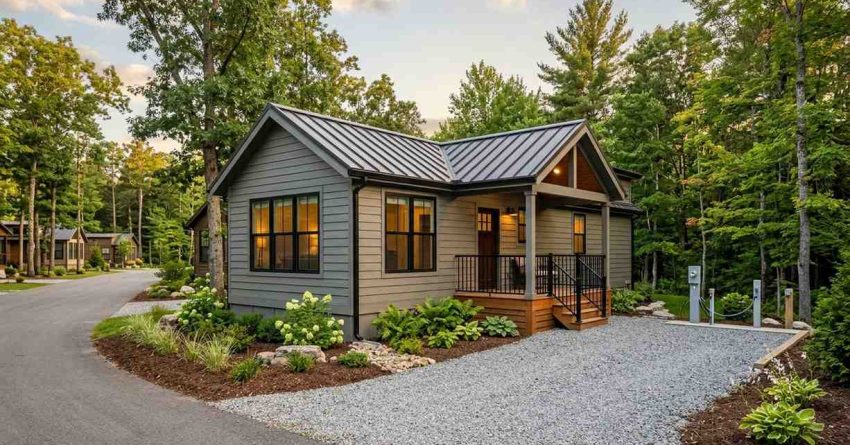
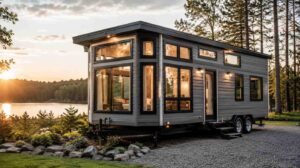
Park models are designed to look and feel like small cottages or cabins. They typically include a full kitchen, bathroom, sleeping area, and living space within that 400-square-foot limit. Lofts are common and do not count toward the floor area calculation under the ANSI standard, which is why many park models feel more spacious than their footprint suggests.
The chassis and wheel assembly must remain part of the unit. Unlike manufactured homes, park models are not permanently affixed to a foundation — they are placed on a site and connected to utilities, but they retain their vehicle classification.
The RVIA Certification Process Step by Step
RVIA certification happens at the manufacturing level, not after purchase or installation. This is a critical distinction that many buyers miss. Here is how the process works from start to finish.
First, the manufacturer must be an RVIA member in good standing. Membership requires agreeing to build to the ANSI A119.5 standard and submitting to a third-party inspection program.
Second, a third-party inspection agency — approved by the RVIA — conducts in-plant inspections during production. These inspectors review structural components, electrical systems, plumbing, LP gas systems, and fire safety features as the unit is being built, not after it is complete.
Third, units that pass inspection receive the RVIA certification label. This label is permanently attached to the unit and includes the manufacturer’s name, the unit’s serial number, and the certification date.
Fourth, the certified unit is delivered to the buyer or dealer. The label travels with the unit and serves as proof of compliance for titling, insurance, and park placement purposes.
Before pursuing certification as a buyer or investor, understanding what inspectors evaluate is essential — a dedicated park model inspection checklist walks through every structural, electrical, and plumbing checkpoint your home must pass.
Third-Party Inspection and Label Requirements
The third-party inspection requirement is what gives RVIA certification its credibility. Manufacturers cannot self-certify. An independent agency must verify compliance at each stage of production. The inspection agencies approved by the RVIA include organizations such as the National Evaluation Service and similar bodies that specialize in recreational vehicle standards.
The certification label must be visible and intact for the unit to be accepted by lenders, insurers, and park operators. A missing or damaged label can create significant problems at the point of sale or placement, so buyers should always verify the label is present and legible before completing a purchase.
Why RVIA Certification Matters for Owners and Buyers
RVIA certification is not just a technical formality. It has direct, practical consequences for how you can use, insure, finance, and place a park model home.
Insurance: Most insurers that offer park model coverage require RVIA certification as a condition of eligibility. Without it, standard RV insurance policies will not apply, and homeowner’s insurance typically will not cover a unit that is classified as a vehicle. RVIA certification directly affects your coverage options, and our tiny home insurance resource explains how certification status shapes policy eligibility, premiums, and lender requirements.
Financing: Lenders who offer chattel loans or RV loans for park models almost universally require the RVIA label. It confirms the unit was built to a recognized standard, which reduces lender risk. Without certification, financing options narrow significantly and interest rates may increase.
Placement: RV parks, resort communities, and seasonal campgrounds that accept park models typically require RVIA certification as a condition of entry. Some states also require the RVIA label for titling purposes, which affects your ability to register the unit as a vehicle.
Insurance, Financing, and Placement Implications
The combined effect of these three factors means that an uncertified park model is significantly harder to insure, finance, and place than a certified one. Buyers who purchase uncertified units — often at a lower price — frequently discover that the savings are offset by higher insurance costs, limited financing options, and restricted placement choices.
For property managers and landlords who use park models as rental units, RVIA certification also affects liability. A certified unit provides documented evidence that the structure meets recognized safety standards, which can be relevant in the event of an insurance claim or legal dispute.
Park Model RVIA Certification vs. HUD Code Housing
Park models and manufactured homes are both factory-built, but they are regulated under entirely different frameworks. Understanding the difference is essential for buyers, landlords, and property managers making placement and investment decisions.
Manufactured homes are regulated under the HUD code, which is a federal standard administered by the U.S. Department of Housing and Urban Development. HUD-code homes are designed for permanent or semi-permanent residential use, can exceed 400 square feet, and are typically placed on a permanent or semi-permanent foundation.
Park models, by contrast, are regulated under the ANSI A119.5 standard and classified as recreational vehicles. They are limited to 400 square feet, retain their chassis and wheels, and are intended for seasonal or temporary occupancy.
The regulatory differences between these two classifications have real consequences for buyers — our HUD vs RVIA comparison breaks down how each standard affects construction, placement, and resale value.
The practical implications are significant. HUD-code homes can be placed on private land with standard residential permits in most jurisdictions. Park models are typically restricted to RV parks, resort communities, and campgrounds. Zoning laws treat them differently, financing products differ, and insurance products differ. Choosing the wrong classification for your intended use can result in placement denials, financing rejections, and insurance gaps.
Common Questions About Park Model Certification
Buyers and property managers frequently encounter the same set of questions when researching park model RVIA certification. The most common points of confusion involve what happens when a label is missing, whether certification can be added after the fact, and how certification affects resale value.
A missing RVIA label cannot simply be replaced. If the original label is lost or damaged, the owner must contact the original manufacturer to obtain documentation of the unit’s certification status. Some states accept manufacturer documentation in place of the physical label for titling purposes, but this varies by jurisdiction.
Certification cannot be added to a unit that was not originally built to the ANSI A119.5 standard. There is no retroactive certification process. Units built outside the RVIA program do not qualify for the label regardless of their construction quality.
Resale value is directly affected by certification status. Certified units sell faster, qualify for more financing products, and attract a larger pool of buyers than uncertified units. For landlords and investors, this makes RVIA certification a meaningful factor in long-term asset value.
Maintaining Your Park Model Home After Certification
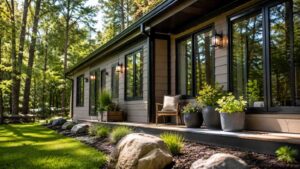
RVIA certification confirms the quality of construction at the time of manufacture. It does not guarantee the condition of the unit over time. Ongoing maintenance is the owner’s responsibility, and neglecting it can affect both the safety of the unit and its eligibility for insurance coverage.
The systems most commonly requiring attention in park model homes include the LP gas connections, electrical panel and wiring, plumbing seals and connections, roof sealing, and the chassis and undercarriage. Each of these systems was inspected during manufacturing, but exposure to weather, seasonal temperature changes, and regular use creates wear that requires periodic attention.
Keeping your park model in top condition requires a consistent approach — our tiny home maintenance guide covers seasonal upkeep, system checks, and the repairs that protect both your investment and your certification status.
Routine Upkeep That Protects Certification Status
While RVIA certification itself does not expire, the condition of your unit affects its insurability and placement eligibility over time. Park operators and insurers may conduct periodic inspections, and a unit in poor condition can be denied placement or coverage even if it carries a valid RVIA label.
Routine upkeep tasks that directly protect the integrity of a certified park model include annual LP gas system inspections by a licensed technician, seasonal roof inspections and resealing, electrical system checks every two to three years, and regular inspection of the chassis for rust, corrosion, or structural damage. Keeping records of all maintenance and repairs also supports insurance claims and resale documentation.
Conclusion
RVIA certification defines how a park model home is classified, insured, financed, and placed — making it one of the most consequential factors in the park model ownership experience. Understanding the certification process, the qualifying criteria, and the differences between RVIA and HUD standards gives buyers and property managers the foundation they need to make confident decisions.
For landlords and investors, certification status directly affects asset value, placement options, and long-term liability exposure. Choosing a certified unit from an RVIA member manufacturer is the most reliable way to protect that investment.
At Mr. Local Services, our team helps park model owners and property managers stay on top of the maintenance and upkeep that keeps certified units in top condition — contact us today to connect with skilled professionals who understand the unique needs of park model properties.
Frequently Asked Questions
What does RVIA stand for in park model certification?
RVIA stands for Recreation Vehicle Industry Association. It is the trade organization that administers the certification program for park model homes, confirming they meet the ANSI A119.5 construction and safety standard.
Can a park model home lose its RVIA certification?
RVIA certification is issued at the time of manufacture and does not expire. However, significant structural modifications made after manufacture can void the certification, and a missing or damaged label can create practical problems with insurance, financing, and placement.
Is RVIA certification required to place a park model in an RV park?
Most RV parks and resort communities in the USA require RVIA certification as a condition of placement. Requirements vary by state and by individual park, but the RVIA label is the most widely recognized proof of compliance that park operators accept.
How is a park model different from a manufactured home?
A park model is classified as a recreational vehicle under the ANSI A119.5 standard and is limited to 400 square feet. A manufactured home is regulated under the HUD code, has no square footage ceiling, and is designed for permanent residential use. The two classifications carry different zoning, financing, and insurance implications.
Who inspects a park model home for RVIA certification?
Third-party inspection agencies approved by the RVIA conduct in-plant inspections during manufacturing. These are independent organizations, not the manufacturer itself, which ensures the certification reflects an objective assessment of the unit’s compliance with the ANSI A119.5 standard.
Does RVIA certification affect park model insurance rates?
Yes. RVIA certification is typically required for eligibility under standard RV insurance policies that cover park models. Certified units generally qualify for more coverage options and more competitive rates than uncertified units, because the certification documents that the unit was built to a recognized safety standard.
What happens if I buy a park model without an RVIA label?
A park model without an RVIA label may be difficult to insure under standard RV policies, harder to finance through conventional lenders, and ineligible for placement in many RV parks and resort communities. Buyers should verify the RVIA label is present and intact before completing any park model purchase.