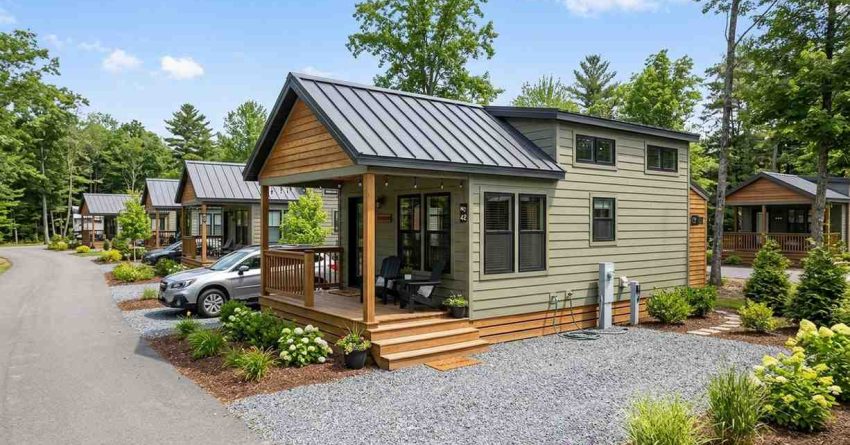
ANSI A119.5 is the national construction and safety standard that governs park model recreational vehicles in the United States, setting minimum requirements for structure, electrical systems, plumbing, and mechanical installations in units up to 400 square feet.
Park models occupy a unique regulatory space — they are not manufactured homes, not traditional RVs, and not site-built houses, which makes understanding the standard that applies to them essential for buyers, owners, and property managers.
This guide explains what ANSI A119.5 covers, how park models are defined and classified under the standard, what compliance means in practice, and what maintenance and service needs owners should plan for.
What Is ANSI A119.5 and Why Does It Matter for Park Models?
ANSI A119.5 is a voluntary consensus standard developed and maintained by the American National Standards Institute in coordination with the Recreational Vehicle Industry Association (RVIA). It establishes the minimum design, construction, and performance requirements for park model recreational vehicles — a category of housing that is factory-built, transportable, and intended for seasonal or semi-permanent placement in RV parks, campgrounds, and resort communities.
The standard matters because park models do not fall cleanly under the same regulatory umbrella as manufactured homes, which are governed by the federal HUD code, or traditional site-built homes, which follow local building codes. Without ANSI A119.5, there would be no consistent national baseline for how these units are built, wired, plumbed, or structurally reinforced. Manufacturers who build to ANSI A119.5 can certify their units through the RVIA, which gives buyers, park operators, and insurers a recognized benchmark for quality and safety.
Park models sit within the broader category of alternative housing — our complete guide to tiny home standards explains how park models, tiny houses, and manufactured homes each fall under different regulatory frameworks and what that means for owners and buyers.
How ANSI A119.5 Differs from Traditional Housing Codes
Traditional residential building codes — such as the International Residential Code (IRC) — apply to site-built homes and are enforced by local jurisdictions through permit and inspection processes. ANSI A119.5 is a factory-level standard, meaning compliance is verified during manufacturing rather than at the installation site. This distinction is important: a park model certified to ANSI A119.5 has been inspected and approved before it ever leaves the factory, which is fundamentally different from how a stick-built home is regulated. Local jurisdictions may still impose additional requirements for placement, utility connections, and zoning, but the unit itself is governed by the standard applied at the point of manufacture.

Key Requirements Under ANSI A119.5 for Park Model Construction
ANSI A119.5 covers a broad range of construction requirements that apply to every park model built under the standard. These requirements are organized across structural, electrical, plumbing, and mechanical categories, and they establish the minimum performance thresholds that manufacturers must meet before a unit can be certified.
The standard addresses roof load capacity, wall construction, insulation values, egress requirements, smoke and carbon monoxide detection, and the overall structural integrity of the unit under transportation and placement conditions. It also sets requirements for the quality and installation of all systems that make a park model habitable — from the wiring that powers it to the pipes that carry water in and out.
Structural and Safety Standards
Under ANSI A119.5, park models must be built to withstand the stresses of transportation as well as the loads they will experience once placed. Roof systems must meet minimum live and dead load ratings, which vary based on the geographic snow load zone where the unit will be used. Wall assemblies must provide adequate insulation and structural support, and all egress openings — doors and windows — must meet minimum size requirements to allow safe exit in an emergency. Smoke detectors and carbon monoxide alarms are required in specified locations, and the standard sets rules for the placement and type of fire-rated materials used in certain areas of the unit.
Electrical, Plumbing, and Mechanical Requirements
The electrical requirements in ANSI A119.5 align closely with the National Electrical Code (NEC) and cover wiring methods, circuit protection, grounding, and the capacity of the electrical service entrance. Park models are typically designed for connection to a 30-amp or 50-amp shore power supply, and all wiring must be installed in a way that is safe for both the factory environment and the final placement site.
Plumbing systems must meet standards for supply line materials, drain-waste-vent configurations, water heater installation, and fixture quality. Mechanical systems — including heating and cooling equipment — must be installed according to manufacturer specifications and must meet minimum efficiency and safety standards.
Electrical systems in park models must meet specific ANSI A119.5 requirements, and any modifications or repairs should be handled by a licensed professional — learn what our park model electrical work services cover and when to call for an inspection. Plumbing installations in ANSI A119.5 park models follow strict supply and drainage standards, and routine maintenance keeps those systems compliant — our park model plumbing services address everything from pipe inspections to fixture upgrades.
How Park Models Are Defined Under ANSI A119.5
ANSI A119.5 defines a park model recreational vehicle as a unit that is built on a single chassis, designed to be transported on its own wheels or on a flatbed, and intended for placement in a location for an extended period of time. The standard distinguishes park models from travel trailers and motorhomes by their size, their level of finish, and their intended use as semi-permanent or seasonal living spaces rather than vehicles used for active travel.
Park models are classified as recreational vehicles under federal law, which means they are subject to federal safety standards administered through the Department of Transportation for their chassis and transportation components, while the living space itself is governed by ANSI A119.5 at the manufacturing level.
Size Limits, Loft Rules, and Classification Criteria
The defining size limit under ANSI A119.5 is 400 square feet of gross floor area, measured at the widest point of the unit. This limit excludes loft areas, which are permitted under the standard subject to specific requirements for ceiling height, access, and structural support. Lofts in park models must have a minimum ceiling height of 5 feet at the highest point and must be accessible by a fixed stairway or ship’s ladder. The 400-square-foot limit is what separates a park model from a manufactured home — once a unit exceeds that threshold, it falls under HUD jurisdiction rather than ANSI A119.5.
Units must also be built on a permanent chassis with a hitch assembly that allows them to be moved, even if they are rarely or never relocated after initial placement. This transportability requirement is what keeps park models classified as recreational vehicles rather than real property in most jurisdictions.
ANSI A119.5 Compliance and the Role of HUD and State Regulations
ANSI A119.5 is a voluntary standard, but it carries significant practical weight because RVIA certification — which is based on compliance with the standard — is required by most RV parks, resort communities, and lenders that finance park model purchases. A unit without RVIA certification may be difficult or impossible to place in a managed community, and it may not qualify for standard park model insurance or financing products.
The federal HUD code governs manufactured homes — units over 400 square feet built on a permanent chassis — and does not apply to park models. However, HUD’s broader regulatory framework for housing safety has influenced the development of ANSI A119.5, and the two standards share common principles around structural integrity, fire safety, and systems performance.
When compliance upgrades or interior modifications are needed to meet ANSI A119.5 or local zoning requirements, a qualified contractor makes the difference — explore our park model remodeling services for structural and interior improvement options.
How State Inspections and Local Zoning Interact with ANSI A119.5
State-level regulation of park models varies significantly across the United States. Some states treat park models as recreational vehicles and apply minimal additional requirements beyond ANSI A119.5 certification. Others impose state-specific construction standards, require state inspections at the point of manufacture or installation, or classify park models differently for tax and titling purposes.
Local zoning is a separate layer entirely. Even a fully ANSI A119.5-compliant park model may not be permitted in a given location if local zoning does not allow recreational vehicles or if the property is not designated as an RV park or resort community. Buyers and owners should verify local zoning requirements before purchasing or placing a unit, as ANSI A119.5 compliance does not guarantee placement approval in any specific jurisdiction. For a detailed look at how state and local rules vary, our guide on park model zoning laws by state covers placement requirements, permit processes, and jurisdiction-specific rules across the country.
Maintenance and Upkeep Requirements for ANSI A119.5 Park Models
Owning an ANSI A119.5 park model comes with ongoing maintenance responsibilities that are distinct from those of a traditional home. Because park models are factory-built and designed for placement in managed communities, their systems are often more compact and more tightly integrated than those in site-built homes — which means that deferred maintenance can create problems faster and in more interconnected ways.
Routine upkeep on an ANSI A119.5 park model covers a wide range of small but critical tasks — from sealing gaps to replacing fixtures — and our park model handyman services provide reliable, on-call support for owners who want to stay ahead of repairs. The roof on a park model is one of its most maintenance-sensitive components, and ANSI A119.5 sets minimum standards for roofing materials and load capacity — our park model roofing services include inspections, repairs, and full replacements to keep your unit protected.
Common Repair and Service Needs for Park Model Owners
The most common maintenance issues in park models involve the roof, the plumbing system, the electrical connections, and the HVAC equipment. Roof seams and penetrations are frequent sources of water intrusion, particularly in units that experience significant temperature swings or are located in areas with heavy rainfall or snow. Plumbing connections at the point of utility hookup are another common failure point, especially in units that are winterized and de-winterized seasonally.
Electrical issues often arise at the shore power connection or at circuit breakers that have been repeatedly tripped over time. HVAC systems in park models are typically mini-split or ductless systems, and their filters, coils, and refrigerant levels require regular attention to maintain efficiency and compliance with the mechanical standards referenced in ANSI A119.5.
Heating and cooling systems in park models must meet ANSI A119.5 mechanical standards, and seasonal servicing keeps them running efficiently — our park model HVAC services cover installation, maintenance, and emergency repairs for all unit types.
Buying or Placing a Park Model: What ANSI A119.5 Means for You
For buyers, ANSI A119.5 certification is one of the most important indicators of quality and compliance to look for when evaluating a park model. A unit built to the standard and certified by the RVIA has been inspected at the factory, meets a recognized national baseline for construction and safety, and will be accepted by the vast majority of managed communities and lenders.
When evaluating a park model for purchase, buyers should request the RVIA certification label, which is affixed to the unit at the factory and identifies the certifying body, the standard applied, and the date of manufacture. Units without this label may have been built to a different standard — or to no recognized standard at all — and should be evaluated carefully before purchase.
Understanding ANSI A119.5 is only one part of the process — our tiny home placement guide covers zoning requirements, utility hookups, and site preparation considerations that every park model buyer should review before purchase. Site preparation around a park model affects both compliance and long-term livability, and proper grading, drainage, and landscaping are essential from day one — our park model site prep services help owners establish a safe, functional outdoor environment.
Conclusion
ANSI A119.5 establishes the construction, safety, and systems standards that define what a park model is and how it must be built. Understanding the standard helps buyers make informed decisions, helps owners maintain their units correctly, and helps property managers evaluate the units placed in their communities.
Compliance with ANSI A119.5 is the starting point — not the finish line. Ongoing maintenance, local zoning alignment, and qualified service providers are what keep a park model safe, functional, and compliant over time.
At Mr. Local Services, our team connects park model owners with skilled professionals across every service category — from electrical and plumbing to roofing and HVAC — so your unit stays in top condition year-round.
Frequently Asked Questions
What does ANSI A119.5 cover for park models?
ANSI A119.5 covers the minimum construction, structural, electrical, plumbing, and mechanical requirements for park model recreational vehicles. It applies at the point of manufacture and governs everything from roof load capacity to wiring methods and plumbing materials.
Is ANSI A119.5 the same as HUD standards?
No. HUD standards apply to manufactured homes, which are units over 400 square feet built on a permanent chassis. ANSI A119.5 applies to park models, which are classified as recreational vehicles and must not exceed 400 square feet of gross floor area.
Do park models require building permits?
ANSI A119.5 compliance is verified at the factory, but local jurisdictions may still require permits for placement, utility connections, and site improvements. Requirements vary significantly by state and municipality, so buyers should check local rules before placing a unit.
What is the maximum size allowed under ANSI A119.5?
Park models governed by ANSI A119.5 may not exceed 400 square feet of gross floor area, measured at the widest point of the unit. Loft areas are permitted in addition to this limit, subject to minimum ceiling height and access requirements specified in the standard.
Can a park model be used as a permanent residence?
Park models are classified as recreational vehicles and are intended for seasonal or semi-permanent use. Whether a park model can serve as a permanent residence depends on local zoning laws, which vary by jurisdiction. ANSI A119.5 compliance alone does not determine whether permanent occupancy is permitted.
Who enforces ANSI A119.5 compliance?
ANSI A119.5 is a voluntary standard enforced through the RVIA certification program. Manufacturers who build to the standard are inspected by RVIA-authorized inspectors at the factory. Local jurisdictions may impose additional requirements, but the standard itself is not enforced by a government agency.
What maintenance does an ANSI A119.5 park model need?
Park models require regular attention to roofing seams, plumbing connections, electrical systems, and HVAC equipment. Seasonal inspections, weatherproofing, and prompt repair of water intrusion or system failures are the most important maintenance priorities for owners.