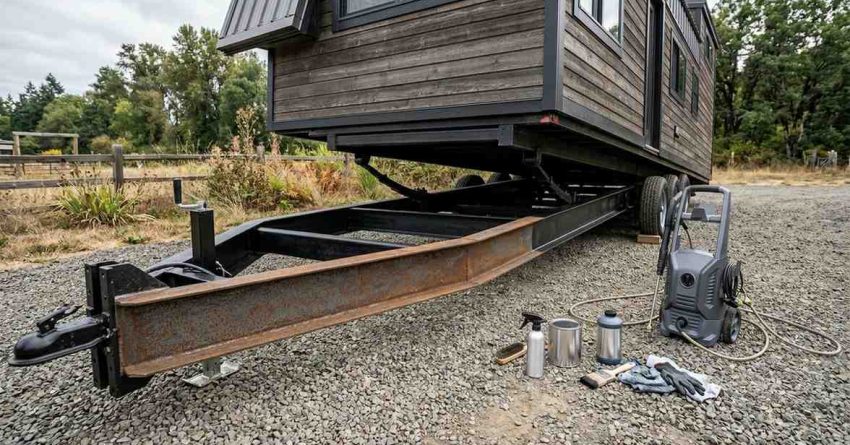
Rust is the single biggest structural threat to any THOW trailer frame, and catching it early — or stopping it before it starts — can add years to your trailer’s life and thousands of dollars to its resale value. Most THOW owners discover rust damage only after it has already compromised the steel, at which point repairs become costly and complex. A consistent prevention routine changes that outcome entirely.
Ignoring frame rust does not just affect appearance — it weakens the structural steel that carries your entire tiny home, creating real safety risks on the road.
This guide walks through every step of THOW trailer frame rust prevention, from understanding why frames rust to choosing the right products and knowing when professional help is the right call.
What Makes THOW Trailer Frames Vulnerable to Rust
THOW trailer frames are built from structural steel, which is strong and load-bearing but naturally prone to oxidation when its protective surface is compromised. Unlike enclosed vehicle frames, THOW trailer frames are fully exposed to the elements from below, making them one of the most rust-vulnerable components of any tiny home on wheels.
Understanding why THOW trailer frames rust is the first step in a broader maintenance approach — our THOW trailer maintenance guide covers every system in your trailer, from the frame up, so you can protect your investment year-round.
Steel Composition and Moisture Exposure
Structural steel oxidizes when iron in the metal reacts with oxygen and moisture. On a THOW trailer frame, this process begins the moment bare steel is exposed — through scratches, chips in factory coating, welding points, or areas where the original finish has worn away from road vibration. Even a small breach in the protective layer is enough to start a rust cycle that spreads outward and inward through the metal.
Road Salt, Humidity, and Environmental Factors
Road salt is one of the most aggressive accelerants of steel corrosion. In northern states and coastal regions, salt from winter road treatment or ocean air deposits directly onto the underside of the trailer frame, drawing moisture into the steel and dramatically speeding up oxidation. High humidity climates compound the problem year-round, even without salt exposure. Trailers stored on grass or dirt are also at higher risk because ground moisture wicks upward and stays in contact with the frame for extended periods.
How to Inspect Your THOW Trailer Frame for Early Rust Signs
Catching rust in its earliest stage — surface oxidation, also called flash rust — means you can treat it with simple products and minimal effort. Waiting until rust has pitted or scaled the steel means grinding, cutting, or in severe cases, professional structural repair. A twice-yearly inspection is the minimum standard for any THOW owner.
Visual Inspection Checklist
Work through the following points during every frame inspection:
- Look for orange or reddish-brown discoloration on any steel surface
- Check all weld points and joints, where coating is thinnest and moisture collects
- Inspect the tongue and coupler area, which takes the most road debris impact
- Examine cross members and any areas where wood or insulation contacts the steel
- Look for bubbling or flaking in any existing paint or undercoating — this signals rust forming beneath the surface
- Check mounting brackets, tie-down points, and any hardware bolted to the frame
Tools You Need for a Thorough Frame Check
You do not need specialized equipment for a basic inspection. A flashlight or work light, a wire brush, a flathead screwdriver for probing suspect areas, and a creeper or floor mat to lie under the trailer are sufficient for most homeowners. For a more detailed assessment, a moisture meter can identify areas where steel is holding water beneath coatings, and a rust test kit can confirm whether discoloration is active oxidation or old surface staining.
Step-by-Step THOW Trailer Frame Rust Prevention Process
A complete rust prevention treatment follows four sequential steps. Skipping any step reduces the effectiveness of the entire process. This sequence applies whether you are treating a new trailer for the first time or maintaining a frame that has already had surface rust removed.
Keeping your THOW frame rust-free is one of the most important aspects of long-term tiny home upkeep, and the steps below give you a repeatable process you can follow every season.
Step 1 — Clean and Degrease the Frame
Start with a thorough pressure wash of the entire frame underside. Remove all road grime, mud, grease, and loose debris. Pay particular attention to crevices around cross members and weld points where compacted dirt holds moisture against the steel. After washing, allow the frame to dry completely — at least 24 hours in warm conditions, longer in humid weather. Apply a degreaser to any areas with oil or grease buildup and rinse clean before moving to the next step. No coating or treatment will bond properly to a dirty or greasy surface.
Step 2 — Remove Existing Surface Rust
Any visible rust must be removed before applying protective products. For light surface rust, a wire brush attachment on an angle grinder or drill removes oxidation quickly and exposes clean steel. For heavier rust with pitting, a flap disc or grinding wheel may be needed to cut back to solid metal. Work until the steel surface is uniformly bright and free of loose scale. Wear eye protection and a dust mask throughout this step. Do not leave any rust beneath the treatment layer — it will continue to spread under the coating.
Step 3 — Apply a Rust Converter or Inhibitor
On any areas where rust was present, apply a rust converter before coating. Rust converters contain tannic acid or similar compounds that chemically react with residual iron oxide, converting it into a stable compound that no longer promotes corrosion. Apply with a brush to all previously rusted areas and allow to cure fully per the product instructions — typically two to four hours. On clean steel with no rust history, a rust inhibitor primer serves the same protective function by creating a barrier that prevents oxidation from starting.
Step 4 — Apply Protective Undercoating or Paint
The final layer is your primary long-term barrier. Rubberized undercoating is the most widely used option for THOW trailer frames because it bonds to steel, resists chipping from road debris, and remains flexible through temperature changes. Apply in two coats, allowing full cure time between applications. Alternatively, a high-quality rust-inhibiting enamel paint provides a harder finish that is easier to inspect visually but more prone to chipping. For maximum protection in high-salt or high-humidity environments, a combination of rust inhibitor primer followed by rubberized undercoating gives the best results.
Best Rust Prevention Products for THOW Trailer Frames
The product category you choose depends on your climate, how often you travel, and whether you are treating new steel or steel with existing rust history. No single product is the right answer for every situation.
Undercoating, Rust Inhibitors, and Sealants Compared
Rubberized undercoating products such as those in the Fluid Film, Woolwax, and 3M Rubberized Undercoating categories provide flexible, long-lasting protection and are well-suited to trailers that travel frequently and accumulate road debris. They require reapplication every one to two years depending on use and climate.
Rust inhibitor primers such as Rust-Oleum Rusty Metal Primer or POR-15 are designed for direct application to bare or previously rusted steel and provide a hard, chemical-resistant base layer. They are typically used under a topcoat rather than as a standalone finish.
Penetrating oil-based treatments such as Fluid Film or Corroseal work by displacing moisture and penetrating into existing rust to slow its progression. These are particularly useful for hard-to-reach areas like hollow cross members and enclosed frame sections where brush or spray application is difficult.
Choosing the right coating makes a significant difference in how long your protection lasts — our dedicated resource on trailer undercoating options breaks down every product category, application method, and durability rating in detail.
How Often Should You Treat Your THOW Trailer Frame
Treatment frequency depends on three factors: how often the trailer is used, what climate and road conditions it is exposed to, and what type of protective coating was applied. A trailer that travels year-round in northern states with heavy road salt exposure needs more frequent attention than one stored in a dry climate and moved only occasionally.
Seasonal Maintenance Schedule
A practical maintenance schedule for most THOW owners looks like this:
- Spring: Full inspection after winter storage or winter travel. Remove any salt residue with a pressure wash. Touch up any areas where coating has chipped or worn. Reapply undercoating to any bare spots.
- Fall: Inspect before winter storage or the start of salt season. Apply a full treatment if the last full application was more than 12 months ago. Ensure all drain points and weep holes in hollow frame sections are clear.
- After long trips: Quick visual inspection after any trip exceeding 500 miles, particularly if roads were wet or salted. Address any new chips or scrapes before they develop into active rust.
- Annual full treatment: Even with regular touch-ups, a complete clean, strip, and recoat every two to three years maintains maximum protection across the entire frame.
When to Call a Professional for THOW Frame Rust Repair
Surface rust that has not penetrated deeply into the steel is a DIY-manageable problem. Structural rust is not. If your inspection reveals any of the following conditions, professional assessment is the appropriate next step rather than a DIY treatment attempt.
Pitting that has reduced the visible thickness of a frame member, rust that has spread through a weld joint, any flex or movement in a frame member that was previously rigid, or rust that has compromised a mounting point for axles, suspension, or the trailer coupler — all of these require professional evaluation before the trailer is used again.
When rust damage extends beyond surface treatment and into structural steel, it is time to bring in skilled help — our handyman repair services connect you with experienced professionals who can assess frame integrity and complete repairs safely.
Attempting to coat over structural rust without proper repair does not fix the problem. It conceals it, which makes future assessment harder and allows damage to continue unseen.
Rust prevention is one piece of a larger care routine — if you want a complete picture of what it takes to keep your THOW road-ready, our full trailer maintenance resource covers every system and seasonal task in one place.
Conclusion
THOW trailer frame rust prevention comes down to three consistent habits: regular inspection, prompt treatment of any surface rust, and a reliable protective coating applied on a seasonal schedule. These steps protect the structural steel that your entire tiny home depends on.
Frames that receive consistent care last significantly longer, hold their value better, and avoid the costly structural repairs that come from neglected oxidation. Prevention is always less expensive than repair.
At Mr. Local Services, our professionals are ready to help with frame inspections, rust treatment, and structural repairs — contact us today to keep your THOW trailer in safe, road-ready condition year-round.
Frequently Asked Questions
What is the best undercoating for a THOW trailer frame?
Rubberized undercoating is the most widely recommended option for THOW trailer frames because it stays flexible through temperature changes and resists chipping from road debris. Products in the Fluid Film and 3M Rubberized Undercoating categories are popular choices among THOW owners for their durability and ease of application.
How do I know if my THOW trailer frame rust is structural or just surface rust?
Surface rust appears as orange or reddish discoloration on the steel without visible pitting or loss of metal thickness. Structural rust has visibly eaten into the steel, created pitting, or compromised weld joints and mounting points. If you can probe a rusted area with a screwdriver and the metal feels soft or flakes away, the rust is structural and requires professional assessment.
Can I apply rust prevention products myself, or do I need a professional?
Most surface rust prevention work — cleaning, wire brushing, applying rust converter, and spraying undercoating — is manageable for a homeowner with basic tools and safety equipment. Professional help is needed when rust has reached structural steel, when frame members show visible thinning or flex, or when mounting points for axles or the coupler are affected.
How long does trailer frame undercoating last?
Most rubberized undercoating products last one to two years under regular use and road exposure. Trailers used in high-salt environments or driven frequently on rough roads may need reapplication annually. A full inspection each spring and fall will tell you whether touch-ups or a full recoat are needed before the next season.
Does parking a THOW on grass or dirt accelerate frame rust?
Yes. Parking on grass or dirt keeps ground moisture in close contact with the trailer frame for extended periods, which accelerates oxidation significantly. Parking on gravel, concrete, or using trailer stands to elevate the frame reduces moisture contact and extends the life of any protective coating applied to the steel.
What happens if I ignore rust on my THOW trailer frame?
Untreated rust spreads through the steel, weakening structural members over time. In advanced stages, it can compromise weld joints, axle mounts, and the trailer coupler — all of which are critical to safe towing. Structural rust repair is significantly more expensive than preventive treatment, and in severe cases, a frame may need to be replaced entirely.
Is rust converter the same as rust remover?
No. Rust remover chemically dissolves iron oxide and strips it from the steel surface. Rust converter reacts with iron oxide and transforms it into a stable compound — iron tannate — that stops further corrosion and provides a bondable surface for primer or topcoat. Both have a role in rust treatment, but rust converter is typically used as a preparation step before coating rather than as a standalone cleaning product.