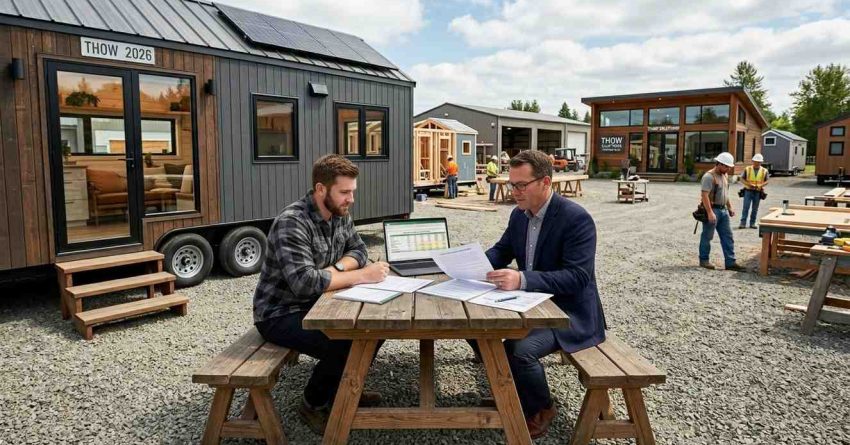
Financing a tiny house on wheels is not the same as financing a traditional home. THOWs fall into a classification gap between real estate and recreational vehicles, which means standard mortgage products rarely apply — and buyers who walk into a bank expecting a home loan often walk out empty-handed. The right financing path depends on how your THOW is built, where it will be placed, and how lenders categorize it.
This gap creates real confusion for buyers who are ready to commit but unsure where to start. Knowing your options before you shop saves time, protects your credit, and puts you in a stronger negotiating position.
This guide covers every major THOW financing option available in the USA, explains how each one works, and helps you identify which path fits your situation best.
What Is a THOW and Why Does Financing Work Differently?
A tiny house on wheels (THOW) is a small, fully functional dwelling built on a trailer chassis rather than a permanent foundation. Because it is mobile, it does not qualify as real property under most state definitions — and that single fact changes everything about how lenders approach it.
Traditional home mortgages require the property to be permanently affixed to land that the borrower owns or is purchasing. THOWs, by definition, do not meet that requirement. This pushes buyers toward personal loans, RV loans, and specialty financing products that carry different interest rates, shorter repayment terms, and stricter qualification criteria than conventional mortgages.
Understanding how THOWs compare to other non-traditional builds is useful context before choosing a financing path — our custom home investment analysis breaks down how build type affects long-term value, resale potential, and financing access across different property categories.
How Lenders Classify THOWs
Lenders place THOWs into one of three categories depending on the build and its certifications: recreational vehicle, personal property, or — in rare cases — real property. The classification determines which loan products are available, what interest rates apply, and how long the repayment term can be.
A THOW certified by the Recreational Vehicle Industry Association (RVIA) is most likely to qualify for RV financing. An uncertified THOW built by an independent builder typically falls under personal property, which limits buyers to personal loans or specialty lenders. A THOW placed on a permanent foundation on owned land may qualify for a chattel loan or, in limited cases, a construction loan.
Personal Loans for THOW Purchases
Personal loans are the most accessible financing option for THOW buyers, particularly those purchasing from independent builders or buying used. Banks, credit unions, and online lenders offer unsecured personal loans that do not require the THOW to meet any specific certification standard.
Loan amounts typically range from $5,000 to $100,000 depending on the lender and the borrower’s credit profile. Repayment terms are shorter than mortgages — usually two to seven years — which means monthly payments are higher relative to the loan amount. Interest rates for personal loans are also higher than secured loan products, often ranging from 7% to 36% depending on creditworthiness.
The primary advantage is speed and simplicity. There is no appraisal, no title search, and no property classification requirement. Buyers with strong credit scores can often receive approval and funding within a few business days.
Pros and Cons of Unsecured Personal Loans
Personal loans offer flexibility that no other THOW financing product matches. They work for any build type, any builder, and any placement situation. The tradeoff is cost — higher interest rates and shorter terms mean more money paid over the life of the loan compared to secured alternatives.
Buyers who plan to pay off their THOW quickly or who have strong credit scores will find personal loans competitive. Buyers who need a 10- to 20-year repayment window will find the monthly payments on a personal loan difficult to sustain and should explore RV loan options instead.
RV Loans and THOW Financing
RV loans are secured loans specifically designed for recreational vehicles, and they are the closest equivalent to a mortgage available to most THOW buyers. They offer longer repayment terms — typically 10 to 20 years — and lower interest rates than personal loans because the THOW itself serves as collateral.
To qualify for an RV loan, the THOW must typically meet lender-specific requirements around build quality, size, and certification. Many lenders require the unit to be purchased from a licensed dealer or certified builder. Some lenders also require the THOW to include standard RV amenities such as a kitchen, bathroom, and sleeping area.
Interest rates for RV loans generally range from 6% to 11% for borrowers with good credit, making them significantly more affordable over time than personal loans for larger purchases.
RVIA Certification and Loan Eligibility
RVIA certification is a build standard that signals to lenders that a THOW was constructed to recognized safety and quality specifications. Many RV lenders require RVIA certification as a condition of loan approval. Builders who carry RVIA membership and certify their units give buyers access to a wider pool of lenders and better loan terms.
Buyers purchasing from a builder who does not carry RVIA certification should ask directly whether the unit qualifies for RV financing before committing to a purchase. An uncertified unit may still be financeable through a personal loan, but the buyer loses access to the lower rates and longer terms that RV loans provide.
Manufacturer and Builder Financing Programs
Some THOW manufacturers and builders offer in-house financing or have established relationships with specialty lenders who understand the THOW market. These programs are designed specifically for buyers who may not qualify for traditional RV loans or who prefer to finance directly through the builder.
Builder financing programs vary widely. Some offer competitive rates comparable to RV loans. Others function more like high-interest installment plans that cost significantly more over time. The convenience of one-stop financing can be valuable, but buyers should compare the total cost of builder financing against personal loan and RV loan alternatives before signing.
What to Ask Before Signing a Builder Financing Agreement
Before committing to builder financing, buyers should ask for the annual percentage rate (APR), the total repayment amount over the full loan term, any prepayment penalties, and whether the loan is held by the builder or sold to a third-party lender. Understanding who holds the loan matters because it affects where payments go and what recourse exists if disputes arise.
Buyers should also confirm whether the financing agreement includes any conditions tied to the build itself — such as warranty terms, delivery timelines, or customization changes — that could affect the loan if the build is delayed or modified.
Land and Property Considerations That Affect Financing
Where a THOW will be placed is not just a lifestyle decision — it is a financing variable. Lenders assess placement risk when evaluating THOW loan applications, and buyers who have a clear, documented plan for where their unit will live are more likely to receive favorable terms.
THOWs placed on rented land, in RV parks, or on a family member’s property are treated differently than units placed on land the buyer owns. Owned land opens the door to chattel loans and, in some cases, construction financing. Rented or informal placement arrangements limit buyers to personal loans and RV loans.
Where you plan to place your THOW directly shapes what financing is available to you — a dedicated resource on THOW zoning rules covers permitted land types, local ordinances, and how placement decisions affect loan eligibility.
Financing a THOW on a Permanent Foundation
A THOW placed on a permanent foundation on owned land may qualify for a chattel loan, which is a secured loan for personal property that is affixed to land but not legally classified as real estate. Chattel loans are commonly used for manufactured homes and can apply to THOWs in certain states.
Chattel loans typically offer better rates than personal loans and longer terms than most RV loans. However, they require the land to be owned by the borrower, the THOW to be permanently installed, and the unit to meet specific size and construction standards that vary by state.
Alternative Financing Options for THOWs
Buyers who do not qualify for personal loans or RV loans, or who are looking for lower-cost alternatives, have several additional paths worth exploring.
Home equity loans and home equity lines of credit (HELOCs) are available to buyers who already own a home with sufficient equity. These products use the existing home as collateral, which typically results in lower interest rates than any unsecured THOW financing option. The risk is that the existing home secures the debt — defaulting on a HELOC used to buy a THOW puts the primary residence at risk.
Peer-to-peer lending platforms connect borrowers directly with individual investors and can offer competitive rates for buyers with strong credit profiles. Crowdfunding is a viable option for buyers with an established audience or community, though it is rarely sufficient to cover the full cost of a THOW build on its own.
Buyers weighing a THOW against a conventionally built home will find the spec home financing comparison useful for understanding how lender risk assessments differ across property types.
Crowdfunding, Peer-to-Peer Lending, and Home Equity Options
Each alternative financing method carries its own qualification requirements and risk profile. Peer-to-peer loans function similarly to personal loans in terms of rates and terms but may offer more flexibility for non-traditional purchases. HELOCs offer the lowest rates but require existing home equity and introduce collateral risk. Crowdfunding works best as a supplement to other financing rather than a standalone solution.
Buyers should evaluate each option based on their current financial position, their timeline, and their risk tolerance — not simply on which option is easiest to access.
How to Improve Your Chances of THOW Loan Approval
Lenders evaluate THOW loan applications using the same core criteria they apply to any loan: credit score, debt-to-income ratio, income stability, and the quality of the asset being financed. Buyers who prepare on all four dimensions before applying are significantly more likely to receive approval and favorable terms.
A credit score above 700 opens access to most personal loan and RV loan products. Buyers with scores below 650 should focus on credit repair before applying, or explore credit unions and community banks that may apply more flexible underwriting standards than national lenders.
Debt-to-income ratio matters as much as credit score. Lenders want to see that monthly loan payments will not exceed 35% to 45% of gross monthly income when combined with existing obligations. Paying down existing debt before applying for THOW financing improves this ratio and strengthens the application.
Lenders respond positively to documented build quality, and understanding THOW builder certification requirements gives buyers a concrete advantage when applying for RV loans or personal financing.
Having a clear placement plan, a signed land lease or proof of land ownership, and a detailed builder contract also strengthens an application. Lenders are more comfortable financing a THOW when the buyer can demonstrate that the unit has a defined, stable home.
Conclusion
THOW financing requires a different approach than traditional home buying, but the options are broader than most buyers realize. Personal loans, RV loans, builder programs, chattel loans, and home equity products each serve different buyer profiles and placement situations.
The right financing path depends on your credit profile, your builder’s certifications, and where your THOW will be placed — three variables that work together to determine what lenders will offer you.
At Mr. Local Services, we connect property owners and THOW buyers with trusted professionals who understand the full picture — from build quality to placement planning — so you can move forward with confidence and the right financing in place.
Frequently Asked Questions
Can I get a mortgage for a tiny house on wheels?
Standard mortgages are not available for THOWs because they are not classified as real property. Buyers typically use personal loans, RV loans, or chattel loans depending on the build and placement situation.
What credit score do I need to finance a THOW?
Most personal loan and RV loan lenders prefer a credit score of 700 or higher. Scores below 650 may still qualify through credit unions or specialty lenders, but rates will be higher and terms shorter.
Does RVIA certification affect my financing options?
Yes. RVIA certification makes a THOW eligible for RV loans, which offer lower interest rates and longer repayment terms than personal loans. Uncertified builds are typically limited to personal loan financing.
How long are repayment terms for THOW loans?
Personal loans typically offer two to seven year terms. RV loans can extend to 10 to 20 years. Chattel loans vary by lender and state but generally fall between 10 and 25 years.
Can I use a home equity loan to buy a THOW?
Yes, if you own a home with sufficient equity. A home equity loan or HELOC uses your existing home as collateral and typically offers lower interest rates than personal or RV loans. The risk is that your primary home secures the debt.
Is builder financing a good option for THOW buyers?
Builder financing can be convenient, but rates and terms vary widely. Always compare the APR and total repayment cost against personal loan and RV loan alternatives before committing to a builder financing agreement.
What happens if I place my THOW on rented land?
Placement on rented land limits financing options to personal loans and RV loans. Chattel loans and construction financing generally require the buyer to own the land where the THOW will be permanently placed.