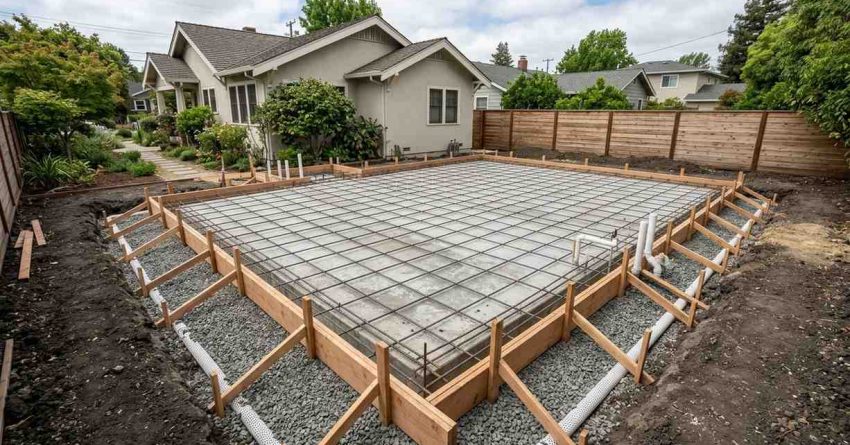
ADU foundation options determine the structural integrity, long-term durability, and total cost of your accessory dwelling unit — and choosing the wrong type can lead to costly repairs, failed inspections, and significant project delays. This guide covers every major foundation type available for ADUs, explains how each one works, and walks through the key factors that determine which option fits your property, budget, and local building requirements.
Whether you are planning a detached backyard unit, a garage conversion, or a prefabricated ADU, the foundation beneath it is the single most consequential decision in the entire build. Getting it right from the start protects your investment for decades.
This guide covers foundation types, selection criteria, construction steps, cost ranges, common problems, and maintenance practices to help you make a confident, informed decision.
What Is an ADU Foundation and Why Does It Matter?
An ADU foundation is the structural base that transfers the weight of the accessory dwelling unit into the ground below it. It supports every wall, floor, and roof system above it, and it determines how the structure responds to soil movement, moisture, seismic activity, and temperature changes over time.
Unlike the foundation of a primary residence, an ADU foundation must meet the same structural engineering standards while often working within tighter site constraints — smaller footprints, proximity to property lines, existing utility lines, and limited access for heavy equipment. These constraints make foundation selection more complex, not less.
The foundation type you choose affects more than structural performance. It directly influences your project timeline, permit approval process, total construction cost, and the long-term maintenance demands of the unit. A foundation that is undersized for the soil conditions beneath it will settle unevenly. One that lacks proper drainage will allow moisture to migrate into the structure. One that does not meet local code requirements will fail inspection and require costly remediation.
Load-Bearing Requirements for ADUs
Every ADU foundation must be engineered to carry the dead load of the structure — the permanent weight of framing, roofing, insulation, and mechanical systems — plus the live load of occupants, furniture, and appliances. For a standard 400–800 square foot ADU, total structural loads typically range from 30 to 50 pounds per square foot depending on construction type and local snow load requirements.
Soil bearing capacity is the critical variable. Clay soils, expansive soils, and fill soils have lower bearing capacity than compacted native soils or bedrock, and they require deeper or wider foundation systems to distribute loads safely. A geotechnical report, also called a soils report, quantifies bearing capacity and provides the engineering basis for foundation design.
How Foundation Type Affects ADU Permits and Approvals
Foundation selection is one of the first decisions reviewed during the permit application process. Most jurisdictions require stamped structural drawings that specify foundation type, dimensions, reinforcement, and connection details before issuing a building permit. Understanding what your local jurisdiction requires is essential before breaking ground — our guide to ADU permit requirements walks through every approval step, inspection milestone, and documentation checklist you need to move your project forward legally and on schedule.
Inspections are typically required at three foundation stages: after excavation and before forming, after forming and before pouring concrete, and after the pour has cured and before framing begins. Missing any of these inspection windows can result in a stop-work order and required demolition of completed work.
Types of ADU Foundations
The four primary foundation types used for ADUs are concrete slab, crawl space, basement, and pier and beam. Each has distinct structural characteristics, cost profiles, and site requirements. The right choice depends on your soil conditions, climate, local code requirements, and the type of ADU you are building.
Concrete Slab Foundations
A concrete slab foundation is a single, continuous layer of reinforced concrete poured directly on prepared ground. It is the most common foundation type for detached ADUs in mild climates because it is cost-effective, fast to construct, and requires minimal ongoing maintenance.
Slab thickness for ADUs typically ranges from 4 to 6 inches, with thickened edges at the perimeter to provide additional bearing capacity under exterior walls. Reinforcement consists of either welded wire mesh or rebar placed at mid-depth in the slab. In areas with expansive soils or seismic risk, post-tensioned slabs with steel cables are used to resist cracking and movement.
The primary limitation of a slab foundation is that all plumbing must be embedded in or beneath the concrete before the pour. Any future plumbing modifications require cutting through the slab, which adds cost and disruption. Slabs also transmit cold from the ground into the living space in colder climates unless insulated properly at the perimeter and beneath the slab.
A concrete slab is the most widely used foundation type for detached ADUs in mild climates — our dedicated on concrete slab foundation covers thickness requirements, reinforcement options, and the full installation process in detail.
Crawl Space Foundations
A crawl space foundation elevates the ADU floor system above grade on a perimeter wall, creating an accessible space beneath the structure typically 18 to 36 inches in height. This space provides access to plumbing, electrical conduit, and HVAC components without cutting through a slab, making future repairs and modifications significantly easier.
Crawl spaces are well-suited to sites with moderate slopes, areas with high water tables where a slab would require extensive drainage work, and climates where ground freezing is a concern. The perimeter wall is typically constructed from poured concrete or concrete masonry units and must extend below the frost line in cold climates.
The primary maintenance challenge with crawl spaces is moisture management. Without proper ventilation or encapsulation, humidity accumulates beneath the floor system, promoting mold growth, wood rot, and pest activity. Modern best practice favors sealed, conditioned crawl spaces over vented ones in most climates.
Crawl space foundations offer valuable access to plumbing and electrical systems beneath the ADU — our resource on crawl space foundation explains when this option is appropriate, how ventilation works, and what encapsulation involves.
Basement Foundations
Basement foundations extend the foundation walls below grade to create usable living or storage space beneath the ADU. They are the most expensive foundation option and are most common in cold climates where frost depth requirements already necessitate deep excavation.
For ADUs, full basements are relatively rare due to cost and site constraints, but they add significant square footage to the unit and can substantially increase the property’s rental income potential. Basement walls must be waterproofed on the exterior and equipped with drainage systems to manage groundwater pressure.
Basement construction requires the deepest excavation of any foundation type, the most concrete, and the most complex waterproofing system. In areas with high water tables or expansive soils, basements may not be feasible without extensive and expensive mitigation measures.
Pier and Beam Foundations
Pier and beam foundations support the ADU floor system on a grid of concrete piers or steel columns connected by horizontal beams. The structure sits above grade, leaving an open space beneath it similar to a crawl space but without perimeter walls.
This foundation type is particularly well-suited to sloped sites where a slab would require extensive grading and fill, and to areas with expansive clay soils that swell and shrink with moisture changes. The piers extend below the active soil zone to stable bearing material, isolating the structure from surface soil movement.
Pier and beam systems are also common for manufactured and modular ADUs, where the unit is delivered to the site and set on pre-installed piers. Leveling adjustments can be made by shimming the beams, which is a significant advantage over slab foundations where settling requires more invasive repair.
Pier and beam systems are a strong fit for sloped lots and expansive soils — our on pier and beam foundation details spacing requirements, beam sizing, and the conditions under which this type outperforms a slab.
How to Choose the Right Foundation for Your ADU
Selecting the right foundation requires evaluating four factors in sequence: site conditions, local code requirements, ADU type and design, and budget. Skipping any of these steps increases the risk of choosing a foundation that performs poorly, fails inspection, or costs significantly more than anticipated.
Soil Conditions and Site Assessment
Soil conditions are the most important technical factor in foundation selection. Expansive soils require foundations that can resist uplift and lateral movement. Loose or fill soils require deeper bearing or ground improvement. Sloped sites favor pier and beam or crawl space systems over slabs. High water tables complicate slab and basement construction.
A geotechnical investigation — typically a soils report prepared by a licensed geotechnical engineer — provides the data needed to make an informed foundation decision. The report identifies soil type, bearing capacity, expansion potential, and groundwater depth, and it recommends appropriate foundation systems for the site.
Choosing the right foundation starts with understanding what is beneath your property — our resource on ADU site assessment explains how soil testing works, what results mean, and how findings directly influence your foundation decision.
Local Building Codes and Zoning Requirements
Local building codes specify minimum foundation requirements including depth, width, reinforcement, and connection details. These requirements vary significantly by jurisdiction and are influenced by seismic zone, frost depth, soil conditions, and local construction practices.
Zoning regulations may also affect foundation choice indirectly by limiting ADU height, setbacks, and lot coverage. A taller foundation system like a basement or elevated crawl space may push the ADU above the maximum allowed height in some jurisdictions.
Every foundation decision must align with local zoning rules and building codes before construction begins — our guide to ADU zoning requirements covers setback rules, height restrictions, and the code compliance steps that affect foundation design.
Budget Considerations by Foundation Type
Foundation costs vary significantly by type. Concrete slabs are the least expensive option for flat sites with good soil conditions. Crawl space foundations cost more due to the additional perimeter wall construction and moisture management systems. Pier and beam foundations fall in a similar range to crawl spaces but can be more economical on sloped sites where slab grading costs would be high. Basement foundations are the most expensive option by a significant margin.
Budget planning should account not just for initial construction cost but for long-term maintenance costs. A crawl space that is not properly encapsulated will require remediation within a few years. A slab with inadequate drainage will develop moisture problems that are expensive to address after the fact.
ADU Foundation Construction Process
Foundation construction follows a defined sequence of steps that must be completed in order and inspected at key milestones. Understanding this process helps you set realistic expectations for your project timeline and communicate effectively with your contractor.
Site Preparation and Excavation
Site preparation begins with staking the foundation layout, establishing grade elevations, and clearing vegetation and topsoil from the building footprint. For slab foundations, the subgrade is then compacted and graded to the specified elevation. For crawl space and basement foundations, excavation removes soil to the required depth.
Utility lines must be located and protected before any excavation begins. Underground electrical, gas, water, and sewer lines are common on developed residential lots, and striking one during excavation creates safety hazards and significant project delays.
Forming, Pouring, and Curing Concrete
After excavation and subgrade preparation, forms are set to define the shape and dimensions of the foundation. Reinforcement is placed according to the structural drawings, and any embedded plumbing or conduit is installed before the pour.
Concrete is ordered to the specified compressive strength — typically 2,500 to 3,000 psi for residential foundations — and poured in a single continuous operation where possible to avoid cold joints. After the pour, the concrete must cure for a minimum of 7 days before loading, and 28 days to reach full design strength.
Inspections and Final Approval
Most jurisdictions require a minimum of two foundation inspections: one before the concrete pour to verify forming and reinforcement, and one after the pour and cure to verify dimensions and surface condition. Some jurisdictions also require a pre-excavation inspection to verify soil conditions match the geotechnical report.
Foundation work is one of the most time-sensitive phases of any ADU project, and delays here cascade through every subsequent stage — our overview of the ADU construction timeline shows how foundation milestones fit within the full build schedule and what to expect at each phase.
ADU Foundation Costs: What to Expect
Foundation costs for ADUs vary based on foundation type, site conditions, local labor rates, and material prices. Understanding the cost ranges for each option helps you budget accurately and evaluate contractor proposals.
Cost Breakdown by Foundation Type
| Foundation Type | Typical Cost Range (per sq ft) | Notes |
| Concrete Slab | $5–$14 | Lower end for flat sites with good soil; higher for post-tensioned or thickened slabs |
| Crawl Space | $8–$18 | Includes perimeter wall, ventilation or encapsulation, and access hatch |
| Pier and Beam | $8–$20 | Wider range due to pier depth variability and beam sizing requirements |
| Basement | $25–$50+ | Highest cost; includes deep excavation, waterproofing, and drainage systems |
These ranges reflect foundation construction costs only and do not include site preparation, grading, utility work, or permits. For a 600 square foot ADU, total foundation costs typically range from $3,000 to $12,000 for a slab, $5,000 to $11,000 for a crawl space, and $15,000 to $30,000 or more for a basement.
Foundation work typically represents 10–15% of total ADU project costs, making it one of the most significant budget line items — our complete ADU cost breakdown covers every major expense category from permits and site prep through finishing and landscaping so you can plan your full budget accurately.
Factors That Increase Foundation Costs
Several site and design conditions can push foundation costs above the typical ranges. Expansive or unstable soils require deeper bearing, ground improvement, or post-tensioned systems. Sloped sites require additional grading, retaining walls, or taller foundation walls. High water tables require dewatering during construction and more robust waterproofing systems. Remote or constrained sites with limited equipment access increase labor costs.
Permit fees, engineering fees for stamped structural drawings, and geotechnical investigation costs are additional line items that are sometimes overlooked in early budget estimates. These typically add $1,500 to $5,000 to the total foundation cost depending on jurisdiction and project complexity.
Common ADU Foundation Problems and How to Fix Them
Even well-built foundations can develop problems over time, particularly in areas with expansive soils, significant rainfall, or seismic activity. Recognizing the early signs of foundation distress allows you to address problems before they escalate into structural failures.
Settling, Cracking, and Shifting
Some degree of settlement is normal in new construction as the soil beneath the foundation consolidates under load. Uniform settlement — where the entire foundation drops evenly — is generally not a structural concern. Differential settlement — where one part of the foundation drops more than another — creates stress in the structure and can cause cracking in walls, sticking doors and windows, and sloping floors.
Hairline cracks in concrete slabs and foundation walls are common and typically not structural. Cracks wider than 1/4 inch, cracks that are actively growing, or cracks accompanied by displacement or separation are warning signs that require professional evaluation. Pier and beam foundations may develop problems when individual piers settle or when wood beams deteriorate due to moisture exposure.
Moisture Intrusion and Drainage Issues
Moisture is the most common cause of long-term foundation deterioration. Water that pools against foundation walls creates hydrostatic pressure that can crack concrete and masonry. Water that infiltrates crawl spaces promotes wood rot, mold, and pest activity. Water that migrates beneath slabs can cause soil erosion and differential settlement.
Proper site drainage — grading the soil away from the foundation at a minimum slope of 6 inches over 10 feet — is the first line of defense. Gutters and downspouts that discharge water away from the foundation perimeter are equally important. When drainage problems exist, French drains, sump pumps, and exterior waterproofing systems provide additional protection.
When settling, cracking, or moisture problems appear, acting quickly limits the scope and cost of repairs — our on foundation repair options explains the most common repair methods, what each addresses, and how to evaluate contractor proposals.
Foundation Maintenance for Long-Term ADU Performance
A well-built foundation requires relatively little maintenance, but consistent annual inspections catch developing problems before they become expensive repairs. The goal of foundation maintenance is to identify and address the conditions that cause deterioration — primarily moisture, soil movement, and vegetation encroachment.
Annual Inspection Checklist
Inspect the following items at least once per year, ideally in spring after the wet season:
- Exterior grade: Confirm soil slopes away from the foundation on all sides. Re-grade areas where soil has settled toward the structure.
- Gutters and downspouts: Clear debris and confirm downspouts discharge at least 6 feet from the foundation.
- Visible cracks: Document any new cracks in the foundation wall or slab. Photograph and measure them to track changes over time.
- Crawl space condition: Check for standing water, condensation on framing, signs of mold or wood rot, and pest activity.
- Pier and beam connections: Inspect beam-to-pier connections for deterioration, displacement, or signs of settlement.
- Vegetation: Remove shrubs, vines, and tree roots that are growing against or beneath the foundation.
Consistent annual inspections are the most cost-effective way to protect your ADU foundation investment over time — our home maintenance services explains how professional inspections work, what technicians look for, and how routine upkeep prevents expensive structural repairs.
ADU Foundation and Property Value
The foundation is not a visible feature of a finished ADU, but it has a direct and measurable impact on property value. Appraisers and buyers evaluate foundation condition as a primary indicator of structural integrity, and foundation problems are among the most common reasons ADU valuations come in below expectations.
A foundation that is properly engineered, permitted, and constructed adds value in two ways. First, it eliminates the risk of costly future repairs that would otherwise be priced into a buyer’s offer or flagged in a home inspection. Second, it supports the full permitted square footage of the ADU, which is the basis for rental income calculations and resale value assessments.
Conversely, unpermitted foundation work or foundation systems that do not meet current code requirements create title and financing complications that can prevent a sale or require expensive remediation before closing. In jurisdictions where ADU legalization programs exist, bringing an unpermitted foundation into compliance is often the most expensive part of the legalization process.
A properly built foundation is one of the most direct contributors to long-term ADU value and appraisal outcomes — our guide to ADU return on investment explains how structural quality, permitted construction, and foundation type influence resale value and rental income potential.
Conclusion
ADU foundation options range from cost-effective concrete slabs to full basement systems, and each type serves a distinct set of site conditions, budget parameters, and structural requirements. The right foundation is the one that matches your soil conditions, complies with local code, and supports the long-term performance of your ADU.
Investing in proper site assessment, engineering, and construction quality at the foundation stage prevents the most expensive problems that ADU owners face — differential settlement, moisture intrusion, and failed inspections that delay or derail projects.
At Mr. Local Services, our network of skilled professionals handles every phase of ADU foundation work, from site assessment and permit coordination through construction and final inspection — contact us today to connect with a qualified foundation specialist in your area.
Frequently Asked Questions About ADU Foundations
What is the cheapest foundation option for an ADU?
A concrete slab is typically the least expensive foundation option for ADUs on flat sites with stable soil conditions. For a 600 square foot ADU, slab foundation costs generally range from $3,000 to $8,400 depending on thickness, reinforcement, and local labor rates.
How deep does an ADU foundation need to be?
Foundation depth depends on local frost depth requirements and soil conditions. In warm climates with no frost, slab foundations may require only 12 inches of bearing depth. In cold climates, foundations must extend below the frost line, which can range from 12 inches in mild regions to 48 inches or more in northern states.
Can I build an ADU on an existing concrete slab?
In some cases, yes — but the existing slab must be evaluated by a structural engineer to confirm it meets current load requirements, has adequate thickness and reinforcement, and is in acceptable condition. Cracked, settled, or undersized slabs typically require replacement rather than reuse.
How long does ADU foundation construction take?
Foundation construction for a standard ADU typically takes 1 to 3 weeks from site preparation through final inspection. Slab foundations are the fastest, often completed in 5 to 10 working days. Crawl space and basement foundations take longer due to additional forming, wall construction, and waterproofing work.
Do I need a soils report for an ADU foundation?
Most jurisdictions require a geotechnical report for new ADU construction, particularly for detached units. Even where not required, a soils report is strongly recommended because it identifies soil conditions that affect foundation design and helps prevent costly problems during and after construction.
What foundation type is best for a sloped lot?
Pier and beam foundations are generally the best option for sloped lots because they can be installed at varying depths to follow the terrain without requiring extensive grading or fill. Crawl space foundations with stepped perimeter walls are also used on moderate slopes. Slabs on sloped sites require significant grading and retaining work that can exceed the cost of alternative foundation systems.
How do I know if my ADU foundation has a problem?
Common warning signs include cracks wider than 1/4 inch in foundation walls or slabs, doors and windows that stick or no longer close properly, sloping or uneven floors, gaps between walls and ceilings or floors, and visible moisture or efflorescence on foundation surfaces. Any of these signs warrants a professional inspection.
What permits are required for ADU foundation work?
Foundation work requires a building permit in virtually all jurisdictions. The permit application typically requires stamped structural drawings, a site plan, and in many cases a geotechnical report. Inspections are required at key construction milestones before work can proceed to the next phase.