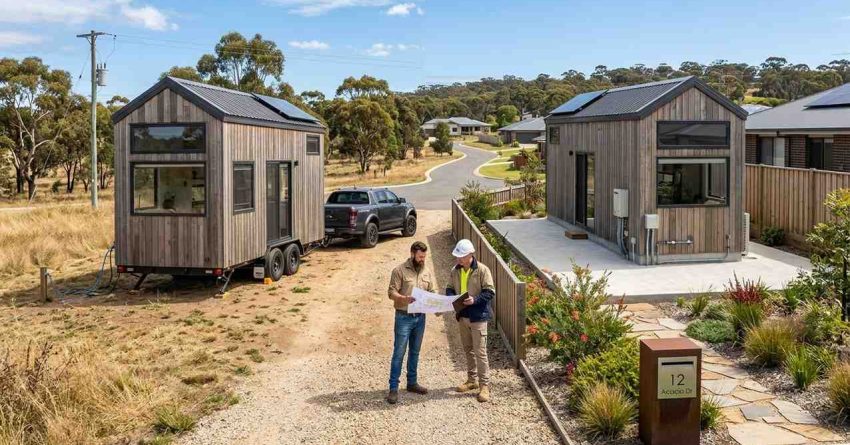
A THOW sits on a trailer and moves with you. A tiny house on a foundation stays put — and that single difference shapes everything from your permit requirements to your long-term costs.
Choosing between these two tiny home types is one of the most consequential decisions a prospective tiny homeowner makes, and the wrong choice can mean unexpected legal hurdles, financing problems, or lifestyle mismatches.
This guide breaks down every major difference between THOWs and foundation tiny homes — covering structure, cost, zoning, utilities, and how to decide which option fits your situation.
What Is a THOW (Tiny House on Wheels)?
A THOW, or tiny house on wheels, is a small residential dwelling built on a trailer chassis rather than a permanent foundation. Because it is mounted on a trailer, it is classified in most U.S. jurisdictions as a recreational vehicle (RV) rather than a permanent structure. This classification has significant implications for where you can live in it, how it is regulated, and how you finance it.
THOWs typically range from 100 to 400 square feet and are built to be road-legal, meaning they must comply with width, height, and weight limits set by the Department of Transportation. Most builders follow RVIA (Recreational Vehicle Industry Association) standards or NOAH (National Organization of Alternative Housing) certification to ensure safety and improve placement options.
How a THOW Is Built and Classified
A THOW is constructed on a steel trailer frame, often a gooseneck or bumper-pull design, with the home built directly on top. The framing, insulation, and exterior cladding must account for road vibration, wind load during transport, and the structural stress of repeated moves. Because THOWs are classified as vehicles in most states, they are registered with the DMV rather than the county assessor’s office.
If you are new to the tiny home movement, our tiny home overview covers every major type, construction method, and lifestyle consideration in one place — a useful starting point before diving into the THOW vs. foundation comparison.
Who Typically Chooses a THOW?
THOWs attract buyers who prioritize flexibility. Remote workers, minimalists, and people who want to relocate without selling a home are the most common THOW buyers. They are also popular among people who want to avoid property taxes or who cannot afford land in high-cost areas. The trade-off is that finding legal, long-term parking for a THOW is one of the most persistent challenges owners face.
What Is a Tiny House on a Foundation?
A tiny house on a foundation is a small permanent dwelling built directly on a concrete slab, crawl space, or basement — the same way a conventional home is built. It is classified as real property, subject to local residential building codes, and assessed for property taxes. Foundation tiny homes typically range from 200 to 600 square feet and are designed to stay in one location indefinitely.
Because they are classified as permanent structures, foundation tiny homes must meet the same International Residential Code (IRC) standards as any other home. This means full electrical panels, permitted plumbing, HVAC systems, and inspections at every stage of construction.
How Foundation Tiny Homes Are Constructed
Foundation tiny homes are built using conventional residential construction methods — wood or steel framing, standard insulation, roofing systems, and utility rough-ins. The foundation type depends on soil conditions, climate, and local code requirements. Slab foundations are common in warm climates; crawl spaces and basements are more typical in colder regions where frost depth matters.
Because they are permanent structures, foundation tiny homes can be built with full-size appliances, standard ceiling heights, and conventional windows and doors — features that are often compromised in a THOW due to road-travel constraints.
Who Typically Chooses a Foundation Tiny Home?
Foundation tiny home buyers tend to prioritize stability, permanence, and conventional financing. Retirees downsizing, couples building on family land, and property investors adding accessory dwelling units (ADUs) are the most common buyers. They want the simplicity of tiny living without the logistical complexity of finding legal parking or managing vehicle registration.
Key Structural Differences Between THOWs and Foundation Tiny Homes
The structural differences between these two types go well beyond size. They affect how the home is built, how it performs over time, and what systems it can support.
Mobility and Permanence
A THOW is designed to move. Its framing must withstand road vibration, its connections must be secure during transport, and its weight must stay within legal towing limits — typically under 26,000 pounds gross vehicle weight for a standard Class A driver’s license. This limits the materials, insulation thickness, and appliance sizes a builder can use.
A foundation tiny home has none of these constraints. It can use heavier materials, thicker insulation, and full-size mechanical systems. It will not shift, settle from road stress, or require re-leveling after a move. Over a 10- to 20-year horizon, foundation homes typically require less structural maintenance than THOWs, which experience ongoing wear from transport and seasonal movement.
Building Codes and Permits
This is where the two types diverge most sharply. THOWs are regulated as vehicles in most states, which means they bypass local residential building codes entirely — but also means they cannot be legally occupied as a primary residence in most residential zones. Many THOW owners park on private land with the owner’s permission, in RV parks, or in tiny home communities that specifically allow them.
Foundation tiny homes must obtain building permits, pass inspections, and meet all local residential codes. The permitting process is more involved, but the result is a legally recognized dwelling that can be financed with a conventional mortgage, insured as real property, and sold on the open market.
Understanding which permits apply to your build is one of the most critical steps in the planning process — our tiny home permits guide walks through state-by-state zoning rules, RV classification requirements, and ADU approval processes so you know exactly what to expect before breaking ground.
Utility Connections and Infrastructure
THOWs are built to operate off-grid or with temporary hookups. They typically use propane, solar panels, or generator power for electricity; composting or cassette toilets for waste; and fresh water tanks or campground hookups for water. This flexibility is an advantage in remote locations but a limitation in urban or suburban settings where full utility connections are expected.
Foundation tiny homes connect to municipal water, sewer, and electrical systems exactly like a conventional home. They can support standard HVAC systems, full-size water heaters, and dishwashers. For homeowners who want the simplicity of tiny living without managing tanks, generators, or propane levels, a foundation home is the more practical choice.
Cost Comparison: THOW vs Tiny House on Foundation
Cost is one of the most searched aspects of this comparison, and the answer is more nuanced than most buyers expect.
Upfront Build and Purchase Costs
A professionally built THOW in the U.S. typically costs between $60,000 and $150,000, depending on size, materials, and builder. DIY builds can come in lower — sometimes $20,000 to $50,000 — but require significant time, skill, and access to tools. The trailer chassis alone can cost $5,000 to $15,000.
A foundation tiny home typically costs between $50,000 and $200,000, depending on land costs, foundation type, and finish level. If land is already owned, the build cost alone ranges from $40,000 to $120,000. Permit fees, utility hookup costs, and site preparation add $5,000 to $30,000 on top of construction.
For a full breakdown of material costs, contractor fees, and financing options across both build types, our tiny home cost guide provides current pricing benchmarks and budget planning tools to help you plan your investment accurately.
Long-Term Ownership and Maintenance Costs
THOWs depreciate like vehicles, not real estate. A THOW purchased for $100,000 may be worth $60,000 to $70,000 in five years. Foundation tiny homes, like conventional homes, can appreciate in value if they are on owned land in a desirable area. Property taxes apply to foundation homes but not to THOWs in most states.
Maintenance costs also differ. THOWs require trailer maintenance — wheel bearings, brake systems, and hitch components — in addition to standard home maintenance. Foundation homes require no vehicle-related upkeep but may have higher utility costs due to full system connections.
Zoning, Legal, and Land Considerations
Zoning is the single biggest practical barrier for both THOW and foundation tiny home buyers in the U.S.
Where You Can Park or Place Each Type
THOWs cannot be legally parked and occupied in most residential zones. Options include RV parks, tiny home communities, rural land with permissive zoning, and private land with the owner’s consent. Some states — including Oregon, California, and Texas — have made legislative progress in allowing THOWs in residential zones, but rules vary significantly by county and municipality.
Foundation tiny homes face a different challenge: minimum square footage requirements. Many municipalities require homes to be at least 600 to 1,000 square feet, which disqualifies most tiny homes. ADU-friendly zoning, rural land, and tiny home subdivisions are the most viable options for foundation tiny home placement.
Financing and Insurance Differences
THOWs are financed as RVs or personal property loans, not mortgages. Interest rates are typically higher — often 7% to 12% — and loan terms are shorter, usually 10 to 15 years. Standard homeowner’s insurance does not apply; THOW owners need RV insurance or specialty tiny home insurance.
Foundation tiny homes can qualify for conventional mortgages if they meet minimum size and value requirements set by lenders. FHA and USDA loans may be available in rural areas. Homeowner’s insurance applies as it would to any permanent dwelling.
Securing the right loan or insurance policy for a non-traditional dwelling requires specialized knowledge — our tiny home financing resource explains which lenders work with THOWs, what foundation homes qualify for, and how to compare coverage options side by side.
Pros and Cons of Each Option
Advantages and Disadvantages of a THOW
A THOW offers genuine freedom of movement, lower property tax exposure, and the ability to relocate without selling. It is a strong fit for people who value flexibility over permanence and who are comfortable managing off-grid systems.
The disadvantages are real: finding legal long-term parking is difficult, financing is more expensive, and the home depreciates over time. Road travel causes ongoing wear, and the size constraints imposed by transport limits mean compromises in insulation, ceiling height, and appliance selection.
Advantages and Disadvantages of a Foundation Tiny Home
A foundation tiny home offers permanence, conventional financing, and the ability to build equity. It can be built to full residential code, connected to all utilities, and insured and sold like any other home. For buyers who own land or have access to ADU-friendly zoning, it is often the more financially sound long-term choice.
The disadvantages include higher upfront permitting costs, zoning restrictions in many municipalities, and the complete absence of mobility. Once built, a foundation tiny home stays where it is.
Which Option Is Right for You?
The right choice depends on three factors: your lifestyle priorities, your land situation, and your financial goals.
If you want to move frequently, avoid property taxes, or live in a remote location without utility access, a THOW is the more practical choice. If you want to build equity, access conventional financing, and live in a legally recognized permanent dwelling, a foundation tiny home is the stronger option.
For buyers who are undecided, the most useful exercise is to answer two questions honestly: Do you have — or can you access — land where a foundation home is legally permitted? And are you prepared to manage the ongoing logistics of finding legal THOW parking? The answers to those two questions will point clearly in one direction for most buyers.
How Home Services Apply to Tiny Homes
Tiny homes — whether on wheels or a foundation — require the same core maintenance and repair services as any other residential property. Plumbing, electrical, HVAC, roofing, and appliance services all apply, though the scale and access points differ from a conventional home.
THOWs often need specialized service providers familiar with RV-style systems — propane lines, composting toilets, and 12-volt electrical systems. Foundation tiny homes use standard residential systems and can be serviced by any licensed contractor.
Whether your tiny home sits on wheels or a permanent foundation, routine maintenance and skilled repairs are essential to protecting your investment — explore our tiny home services to see how Mr. Local Services connects tiny homeowners with qualified professionals across plumbing, electrical, HVAC, and more.
Conclusion
THOWs and foundation tiny homes represent two fundamentally different approaches to small-space living, each with distinct structural, legal, and financial profiles. The comparison comes down to mobility versus permanence, flexibility versus stability, and vehicle financing versus mortgage access.
Your land situation and lifestyle priorities are the clearest guides to the right choice. Buyers with owned land and a preference for permanence will find foundation tiny homes more practical; buyers who value freedom of movement will find THOWs better suited to their needs.
When you are ready to maintain, repair, or improve your tiny home — whatever type you choose — Mr. Local Services connects you with skilled professionals who understand the unique demands of small-space residential living and deliver dependable results.
Frequently Asked Questions
What is the main difference between a THOW and a tiny house on a foundation?
A THOW is built on a trailer and classified as a vehicle, while a tiny house on a foundation is a permanent structure classified as real property. This difference affects zoning, financing, insurance, and long-term value.
Can you live in a THOW full time legally in the U.S.?
Full-time legal occupancy of a THOW depends on your state and municipality. Some areas allow it in RV parks or tiny home communities, but most residential zones do not permit permanent THOW occupancy. Rules vary significantly by location.
Is a tiny house on a foundation cheaper than a THOW?
Not necessarily. Foundation tiny homes can cost $50,000 to $200,000 including land preparation and permits, while THOWs range from $60,000 to $150,000 professionally built. Long-term, foundation homes can appreciate in value while THOWs depreciate like vehicles.
Can you get a mortgage for a THOW?
No. THOWs are financed as RVs or personal property, not real estate. Mortgage products do not apply. Foundation tiny homes may qualify for conventional, FHA, or USDA mortgages depending on size, value, and location.
Do tiny houses on foundations require building permits?
Yes. Foundation tiny homes must obtain building permits and pass inspections under local residential building codes, just like any conventional home. THOWs bypass residential building codes in most states because they are classified as vehicles.
Which type of tiny home holds its value better?
Foundation tiny homes on owned land can appreciate in value like conventional real estate. THOWs depreciate over time, similar to vehicles. For buyers focused on long-term financial return, a foundation tiny home is generally the stronger investment.
What kind of maintenance does a THOW need that a foundation home does not?
THOWs require vehicle-specific maintenance including trailer wheel bearings, brake systems, hitch components, and road-travel structural checks. Foundation tiny homes require no vehicle maintenance but do need standard residential upkeep for roofing, plumbing, HVAC, and electrical systems.