The pre-construction phase of a custom home is the planning period before any building begins — covering land selection, budgeting, design, permitting, and contractor hiring. Every decision made during this phase directly shapes the cost, timeline, and quality of the finished home. Skipping steps or rushing through pre-construction is the single most common reason custom home projects go over budget or stall mid-build.
This phase matters now because material costs, permit timelines, and contractor availability all require early coordination to avoid delays that compound quickly.
This guide covers every major pre-construction step — what each involves, why it matters, and what to do first — so you can move forward with confidence.
What Is the Pre-Construction Phase of a Custom Home?
The pre-construction phase is the structured planning period that takes place before a single shovel breaks ground. It begins the moment you decide to build a custom home and ends when all permits are approved, contracts are signed, and the construction schedule is locked. This phase typically includes land acquisition, site evaluation, architectural design, budget development, permit applications, and general contractor selection.
Unlike buying an existing home, building custom means every detail — from room layout to roofing material — must be decided before construction begins. Pre-construction is where those decisions are made, documented, and approved. The quality of this planning directly determines how smoothly the build phase runs.
Why This Phase Sets the Foundation for Everything
Errors made during pre-construction are the most expensive to fix. A poorly evaluated lot can require thousands of dollars in grading or utility extension. A budget built on incomplete estimates leads to financing gaps mid-build. A design approved without checking local zoning can require costly revisions after permits are denied. Pre-construction exists to surface and resolve these problems before they become construction-phase crises.
The pre-construction phase is just one stage in a multi-step journey — our custom home building guide covers every phase from land selection through final walkthrough, giving you a complete picture of what to expect from start to finish.
Land Acquisition and Site Evaluation
Choosing the right lot is the first major decision of the pre-construction phase, and it carries consequences that affect every phase that follows. The location, size, and physical characteristics of the land determine what you can build, how much it will cost to prepare, and how long permitting will take.
Before purchasing any lot, evaluate access to municipal water and sewer lines or the feasibility of a well and septic system. Confirm that utilities — electricity, gas, and internet — can reach the site without prohibitive extension costs. Check flood zone designations through FEMA maps, as flood zone classification affects both buildability and insurance costs.
Key Factors to Assess Before Buying Land
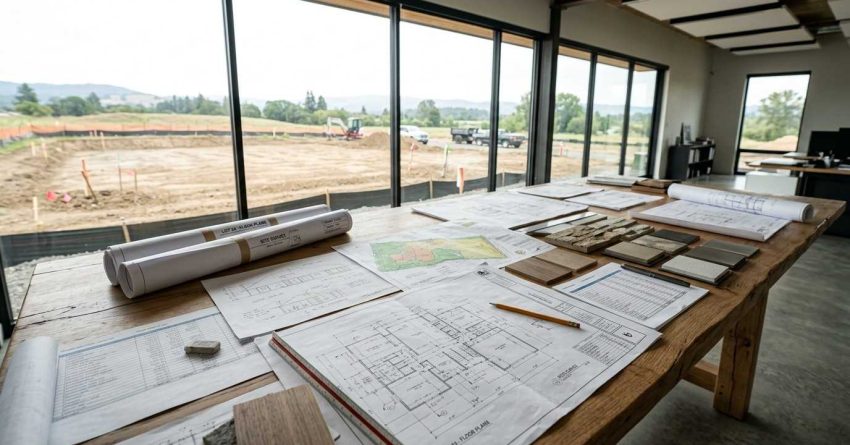
Topography matters as much as location. Steep slopes require more grading and foundation work, which adds cost. Heavily wooded lots require clearing. Rocky soil may complicate excavation. Each of these conditions is identifiable before purchase through a professional site assessment.
Choosing the right lot involves more than location preferences — the site evaluation process examines soil conditions, drainage, utility access, and zoning restrictions that directly affect what you can build and what it will cost.
If soil testing reveals unstable ground, a standard foundation may not be viable. A geotechnical report — sometimes called a soils report — identifies bearing capacity and recommends foundation type. This report is often required by lenders and structural engineers before design can begin. For a deeper look at what this testing involves, our resource on soil testing for custom home sites explains what the report covers and when to commission it.

Budgeting and Financial Planning for Custom Home Builds
A realistic budget is the backbone of a successful custom home project. Most homeowners underestimate total project cost because they focus on construction costs alone and overlook land, permits, design fees, utility connections, landscaping, and contingency reserves.
A standard rule of thumb is to set aside 10–15% of the total project budget as a contingency fund. This buffer absorbs cost overruns from material price changes, design revisions, or unforeseen site conditions — all of which are common in custom builds.
How to Estimate Costs and Avoid Budget Overruns
Start with a detailed cost breakdown organized by category: land purchase, site preparation, foundation, framing, roofing, mechanical systems, interior finishes, and exterior work. Get itemized estimates from your contractor and subcontractors before finalizing the budget, not after.
Getting your numbers right before breaking ground is critical — our custom home cost guide walks through every major expense category, from land and permits to materials and contractor fees, so you can build a realistic budget from day one.
Financing a custom build typically requires a construction loan rather than a traditional mortgage. Construction loans disburse funds in draws as each phase is completed, which means your lender will require a detailed project schedule and cost breakdown before approving the loan. Our resource on construction loans for custom home builds explains how these loans work and what documentation lenders require.
Designing Your Custom Home — Working With Architects and Designers
The design phase translates your vision into a set of construction documents that builders, engineers, and permit offices can use. This process typically involves an architect or designer, a structural engineer, and in some cases, specialized consultants for mechanical systems or energy efficiency.
Begin the design process with a detailed program — a written list of every room, its intended use, approximate size, and any special requirements. This document guides the architect and prevents scope creep during design, which is one of the most common sources of budget overruns.
What to Expect During the Design and Blueprint Stage
The design process moves through several stages: schematic design (rough floor plans and massing), design development (refined layouts and material selections), and construction documents (detailed drawings and specifications used for permits and bidding). Each stage requires your review and approval before moving forward.
The design stage is where your vision becomes a buildable plan — our resource on working with architects explains how to communicate your goals, review blueprints, and make design decisions that balance aesthetics with structural and budget realities.
One of the most consequential early decisions is whether to use a design-build firm — where one company handles both design and construction — or to hire an architect independently and then bid the project to builders separately. Our comparison of design-build vs. architect-led custom homes breaks down the tradeoffs in cost, control, and timeline for each approach.
Permits, Zoning, and Legal Requirements
No custom home can be built legally without the required permits and regulatory approvals. The permitting process varies significantly by municipality, but it universally requires approved construction documents, proof of land ownership, and compliance with local zoning ordinances.
Zoning ordinances govern what can be built on a given parcel — including setbacks from property lines, maximum building height, lot coverage limits, and permitted land uses. Before finalizing your design, confirm that your plans comply with all applicable zoning requirements. A design that violates setback rules, for example, will be rejected at permit submission and require costly revisions.
How to Navigate Local Building Codes and Approvals
Building codes set minimum standards for structural integrity, fire safety, energy efficiency, and accessibility. Your architect’s construction documents must demonstrate compliance with the applicable code edition adopted by your jurisdiction — typically the International Building Code (IBC) or International Residential Code (IRC), often with state or local amendments.
Every municipality has its own approval process, and missing a step can delay your project by months — the building permits and zoning guide explains what approvals are required, how to apply, and how long the process typically takes in most U.S. jurisdictions.
Beyond standard permits, check whether your lot is subject to HOA restrictions, deed covenants, or historic district regulations. These private restrictions can limit design choices in ways that local zoning does not. Our resource on HOA rules and deed restrictions for custom homes explains how to identify these restrictions before they affect your design.
Selecting a General Contractor and Building Team
Your general contractor (GC) is responsible for managing the entire construction process — hiring and coordinating subcontractors, ordering materials, maintaining the schedule, and ensuring quality control on site. Choosing the right GC is one of the most consequential decisions of the pre-construction phase.
Verify that any contractor you consider holds a valid state contractor’s license and carries both general liability insurance and workers’ compensation coverage. Request certificates of insurance directly from the insurer — not just from the contractor — and confirm that coverage limits are adequate for a project of your scope.
What to Look for When Hiring a Custom Home Builder
Interview at least three contractors before making a selection. Ask each for a list of completed custom home projects of similar size and complexity, and contact those references directly. Ask references specifically about budget adherence, schedule performance, communication quality, and how the contractor handled unexpected problems.
Choosing the right builder is one of the most consequential decisions in the entire process — our guide on how to hire a custom home builder covers licensing verification, contract review, reference checks, and the questions every homeowner should ask before signing.
Review the proposed contract carefully before signing. A well-structured custom home contract specifies the scope of work, payment schedule, change order process, warranty terms, and dispute resolution procedures. Never sign a contract that lacks a detailed scope of work or that ties all payments to a fixed schedule rather than to completed milestones.
Pre-Construction Planning for Key Home Systems
Mechanical systems — HVAC, plumbing, and electrical — must be planned during pre-construction, not after framing begins. The location of ductwork, drain lines, electrical panels, and service entries affects structural design, ceiling heights, and wall placement. Changes made after framing is complete are expensive and sometimes structurally disruptive.
Work with your architect and mechanical engineers to finalize system layouts before construction documents are completed. This coordination ensures that structural elements — beams, joists, and load-bearing walls — are designed to accommodate mechanical runs without compromise.
HVAC, Plumbing, and Electrical Considerations Before Breaking Ground
Heating and cooling system decisions made during pre-construction directly affect energy efficiency, comfort, and long-term operating costs — the HVAC planning guide explains how to size systems correctly, choose between options, and coordinate with your builder before framing begins.
Plumbing layout decisions must be finalized before concrete is poured or walls are framed — our plumbing rough-in planning resource explains how to position fixtures, plan drain lines, and coordinate with your plumber during the design phase to avoid costly changes later.
Electrical planning is equally time-sensitive. Panel size, circuit layout, and service entry location must be determined before the electrical rough-in begins. Our resource on electrical planning for new home construction covers load calculations, panel sizing, and how to plan for future needs like EV charging or solar integration.
Common Pre-Construction Mistakes and How to Avoid Them
The most costly pre-construction mistakes share a common cause: decisions made too quickly, without adequate information. Rushing land purchase without a site evaluation, finalizing a design before confirming zoning compliance, or hiring a contractor based on price alone rather than verified credentials — each of these shortcuts creates problems that are far more expensive to fix than they were to prevent.
Many of the most expensive problems in custom home builds trace back to decisions made — or skipped — before construction began — our breakdown of common planning mistakes identifies the errors homeowners make most often and explains exactly how to avoid each one.
A pre-construction checklist helps ensure that no critical step is overlooked. Our pre-construction checklist for custom home builds organizes every required task by phase, so you can track progress and confirm completion before moving to the next stage.
How Long Does the Pre-Construction Phase Take?
The pre-construction phase for a custom home typically takes between six months and one year, depending on the complexity of the design, the responsiveness of local permit offices, and the availability of contractors. In jurisdictions with high construction activity, permit review alone can take three to six months.
Land acquisition and site evaluation typically take four to eight weeks. Architectural design — from initial schematic through completed construction documents — typically takes three to six months for a custom home. Permit review and approval adds two to six months in most U.S. markets.
Understanding how long each phase takes helps you plan financing, temporary housing, and contractor scheduling — the custom home build timeline breaks down realistic durations for every stage, including pre-construction, permitting, construction, and final inspections.
Conclusion
The pre-construction phase of a custom home is where every critical decision — land, budget, design, permits, and team — comes together into a buildable plan. The quality of this planning determines whether the construction phase runs smoothly or becomes a series of costly corrections.
Homeowners who invest time and resources in thorough pre-construction planning consistently experience fewer delays, fewer budget overruns, and better outcomes than those who rush to break ground. The phase is not overhead — it is the foundation of the entire project.
At Mr. Local Services, our network of trusted professionals supports every stage of the pre-construction process — from site evaluation and contractor selection to system planning and permit coordination — so your custom home build starts on solid ground.
Frequently Asked Questions
What happens during the pre-construction phase of a custom home?
The pre-construction phase covers all planning activities before construction begins, including land acquisition, site evaluation, architectural design, budgeting, permit applications, and general contractor selection. It ends when permits are approved and contracts are signed.
How much does the pre-construction phase cost?
Pre-construction costs typically range from 10% to 15% of the total project budget and include architectural fees, engineering reports, permit fees, site surveys, and geotechnical testing. These costs vary significantly based on project complexity and local permit requirements.
Do I need an architect before hiring a builder?
In most cases, yes. Architectural drawings are required for permit applications, and most general contractors need completed construction documents before they can provide an accurate bid. Hiring an architect first ensures your design is buildable and code-compliant before contractor negotiations begin.
What permits are required before building a custom home?
Most custom home builds require a building permit, grading permit, electrical permit, plumbing permit, and mechanical permit. Some jurisdictions also require environmental review, stormwater management approval, or septic system permits depending on the site and location.
How do I choose the right lot for a custom home?
Evaluate the lot for utility access, soil conditions, drainage, flood zone status, zoning compliance, and topography before purchasing. A professional site evaluation and geotechnical report provide the data needed to assess buildability and estimate site preparation costs accurately.
Can I make changes to the design after pre-construction ends?
Changes are possible after pre-construction ends but become progressively more expensive as construction advances. Changes that affect permitted drawings require permit revisions, which add time and cost. Finalizing all design decisions before permits are submitted is strongly recommended.
What is the difference between pre-construction and construction phases?
The pre-construction phase covers all planning, design, permitting, and contracting activities before building begins. The construction phase begins when permits are approved and the contractor mobilizes on site, covering all physical building work through final inspection and certificate of occupancy.