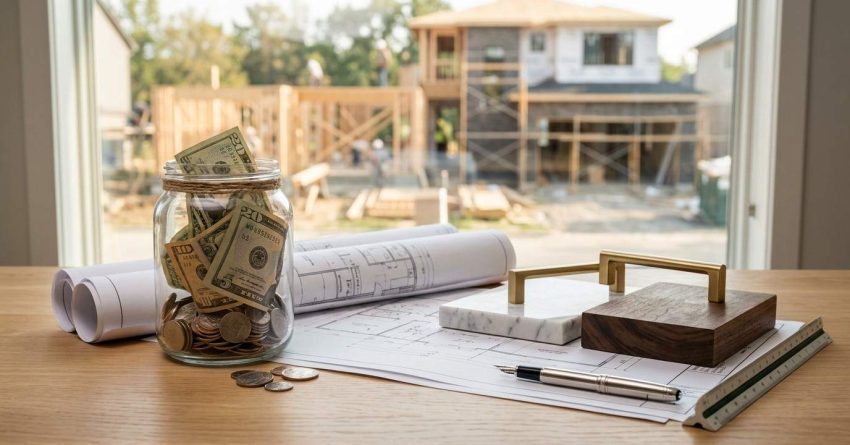
Budgeting for a custom home means planning for land acquisition, architectural design, construction labor, materials, permits, and a contingency reserve — all before a single wall goes up. Most homeowners underestimate total costs because they focus on the build price alone and overlook the full financial picture that surrounds it. A structured budget, built from the ground up with realistic numbers, is what separates a smooth build from a costly surprise.
What Does It Cost to Build a Custom Home?
Building a custom home in the USA typically costs between $300 and $500 per square foot, though high-end builds in premium markets can exceed $600 per square foot. That range reflects significant variation in materials, labor markets, lot conditions, and design complexity. A 2,500-square-foot custom home could realistically cost anywhere from $750,000 to well over $1.2 million when all expenses are included.
Understanding that number requires breaking it into its actual components. The construction contract price is only one part of the total.
Breaking Down the Major Cost Categories
Every custom home budget should account for these core categories:
- Land purchase: Typically 15–25% of the total project budget, depending on location and lot size
- Site preparation: Clearing, grading, utility connections, and foundation work — often $15,000 to $50,000 or more
- Architectural and design fees: Usually 5–15% of construction costs
- Construction costs: Labor and materials for the structure, systems, and finishes
- Permits and inspections: Varies by municipality but commonly ranges from $5,000 to $20,000
- Interior finishes and fixtures: Flooring, cabinetry, countertops, lighting, and appliances
- Landscaping and exterior work: Often treated as an afterthought but can add $20,000 to $80,000
Each category carries its own variables. Skipping any one of them in early planning creates gaps that surface as overruns later.
How Location and Size Affect Your Budget
Location is one of the most powerful cost drivers in custom home construction. Labor rates, material availability, local building codes, and land values all shift significantly from one region to another. Building in a rural area of the Midwest costs far less per square foot than building in coastal California or the Pacific Northwest.
Square footage compounds every cost. A larger footprint means more materials, more labor hours, more mechanical systems, and more finishing work. Choosing to build smaller with higher-quality finishes often delivers better long-term value than building large with budget materials.
Once you understand what drives the numbers, structuring a remodeling and improvement plan for post-construction upgrades becomes a natural part of the overall financial strategy — because the build is rarely the last investment a homeowner makes in a custom property.
How to Structure Your Custom Home Budget
A working custom home budget is not a single number. It is a layered financial plan that accounts for pre-construction costs, active build costs, and post-completion expenses. Structuring it correctly from the start keeps spending predictable and decisions clear.
Start with your maximum all-in number — the total you can finance and sustain. Work backward from there to allocate across categories. Never start with the construction contract and add costs on top. That approach consistently leads to budget overruns because it treats the build as the whole project rather than the center of a larger financial picture.
Setting a Realistic Contingency Fund
Every custom home budget needs a contingency reserve of 10–20% of total construction costs. This is not optional padding. It is a financial buffer for the unexpected costs that appear in nearly every custom build: soil conditions that require deeper foundations, material price increases, design changes mid-construction, or weather-related delays.
Homeowners who skip the contingency fund often face a difficult choice mid-build: cut finishes, take on additional debt, or halt construction. None of those outcomes are acceptable when a proper reserve prevents them.
Tracking Costs Through Each Build Phase
Custom home construction moves through defined phases: site preparation, foundation, framing, mechanical rough-in, insulation, drywall, finishes, and exterior work. Each phase has its own cost profile and its own opportunities for overrun.
Working with skilled professionals at each phase helps homeowners stay aligned with the budget as work progresses. Request itemized invoices at every phase completion. Compare actual spend against your budget allocation before authorizing the next phase. This discipline catches drift early, when corrections are still affordable.
Where Budgets Break Down — and How to Protect Yours
Most custom home budgets fail at the same pressure points. Scope creep is the most common: small upgrades requested mid-build accumulate into tens of thousands of dollars in unplanned costs. Change orders are expensive not just for the material or labor involved, but for the scheduling disruption they cause.
Vague contracts are the second major risk. A contract that does not specify material grades, finish levels, or allowance amounts leaves too much room for interpretation — and interpretation always costs money. Before signing any construction agreement, confirm that every line item is defined with enough specificity to hold a contractor accountable.
Finally, financing timing matters. Delays in draw approvals from construction lenders can stall work and trigger penalty clauses. Coordinate your financing schedule with your build timeline before breaking ground.
Conclusion
Budgeting for a custom home requires planning across land, design, construction, permits, finishes, and contingency — not just the build contract. Every category matters, and every gap in planning becomes a cost.
Homeowners who approach this process with a structured, phase-aware budget protect their investment from the start. Ongoing maintenance costs after move-in are the next financial reality to plan for once construction is complete.
At Mr. Local Services, we connect homeowners with trusted professionals across every stage of property ownership — from build support to long-term maintenance and improvement.
Frequently Asked Questions
What is a realistic budget for a custom home?
A realistic budget for a custom home in the USA ranges from $400,000 to over $1 million, depending on size, location, materials, and design complexity. Always include land, permits, and contingency costs in your total.
How much should I set aside for unexpected costs?
Set aside 10–20% of your total construction budget as a contingency reserve. This covers soil issues, material price changes, design modifications, and weather-related delays that arise in most custom builds.
What is the most expensive part of building a custom home?
Construction labor and materials typically represent the largest share of the budget, often 50–60% of total project costs. Site preparation, foundation work, and high-end finishes are the most common drivers of cost increases.
Should I get pre-approved for financing before budgeting?
Yes. Knowing your financing limit before building your budget prevents planning around numbers you cannot actually access. Construction loan pre-approval also clarifies draw schedules, which directly affects your build timeline.
How do I choose between a custom home and a semi-custom home?
A custom home offers full design control but requires a larger budget and longer timeline. A semi-custom home uses a builder’s existing floor plans with limited modifications, typically costing 20–30% less and delivering faster completion.