Building a granny flat or accessory dwelling unit (ADU) is one of the most financially rewarding additions a homeowner can make, creating a fully functional secondary living space that generates rental income, supports multi-generational living, or adds long-term property value.
Skipping proper planning for ADU regulations, construction methods, true costs, and financing options before breaking ground will cost you months of serious delays and tens of thousands in preventable mistakes.
This complete guide covers every dimension of ADU planning: types, zoning laws, design, construction methods, utilities, costs, financing options, ROI, the permit process, and how to hire the right builder.
What Is a Granny Flat / ADU? Definition, Types and Why It Matters
An accessory dwelling unit (ADU) is a complete, self-contained residential unit located on the same property as a primary single-family home. It includes its own kitchen, bathroom, and sleeping area, making it fully habitable for independent occupancy without sharing the main home’s living spaces.
The term “granny flat” originates from the concept of housing an aging parent near family without sharing walls, but today’s ADUs serve a far broader range of purposes. Homeowners build them to generate rental income, house adult children, create dedicated workspace, support aging-in-place needs, and add measurable property value.
ADU vs Granny Flat vs Casita: What’s the Difference?
“ADU,” “granny flat,” “casita,” “in-law unit,” and “accessory suite” are largely interchangeable in everyday conversation, but they carry important legal distinctions. “ADU” is the formal planning and zoning term used in building codes and permit applications across most U.S. jurisdictions. “Casita” is common in Southwestern states and typically refers to a small detached guest house. “Granny flat” is a colloquial term still widely used across the U.S. and Australia.
Using the correct terminology for your jurisdiction matters because zoning regulations, permit applications, and building code sections reference specific defined terms that can differ from everyday usage.
Why Homeowners Build ADUs in 2025
ADU construction has accelerated sharply across the United States as housing costs have risen and state legislatures have reformed zoning rules to streamline secondary unit permitting. According to research published by the Harvard Joint Center for Housing Studies, ADU permit issuance in California grew by more than 1,000% between 2017 and 2022 following landmark regulatory reform, with accelerating growth trends documented in Oregon, Washington, and Connecticut.
The primary motivations for building an ADU include generating ongoing rental income to offset mortgage payments, accommodating aging parents or returning adult children on-site, adding flexible-use space for a studio or remote office, and increasing property resale value in markets where ADUs are increasingly valued by buyers.
Because every ADU project begins with precise terminology, our guide to ADU types and definitions explains the legal distinctions between granny flats, casitas, JADUs, and in-law suites, covering the specific terms your local jurisdiction uses and the twelve primary reasons homeowners invest in secondary units.
ADU Types: Detached, Attached, JADU, Garage Conversion and More
Not all ADUs are classified the same way by local zoning or built the same way by contractors. The type of ADU you choose determines your site requirements, permitting pathway, utility connection options, and total construction cost range. Five primary ADU types exist in the U.S., each suited to different property configurations and goals.
Detached ADU: Maximum Privacy and Design Flexibility
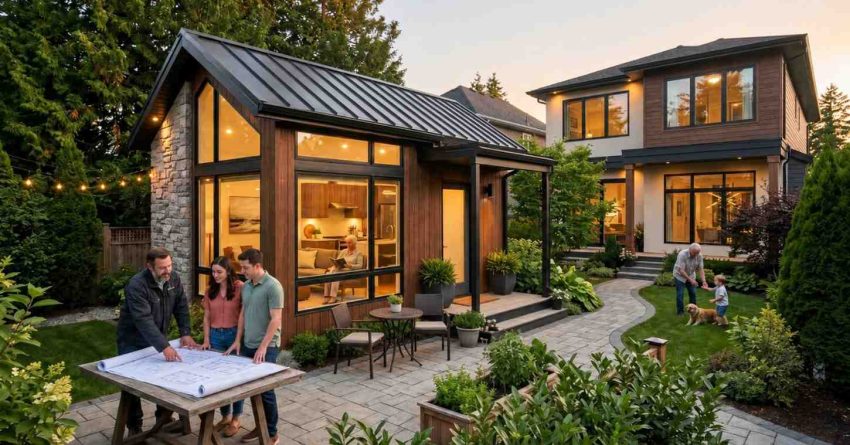
A detached ADU is a completely separate structure with its own foundation, roof, and exterior walls. It offers maximum privacy for both tenants and homeowners, and it is the most versatile ADU type in terms of size range, design flexibility, and site placement. Detached ADUs are also typically the most expensive to build, with costs ranging from $150,000 to $400,000+ depending on size, site conditions, and local labor markets.
The detached configuration is preferred for rental income optimization because it provides complete acoustic and visual separation between the primary home and the ADU, which typically commands a higher market rent and attracts more stable long-term tenants.
Attached ADU and Junior ADU (JADU)
An attached ADU shares at least one wall with the primary residence but functions as a fully independent unit with its own exterior entrance. Because shared walls reduce structural and exterior material requirements, attached ADUs typically cost 10-20% less than equivalent detached builds.
A Junior ADU (JADU) is a distinct regulatory category established under California AB 68 and adopted in modified forms by several other states. A JADU is created within the existing footprint of the primary home, commonly by converting a ground-floor bedroom or den, and is typically capped at 500 square feet. Some jurisdictions allow JADUs to share bathroom facilities with the primary dwelling, and JADUs generally face lower permit fees and faster approval timelines than standard ADUs.
Garage Conversion ADU, Basement ADU and Above-Garage ADU
Conversion ADUs leverage existing structure, significantly reducing foundation, framing, and exterior costs compared to new-build options.
A garage conversion ADU repurposes an attached or detached garage into legal habitable living space. Total project costs typically range from $80,000 to $180,000, making it the most cost-effective ADU path for most U.S. homeowners.
A basement ADU converts existing below-grade space into a legal dwelling unit. This approach requires attention to egress window compliance (minimum 5.7 square feet of clear opening per IRC requirements), waterproofing system upgrades, minimum ceiling height compliance (7 feet in most jurisdictions), and a dedicated HVAC solution.
An above-garage ADU constructs new living space on top of an existing garage structure, requiring a structural engineering assessment of the garage’s load-bearing capacity before design work begins.
Because the structural requirements, zoning approvals, construction costs, and rental income potential differ significantly depending on whether you build detached, attached, or convert an existing structure, our detailed detached vs attached ADU comparison breaks down every key difference across cost, privacy, permitting pathways, and long-term rental income potential.
ADU Zoning Laws, Setbacks and Legal Requirements
ADU zoning in the United States underwent substantial reform between 2017 and 2023. State-level preemption laws in California (SB 9, AB 68), Oregon (HB 2001), Washington, Maine, and Connecticut overrode local ordinances that had effectively banned ADUs in single-family residential zones. As of 2025, the majority of U.S. states have taken some form of legislative action to streamline ADU permitting, but local rules still vary significantly by county and municipality.
How to Check Whether Your Lot Allows an ADU
The fastest way to confirm ADU eligibility is to use your local planning department’s online zoning portal or contact the planning desk directly with your parcel address. You need your parcel’s zoning designation, lot size, and any applicable overlay districts to make this determination.
Most jurisdictions permitting ADUs require a minimum lot size of 4,000-6,000 square feet for a detached build, though several states have eliminated minimum lot size requirements entirely as part of broader housing reforms.
Setbacks, Height Limits and Parking Requirements
ADU setback requirements define how far the structure must be positioned from property lines. Typical rear setback requirements range from 4 to 5 feet, with side setbacks of 4 to 6 feet. California’s AB 68 established a maximum 4-foot setback requirement for ADUs under 800 square feet in most circumstances, a rule that many other states have subsequently referenced in their own ADU legislation.
Height limits for detached ADUs typically fall between 16 and 25 feet to the roof peak. Parking requirements have been substantially reduced in most progressive ADU states, with California and Oregon eliminating replacement parking requirements for ADUs located near established transit corridors.
ADU permit applications trigger inspections and code compliance reviews covering electrical, plumbing, energy efficiency, and egress requirements, and our complete guide to remodeling permits and code compliance explains how these regulatory systems work together at every construction phase, including what to expect at each mandatory inspection.
HOA Restrictions and Owner-Occupancy Rules
Homeowners associations retain limited authority to regulate ADU aesthetics but cannot outright prohibit ADU construction in states that have passed preemption legislation. Verify your specific state’s HOA preemption provisions before relying on this protection.
Owner-occupancy requirements, which previously required the property owner to live on-site to legally rent an ADU, have been eliminated in California and several other states as of 2025, opening ADU ownership to non-resident landlords and real estate investors in those jurisdictions.
Because ADU regulations vary so dramatically across states, counties, and municipalities, our master reference on ADU zoning laws by state compiles lot size minimums, setback requirements, height limits, owner-occupancy rules, and parking mandates for all 50 states, giving you a reliable research baseline before contacting your local planning department.
Designing Your ADU: Floor Plans, Layouts and Exterior Aesthetics
Good ADU design is fundamentally a constraint-solving exercise. You are working within tight square footage, setback limits, and budget boundaries while creating a space that functions well, feels livable, and fits the visual character of the primary home. The most successful ADU designs prioritize efficient layouts, natural light, built-in storage, and clear separation of the tenant’s entrance from the homeowner’s primary entry.
Studio, One-Bedroom and Two-Bedroom ADU Layouts
ADU floor plans typically fall into three size categories based on common zoning limits and practical construction economics:
Under 600 square feet: Studio or compact one-bedroom configurations. Optimal for rental income maximization in high-cost markets where smaller units command strong rents relative to construction cost.
600-800 square feet: Full one-bedroom with a dedicated living area. This range delivers the strongest balance between construction cost and livability for most U.S. rental markets.
800-1,200 square feet: One-bedroom with a den, or a full two-bedroom layout. Best suited for long-term family occupancy or premium rental markets where larger units are actively sought.
Open floor plans work well at the lower square footage ranges by combining kitchen, dining, and living zones into a shared area that maximizes perceived space. Closed bedroom configurations are preferred for units intended for multi-occupant tenancies or when acoustic separation is a tenant requirement.
Privacy, Storage and Accessibility in ADU Design
Privacy from the main home should be a design priority from day one of the planning process. Effective strategies include placing the ADU entrance on a different side of the property, using strategic landscaping as visual screening, and orienting windows away from the primary home’s main living areas.
Built-in storage, including under-stair closets, loft storage, and integrated cabinetry along walls, is essential in units under 600 square feet. Designing for accessibility from the outset, with no-step entries, 36-inch clear door widths, and blocking in walls for future grab bar installation, adds minimal cost to a new build but prevents expensive retrofitting later as the unit ages.
From compact studio configurations that maximize rentable square footage to flexible two-bedroom designs built for long-term family occupancy, our resource on ADU floor plans and layouts presents proven designs across every size range, with practical guidance on privacy separation from the main home, built-in storage strategies, and accessibility-first planning principles.
ADU Construction Methods: Stick-Built, Modular, Prefab and Conversions
How you build your ADU determines your project cost, construction timeline, quality consistency, and design flexibility. Five primary construction methods are used for ADUs in the U.S., and each carries meaningful trade-offs worth evaluating carefully before you commit to a path.
Stick-Built vs Prefab ADU: Key Trade-Offs
Stick-built (site-built) ADUs are constructed entirely on-site using conventional wood framing methods. They offer maximum design flexibility, can accommodate irregular lots and difficult site conditions, and allow customization at every phase of the build. The trade-off is labor intensity and construction timeline: stick-built ADUs typically require 6-12 months from permit issuance through final inspection.
Prefab, modular, and panelized ADUs are manufactured or substantially assembled off-site and then installed on your property. They typically reduce on-site construction time by 30-40% and deliver more predictable cost outcomes than conventional framing because factory production eliminates many of the weather delays and subcontractor scheduling challenges that affect site-built projects. According to reporting from Dwell on prefab ADU manufacturers, companies like Abodu, Cover, and Mighty Buildings have expanded the accessible market for factory-built ADUs significantly, though local permitting acceptance of prefab units still varies.
SIPs (Structural Insulated Panels) combine structural performance and insulation in a single panel system, offering superior energy efficiency and faster framing timelines than conventional lumber framing. SIPs are a strong option for all-electric ADU builds in climate-sensitive markets.
Garage-to-ADU and Basement-to-ADU Conversions
Conversion projects are typically the most cost-effective ADU path because they leverage an existing structure, foundation, and often an existing roof, eliminating the most expensive components of new construction. A garage conversion ADU can be completed for $80,000-$180,000 in most U.S. markets, compared to $150,000-$400,000+ for a comparable new detached build.
For a complete, phase-by-phase walkthrough of every step involved in converting an existing garage into a legal, fully habitable ADU, including structural requirements, insulation upgrades to current energy codes, egress window compliance, HVAC solutions, and permit sequencing by jurisdiction type, our garage-to-ADU conversion guide covers the entire process in actionable detail.
Basement ADU conversions require egress window installation meeting IRC minimums (5.7 square feet of clear opening), waterproofing system upgrades if the existing basement has any moisture history, dedicated HVAC zoning independent from the primary home’s system, and a minimum 7-foot ceiling height in all habitable areas. Ceiling height deficiencies are the most common reason basement ADU projects require structural modifications.
To determine which construction approach best matches your lot conditions, budget, local permitting environment, and timeline requirements, our resource on stick-built vs prefab ADU methods compares every major construction system side by side, from conventional site framing and SIPs panels to factory-built modular units and panelized systems, with real cost and timeline data for each approach.
Utilities and Systems: HVAC, Electrical, Plumbing and Meters
Utility infrastructure is the technical backbone of any ADU project and consistently the area where first-time ADU builders encounter the most unexpected costs. Decisions about separate metering, HVAC system type, water and sewer connections, and electrical service capacity must be made and priced during the design phase. Retrofitting these systems after construction has started is substantially more expensive and disruptive than planning for them upfront.
Separate vs Shared Utility Meters
Whether your ADU requires a separate electrical meter depends on local utility rules and whether you plan to bill tenants independently for utilities. A separate meter simplifies billing and eliminates landlord-tenant disputes over shared utility costs, but it adds $3,000-$8,000 in project costs, including the utility company’s connection and meter socket fees plus internal subpanel work.
Separate water meters are less commonly installed due to higher cost and utility approval complexity. Most ADU owners opt for shared water service with internal sub-metering installed to track usage for billing purposes.
HVAC, Water, Sewer and Electrical for Your ADU
Mini-split heat pumps are the overwhelmingly dominant HVAC solution for ADUs. A single-zone mini-split delivers effective heating and cooling for a studio or one-bedroom ADU at an installed cost of $3,000-$6,000, and it is fully compatible with all-electric building configurations increasingly required by local energy codes in 2025.
Water and sewer connections for detached ADUs require a dedicated plumbing permit and, in many jurisdictions, a capacity fee paid to the local sewer and water authority. These fees range from $5,000 to $30,000+ in high-demand urban markets and represent one of the most consistently underestimated line items in ADU project budgets.
Electrical service upgrades are commonly required when adding a new all-electric ADU with a heat pump, modern appliances, and an EV charging circuit. Upgrading a main panel from 100A to 200A typically costs $2,500-$6,000 and should be confirmed with your local utility before finalizing your project budget.
The decisions you make about electrical service capacity, water and sewer connection type, HVAC configuration, and utility metering structure during the design phase have long-term cost and liability consequences, which is why our ADU utilities and systems guide walks through every critical infrastructure decision, from shared versus separate meter arrangements to all-electric ADU configurations and mini-split sizing guidelines.
How Much Does an ADU Cost to Build in 2025?
ADU construction costs vary more than almost any other residential project type because they depend on your local market’s labor rates, the type of ADU being built, site-specific conditions, and the finish level you select. Reliable cost benchmarks can frame an initial budget, but a detailed estimate from a licensed ADU contractor with experience in your specific jurisdiction is essential before committing to a project scope or applying for financing.
ADU Cost Ranges by Type
| ADU Type | Typical Cost Range (2025) | Primary Cost Drivers |
| New Detached ADU (400-800 sq ft) | $150,000-$300,000 | Foundation, full MEP, exterior finishes |
| New Detached ADU (800-1,200 sq ft) | $250,000-$450,000 | Size, site work complexity, finish level |
| Attached ADU | $100,000-$250,000 | Shared wall reduces some structural costs |
| Garage Conversion ADU | $80,000-$180,000 | Leverages existing structure and foundation |
| Basement Conversion ADU | $100,000-$200,000 | Waterproofing, egress, HVAC, ceiling height |
| Prefab or Modular ADU (installed) | $100,000-$250,000 | Delivery, crane, site prep, utility tie-in |
Cost per square foot benchmarks range from $300-$500 per square foot in moderate-cost markets to $500-$800 per square foot in high-cost metros including San Francisco, Seattle, Boston, and New York City.
For homeowners who want to understand how ADU project budgets fit within the broader principles of construction cost management, including how hard costs, soft costs, contingency reserves, draw schedules, and lien waivers work in practice, our complete guide to remodeling budgets and financing covers every financial decision framework applicable to any residential construction project.
Soft Costs, Permits and Hidden Expenses
Soft costs, which include design fees, structural engineering, permit fees, utility connection fees, and survey costs, typically add $15,000-$50,000 to an ADU project. These costs are consistently underestimated by first-time builders. Key soft cost line items include:
- Architectural design or ADU design firm fees: $5,000-$20,000
- Structural engineering (if required): $2,000-$6,000
- Building, electrical, plumbing, and mechanical permit fees: $3,000-$15,000
- Utility connection fees (sewer, water, electrical): $5,000-$30,000+
- Boundary survey and soil testing: $1,500-$5,000
Budget a minimum 15-20% contingency on top of your base construction estimate to cover unforeseen site conditions, design changes during construction, and material cost escalation.
For a thorough, line-by-line analysis of every cost component, from site work and foundation through framing, MEP systems, permit fees, and finishes, our dedicated ADU construction cost breakdown provides current figures for all major ADU types, including detached new builds, garage conversions, basement conversions, and prefab installations, with soft cost benchmarks and contingency guidance for 2025.
How to Finance an ADU: HELOC, Construction Loans and More
Most U.S. homeowners fund ADU construction through one of four primary mechanisms: a Home Equity Line of Credit (HELOC), a cash-out refinance, a construction-to-permanent loan, or a renovation mortgage such as the Fannie Mae HomeStyle or FHA 203k. State and municipal grant programs have also expanded significantly since 2022 and now represent a meaningful funding source in many markets.
HELOC, Construction Loans and Renovation Mortgages
A HELOC is the most commonly used ADU financing tool because it offers flexible draw-down access against existing home equity with relatively low origination costs. To qualify, most lenders require at least 20% equity in the primary residence and a debt-to-income ratio below 43%. HELOCs carry variable interest rates, which introduces borrowing cost risk over a multi-year project timeline.
A Fannie Mae HomeStyle or FHA 203k renovation mortgage wraps ADU construction costs into a new first mortgage, enabling homeowners with limited existing equity to finance a build. These products are more complex to originate and require lender approval of the project scope, but they allow financing when HELOC equity is insufficient.
A construction-to-permanent loan funds the build phase with interest-only draws and converts to a standard amortizing mortgage at project completion. This structure is most commonly used for larger detached ADU builds where total project costs exceed available home equity.
ADU Grants, Rebates and State Programs
ADU-specific grant and loan programs have expanded substantially since the passage of the Inflation Reduction Act and multiple state housing affordability initiatives launched between 2022 and 2024. California’s CalHFA ADU Grant Program has provided up to $40,000 in pre-development cost assistance for eligible lower-income homeowners. Oregon’s ADU Loan Program offers below-market-rate construction financing. Vermont, Connecticut, and several California municipalities have introduced pre-approved ADU plan sets paired with expedited permit review to reduce both soft costs and timeline.
Because eligible homeowners in a growing number of states can access substantial grants and below-market construction loans specifically for ADU projects, our resource on ADU grants and rebates by state [/adu-grants-rebates-by-state] documents available programs, eligibility requirements, application timelines, and maximum award amounts across all jurisdictions currently running active ADU funding initiatives.
From understanding HELOC qualification requirements and construction loan draw structures to evaluating renovation mortgages, state grant programs, and ADU-specific lending products, our complete guide to ADU financing options explained walks through every funding path available to U.S. homeowners, with practical guidance on costs of borrowing, qualification criteria, and choosing the right financing structure for your specific project timeline.
ADU ROI, Rental Income and Long-Term Investment Value
An ADU is one of the few home improvement projects that generates ongoing cash flow in addition to a one-time property value increase at resale. Understanding the complete return on investment picture, including rental income potential, appraised value uplift, tax treatment, and long-term cash flow modeling, is essential before committing to an ADU project.
Rental Income Potential and Cash Flow
Rental income from an ADU varies significantly by location. In high-cost coastal metro areas, a well-designed one-bedroom ADU generates $2,000-$3,500 per month in long-term rental income. In secondary and tertiary markets, the typical range is $800-$1,800 per month. According to Freddie Mac’s 2024 analysis of ADU rental markets, ADU properties consistently command a rental premium over comparable non-ADU properties across virtually every U.S. market included in the study.
Most ADU projects in appreciating markets reach construction cost break-even through rental income alone within 8-15 years, before factoring in property value appreciation. That timeline shortens substantially in high-rent coastal cities and lengthens in slower-appreciating secondary markets.
Short-Term Rental Use and Property Value Impact
Short-term rental (STR) income through Airbnb or VRBO can run 1.5-3x higher per month than comparable long-term rental rates in tourist-intensive markets, but local STR ordinances are tightening rapidly. Many cities now require active STR permits, owner-occupancy for hosting, annual license renewals, and noise compliance systems. Verify your local STR regulatory environment thoroughly before designing an ADU with short-term rental income as the primary financial model.
On the property value side, a well-built ADU typically adds appraised value equal to approximately 50-70% of its construction cost in most U.S. markets. In high-demand urban markets, ADU value premiums have been documented to approach or exceed construction cost recovery on a per-square-foot basis.
To evaluate whether an ADU makes sound financial sense for your specific property and local market, including how to model rental income, estimate property value uplift, calculate payback period, and project 10-year cash flow, our ADU return on investment analysis covers all of these dimensions alongside the tax implications, depreciation strategy, and short-term rental income realities specific to ADU ownership.
The ADU Construction Process: Pre-Construction, Permits and Timeline
Building an ADU follows a defined sequence of phases. Understanding this sequence helps homeowners set realistic expectations, avoid costly decision bottlenecks, and protect their budgets from the delays that most commonly derail first-time ADU projects.
Pre-Construction Steps for an ADU
Pre-construction is the phase most inexperienced ADU builders underestimate in terms of both time and cost. Before any site work or construction begins, these steps must be completed in sequence:
- Zoning eligibility and setback feasibility confirmation
- Boundary survey and existing condition site documentation
- Soil testing (required by most jurisdictions for new foundation footings)
- ADU design development and architectural drawing preparation
- Structural engineering (required by most building departments for new detached ADUs)
- Permit application submission with complete drawing sets
- Utility pre-applications for water, sewer, and electrical connections
- Contractor bid process and selection
This pre-construction phase typically requires 3-8 months in jurisdictions with standard permit review timelines. In high-demand urban markets such as Los Angeles, Seattle, or San Francisco, plan review and permit issuance for new detached ADUs can take 6-12 months or longer.
ADU Permit Process and Realistic Construction Timeline
Most ADU projects require, at minimum, a building permit plus separate electrical, plumbing, and mechanical permits. Some jurisdictions additionally require a grading permit, demolition permit (for garage conversions), urban forestry review when existing trees are near the building envelope, or a special design review for ADUs in historic districts.
Typical construction timelines by ADU type following permit issuance:
- Garage or basement conversion: 3-5 months of active construction
- Prefab ADU installation: 3-6 months including site preparation
- Stick-built detached ADU: 6-12 months depending on size and complexity
Every ADU project moves through a predictable construction sequence, but the specific permit approval windows, inspection milestones, and trade sequencing decisions vary significantly by jurisdiction type and ADU configuration, which is why our resource on the ADU build process and timeline maps every phase from pre-construction through final occupancy, including realistic permit wait times across different jurisdiction types.
Hiring an ADU Specialist Contractor: What to Look For
The contractor you hire is likely the single most consequential decision in your entire ADU project. ADU construction sits at the intersection of residential building, zoning code compliance, utility coordination, and permit management. These skills are not uniformly distributed among general contractors, and the absence of ADU-specific experience regularly produces cost overruns, timeline failures, and permit complications.
ADU Specialist vs General Contractor: Key Differences
An ADU specialist or ADU design-build firm differs from a standard general contractor in several practically important ways:
- They maintain active working relationships with local planning departments and understand each jurisdiction’s plan review preferences and common comment patterns
- They employ or have established subcontractor relationships with tradespeople experienced in ADU-specific work, including small-footprint foundations, mini-split installations, and utility tie-in coordination
- They offer integrated packages bundling design, permit management, and construction under a single contract, eliminating the coordination gaps that frequently add cost and time to multi-party ADU projects
- They understand the utility pre-application process, which is the most common source of schedule delays and budget surprises in ADU projects
When evaluating any ADU contractor, verify their state contractor’s license with your state licensing board, review their ADU project portfolio specifically within your jurisdiction (not just general residential construction), request references from at least three completed ADU owners who used the same contractor in a comparable project, and confirm active general liability coverage and workers’ compensation insurance before any work begins.
ADU design-build firms typically charge 8-15% higher base prices than general contractors working from owner-provided plans, but they frequently deliver faster permit approval timelines, fewer budget surprises, and a more coherent project management experience. For a first-time ADU builder, that premium commonly pays for itself.
Red flags in ADU contractor bids include inability to provide ADU-specific local references, quotes significantly below the market range without detailed scope explanations, requests for more than 25-30% deposit upfront before permit approval, and unfamiliarity with your specific jurisdiction’s ADU requirements or inspection process.
Not all general contractors have the ADU-specific experience needed to navigate local zoning requirements, coordinate utility tie-ins, manage permit applications efficiently, and deliver the tight construction tolerances required in small-footprint builds, which is why our guide to hiring an ADU specialist explains exactly what credentials to verify, which questions to ask during the bid process, and what distinguishes a qualified ADU design-build firm from a standard general contractor.
Common ADU Mistakes, Case Studies and FAQs
Even well-planned ADU projects can go significantly off course when critical planning steps are skipped, costs are underestimated, or the wrong contractor is selected. The most consequential ADU mistakes share a consistent pattern: they are made early in the project and become progressively more expensive to correct as construction advances.
Ten ADU Build Mistakes That Blow Budgets and Timelines
The most common and costly ADU construction mistakes include:
- Beginning design before confirming zoning eligibility and setback compliance on the actual parcel
- Underestimating soft costs, particularly utility connection fees and permit fees, which regularly add $15,000-$50,000 to project budgets
- Skipping utility pre-application cost estimates before finalizing the project budget
- Selecting a prefab ADU product without confirming crane access viability and foundation compatibility on the actual site
- Omitting a soil test before designing detached ADU foundation systems
- Failing to verify HOA restrictions before project initiation
- Designing the ADU without prioritizing acoustic and visual privacy from the primary residence
- Ignoring current energy code compliance requirements, which are increasingly enforced across jurisdictions in 2025
- Over-specifying finishes beyond what the local rental market supports in comparable rents
- Failing to document the project thoroughly for future resale appraisal and title insurance purposes
Real project outcomes illustrate both failure modes and success paths. A 640-square-foot detached ADU in Sacramento began with an $185,000 construction budget and reached $265,000 after unexpected sewer capacity fees, soil bearing failures requiring redesigned footings, and energy code compliance upgrades the owner had not modeled. By contrast, a garage conversion in Portland that began with a permit pre-consultation meeting and a phased design process came in $12,000 under its revised budget and was fully rented within 30 days of receiving a Certificate of Occupancy.
Whether you need to understand the ten most consequential ADU build mistakes that derail budgets and timelines, or want answers to the sixty most frequently asked questions before starting your project, our comprehensive ADU mistakes and common questions resource covers everything from unpermitted work risks and energy code compliance to over-improving for the local rental market and documenting your ADU for future resale appraisal.
Conclusion
Granny flats and ADUs combine rental income, multi-generational flexibility, and long-term property appreciation, making them one of the most impactful investments available to U.S. homeowners.
Every ADU dimension covered in this guide, from zoning and design to financing and contractor selection, links to a dedicated deeper resource in our knowledge hub.
Contact Mr. Local Services today to connect with qualified ADU specialists who can guide your project from initial feasibility through final inspection and occupancy.
Frequently Asked Questions
How much does it cost to build a granny flat or ADU in the USA in 2025?
ADU construction costs range from $80,000 for a basic garage conversion to over $400,000 for a large new detached build. In most markets, expect $300-$500 per square foot for standard construction, and $500-$800 per square foot in high-cost metros.
Do I need a permit to build an ADU on my property?
Yes, virtually all ADU construction requires a building permit plus separate electrical, plumbing, and mechanical permits. Building without permits creates serious legal and financial liability and typically prevents legal rental of the unit.
How long does it take to build an ADU from start to finish?
A garage conversion takes 8-14 months total, including pre-construction and permit review. A stick-built detached ADU averages 12-18 months. Prefab ADUs reduce on-site construction time but still require several months of pre-construction planning and permit approval.
Can I rent out my ADU as soon as construction is complete?
You can legally rent your ADU once the local building department issues a Certificate of Occupancy. Some jurisdictions also require a separate rental license or landlord registration before you can legally accept tenants.
Will building an ADU increase my property taxes?
In most states, an ADU triggers a partial reassessment covering only the newly added square footage, not the entire property. California’s Proposition 13 protections mean only the ADU’s assessed value is added to your tax base, leaving the existing home’s valuation unchanged.
What is a JADU and how does it differ from a standard ADU?
A Junior ADU (JADU) is a unit created within the existing footprint of the primary home, typically capped at 500 square feet. Unlike a standard ADU, a JADU may share bathroom facilities with the primary dwelling in some jurisdictions and generally faces lower permit fees and faster approval timelines.
Can my HOA legally prevent me from building an ADU?
In states with ADU preemption legislation, including California, Oregon, and Washington, HOAs cannot outright ban ADU construction. However, they retain authority to regulate exterior aesthetics, require design review approval, and enforce existing CC&R provisions related to building appearance and landscaping character.