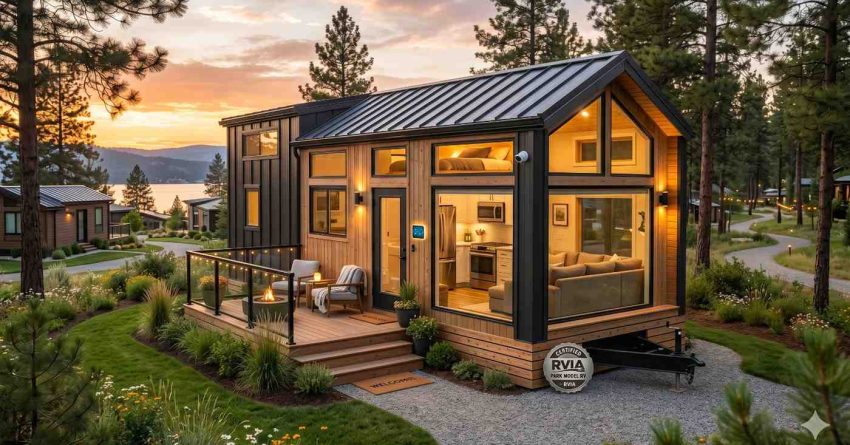
Park model homes are RVIA-certified factory-built recreational dwellings capped at 400 square feet, occupying a unique niche between RVs and manufactured housing. They deliver residential-quality living at a fraction of conventional housing cost, without the mobility commitment of a tiny home on wheels.
Affordable housing pressure, remote work trends, and the tiny living movement have together driven park model demand to all-time highs; buyers who overlook this category often overpay for lesser alternatives.
This guide covers everything you need to know: what park models are, RVIA certification standards, 2025 costs, legal status by state, financing pathways, use cases, top communities, and leading builders.
What Is a Park Model Home?
A park model home is a factory-built recreational dwelling designed for extended or permanent placement at a resort, campground, or private property. Most states title them as park model recreational vehicles (PMRV), placing them legally closer to RVs than to manufactured homes. That classification affects financing, insurance, zoning, and the communities where you can legally place your unit.
Legal Definition and the 400 Square Foot Limit
The 400 square foot maximum for primary floor area is the boundary established by the RVIA to distinguish park models from manufactured homes regulated under federal HUD code. This threshold is not arbitrary. It shapes which construction standard governs the unit, which financing products apply, and which zoning categories accept it.
Many buyers discover that the 400 sqft limit is more generous in practice than on paper. Slide-outs, lofts, covered porches, and add-a-room annexes can expand total livable space well beyond the primary floor measurement while keeping the unit within its RVIA classification. Understanding this distinction before shopping prevents significant confusion during the selection process.
How Park Models Differ From RVs
The RVIA label covers both travel trailers and park models, but the two categories serve entirely different purposes. A park model uses residential-grade construction materials: real wood cabinetry, full-size appliances, residential plumbing fixtures, and proper insulation systems designed for year-round comfort. None of these are standard in typical RVs, which are engineered for mobility and short-term occupancy rather than permanent habitation.
A park model home occupies a legally distinct category between an RV and a manufactured home, and our complete park model home definition guide covers the full legal classification, the RVIA titling process, and exactly what separates a park model from every other tiny living option on the market.
RVIA Certification and ANSI A119.5 Standards
RVIA certification is the foundational quality credential for park models sold in the United States. It tells buyers, lenders, insurers, and community managers that the unit was constructed under a recognized industry standard and inspected by a third-party authority before leaving the factory. The presence or absence of this certification affects nearly every downstream decision in the ownership lifecycle.
What RVIA Certification Means
RVIA member manufacturers participate in a factory inspection program operated by the RVIA or its authorized inspection agencies. These inspectors conduct scheduled and unannounced visits to verify that each unit in production meets the applicable construction standard before receiving the RVIA certification seal. The seal is typically displayed inside the unit near the entry. A missing, unverifiable, or removed seal is a red flag on any used park model that warrants immediate investigation.
RVIA certification is not a permanent lifetime status for a building. If a unit is substantially modified after delivery without proper oversight, its certification status can become questionable. Buyers of used park models should request documentation confirming original certification and note any post-delivery modifications that may affect it.
ANSI A119.5: What It Covers
The ANSI A119.5 standard is the specific construction code every RVIA-certified park model must satisfy, and understanding ANSI A119.5 for park models helps buyers verify that any unit they are considering was inspected and built to code before finalizing a purchase decision. This standard addresses structural requirements for the chassis and floor system, electrical service capacity and wiring methods, plumbing materials and operating pressure standards, HVAC system sizing and installation, and fire safety features including egress windows, smoke detectors, and flame-spread materials.
Why Certification Matters for Buyers
Park model communities and RV resorts overwhelmingly require RVIA certification as a condition of placement. Lenders who offer RV and chattel loan products for park models typically require certification documentation before approving financing. Property and casualty insurers who write park model coverage almost always base their rates and eligibility on certification status. In the resale market, certified units consistently command higher prices than uncertified alternatives.
RVIA certification is the defining quality and legal credential that separates a certified park model from an uncertified recreational structure, and our RVIA certification for park models page walks through every standard covered, the factory inspection process, and why this credential directly affects financing eligibility, insurance rates, and community placement rights.
Park Model vs. THOW, RV, and Manufactured Home
The park model market sits at the intersection of several distinct housing and recreational vehicle categories. Mapping out these differences clearly prevents buyers from purchasing the wrong solution for their lifestyle and then facing zoning, financing, or resale complications that could have been avoided with better upfront research.
Park Model vs. Tiny Home on Wheels
A tiny home on wheels (THOW) is built on a standard gooseneck or bumper-pull trailer, designed to be towed by a personal vehicle, and certified under RVIA, ANSI A119.5, or NOAH standards. Park models are also built on a chassis, but they are significantly larger, heavier, and require specialized transport trucks for delivery rather than personal towing.
If your lifestyle requires regular mobility, following seasonal employment, or exploring different locations year to year, a THOW gives you operational flexibility that a park model structurally cannot match. If you want a fixed destination lifestyle with residential-quality finishes, a larger floor plan, and better climate performance, the park model wins on virtually every livability dimension.
Choosing between a towable tiny home, a standard RV, and a park model requires comparing size, mobility, legal classification, financing, and total cost of ownership side by side, and our detailed THOW vs park model vs RV comparison covers every dimension of that decision in full depth.
Park Model vs. Manufactured Home
A manufactured home built under HUD code can exceed 400 square feet, is eligible for conventional-style mortgage products when titled as real property, and is treated much more like a traditional residence in residential zoning. Park models are classified as recreational vehicles, which creates distinct advantages (simpler placement in resort communities, faster transaction timelines) alongside real constraints (limited financing options, restricted use in residential zones).
The practical difference for most buyers comes down to their goals. If permanent land ownership, traditional mortgage access, and residential zoning are priorities, the manufactured home path makes more sense. If cost efficiency, resort community living, or seasonal flexibility are the priorities, the park model typically wins.
Park Model vs. Standard RV
The most common misconception in this category is treating park models as large RVs. In construction quality, interior finish, insulation performance, and long-term livability, a park model is fundamentally different from a Class A motorhome or fifth-wheel trailer sold at the same price point. Park models are designed to be lived in year-round; most RVs are designed for recreational use measured in days or weeks.
If you are deciding which tiny living structure best fits your lifestyle and budget, our dedicated park model vs tiny home comparison breaks down the differences in construction standards, mobility, zoning eligibility, financing pathways, and long-term total cost of ownership so you can make a fully informed, confident choice.
Park Model Design and Floor Plans
Factory designers have refined park model layout engineering into a sophisticated discipline, maximizing livability within the 400 sqft primary floor area constraint. The result is a range of floor plans that feel noticeably larger and more functional than the square footage measurement suggests.
Single-Level, Loft, and Slide-Out Configurations
Single-level plans keep all living functions on one floor, maximizing accessibility and simplifying the layout for aging-in-place use, mobility considerations, or buyers who prefer open-concept design without vertical space demands.
Loft configurations use the vertical space above the main living area for a sleeping or storage loft, accessed by a staircase, ladder, or compact spiral staircase. This approach effectively adds a second usable zone without adding primary floor area. The best loft designs in today’s market incorporate proper guardrails, adequate ceiling clearance for seated comfort, and built-in storage integrated into the staircase.
Slide-out configurations use one or more rooms on a wheeled mechanism that retracts for transport and extends fully when parked. A well-designed slide-out can add 40 to 80 square feet of usable floor area to a living room, dining area, or bedroom, producing a noticeably more spacious experience than the primary floor measurement alone suggests.
Interior Design and Finish Tiers
The quality gap between entry-level and premium park models is significant. Base packages from volume manufacturers typically include laminate countertops, vinyl flooring, and builder-grade cabinetry. Mid-tier and premium builds offer quartz or solid surface countertops, LVP or engineered hardwood flooring, solid wood cabinetry, stainless appliance packages, and upgraded lighting fixtures that produce an interior that rivals mid-range site-built construction.
Buyers should visit model units in person before ordering, because the photography on manufacturer websites consistently makes base-tier units appear better than they look in person. Requesting detailed specification sheets that list material grades by line item is a sound practice before comparing quotes.
Loft configurations are one of the most effective ways to add sleeping capacity without increasing the primary floor area measurement, and our park model loft design guide covers ceiling height minimums, stair vs. ladder vs. spiral access options, structural weight limits, and the best loft layouts from today’s leading RVIA-certified manufacturers.
Every square foot matters when designing within the RVIA 400 sqft limit, and our park model floor plans under 400 sqft guide showcases the most efficient layouts currently available, from single-level open-concept plans and sleeping loft configurations to full-width designs with slide-outs that significantly expand usable living area.
Park Model Cost in 2025
Park model prices stabilized somewhat in 2024 after the post-pandemic cost surge, but material and labor costs remain elevated compared to pre-2022 levels. Understanding the complete cost picture, including all acquisition and setup costs, is essential for accurate budgeting.
Unit Price Ranges by Tier
Entry-level park models from volume manufacturers with standard finishes typically range from $45,000 to $75,000. Mid-range units with upgraded interiors, premium siding choices, or slide-out configurations generally run $75,000 to $130,000. Luxury builds from boutique manufacturers, featuring custom cabinetry, premium countertops, upgraded appliance packages, and high-performance insulation systems, commonly reach $150,000 to $200,000 or more.
These figures reflect the factory unit price only. Delivery, site preparation, utility connections, skirting, and add-on structures are separate costs that most buyers encounter unexpectedly if they plan only around the unit price.
The Complete Acquisition Cost Picture
Delivery and transport for a park model averages $2 to $5 per loaded mile from factory to site, with oversize load permits adding cost for long-distance deliveries across state lines. Site preparation costs, including pad installation, grading, and utility hookup, typically run $3,000 to $15,000 depending on site conditions. Skirting installation and exterior decking or porch structures are additional costs that meaningfully affect the final installed cost.
First-time buyers routinely underestimate total acquisition and ongoing costs, and our hidden park model ownership costs breakdown covers delivery fees, site preparation, utility hookup, skirting, lot rent, insurance premiums, and annual maintenance reserves that every buyer should build into their budget before signing a purchase agreement.
Prices vary significantly based on manufacturer, floor plan, finish package, slide-out configuration, and delivery distance, and our complete park model cost guide for 2025 covers the full spectrum from entry-level base units to luxury custom builds, with a detailed breakdown of the site preparation and delivery costs that extend well beyond the unit sticker price.
Park Model Legal Status and Zoning
Placement legality is the most consequential decision most park model buyers face. Getting it wrong, specifically purchasing a unit and then discovering that your chosen location does not legally permit full-time habitation, is an expensive mistake that can result in forced relocation.
Where Park Models Are Legal Full-Time
Because park models are titled as recreational vehicles in most states, they are typically ineligible for placement as primary residences in standard residential zones. The jurisdictions and land types that most commonly permit full-time park model occupancy include:
RV resorts and campgrounds that allow long-term or full-time occupancy under state-issued recreation or campground licenses. Many resort communities in Arizona, Florida, and Texas have operated as full-time residential communities for decades.
Dedicated park model communities designed and licensed specifically for this use, often featuring long-term lot leases, residential-style infrastructure, and community governance structures.
Rural parcels in counties that do not restrict recreational vehicle habitation on privately owned agricultural or residential acreage, provided applicable setback and utility requirements are met.
The regulatory landscape varies enormously by state, and in many cases varies significantly between counties within the same state. Verifying legality with the county planning or zoning office before purchase is not optional for buyers intending full-time occupancy.
Placement on Private Land
Placing a park model on your own residential property as a primary dwelling or accessory structure typically requires a zoning determination, building permit, and potentially a variance or conditional use permit. Some counties treat this as an ADU application; others have specific recreational vehicle habitation ordinances. Approaching the local planning department with detailed site and unit specifications before purchasing produces the clearest outcome.
Some buyers convert their park model to a permanent foundation to qualify for traditional mortgage financing and gain access to residential zoning classifications, and our permanent foundation conversion guide explains the engineering requirements, permit process, typical costs, and the specific states where this pathway is most viable and legally straightforward.
Full-time residency rules for RVIA-certified recreational vehicles vary enormously by state, county, and jurisdiction type, and our guide to where park models are legal full-time maps the exact rules for every US state, identifies which areas require resort or community placement, and flags the jurisdictions with outright restrictions that buyers must verify before committing to a location.
Park Model Financing Options
Securing the right financing for a park model requires understanding a set of lending products that differ meaningfully from conventional home mortgages. Rates, terms, down payment requirements, and lender availability all reflect the park model’s hybrid classification between a recreational vehicle and a residential structure.
RV Loans
RV loans are the most common financing vehicle for RVIA-certified park models. These loans are underwritten similarly to auto and boat loans, with approval driven primarily by the borrower’s credit profile and income rather than by property appraisal. Rates in 2025 typically run 1 to 3 percentage points above conventional 30-year mortgage rates. Loan terms range from 10 to 20 years, and most lenders require a 10 to 20 percent down payment.
The primary advantage of RV financing is speed. Approval timelines are substantially faster than traditional mortgage underwriting, and lenders do not require the same level of property condition documentation that a real estate transaction demands. For buyers who have identified their unit and community and are ready to move quickly, RV financing often provides the smoothest path to ownership.
Chattel Loans
Chattel loans finance the park model unit as personal property, similar to how manufactured homes on leased land are financed. These products are common for park models placed in resort communities where the buyer owns the unit but leases the lot. Chattel lenders evaluate the unit, the buyer’s credit and income, and the community’s track record when underwriting.
Cash Purchases
A meaningful share of park model transactions are completed in cash, particularly when buyers are using proceeds from a primary home sale or retirement asset liquidation. Cash transactions eliminate financing costs and streamline the transaction timeline considerably.
Financing a park model requires navigating a set of lending products that differ fundamentally from conventional home mortgages, and our comprehensive park model financing options guide covers RV loans, chattel loans, and personal loan products, names the specialized lenders who work most actively in this asset class, and presents current rate expectations and down payment requirements for 2025.
Park Model Use Cases
The park model’s combination of low acquisition cost, residential-quality construction, and semi-permanent placement flexibility makes it one of the most adaptable housing structures in the market. Understanding which use case fits your situation helps you optimize your unit selection, community selection, and financing approach.
Primary Residence
An increasing number of Americans are choosing park models as their permanent, full-time home. In most resort and park model communities, lot rent plus ownership costs run substantially less than apartment rent or mortgage payments in the same metro area. The lifestyle tradeoff, smaller square footage and community-governed rules, suits a significant segment of buyers, particularly retirees, remote workers, and intentional minimalists.
Full-time park model living requires selecting a community with stable, professional management, verifying that your state and county permit full-time occupancy, establishing utilities and services, and planning carefully for domicile registration and mail handling.
Snowbird and Vacation Home Use
Seasonal ownership is the most established use case in the park model market. Buyers who spend winters in Arizona, Florida, or Texas own a dedicated vacation property at a fraction of the cost of a traditional cabin or vacation home, without the maintenance burden of a standalone structure. Resort communities handle landscaping, roads, and common area maintenance as part of the lot rent arrangement.
For seasonal residents who split the year between northern summers and a warmer winter destination, a park model is one of the most cost-effective snowbird strategies available, and our park model snowbird strategy guide walks through the top destination states, highest-rated resort communities, ownership vs. rental economics, and the seasonal logistics of managing a dedicated winter residence.
Guest House and ADU Use
Placing a park model on existing residential property as an accessory structure for family members, guests, or rental income is a growing application that requires careful navigation of local zoning, and our park model as ADU or guest house guide covers setback requirements, utility connection pathways, and which jurisdictions have become most permissive for this use case.
Rental Investment
Park models in tourist-heavy or resort communities can generate meaningful short-term rental income when listed on platforms like Airbnb or VRBO. The combination of low acquisition costs and strong nightly rates in desirable locations produces cash-on-cash return profiles that compare favorably to traditional real estate investments in many markets. A full park model rental investment analysis covers the ROI framework, optimal market selection, platform-specific setup, and the community rule variables that affect short-term rental viability in specific resort markets.
Making a park model your full-time home requires careful planning around community selection, utility hookup, mail forwarding, domicile registration, and insurance coverage, and our park model as primary residence guide walks through every practical and legal step required to make this work sustainably as your permanent dwelling.
Park Model Communities and Placement
Where you place your park model shapes your daily experience as powerfully as the unit you select. The community determines your neighbors, your amenities, your ongoing costs, your governance rules, and ultimately your quality of life in this housing format.
RV Resorts vs. Dedicated Park Model Communities
Some buyers place park models in traditional RV parks that accept long-term guests. Others seek communities built specifically for park model residents. The difference in experience is substantial. Dedicated park model communities typically maintain higher aesthetic standards, restrict transient RV traffic, offer longer lease terms, and foster a more neighborhood-like social environment. For buyers planning extended or full-time occupancy, a purpose-built park model community usually produces a more satisfying long-term living experience than a general RV park.
Lot Rent: The Core Ongoing Cost
In most park model communities, you own your unit outright but lease the land beneath it on a monthly basis. Lot rent covers land use, road and infrastructure maintenance, and access to community amenities. National averages range from $400 to $900 per month for standard resort lots, with premium waterfront or high-amenity locations reaching $1,200 or more. This ongoing cost must be factored into every purchase analysis. It is largely non-negotiable and subject to annual increases specified in the lease agreement.
Lot rent is typically the largest single ongoing cost of park model living and varies from under $300 to over $1,200 per month depending on location, amenities, and lease terms, and our lot rent costs for park models breakdown explains what drives that variance, what is negotiable before signing, and what annual escalation clauses to watch for in long-term agreements.
Top Park Model Destination States
Arizona leads the national market for park model communities, with dense resort corridors around Mesa, Scottsdale, the East Valley, and Yuma hosting hundreds of communities that serve both winter snowbirds and full-time residents.
Florida offers coast-adjacent and inland resort parks across the Gulf Coast, Central Florida, and the Space Coast, with a strong variety of communities at different price points and lifestyle orientations.
Texas has a growing park model market in the Hill Country, along the Gulf Coast from Galveston to South Padre Island, and in the Rio Grande Valley, which has emerged as one of the country’s most affordable snowbird resort destinations.
Selecting the right community shapes your daily living experience as powerfully as selecting the right unit, and our best park model communities directory covers top-rated resorts across Arizona, Florida, Texas, and beyond with details on lot rent ranges, included amenities, HOA governance structures, and seasonal vs. year-round occupancy policies.
Park Model Brands and Builders
The RVIA-certified park model manufacturing sector is concentrated among a relatively small group of manufacturers, most of which operate production facilities in the Midwest and South. Quality, customization flexibility, warranty coverage, and delivery logistics vary significantly across builders, making manufacturer selection one of the most consequential decisions in the buying process.
Leading RVIA-Certified Manufacturers
The major park model manufacturers include well-known names such as Cavco Industries, Chariot Eagle, Athens Park Homes, Forest River’s park model division, and several regional builders that serve specific geographic markets. Each operates across a price spectrum, offering base floor plans with an upgrade menu that covers exterior materials, roofing choices, interior cabinetry, countertops, flooring, appliance packages, and HVAC specifications.
The distinction between standard and upgraded specifications is substantial. Requesting detailed specification sheets that list every material grade by category and comparing them side by side across builders is the most reliable way to make an accurate price comparison.
What to Look for When Selecting a Builder
Beyond unit price, evaluate manufacturers on warranty coverage (workmanship, systems, and structural terms vary widely across the industry), delivery footprint (some builders serve national markets; others focus regionally), production lead times (custom orders from most builders take 3 to 6 months), and dealer network depth (a strong regional dealer network simplifies warranty service and provides knowledgeable local support).
Side-by-side manufacturer comparisons help buyers understand exactly what separates a base-package unit from a premium build across different price tiers, and our park model brand comparison covers standard feature sets, upgrade menu depth, delivery footprint, warranty duration, and owner satisfaction data across the major RVIA-certified manufacturers currently operating in the US market.
Builder selection has an outsized effect on construction quality, customization flexibility, warranty coverage, and post-delivery service experience, and our best park model builders guide for 2025 reviews the leading RVIA-certified manufacturers by price tier, regional delivery capability, and verified owner satisfaction to help you make a confident builder selection.
Climate-Specific Park Model Considerations
A park model’s performance in your target climate depends on specifications made during the ordering process, including insulation package, HVAC system selection, roofing material, window glass specifications, and underbelly construction. Making the right choices at the factory level is significantly less expensive than retrofitting systems after delivery.
Desert Climates: Heat, Sun, and Cooling Load
Park models placed in Arizona, Nevada, New Mexico, or Southern California face extreme summer heat that demands specific equipment choices. Spray foam insulation in the walls, floor cavity, and roof significantly reduces cooling load compared to standard fiberglass batt packages. Variable-speed mini-split HVAC systems handle the wide temperature swings of desert climates more efficiently than single-speed equipment. Reflective metal roofing materials and low-e double-pane window glass are worth specifying at the factory rather than retrofitting. Covered porches and structural shade structures on south and west exposures reduce peak heat gain and extend the usable outdoor season meaningfully.
Desert placement demands specific factory specifications including high-efficiency mini-split systems, reflective roofing materials, low-e window glass, and reinforced underbelly insulation, and our park model desert climate setup guide covers every equipment specification and site orientation decision that keeps energy costs manageable and indoor comfort reliable during extreme heat conditions.
Cold Climates: Snow Load, Insulation, and Heating
Park models placed in northern states or high-altitude communities face snow load, pipe freeze risk, and extended heating season demands. Roof structural rating for local snow load, measured in pounds per square foot, is a non-negotiable specification in mountain or northern markets. Underbelly insulation and heat tape on water supply and drain lines prevent freeze damage during extended below-zero weather events. Propane or natural gas heating systems with appropriate BTU capacity for the square footage and climate zone ensure comfortable temperatures without over-relying on electric resistance heating, which is expensive during long cold snaps.
Coastal and Hurricane Zone Considerations
Park models in coastal communities face salt air corrosion on exterior materials and, in hurricane-prone regions, wind events that require engineered tie-down systems and impact-resistant construction. Hurricane tie-down anchoring to a properly engineered concrete pad is the minimum requirement in high-wind designation zones. Exterior siding, roofing materials, and window specifications should all be reviewed for salt-air corrosion resistance if the placement site is within several miles of the ocean.
If mobility is a priority and you are weighing a park model against a towable tiny home, our sibling resource, the tiny homes on wheels complete guide, covers THOW design principles, certification pathways, towing requirements, full-time legality by state, and the builder landscape in full depth so you can make a genuinely informed comparison between the two options.
Park Model vs. ADU, Prefab, and Other Alternatives
Park models are one of several viable alternatives to conventional housing that have attracted serious attention as affordability pressures have intensified. Understanding how they compare to adjacent options ensures that you are selecting the right solution rather than the most recently marketed one.
Park Model vs. Detached ADU
A site-built accessory dwelling unit offers more design flexibility, potential for long-term real estate value appreciation, and access to traditional mortgage products that most park models cannot access. The tradeoffs are substantial: site-built ADUs typically cost $150,000 to $400,000 depending on location, require full permitting and inspection processes, and take 12 to 24 months from approval to occupancy. A park model in a permissive jurisdiction arrives in weeks at a fraction of the cost.
The choice between a park model and a manufactured home is one of the most common decision points for buyers in the affordable housing market, and our park model vs manufactured home comparison covers the RVIA vs. HUD code distinction, the financing and zoning differences, size range comparisons, and the long-term value considerations that should drive this decision.
Park Model vs. Prefab Modular Home
For buyers whose space requirements or permanence goals extend beyond the 400 sqft park model category, our prefab homes master guide covers the full range of modular, panelized, and kit home options that provide greater square footage, traditional mortgage eligibility, and full residential zoning compatibility on privately owned land.
Choosing the Right Tiny Living Path
The right answer depends on your specific circumstances: how much space you need, whether you own land or will lease, how important mobility is, what your financing situation looks like, and what lifestyle you are optimizing for. Park models are not the right solution for every buyer, but for the buyer who wants residential quality at RV pricing with semi-permanent placement flexibility, they occupy a uniquely advantageous position in the market.
How to Get Started with a Park Model
Most successful park model buyers follow a consistent sequence from research to move-in. The buyers who encounter the fewest problems start with community selection before they select a unit, confirm legal placement status before they order, and work with experienced local dealers rather than navigating the process independently.
The Recommended Sequence
Start by identifying two or three target communities in your desired location and visiting them in person. Walk the lots, speak with current residents, review the lease agreements, and confirm that the community is financially stable and professionally managed. Only after you have validated a community should you begin selecting a unit, because the community will constrain which unit sizes fit the lot, which exterior aesthetic choices are permitted, and which utility systems are required.
Once you have a community, work with a dealer or manufacturer’s representative who has delivered to that community before. An experienced dealer knows the site access requirements, the community manager’s preferences, and the typical timeline from order to delivery for that corridor. This knowledge eliminates many of the surprises that catch buyers working directly with factories off-guard.
Getting accurate, comparable pricing from multiple builders requires sharing specific site conditions, desired floor plan, feature preferences, and delivery distance in a structured format, and our park model quote request guide provides a complete template that ensures you receive apples-to-apples estimates and avoids the estimate surprises that commonly catch first-time buyers off guard.
Working with a dealer who is familiar with the communities and delivery logistics in your target region simplifies every step from site assessment through warranty service, and our park model dealer locator connects you with RVIA-certified dealers across the US who can match your unit selection to your site conditions and community requirements.
Conclusion
Park model homes offer an unmatched combination of affordability, residential quality, and flexibility that conventional housing at the same price point simply cannot match.
Whether planning a full-time residence, a snowbird retreat, or a rental investment, the right park model in the right community delivers exceptional lifestyle value.
At Mr. Local Services, our trusted specialists connect you with top park model dealers and advisors, start your journey with an expert consultation today.
Frequently Asked Questions
What is the difference between a park model and a manufactured home?
A park model is RVIA-certified and capped at 400 square feet under ANSI A119.5 standards. A manufactured home follows HUD code, can be larger, and qualifies for traditional mortgage financing in many scenarios.
Can I live in a park model full-time?
Yes, in communities and jurisdictions that legally permit RVIA recreational vehicles as full-time dwellings. Legality varies by state and county, so always verify local rules before purchasing.
How much does a park model home cost in 2025?
Entry-level units range from $45,000 to $75,000. Mid-range units run $75,000 to $130,000, and luxury custom builds can reach $150,000 or more before site preparation and delivery costs.
How do you finance a park model home?
RV loans are most common, requiring 10-20 percent down over 10-20-year terms. Chattel loans and personal loans are additional options. Traditional mortgages are typically not available unless the unit is placed on a permanent foundation.
Where can I legally place a park model?
Park models are most commonly placed in dedicated park model communities, RV resorts permitting long-term occupancy, and rural parcels in permissive jurisdictions. Most standard residential zones do not allow them without a variance.
Are park models a good investment?
Park models generate strong returns as vacation rentals in resort markets and cut housing costs significantly as owner-occupied residences. They typically depreciate as personal property rather than appreciate like real estate.
What is RVIA certification and why does it matter?
RVIA certification confirms the park model was built to ANSI A119.5 standards under third-party factory inspection. It directly affects community placement eligibility, RV loan financing access, and insurance coverage availability.