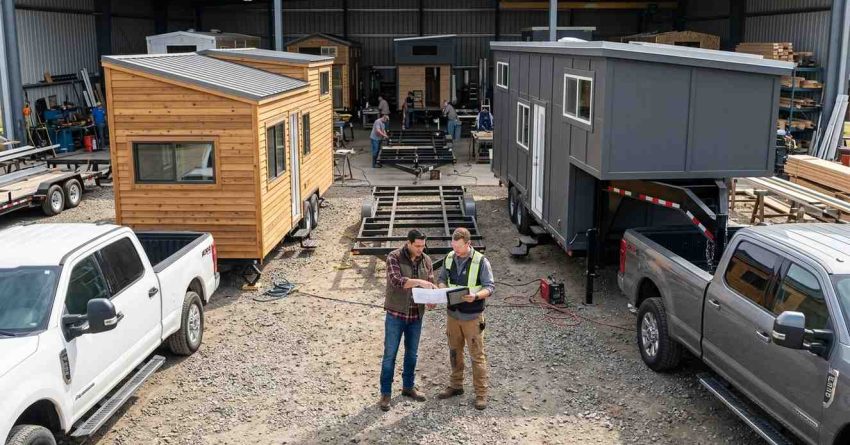
Choosing between a bumper pull and a gooseneck THOW trailer is one of the most consequential decisions in your tiny home build — the wrong choice affects towing safety, interior square footage, and total project cost. Bumper pull trailers connect to a standard receiver hitch at the rear of a tow vehicle, while gooseneck trailers use a ball hitch mounted in the truck bed, distributing weight differently and enabling heavier, longer builds.
This distinction matters because your trailer type determines which trucks can legally tow your home, how stable it rides at highway speeds, and how much living space you can realistically design into the floor plan.
This guide compares both trailer types across every key dimension — weight capacity, tow vehicle requirements, stability, interior layout, and cost — so you can make a confident, informed decision before committing to a build.
What Is a THOW Trailer and Why the Hitch Type Matters
A THOW, or tiny home on wheels, is a residential dwelling built on a purpose-designed trailer chassis that allows the structure to be legally transported on public roads. Unlike a standard RV or travel trailer, a THOW is built with residential-grade materials, insulation, and fixtures — which means it is significantly heavier than a comparable recreational unit of the same length.
That weight difference is exactly why hitch type matters. A THOW is not a weekend camper. It is a full-time or part-time residence that may weigh anywhere from 10,000 to over 20,000 pounds when fully built out. The hitch system connecting that structure to a tow vehicle must handle that load safely, consistently, and within the legal limits of both the trailer and the tow vehicle.
The two primary hitch configurations available for THOW builds are bumper pull and gooseneck. Each has a distinct mechanical design, a different weight distribution profile, and a different set of tow vehicle requirements. Understanding how they differ at a structural level is the foundation for every other comparison in this guide.
Understanding which trailer hitch type suits your build starts with a clear picture of the full tiny home landscape — our guide to tiny home options covers every structure type, build approach, and lifestyle consideration to help you frame this decision in full context.
How Hitch Configuration Affects Towing, Stability, and Living Space
Hitch configuration affects three things simultaneously: how weight is distributed between the trailer and the tow vehicle, how the trailer tracks and handles at speed, and how much of the trailer’s total length can be used for living space.
A bumper pull hitch places the tongue weight — typically 10 to 15 percent of the trailer’s gross vehicle weight rating (GVWR) — on the rear of the tow vehicle. This rear-loading effect can reduce front axle traction and increase sway at highway speeds, particularly as trailer weight increases. A gooseneck hitch, by contrast, places the coupling point over the rear axle of the truck, distributing weight more evenly across the vehicle and significantly reducing sway.
The tradeoff is interior space. A gooseneck trailer’s front section curves up and over the truck bed, creating a loft area above the hitch neck. That loft is usable living space — typically a sleeping loft — but the curved neck design means the main floor plan begins further back than on a bumper pull of equivalent total length.
Bumper Pull THOW Trailers: What They Are and How They Work
A bumper pull THOW trailer uses a standard ball-and-coupler hitch that attaches to a receiver mounted at the rear bumper area of the tow vehicle. This is the same hitch style used on most conventional travel trailers, boat trailers, and utility trailers, which makes it the more familiar and widely supported configuration.
For THOW applications, bumper pull trailers are typically built on purpose-engineered flatbed trailer frames with reinforced steel construction, integrated tie-down systems, and wheel well cutouts designed to accommodate residential wall framing. The trailer frame itself is the structural foundation of the entire build, so frame quality and GVWR rating are critical specifications to verify before purchasing.
Weight Limits and Tow Vehicle Requirements for Bumper Pull
Most bumper pull THOW trailers are rated between 10,000 and 16,000 pounds GVWR, though some purpose-built frames extend to 18,000 pounds. The practical towing limit for a bumper pull configuration is constrained by the tow vehicle’s maximum tow rating and the receiver hitch’s rated capacity — both of which must exceed the trailer’s loaded weight with a meaningful safety margin.
Towing a bumper pull THOW typically requires a heavy-duty pickup truck such as a Ford F-250, Ram 2500, or Chevrolet Silverado 2500 with a properly rated receiver hitch and weight distribution system. Lighter trucks in the half-ton class are generally not suitable for fully built THOW trailers due to payload and tow rating limitations.
Pros and Cons of Choosing a Bumper Pull THOW
Advantages of bumper pull:
- Lower trailer purchase cost compared to gooseneck frames of similar length
- Compatible with a wider range of tow vehicles, including some half-ton trucks for lighter builds
- Simpler hitch connection — no truck bed modification required
- Easier to find service, repair, and parts support due to widespread hitch compatibility
- More straightforward to back into tight spaces for many drivers
Disadvantages of bumper pull:
- Greater sway risk at highway speeds, especially as trailer weight increases
- Lower practical weight ceiling compared to gooseneck configurations
- Rear tongue weight loading reduces front axle traction on the tow vehicle
- Maximum length is typically limited to around 28 to 30 feet for safe towing
- Weight distribution hitches add cost and complexity for heavier builds
Gooseneck THOW Trailers: What They Are and How They Work
A gooseneck THOW trailer uses a curved neck extension that arches over the truck bed and connects to a ball hitch mounted in the truck bed floor, typically above or just forward of the rear axle. This over-axle coupling point is the defining mechanical advantage of the gooseneck design — it places the trailer’s tongue weight directly over the truck’s strongest load-bearing point rather than at the rear bumper.
Gooseneck trailers are the standard choice for heavy commercial hauling applications, including livestock trailers, equipment trailers, and flatbed freight trailers. In the THOW context, the gooseneck design enables builders to construct longer, heavier tiny homes that would exceed the safe towing limits of a bumper pull configuration.
Weight Limits and Tow Vehicle Requirements for Gooseneck
Gooseneck THOW trailers are commonly rated from 14,000 to over 24,000 pounds GVWR, with some custom frames exceeding that range for large builds. The over-axle coupling design allows the tow vehicle to handle significantly more tongue weight without the rear-loading instability that limits bumper pull configurations.
Towing a gooseneck THOW requires a heavy-duty pickup truck with a gooseneck hitch installed in the truck bed. This typically means a Ford F-350, Ram 3500, or Chevrolet Silverado 3500 in a dually (dual rear wheel) configuration for the heaviest builds, though single-rear-wheel heavy-duty trucks are adequate for mid-range gooseneck THOW weights. The truck bed must be modified with a gooseneck ball and safety chain anchors, which adds to the initial setup cost.
Pros and Cons of Choosing a Gooseneck THOW
Advantages of gooseneck:
- Significantly higher weight capacity — suitable for larger, heavier builds
- Superior stability and reduced sway at highway speeds due to over-axle coupling
- Enables longer trailer lengths — commonly 30 to 40 feet for THOW applications
- The gooseneck neck creates a natural loft space above the truck bed
- Better weight distribution reduces wear on the tow vehicle over time
Disadvantages of gooseneck:
- Higher trailer purchase cost compared to bumper pull frames
- Requires truck bed modification and a dedicated gooseneck hitch installation
- Limits truck bed usability while the trailer is attached
- Requires a heavy-duty truck — no compatibility with lighter tow vehicles
- The loft above the neck has limited headroom and a curved floor profile
Bumper Pull vs Gooseneck: Side-by-Side Comparison
The decision between bumper pull and gooseneck ultimately comes down to three practical dimensions: how the trailer handles on the road, how much usable living space it provides, and what the total cost of ownership looks like across the trailer, tow vehicle, and setup.
Stability and Handling on the Road
Gooseneck trailers have a clear and consistent advantage in towing stability. The over-axle coupling point reduces trailer sway, improves braking response, and distributes load more evenly across the tow vehicle’s axles. For a structure as heavy as a fully built THOW, this stability advantage is not a minor comfort improvement — it is a meaningful safety factor on long highway drives.
Bumper pull trailers can be towed safely when properly loaded and equipped with a weight distribution hitch and sway control system, but they require more attention to load placement and are more sensitive to crosswinds and passing truck turbulence at highway speeds. As trailer weight approaches the upper end of the bumper pull range, the stability gap between the two configurations widens.
Living Space and Interior Layout Differences
Bumper pull trailers offer a flat, uninterrupted floor plan from front to back. There is no neck section to design around, which gives builders maximum flexibility in laying out the kitchen, bathroom, living area, and sleeping loft without working around a structural constraint at the front of the trailer.
Gooseneck trailers introduce the neck loft as a design element. Many THOW builders use this space as a sleeping loft, which frees up the main floor for living and kitchen space. However, the loft above the neck has a curved floor profile that follows the arch of the neck, and headroom is limited — typically 4 to 5 feet at the peak. Builders who prefer a ground-level bedroom or who have mobility considerations may find the bumper pull’s flat layout more practical.
Cost Differences: Purchase Price, Tow Vehicle, and Setup
Bumper pull THOW trailer frames typically cost less than gooseneck frames of comparable quality, with the price difference ranging from a few hundred to several thousand dollars depending on the manufacturer and specifications. However, the total cost comparison must include the tow vehicle and hitch setup.
A bumper pull build may allow the use of a less expensive tow vehicle if the finished weight stays within half-ton or light heavy-duty truck capacity. A gooseneck build almost always requires a heavy-duty truck with a bed-mounted hitch installation, which adds cost at the vehicle level even if the trailer frame itself is the primary budget item. Over the full project, the cost difference between the two configurations is often smaller than it appears when comparing trailer prices alone.
Which THOW Trailer Type Is Right for You?
The right trailer type depends on the size of your planned build, the tow vehicle you already own or are willing to purchase, your budget across the full project, and how you plan to use the home once it is built.
If your planned THOW is under 28 feet and under 14,000 pounds finished weight, and you already own or prefer a standard heavy-duty pickup, a bumper pull trailer is a practical and cost-effective choice. If you are planning a larger build, want maximum towing stability, or intend to include a sleeping loft above the hitch neck, a gooseneck trailer is the more capable platform.
If you are weighing a THOW against other alternative housing paths, the custom vs spec home comparison breaks down the investment differences between building to your specifications and buying a pre-designed structure — a useful reference point when calculating total cost of ownership across housing types.
Key Questions to Ask Before You Decide
Before committing to either trailer type, work through these questions:
- What is the planned finished weight of your THOW, including all furnishings, appliances, and water?
- What tow vehicle do you currently own, and what is its rated towing capacity and payload?
- Are you willing to purchase or already own a heavy-duty truck with gooseneck hitch capability?
- How important is a front sleeping loft to your floor plan design?
- How frequently will you be moving the THOW, and over what distances?
- Do you have a specific parking or land situation that affects trailer length or maneuverability?
Answering these questions before selecting a trailer frame will prevent costly mismatches between your build design, your tow vehicle, and your actual use case.
Conclusion
Bumper pull and gooseneck THOW trailers serve different build profiles, and neither is universally superior. The bumper pull suits lighter, shorter builds with flexible tow vehicle options, while the gooseneck enables heavier, longer homes with greater road stability.
Your trailer choice sets the structural and mechanical foundation for every other decision in your tiny home build — from floor plan layout to tow vehicle selection to long-term mobility.
At Mr. Local Services, we connect homeowners and builders with skilled professionals who understand the full scope of a tiny home project — reach out today to get expert guidance matched to your specific build goals.
Frequently Asked Questions
What is the maximum weight a bumper pull THOW trailer can handle?
Most bumper pull THOW trailer frames are rated between 10,000 and 18,000 pounds GVWR. The practical safe towing limit depends on the tow vehicle’s rated capacity and the receiver hitch rating — both must exceed the trailer’s loaded weight.
Do I need a special truck to tow a gooseneck THOW trailer?
Yes. A gooseneck THOW requires a heavy-duty pickup truck — typically a Ford F-350, Ram 3500, or Chevrolet Silverado 3500 — with a gooseneck ball hitch installed in the truck bed. The truck bed must be modified to accommodate the hitch hardware.
Is a gooseneck THOW trailer more stable than a bumper pull?
Gooseneck trailers are generally more stable at highway speeds because the coupling point sits over the truck’s rear axle, reducing trailer sway and improving weight distribution. Bumper pull trailers can be stabilized with weight distribution hitches and sway control systems, but the gooseneck design has a structural advantage for heavy loads.
Can I use a half-ton truck to tow a THOW trailer?
A half-ton truck such as a Ford F-150 or Ram 1500 is generally not suitable for a fully built THOW trailer due to payload and tow rating limitations. Most completed THOW builds exceed the safe towing capacity of half-ton trucks. A three-quarter-ton or one-ton heavy-duty truck is the standard recommendation.
What is the loft above a gooseneck trailer neck used for?
The curved neck section of a gooseneck THOW trailer creates a loft space above the truck bed when the trailer is in use. Most THOW builders use this area as a sleeping loft. Headroom in the neck loft is typically 4 to 5 feet at the peak, and the floor follows the curved profile of the neck.
How does trailer length differ between bumper pull and gooseneck THOW builds?
Bumper pull THOW trailers are typically built up to 28 to 30 feet in total length for safe towing. Gooseneck trailers support longer builds — commonly 30 to 40 feet — because the over-axle coupling design handles the additional weight and length more effectively than a rear-mounted bumper pull hitch.
Which trailer type costs less overall — bumper pull or gooseneck?
Bumper pull trailer frames generally have a lower purchase price than gooseneck frames of similar quality. However, the total cost comparison must include the tow vehicle and hitch setup. When the full project cost is calculated — trailer, truck, and hitch installation — the difference between the two configurations is often smaller than the trailer price alone suggests.