Prefab, modular, manufactured, panelized, and kit homes are five distinct construction methods — each with different build processes, cost structures, regulatory requirements, and customization levels. Choosing the wrong type can mean unexpected costs, zoning complications, or a finished home that does not match your original vision. Understanding the differences before you commit protects your investment and simplifies every decision that follows.
This guide breaks down all five construction types clearly, compares them side by side, and helps you identify which approach fits your property goals, budget, and timeline.
What Does “Prefab” Actually Mean?
Prefab is short for prefabricated — it describes any home where major components are built off-site in a factory before being transported and assembled on the property. The term is not a construction type on its own. It is an umbrella category that includes modular, manufactured, panelized, and kit homes.
Confusion around the word “prefab” is common because it gets used interchangeably with “modular” in casual conversation. In practice, every modular home is a prefab home, but not every prefab home is modular. The distinction matters when you are applying for permits, securing financing, or comparing resale values.
How Prefab Became an Umbrella Term
Factory-built housing gained traction in the United States after World War II as a faster, lower-cost alternative to traditional site-built construction. Over decades, the industry split into distinct categories — each governed by different building codes, financing rules, and installation requirements. Understanding what prefab means is the first step toward choosing the right build type — our tiny home options guide covers how these construction methods apply to compact, affordable housing across the USA.
Modular Homes — Built in Sections, Finished On-Site
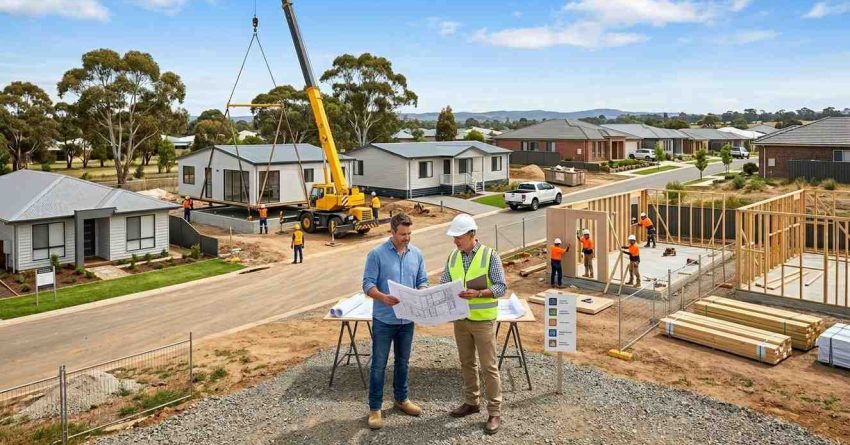
A modular home is built in two or more three-dimensional sections — called modules — inside a climate-controlled factory. Each module is completed to roughly 80–90% of its finished state before being transported to the building site, where a crane sets the sections onto a permanent foundation. Local contractors then connect the modules, finish the interior seams, and complete utility hookups.
Modular homes must comply with the same local and state building codes as site-built homes. They are appraised and financed the same way as traditional construction, which makes them easier to mortgage than other prefab types. Once assembled, a modular home is structurally indistinguishable from a site-built property.
What Sets Modular Apart From Other Prefab Types
The key differentiator is the permanent foundation requirement and full compliance with local building codes. Modular homes are not subject to HUD code — the federal standard that governs manufactured housing. This distinction directly affects financing options, insurance rates, and long-term resale value. Once a modular home is set on its foundation, interior upgrades follow the same process as any site-built property — our home remodeling services explains what those improvements typically include and how to plan for them.
Manufactured Homes — HUD-Code Construction Explained
A manufactured home is built entirely in a factory on a permanent steel chassis and transported to the site as a complete unit. Unlike modular homes, manufactured homes are regulated by the federal HUD Code — the Manufactured Home Construction and Safety Standards established in 1976 — rather than local building codes.
The HUD Code sets national standards for design, construction, strength, energy efficiency, fire resistance, and installation. Every manufactured home carries a red certification label confirming it meets these standards. This federal oversight makes manufactured homes consistent in quality across all 50 states, but it also means they are treated differently from site-built homes for financing and zoning purposes.
Manufactured homes share several design principles with compact builds — the tiny home construction overview explains how HUD-code standards compare to the alternative housing approaches used in smaller footprint projects.
Permanent vs. Non-Permanent Foundation Options
Manufactured homes can be placed on a permanent foundation — making them real property — or on a non-permanent setup such as a rental lot in a manufactured home community, where they are classified as personal property. This distinction has significant implications for mortgage eligibility. Homes on permanent foundations qualify for conventional and FHA financing. Homes on non-permanent setups typically require chattel loans, which carry higher interest rates and shorter terms.
Panelized Construction — Wall Panels Built Off-Site
Panelized construction is a method where individual wall panels, floor systems, and roof sections are manufactured in a factory and shipped flat to the building site. Unlike modular construction, panelized components are not three-dimensional rooms — they are flat structural elements that a crew assembles on-site like a large, precision-engineered puzzle.
The result is faster framing than traditional stick-built construction, with less material waste and tighter tolerances. Panelized homes comply with local building codes and are treated as site-built properties for financing and appraisal purposes.
Open Panel vs. Closed Panel Systems
Open panels are basic structural frames — studs, plates, and sheathing — with no insulation, wiring, or plumbing installed. They give contractors maximum flexibility to run systems on-site. Closed panels arrive with insulation, windows, doors, and sometimes pre-run electrical or plumbing already integrated. Closed panel systems reduce on-site labor time significantly but require more precise planning before fabrication begins. Panelized systems rely heavily on precision framing and joinery — our structural carpentry work outlines how skilled carpenters support panel assembly, finishing, and on-site integration for residential builds.
Kit Homes — You Supply the Labor
A kit home is a package of pre-cut, pre-measured building materials — framing lumber, fasteners, roofing, windows, doors, and sometimes siding — delivered to your site ready for assembly. The manufacturer designs the home, cuts every component to specification, and ships everything together. You or your hired crew provide the labor to build it.
Kit homes are the most hands-on prefab option. They offer significant cost savings for buyers who can manage or perform the construction themselves, but they require strong project management skills, local permit knowledge, and reliable subcontractors for electrical, plumbing, and HVAC work.
What Comes in a Kit Home Package
A standard kit home package typically includes engineered framing plans, pre-cut structural lumber, roofing materials, exterior cladding, windows, and exterior doors. It does not include the foundation, interior finishes, mechanical systems, or site preparation. Buyers are responsible for sourcing those components separately and coordinating all trades. Many kit home buyers hire professionals for specific stages of the build — our handyman assembly help covers the types of tasks a skilled handyman can take on during a kit home project.
Side-by-Side Comparison — Which Type Fits Your Needs?
Each construction type serves a different buyer profile. The table below summarizes the key differences across the five categories.
| Feature | Modular | Manufactured | Panelized | Kit | Traditional Prefab |
| Built off-site | Partially | Fully | Partially | No (cut only) | Varies |
| Foundation required | Permanent | Optional | Permanent | Permanent | Varies |
| Building code | Local/state | Federal HUD | Local/state | Local/state | Varies |
| Financing | Conventional | Chattel or FHA | Conventional | Conventional | Varies |
| Customization level | High | Moderate | High | High | Varies |
| On-site labor | Low | Very low | Moderate | High | Varies |
| Typical timeline | 3–6 months | 1–3 months | 4–7 months | 6–12 months | Varies |
For homeowners still weighing their options, the full breakdown of prefab housing types provides deeper context on how each construction method performs in real-world USA builds.
Cost, Timeline, and Customization at a Glance
Cost varies significantly across all five types, driven by size, finish level, site conditions, and regional labor rates. As a general benchmark, manufactured homes tend to carry the lowest per-square-foot cost, followed by kit homes for buyers who self-manage labor. Modular and panelized construction typically fall in the mid-range, while highly customized kit or panelized builds can approach site-built pricing.
Timeline differences are equally important for planning. Manufactured homes move fastest from order to occupancy — often within 60 to 90 days for a standard model. Modular homes typically take three to six months. Panelized and kit builds depend heavily on site preparation, permit timelines, and contractor availability.
Customization follows the opposite pattern. Kit and panelized homes offer the most design flexibility because components are fabricated to your specifications. Modular homes offer strong customization within the manufacturer’s module system. Manufactured homes offer the least flexibility, particularly for structural changes, because the HUD Code governs the build process from the factory floor. Budget planning for any prefab type should account for post-delivery improvements — our remodeling cost guide walks through typical project scopes, timelines, and pricing for residential upgrades.
Conclusion
Prefab, modular, manufactured, panelized, and kit homes each represent a distinct approach to residential construction — with different codes, costs, timelines, and customization levels defining each type.
Choosing the right method depends on your foundation plans, financing options, design goals, and how much on-site involvement you want to manage throughout the build process.
At Mr. Local Services, we connect homeowners and property managers with skilled professionals who support every stage of a prefab project — from structural carpentry and handyman assembly to remodeling and finishing work that brings any build to completion.
Frequently Asked Questions
What is the difference between a prefab home and a modular home?
Prefab is an umbrella term for any home with factory-built components. Modular is a specific type of prefab where three-dimensional sections are built in a factory and assembled on a permanent foundation on-site. All modular homes are prefab, but not all prefab homes are modular.
Are manufactured homes the same as mobile homes?
The terms are often used interchangeably, but they are not identical. “Mobile home” refers to factory-built housing constructed before June 15, 1976. After that date, the federal HUD Code took effect, and homes built to that standard are officially called manufactured homes. Modern manufactured homes are significantly more regulated and structurally sound than pre-1976 mobile homes.
Can you get a traditional mortgage on a manufactured home?
Yes, but only under specific conditions. A manufactured home placed on a permanent foundation and titled as real property qualifies for FHA, VA, and conventional financing. Homes on non-permanent setups or titled as personal property typically require a chattel loan, which carries higher rates and shorter repayment terms.
How long does it take to build a modular home?
Most modular homes are completed within three to six months from order to move-in. Factory production typically takes four to eight weeks. Site preparation, foundation work, module delivery, assembly, and utility connections account for the remaining time. Permit timelines vary by location and can extend the schedule.
What is the main advantage of panelized construction?
Panelized construction combines factory precision with on-site flexibility. Wall panels, floor systems, and roof sections are manufactured to tight tolerances in a controlled environment, reducing material waste and framing errors. On-site assembly is faster than traditional stick-built framing, and the finished home complies with local building codes and qualifies for conventional financing.
Is a kit home cheaper than a modular home?
A kit home can cost less upfront if you manage or perform significant labor yourself. However, total project costs depend heavily on site preparation, subcontractor rates, permit fees, and finish selections. Buyers who underestimate labor costs often find that kit home projects approach or exceed modular pricing by the time the home is complete.
Which prefab type is best for a landlord or property manager?
Manufactured homes offer the fastest path to occupancy and the lowest entry cost, making them a common choice for rental property investors. Modular homes offer stronger long-term appreciation and easier conventional financing, which benefits landlords building equity. The best choice depends on the intended use, local zoning rules, and whether the property will be financed or purchased outright.