Building an off-grid home means designing a property that generates its own power, sources its own water, manages its own waste, and operates entirely independent of municipal utilities — a complete departure from conventional construction that demands careful planning across every system.
Living off the grid is no longer a fringe lifestyle choice. According to research from the American Housing Survey, interest in energy-independent housing has grown steadily alongside rising utility costs and increasing awareness of grid vulnerability across the USA.
This guide covers everything you need to know to plan, build, and maintain an off-grid home — from defining what off-grid truly means to understanding energy systems, water supply, waste management, construction methods, heating and cooling, food production, electrical and plumbing work, ongoing maintenance, real costs, and how to find the right professionals for every phase of your build.
What Does “Off-Grid” Really Mean for a Home Build?
The term “off-grid” is used loosely, but for a home build it has a precise meaning: a property that operates without any connection to public utility infrastructure, including the electrical grid, municipal water supply, and public sewer systems. Every resource the home needs — power, water, heat, and waste processing — must be generated, sourced, or managed entirely on-site.
This is distinct from a “grid-tied” home with solar panels, which still draws from and feeds back into the public electrical grid. It is also different from a “grid-optional” or “hybrid” setup, where a home has off-grid capability but maintains a utility connection as a backup. A true off-grid home has no utility connection at all.
The Difference Between Off-Grid and Grid-Tied Systems
Grid-tied solar systems are the most common form of residential renewable energy in the USA. They reduce utility bills and may generate credits through net metering, but they do not provide power during a grid outage unless a battery backup is installed. Off-grid systems, by contrast, are designed from the start to be the sole power source — which means battery storage, system sizing, and backup generation are not optional additions but core design requirements.
Understanding this distinction matters enormously for budgeting, permitting, and system design. Many homeowners begin researching off-grid living with grid-tied assumptions and are surprised by the additional complexity and cost that true energy independence requires.
Understanding exactly what off-grid living means — from energy independence to water autonomy and waste management — is the essential first step before any build decision, and our off-grid home definition guide breaks down every dimension of the lifestyle, the systems involved, and what true self-sufficiency looks like in practice.
Planning Your Off-Grid Home Build from the Ground Up
Successful off-grid builds do not begin with construction — they begin with months of research, site analysis, and system planning. The planning phase is where most off-grid projects either succeed or fail, because decisions made at this stage determine every downstream cost, timeline, and system choice.
Site Selection and Land Assessment
The land you choose for an off-grid build is not just a location — it is the foundation of every system your home will depend on. Solar exposure determines your energy potential. Geology and hydrology determine your water options. Soil composition affects your septic system design. Slope, drainage, and vegetation affect your building footprint and fire risk.
Before purchasing land for an off-grid build, a thorough site assessment should evaluate annual solar hours, prevailing wind patterns, proximity to water sources, soil percolation rates for septic systems, and access road requirements. Many buyers discover that a parcel that looks ideal on paper has a critical limitation — a north-facing slope with poor solar exposure, or bedrock that makes well drilling prohibitively expensive — that fundamentally changes the project’s viability.
Permits, Zoning, and Legal Considerations
Off-grid does not mean unregulated. In most USA jurisdictions, building permits, septic permits, and well permits are required regardless of whether a property connects to public utilities. Zoning laws may restrict the type of structure you can build, the minimum square footage, or whether certain alternative systems — composting toilets, for example — are legally permitted.
Some rural counties have minimal building codes that make off-grid construction straightforward. Others apply full residential building codes even to remote properties. Researching your specific county’s requirements before purchasing land is not optional — it is one of the most important steps in the entire planning process.
Budgeting for an Off-Grid Build
Off-grid builds typically cost more upfront than comparable grid-connected homes because every utility system must be purchased and installed independently. A grid-connected home benefits from infrastructure that has already been paid for collectively. An off-grid home must fund its own power generation, water supply, and waste management from scratch.
According to data from the National Renewable Energy Laboratory, a complete off-grid solar and battery system for a modest home can range from $15,000 to $50,000 depending on system size, battery chemistry, and installation complexity — and that is before accounting for well drilling, septic installation, or the structure itself.
Every successful off-grid build starts with a structured planning process that accounts for land, permits, budget, and system design long before the first foundation is poured — our off-grid home planning guide walks through every planning phase in full detail, from initial site assessment to final build timeline.
Off-Grid Energy Systems — Power Without the Grid
Energy is the most visible and most discussed dimension of off-grid living. Without a utility connection, every watt of electricity your home uses must be generated on-site, stored efficiently, and managed carefully to match your actual consumption patterns.
Solar Power Systems
Photovoltaic solar panels are the dominant energy source for off-grid homes in the USA, and for good reason. Solar technology has dropped dramatically in cost — according to the Solar Energy Industries Association, the cost of solar installations has fallen by more than 70% over the past decade — making it the most cost-effective off-grid energy source for most climates and locations.
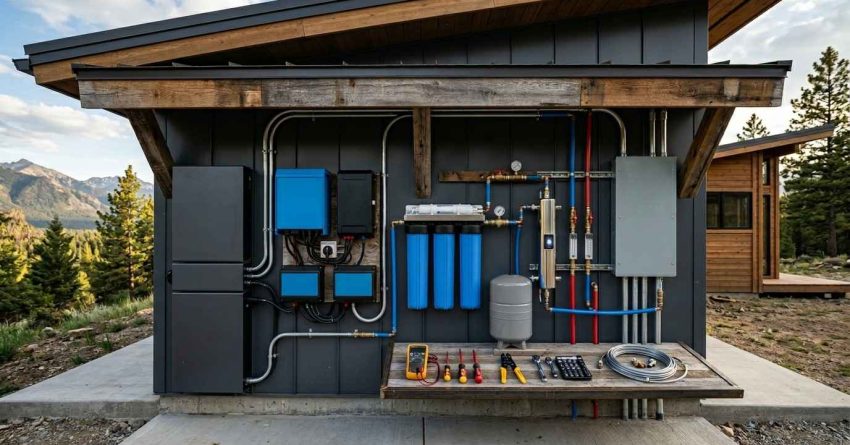
An off-grid solar system consists of four core components: solar panels that convert sunlight to DC electricity, a charge controller that regulates the flow of power to the battery bank, a battery bank that stores energy for use when the sun is not shining, and an inverter that converts stored DC power to the AC electricity your appliances use.
Wind and Micro-Hydro Alternatives
In locations with consistent wind resources or a reliable water source with sufficient elevation drop, wind turbines and micro-hydro generators can supplement or even replace solar as the primary energy source. Wind and micro-hydro have the advantage of generating power continuously — day and night, regardless of cloud cover — which can significantly reduce the battery storage capacity required.
Battery Storage and Backup Power
Battery storage is the most expensive single component of most off-grid energy systems. Lithium iron phosphate (LiFePO4) batteries have become the preferred choice for off-grid applications due to their long cycle life, high depth of discharge, and relatively stable chemistry — but they carry a significant upfront cost compared to older lead-acid alternatives.
Choosing the right energy system is one of the most consequential decisions in any off-grid build, and the variables — panel sizing, battery capacity, inverter selection, and backup integration — require careful analysis specific to your location and load requirements — our off-grid solar energy systems guide covers every component, sizing formula, and installation consideration in full.
Water Systems for Off-Grid Homes
Water access is the second most critical system in any off-grid home, and unlike energy systems, there is no universal solution. The right water supply strategy depends entirely on your land’s geology, your local rainfall patterns, your household’s daily demand, and the regulatory environment in your county.
Well Drilling and Rainwater Harvesting
Drilled wells are the most reliable water source for most off-grid properties in the USA. A properly constructed well can supply clean, consistent water for decades with minimal maintenance. Well depth, yield, and water quality vary significantly by location — in some areas, a productive well can be drilled at 100 feet; in others, 400 feet or more may be required to reach a reliable aquifer.
Rainwater harvesting is a viable primary or supplementary water source in regions with adequate annual rainfall. A well-designed rainwater collection system captures roof runoff, filters it through a series of screens and sediment filters, and stores it in large cisterns — typically 2,500 to 10,000 gallons — for household use. Regulations on rainwater collection vary by state; some states actively encourage it, while others have historically restricted it.
Water Filtration and Purification
Regardless of source, all off-grid water supplies require filtration and purification before use as drinking water. A complete treatment system typically includes sediment pre-filtration, activated carbon filtration for taste and odor, and a final purification stage — either UV sterilization, reverse osmosis, or both — to eliminate biological and chemical contaminants.
Reliable water access is non-negotiable for any off-grid property, and the right system depends entirely on your land’s geology, rainfall patterns, and daily household demand — our off-grid water supply systems guide covers well drilling, rainwater harvesting, filtration options, and storage sizing for every property type.
Off-Grid Waste Management and Septic Solutions
Waste management is one of the least glamorous but most legally consequential aspects of an off-grid build. Every off-grid home must have an approved system for managing both blackwater (toilet waste) and greywater (sink, shower, and laundry drainage), and most jurisdictions require these systems to be permitted and inspected.
Composting Toilets, Septic Tanks, and Greywater Systems
Conventional septic systems — a septic tank combined with a drain field — are the most widely approved waste management solution for off-grid properties in the USA. They require no electricity to operate, handle both blackwater and greywater, and are well understood by local health departments and permitting offices.
Composting toilets offer an alternative for properties where soil conditions make conventional septic installation impractical or prohibitively expensive. They process toilet waste aerobically, reducing it to a small volume of compost material that can be safely disposed of. Many jurisdictions now permit composting toilets as a primary or supplementary waste management solution, though approval requirements vary significantly by county.
Greywater systems — which separate and treat sink, shower, and laundry water separately from toilet waste — can significantly reduce the load on a septic system and allow treated greywater to be reused for irrigation. Greywater reuse is regulated at the state level, with some states providing clear approval pathways and others restricting it entirely.
Managing waste responsibly off the grid requires understanding composting systems, septic design, and greywater reuse — our off-grid septic and waste solutions guide explains every approved system type, installation requirements, and maintenance schedule to keep your property compliant and functional.
Building Materials and Construction Methods for Off-Grid Homes
The structure of an off-grid home is not just a shelter — it is a system that directly affects how much energy you need to generate, how comfortable your home is in extreme weather, and how much maintenance it will require over its lifetime. Material and method choices made at the design stage have consequences that compound over decades.
Sustainable and Natural Building Materials
Natural building materials — including straw bale, cob, rammed earth, and timber frame — have been used for centuries and offer genuine advantages for off-grid construction. They are often locally sourced, have low embodied energy, provide excellent thermal mass, and can be worked by skilled owner-builders with less specialized equipment than conventional framing.
Straw bale construction, for example, produces walls with R-values of R-30 or higher, dramatically reducing heating and cooling loads. Rammed earth walls provide exceptional thermal mass, absorbing heat during the day and releasing it slowly at night — a passive heating and cooling strategy that reduces energy system demands significantly.
Tiny Homes, Container Homes, and Modular Builds
Smaller structures are inherently more energy-efficient and less expensive to build and maintain off-grid. Tiny homes — typically defined as structures under 400 square feet — have become a popular entry point for off-grid living because they minimize the energy, water, and material demands of the build while maximizing the proportion of the budget available for quality systems.
Shipping container homes offer structural durability, rapid construction timelines, and a modular design flexibility that suits off-grid sites with difficult access. Modular and prefabricated builds can reduce on-site construction time significantly, which matters on remote properties where every contractor visit involves travel time and cost.
Insulation, Passive Solar Design, and Energy Efficiency
Passive solar design — orienting the home to maximize winter sun exposure through south-facing glazing while minimizing summer overheating through roof overhangs and shading — is one of the most cost-effective strategies available to off-grid builders. A well-designed passive solar home can reduce heating energy requirements by 30–50% compared to a conventionally oriented structure, according to the U.S. Department of Energy.
Insulation quality is equally critical. Every dollar invested in above-code insulation reduces the size — and cost — of the energy system required to maintain comfortable temperatures.
The materials and methods you choose for your off-grid build directly affect long-term energy efficiency, maintenance demands, and structural resilience — our sustainable off-grid construction methods guide compares natural building materials, container construction, modular systems, and passive design strategies with real-world performance data.
Heating and Cooling an Off-Grid Home
Maintaining comfortable indoor temperatures without grid power is one of the most practically demanding aspects of off-grid living. The right heating and cooling strategy depends on your climate zone, your building’s thermal performance, and the energy resources available on your site.
Wood Stoves, Propane, and Biomass Heating
Wood stoves remain the most reliable and widely used primary heating source for off-grid homes in cold climates. A high-efficiency wood stove or wood gasification boiler can heat a well-insulated home entirely on locally sourced fuel, with no dependence on electricity or fossil fuel supply chains. Propane is a common backup or supplementary heating source, offering the convenience of a conventional furnace or boiler with the independence of on-site fuel storage.
Biomass systems — including pellet stoves and outdoor wood boilers — offer automation and convenience advantages over traditional wood stoves, at the cost of dependence on a manufactured fuel supply.
Passive Cooling and Mini-Split Systems
In hot climates, passive cooling strategies — cross-ventilation, thermal mass, earth tubes, and strategic shading — can maintain comfortable temperatures without any mechanical cooling. In climates where passive strategies alone are insufficient, mini-split heat pumps are the most energy-efficient mechanical cooling option for off-grid homes. Modern mini-splits can achieve heating and cooling efficiencies of 300–400% (a coefficient of performance of 3–4), meaning they deliver three to four times more heating or cooling energy than the electrical energy they consume.
Maintaining comfortable indoor temperatures without grid power demands a carefully matched combination of passive design, efficient appliances, and backup heating sources — our off-grid heating and cooling systems guide covers wood stoves, propane systems, mini-splits, and passive cooling strategies for every climate zone.
Off-Grid Food Production and Self-Sufficiency
For many off-grid homeowners, growing a meaningful portion of their own food is not just a practical goal — it is a central motivation for the lifestyle. Food production reduces dependence on supply chains, lowers ongoing living costs, and provides a level of resilience that no amount of stored food can fully replicate.
Gardens, Greenhouses, and Food Storage
A productive vegetable garden requires careful planning around your climate zone, frost dates, soil quality, and available water. Raised bed systems are popular on off-grid properties because they allow precise control over soil composition, reduce weed pressure, and can be positioned to maximize solar exposure regardless of the native soil quality.
Greenhouses extend the growing season significantly — in cold climates, a well-designed passive solar greenhouse can enable year-round food production. Root cellars provide low-energy food storage for root vegetables, preserved foods, and fermented products, maintaining stable temperatures through the thermal mass of the surrounding earth.
Growing, preserving, and storing food on your property is one of the most rewarding dimensions of off-grid living — and one of the most complex to plan well — our off-grid food production strategies guide covers garden layout, greenhouse design, root cellaring, and seasonal food planning for year-round self-sufficiency.
Structural, Electrical, and Plumbing Work on an Off-Grid Build
Off-grid does not mean exempt from building codes or safety standards. The structural, electrical, and plumbing systems in an off-grid home must meet the same fundamental safety requirements as any residential construction — and in many jurisdictions, they must be inspected and approved by licensed officials regardless of how remote the property is.
DIY vs. Licensed Contractor Work
One of the most common questions among off-grid builders is how much of the work they can legally and safely do themselves. The answer varies significantly by jurisdiction and by trade. In many rural counties, owner-builders are permitted to perform their own structural framing, insulation, and finish work. Electrical and plumbing work, however, typically requires a licensed contractor in most USA states — even on off-grid properties.
The consequences of unlicensed electrical work on an off-grid system can be severe. Improperly wired battery banks and inverters are a significant fire risk. Undersized wiring in a DC system can cause dangerous voltage drops and heat buildup. These are not theoretical risks — they are documented causes of off-grid home fires.
Inspections and Code Compliance Off-Grid
Many off-grid builders assume that remote properties are beyond the reach of building inspectors. In practice, most counties require inspections at key stages of construction — foundation, framing, rough electrical, rough plumbing, and final — regardless of location. Skipping required inspections can result in stop-work orders, fines, and in some cases, requirements to demolish non-compliant work.
Working with licensed professionals for electrical, plumbing, and structural work is not just a legal requirement in most jurisdictions — it is a practical investment in the long-term safety and insurability of your property.
The structural, electrical, and plumbing systems in an off-grid home must meet the same safety and code standards as any conventional build, even when the energy and water sources are entirely independent — our off-grid electrical and plumbing work guide explains what licensed professionals must handle, what inspections are required, and how to coordinate trades on a remote build site.
Maintaining an Off-Grid Home Year-Round
An off-grid home requires a level of active, ongoing maintenance that most conventional homeowners never encounter. When a utility fails in a grid-connected home, the utility company fixes it. When a system fails in an off-grid home, the homeowner is responsible — which means understanding every system well enough to diagnose problems, perform routine maintenance, and know when to call a professional.
Seasonal Maintenance Priorities
Off-grid maintenance follows a seasonal rhythm. Spring is the time to inspect solar panels for winter damage, test battery capacity after months of reduced solar input, check water system components for freeze damage, and assess the structure for any winter weathering. Summer maintenance focuses on cooling system performance, water storage levels, and garden infrastructure. Fall preparation — winterizing water lines, stocking fuel supplies, and testing backup heating systems — is critical in cold climates.
When to Call a Professional Service Provider
Even the most capable off-grid homeowner will encounter situations that require professional expertise. Battery bank failures, well pump problems, septic system issues, and structural repairs all benefit from professional assessment. Attempting to repair complex systems without the right knowledge and tools can turn a manageable problem into a costly failure.
Keeping every system in an off-grid home running reliably requires a proactive maintenance schedule that most conventional homeowners never need to think about — our year-round off-grid home maintenance guide provides a complete seasonal checklist covering energy systems, water infrastructure, structural components, and when to bring in a professional service provider.
The Real Costs of Building and Living Off-Grid
Off-grid living is often portrayed as a path to financial freedom — and over the long term, it can be. But the upfront costs of an off-grid build are substantial, and understanding the full financial picture before committing to the project is essential for making sound decisions.
Upfront Build Costs vs. Long-Term Savings
A complete off-grid home build in the USA — including land, structure, energy system, water system, and septic — typically ranges from $150,000 to $500,000 or more depending on size, location, and system specifications. This is a wide range because the variables are enormous: a 400-square-foot tiny home on owner-builder land with a simple solar system and hand-dug well sits at one end; a 2,000-square-foot timber frame home with a full solar-plus-battery system, drilled well, and engineered septic sits at the other.
The long-term financial case for off-grid living is compelling. With no utility bills, no water bills, and no sewer charges, the ongoing cost of living is dramatically lower than in a grid-connected home. According to the U.S. Energy Information Administration, the average American household spends approximately $2,000 per year on electricity alone — a cost that an off-grid homeowner eliminates entirely after the initial system investment is recovered.
Financing Options for Off-Grid Builds
Financing an off-grid build is more challenging than financing a conventional home because most traditional mortgage products require a property to be connected to public utilities. Construction loans, land loans, personal loans, and owner-financing arrangements are the most common funding paths for off-grid projects. Some lenders have developed specific products for alternative and sustainable housing, and federal programs through the USDA Rural Development office offer loan and grant options for rural housing that may apply to off-grid builds.
Understanding the full financial picture of an off-grid build — from land acquisition and system installation to long-term operating savings — is essential before committing to the project — our off-grid home build costs guide breaks down every cost category, realistic budget ranges, and financing options available to off-grid builders in the USA.
How to Find Reliable Professionals for Your Off-Grid Build
Building an off-grid home is not a solo endeavor for most people. Even experienced owner-builders rely on licensed electricians, plumbers, well drillers, septic installers, and structural engineers at various stages of the project. Finding professionals who understand off-grid systems — not just conventional residential construction — is one of the most practically challenging aspects of the entire build.
Vetting Contractors, Handymen, and Specialists
Not every licensed electrician has experience with DC wiring, battery banks, and off-grid inverter systems. Not every plumber has installed a rainwater harvesting system or a composting toilet. When hiring for an off-grid build, the standard question — “are you licensed and insured?” — is necessary but not sufficient. You also need to ask specifically about their experience with the systems your build requires.
Useful vetting questions include: Have you installed an off-grid solar system before? Can you provide references from off-grid projects? Are you familiar with the permitting requirements for off-grid systems in this county? Do you have experience working on remote sites with limited access?
Getting multiple quotes is standard practice, but for off-grid work, the lowest quote is rarely the best choice. Professionals who understand off-grid systems command a premium — and they earn it by avoiding the costly mistakes that come from applying conventional construction assumptions to unconventional systems.
For property managers and landlords considering off-grid properties in their portfolios, the same vetting principles apply. Ongoing maintenance contracts with professionals who understand the specific systems on a property are far more valuable than reactive repair relationships with generalist contractors who encounter the systems for the first time during an emergency.
Assembling the right team of contractors, electricians, plumbers, and system specialists is one of the most challenging logistics of any off-grid project — our off-grid build contractors and specialists guide explains how to vet professionals, what certifications matter for off-grid work, and how to coordinate multiple trades on a remote build site.
Conclusion
An off-grid home build integrates energy systems, water supply, waste management, construction methods, heating and cooling, food production, and professional trades into a single, self-sustaining property — each system dependent on the others, and all of them dependent on sound planning from the start.
The resources linked throughout this guide go deeper into every dimension of the off-grid build process, from system sizing and material selection to cost planning and contractor vetting — use them as your roadmap for each phase of the project.
At Mr. Local Services, our network of skilled professionals supports every stage of your off-grid build and ongoing maintenance — connect with us today to find reliable, experienced specialists for your project.
Frequently Asked Questions
What is the first step in planning an off-grid home build?
The first step is a thorough site assessment of your land, evaluating solar exposure, water access, soil conditions, and local permitting requirements. These factors determine which systems are viable and what your build will realistically cost.
How much does it cost to build a complete off-grid home in the USA?
A complete off-grid home build typically ranges from $150,000 to $500,000 or more, depending on size, location, and system specifications. Energy systems, water supply, and septic installation are the largest variable cost categories beyond the structure itself.
Do off-grid homes still need building permits?
Yes. Most USA jurisdictions require building permits, septic permits, and well permits for off-grid properties regardless of utility connection status. Zoning laws and code requirements vary significantly by county, so researching local regulations before purchasing land is essential.
What is the most reliable energy source for an off-grid home?
Solar photovoltaic systems combined with battery storage are the most widely used and cost-effective energy source for off-grid homes in most USA climates. Wind and micro-hydro systems are viable alternatives in locations with consistent wind or water resources.
Can you get a mortgage for an off-grid home?
Traditional mortgages are difficult to obtain for off-grid properties because most lenders require utility connections. Construction loans, USDA Rural Development programs, land loans, and owner-financing are the most common funding paths for off-grid builds.
What maintenance does an off-grid home require compared to a conventional home?
Off-grid homes require significantly more active maintenance because every utility system is the homeowner’s responsibility. Seasonal maintenance of solar panels, batteries, water systems, septic systems, and heating equipment is essential to prevent costly failures.
How long does it take to build an off-grid home from start to finish?
A complete off-grid home build typically takes 12 to 36 months from land purchase to move-in, depending on permitting timelines, contractor availability, site access, and the complexity of the systems involved. Owner-builder projects often take longer but can reduce costs significantly.