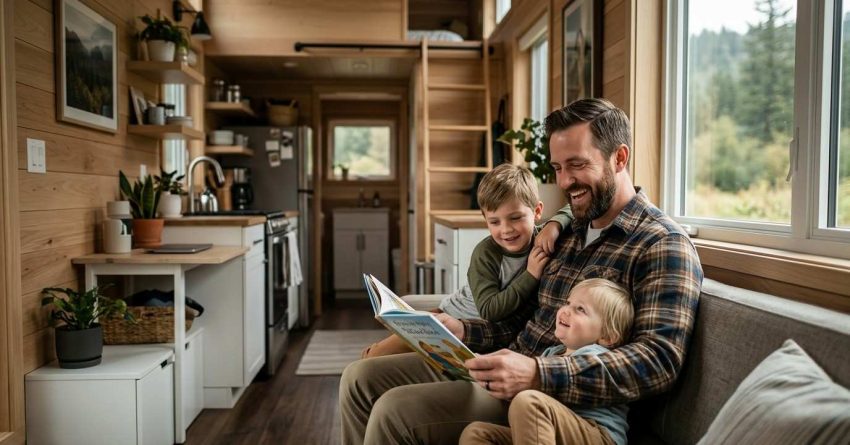
Families across the USA are choosing to live full-time in a tiny home on wheels (THOW) — trading square footage for financial freedom, flexibility, and a simpler way of life. A THOW is a fully functional home built on a trailer chassis, designed to be road-legal and moveable, yet livable as a permanent residence for one person, a couple, or an entire family.
Making that choice with children involved raises real, practical questions that deserve honest answers. This guide covers what daily family life in a THOW actually looks like, from space planning and sleeping arrangements to essential home systems, schooling on the road, and the true financial picture.
What Is a THOW and Why Are Families Choosing Tiny Home Living?
A tiny home on wheels (THOW) is a residential structure built on a trailer frame, typically ranging from 150 to 400 square feet. Unlike a traditional tiny home on a permanent foundation, a THOW is classified as a vehicle in most U.S. states, which affects how it is registered, insured, and parked. It contains all the core systems of a conventional home — kitchen, bathroom, sleeping areas, and living space — compressed into a highly efficient layout.
Understanding how a THOW fits into the broader housing landscape is easier when you compare it against traditional builds — our custom home investment analysis breaks down the financial trade-offs between custom, spec, and alternative housing paths so families can make a fully informed decision.
How a THOW Differs From a Traditional Tiny Home
A traditional tiny home sits on a permanent foundation and is treated legally as real property. A THOW sits on a trailer, is towed by a vehicle, and is typically registered as a recreational vehicle or specialty trailer. This distinction affects financing, zoning compliance, and where the home can legally be parked long-term. Families choosing a THOW gain mobility but must navigate parking regulations that vary significantly by state and county.
Why Families Are Downsizing to Life on Wheels
The motivations vary, but the most common reasons families move into a THOW include eliminating mortgage debt, reducing monthly living costs, gaining location flexibility for remote work or travel, and simplifying daily life. For some families, it is a deliberate lifestyle choice. For others, it is a practical response to rising housing costs in their region.
How Families Make a THOW Work Day to Day
Living in a THOW with children requires intentional design and consistent routines. The homes that work best for families are not simply small versions of conventional houses — they are purpose-built spaces where every square foot serves a clear function.
Space Planning and Storage Solutions for Family Life
Effective THOW design for families relies on multi-use furniture, vertical storage, and clearly defined zones for sleeping, eating, working, and playing. Loft sleeping areas are common for children, freeing up the main floor for shared living. Built-in storage under stairs, beneath seating, and inside walls replaces the closets and spare rooms of a conventional home. Families who plan their layout before building or buying report significantly less friction in daily life than those who adapt to an existing floor plan.
Managing Daily Routines in a Small Footprint
Morning routines, meal preparation, homework, and downtime all happen within the same compact space. Successful THOW families establish clear schedules and designated areas for each activity, even when those areas overlap. Outdoor space — a porch, a deck extension, or simply the surrounding yard — becomes an essential extension of the living area, particularly for families with young children.
THOW Living With Kids — Challenges and Real Solutions
Living in a THOW with children is genuinely challenging in ways that lifestyle content often understates. The challenges are real, but they are also solvable with the right preparation and mindset.
Sleeping Arrangements and Privacy in a Tiny Home
Privacy is the most frequently cited challenge for families in a THOW. Children need defined sleeping spaces, and parents need separation from those spaces. Loft beds with curtains or partial walls, murphy beds that fold away during the day, and bunk configurations built into the trailer frame are all practical solutions. Families with teenagers report the greatest difficulty, as older children have stronger needs for personal space and quiet.
Schooling, Activities, and Social Life on the Road
Many THOW families homeschool or use online learning programs, which removes the constraint of staying in one school district. For families who prefer traditional schooling, staying in one location for an extended period — typically a full academic year — is necessary. Social connection for children in a THOW often comes through homeschool co-ops, community campgrounds, and organized activities rather than neighborhood proximity.
Essential Systems Every Family THOW Needs
A THOW must function as a complete home, which means its mechanical and utility systems must be reliable, appropriately sized for the number of occupants, and maintainable without specialized equipment.
Plumbing, Electrical, and HVAC in a Tiny Home on Wheels
Family THOWs require a freshwater tank, a greywater system, and either a composting toilet or a connection to a standard sewer hookup. Electrical systems are typically 30-amp or 50-amp shore power connections, supplemented by solar panels for off-grid capability. Heating and cooling in a small space can be managed efficiently with a mini-split HVAC system, a propane heater, or a wood-burning stove, depending on the climate and the family’s travel patterns.
Keeping a THOW’s plumbing, electrical, and HVAC systems in reliable working order requires the same professional attention as any residential property — connecting with a tiny home maintenance specialist ensures repairs are handled correctly and the home stays road-ready year-round.
Maintenance and Repairs That Keep a THOW Road-Ready
A THOW is both a home and a vehicle, which means it requires maintenance on two fronts. The trailer frame, axles, tires, and hitch components need regular inspection before any move. The home systems — roof seals, window caulking, plumbing connections, and electrical panels — need the same seasonal attention as a conventional house. Families who build a maintenance schedule into their routine avoid the most common and costly THOW repair issues.
Financial Realities of Family Life in a THOW
The financial case for THOW living is compelling on the surface, but the full picture includes costs that are easy to overlook during the planning phase.
Cost of Building or Buying a THOW for a Family
A professionally built family THOW in the USA typically costs between $60,000 and $150,000, depending on size, materials, and systems. DIY builds can reduce that figure significantly but require substantial time, skill, and access to tools. Purchasing a used THOW is a lower-cost entry point, though inspection of the trailer frame and all systems is essential before any purchase.
Ongoing Costs, Savings, and Long-Term Value
Monthly living costs in a THOW are substantially lower than a conventional mortgage for most families — land or campsite rental, utilities, insurance, and maintenance typically total between $800 and $2,000 per month depending on location and lifestyle. However, THOWs do not build equity in the same way real estate does, and resale value depends heavily on the quality of the build and the condition of the trailer. Families weighing the cost of a THOW against conventional housing options will find a detailed spec home comparison useful — it covers purchase price, long-term equity, and resale value across housing types so you can see exactly where a THOW stands financially.
Is a THOW the Right Housing Investment for Your Family?
A THOW is not the right fit for every family, but for those who value mobility, lower overhead, and intentional living, it offers a genuinely viable alternative to conventional housing. The families who thrive in a THOW share a few common traits: they plan their space carefully, they maintain their home consistently, and they build routines that make small-space living feel structured rather than cramped.
Before committing to a THOW as your family’s primary residence, reviewing a full housing investment guide that compares custom builds, spec homes, and alternative housing will help you evaluate long-term value, financing options, and resale potential side by side.
If you are ready to take the next step — whether that means planning a build, evaluating a purchase, or maintaining a THOW you already own — Mr. Local Services connects families with skilled professionals across every home service category, from plumbing and electrical to HVAC and structural repairs, so your tiny home stays safe, functional, and road-ready.
Conclusion
Family life in a THOW is built on intentional space planning, reliable home systems, and a clear-eyed understanding of the financial trade-offs involved. The lifestyle rewards those who prepare thoroughly and maintain consistently.
The challenges are real — privacy, schooling, and system maintenance require ongoing attention — but families who commit to the THOW lifestyle consistently report lower stress, reduced financial pressure, and stronger daily connection.
At Mr. Local Services, we help THOW families keep every system in their home performing at its best — from plumbing and electrical to HVAC and structural maintenance, our professionals are ready to support your tiny home at every stage.
Frequently Asked Questions
What does THOW stand for?
THOW stands for Tiny Home on Wheels. It refers to a fully functional residential structure built on a road-legal trailer chassis, designed to be moveable while serving as a permanent or semi-permanent living space.
Can a family of four realistically live in a THOW?
Yes, families of four do live full-time in THOWs, though it requires a purpose-built layout with dedicated sleeping lofts, multi-use furniture, and strong daily routines. Homes in the 300 to 400 square foot range are most practical for four occupants.
How much does a family THOW cost to build in the USA?
A professionally built family THOW typically costs between $60,000 and $150,000 in the USA. DIY builds can cost significantly less but require substantial time and construction skill. Used THOWs offer a lower entry point with careful inspection.
Where can a family legally park a THOW long-term?
Legal long-term parking for a THOW depends on state and county zoning laws, which vary widely across the USA. Options include private land with owner permission, RV parks, tiny home communities, and some rural agricultural zones. Urban areas typically have the most restrictive regulations.
Do THOW families need to homeschool their children?
Homeschooling is common among THOW families but not required. Families who stay in one location for a full academic year can enroll children in local public schools. Many THOW families use accredited online learning programs that allow schooling to continue regardless of location.