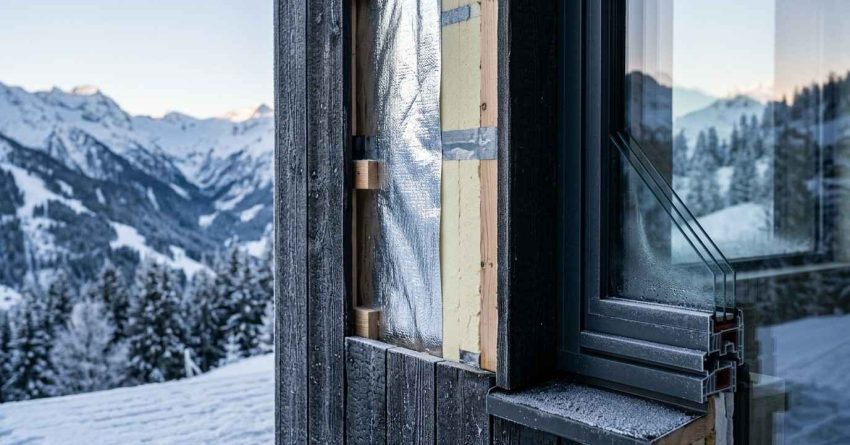
Envelope design for cold climates is the practice of engineering a building’s outer shell — walls, roof, foundation, windows, and doors — to resist extreme heat loss, prevent moisture damage, and maintain a stable, energy-efficient interior environment through freezing temperatures.
Cold climate conditions create unique thermal and moisture challenges that standard construction methods are not built to handle. Without a properly designed envelope, homes and commercial properties lose heat rapidly, accumulate damaging condensation, and develop structural problems that worsen every winter.
This guide explains the core components of cold climate envelope design, the insulation and air sealing strategies that matter most, and how professional services help property owners protect their buildings year-round.
What Is Building Envelope Design?
The building envelope is every physical element that separates the conditioned interior of a structure from the outdoor environment. This includes the exterior walls, roof assembly, foundation, windows, doors, and all the layers within them — insulation, air barriers, vapor control membranes, and structural sheathing.
Envelope design is the process of selecting, sizing, and integrating these components so they work together as a unified thermal and moisture management system. A well-designed envelope controls heat flow, manages air movement, and handles moisture without allowing condensation to accumulate inside the assembly.
In cold climates, envelope design is not a secondary consideration — it is the primary determinant of whether a building performs safely and efficiently. Every component must be specified for the thermal demands of the local climate zone, and every connection point between components must be detailed to prevent air leakage and thermal bridging.
Understanding the building envelope is the foundation of any effective energy strategy — our home insulation services cover the full range of insulation solutions that keep cold air out and conditioned air in across every layer of your property.
Why Cold Climate Envelope Design Demands a Different Approach
Buildings in cold climates face a combination of stresses that do not apply in milder regions. Sustained sub-freezing temperatures create large temperature differentials across the envelope, which drives heat out of the building continuously. Freeze-thaw cycles stress materials at joints, penetrations, and transitions. And the physics of moisture movement in cold climates are reversed compared to hot climates — vapor pressure pushes moisture from the warm interior outward through the wall assembly, where it can condense inside the structure.
These conditions require envelope assemblies that prioritize continuous thermal resistance, airtight construction, and carefully positioned vapor control. A wall system that performs adequately in a mixed climate may fail in a cold climate by allowing condensation to form within the insulation layer, leading to mold growth, structural rot, and degraded thermal performance over time.
Cold climate envelope design also requires attention to thermal bridging — the transfer of heat through conductive structural elements like studs, joists, and fasteners that bypass the insulation layer. In extreme cold, even small thermal bridges can cause surface condensation, frost formation, and localized structural damage.
Insulation Strategies for Cold Climate Building Envelopes
Insulation is the primary tool for controlling heat flow through the building envelope. In cold climates, insulation must be specified to meet minimum R-value requirements for each climate zone while also being positioned within the wall assembly to prevent condensation from forming at critical interfaces.
Continuous Insulation vs. Cavity Insulation
Cavity insulation — batts or blown-in material installed between studs, joists, or rafters — fills the space within the structural frame but does not cover the framing members themselves. This leaves thermal bridges at every stud, which can account for a significant portion of total wall heat loss in a wood-framed building.
Continuous insulation is installed on the exterior face of the structural sheathing, wrapping the entire wall surface including the framing. This eliminates stud-line thermal bridging and moves the condensation plane to a safer location within the assembly. In cold climates, continuous exterior insulation is often required to keep the sheathing temperature above the dew point, preventing moisture accumulation inside the wall.
The most effective cold climate wall assemblies combine both approaches — cavity insulation for thermal mass and continuous exterior insulation for thermal bridge elimination and condensation control.
Recommended R-Values for Cold Climate Zones
The U.S. Department of Energy divides the country into climate zones 1 through 8, with zones 5 through 8 classified as cold, very cold, and subarctic. The DOE’s Building Energy Codes Program establishes minimum R-value requirements for each zone and assembly type.
For climate zones 5 and 6, wall assemblies typically require R-20 to R-25 total, with a portion of that value provided by continuous exterior insulation. Attic and ceiling assemblies in these zones require R-49 to R-60. Climate zones 7 and 8 — covering Alaska and the northernmost continental states — require even higher values, with attic insulation often specified at R-60 or above.
Because the roof is one of the highest heat-loss surfaces in any cold climate structure, pairing your insulation strategy with professional roofing services ensures the entire upper envelope performs as a unified thermal system.
Air Barrier Systems and Vapor Control in Cold Climates
Insulation controls conductive heat flow, but air leakage is responsible for a substantial portion of total building heat loss. The Lawrence Berkeley National Laboratory has documented that air infiltration can account for 25 to 40 percent of heating and cooling energy use in residential buildings. In cold climates, uncontrolled air movement also carries moisture into the envelope assembly, where it condenses and causes damage.
How Air Barriers Prevent Heat Loss
An air barrier is a continuous layer within the building envelope that resists the movement of air through the assembly. It can be located at the exterior sheathing, within the wall cavity, or at the interior surface, depending on the assembly design. The critical requirement is continuity — any gap, penetration, or unsealed joint in the air barrier creates a pathway for air infiltration.
Effective air barrier installation requires careful detailing at all transitions: where walls meet roofs, where floors meet walls, around window and door rough openings, and at all mechanical, electrical, and plumbing penetrations. In cold climates, these details are not optional refinements — they are the difference between an envelope that performs and one that fails.
Dedicated air sealing services address every infiltration pathway in the building envelope, from attic bypasses and rim joist gaps to electrical outlet penetrations and recessed lighting fixtures, ensuring the air barrier functions as a complete and continuous system.
Vapor Retarders vs. Vapor Barriers — What Cold Climates Need
Vapor control is one of the most misunderstood aspects of cold climate envelope design. The goal is not to stop all vapor movement — it is to prevent moisture from accumulating within the assembly at a rate faster than it can dry out.
In cold climates, the primary vapor drive is from the warm interior toward the cold exterior. A vapor retarder — a material with a permeance rating between 0.1 and 1.0 perms — is typically installed on the warm-in-winter side of the insulation to slow this outward vapor movement. A true vapor barrier, with a permeance below 0.1 perms, is used in the most extreme cold climates or in assemblies where drying to the interior is not possible.
The specific vapor control strategy depends on the climate zone, the wall assembly type, and the interior humidity conditions. Professional vapor barrier installation ensures the correct material is selected, positioned accurately within the assembly, and detailed at all seams and penetrations to provide reliable moisture control without trapping moisture in the wall.
Windows and Doors in Cold Climate Envelope Design
Windows and doors are the weakest thermal links in most building envelopes. Even high-performance glazing has a much lower R-value than an insulated wall, and poorly sealed frames and thresholds create direct pathways for both air infiltration and conductive heat loss.
Glazing Performance and U-Factor Requirements
Window thermal performance in cold climates is measured primarily by U-factor — the rate of heat transfer through the entire window assembly, including the frame. Lower U-factors indicate better insulating performance. The ENERGY STAR program requires U-factors of 0.27 or below for windows in the Northern climate zone, which covers most cold climate regions in the United States.
Triple-pane glazing with low-emissivity coatings and argon or krypton gas fill is the standard specification for cold climate applications. These windows reduce radiant heat loss, minimize cold surface condensation on the interior glass, and improve occupant comfort near exterior walls.
Upgrading to thermally broken, high-performance glazing is one of the most impactful envelope improvements available — our window replacement services include cold-climate-rated units with verified U-factor performance for every climate zone.
Door Sealing and Thermal Break Considerations
Exterior doors in cold climates must provide both thermal resistance and airtight sealing at the frame, threshold, and weatherstripping. Metal doors without thermal breaks conduct heat directly through the door slab, creating cold interior surfaces that can cause condensation and frost. Fiberglass and insulated steel doors with polyurethane foam cores and thermal break frames are the preferred specification for cold climate applications.
Properly sealed and insulated entry points are just as critical as the walls around them — our exterior door installation team fits thermally broken doors with compression seals designed to eliminate drafts and prevent frost infiltration at the threshold.
Weatherstripping at all door perimeters and door sweeps at thresholds must be inspected and replaced regularly, as these components degrade with use and temperature cycling. Dedicated weatherstripping and draft sealing services address every gap around doors and windows where cold air infiltration reduces comfort and increases heating costs.
Roofing and Foundation as Envelope Components
The roof and foundation are often treated as separate systems from the wall envelope, but they are integral components of the complete thermal boundary. Heat loss through an uninsulated or under-insulated attic can exceed heat loss through all exterior walls combined, and an uninsulated foundation allows ground cold to conduct directly into the building structure.
Cold Roof vs. Warm Roof Design
A cold roof design places the insulation at the ceiling level, leaving the roof structure and attic space outside the thermal boundary. Ventilation is provided between the insulation and the roof deck to remove moisture and prevent ice dam formation. This approach is common in residential construction and works well when the insulation layer is continuous, airtight, and specified to the correct R-value for the climate zone.
A warm roof design places the insulation directly above the roof deck, keeping the entire roof structure within the thermal boundary. This eliminates the ventilated attic space and is commonly used in commercial construction and in residential applications where the attic space is conditioned or used as living space.
The roof assembly in a cold climate must manage both heat retention and moisture — our cold climate roofing professionals assess ventilation, insulation placement, and membrane selection to prevent ice damming and structural moisture damage.
Below-Grade Insulation and Frost Protection
Foundation walls and slabs in contact with the ground are subject to continuous heat loss to the surrounding soil, which remains cold throughout the winter. Insulating foundation walls on the exterior face is the most effective approach — it keeps the foundation mass within the thermal boundary, reduces frost penetration, and protects the waterproofing membrane from freeze-thaw damage.
Interior foundation insulation is an alternative where exterior access is limited, but it leaves the foundation wall exposed to freezing temperatures and does not provide the same level of frost protection. Slab-on-grade construction in cold climates requires sub-slab insulation to prevent heat loss through the floor and to protect the slab from frost heave.
Comprehensive below-grade waterproofing and foundation insulation services address both the thermal and moisture management requirements of below-grade envelope assemblies, ensuring the foundation performs as a reliable part of the complete building envelope.
Common Cold Climate Envelope Failures and How to Prevent Them
Even well-designed envelopes can fail when installation is inconsistent, materials are specified incorrectly, or maintenance is deferred. The most common cold climate envelope failures share a common cause: gaps in the thermal, air, or vapor control layers that allow heat and moisture to move through the assembly in ways the design did not intend.
Ice dams form when heat escapes through the roof assembly, melts snow at the upper roof surface, and refreezes at the cold eave overhang. The resulting ice buildup forces meltwater under shingles and into the structure. Ice dam formation is a direct indicator of inadequate attic insulation, air sealing failures at the ceiling plane, or insufficient roof ventilation. Addressing ice dam prevention requires correcting the underlying envelope deficiency — not just removing the ice.
Interstitial condensation — moisture forming within the wall assembly rather than on visible surfaces — is the most damaging and least visible cold climate failure mode. It occurs when warm, humid interior air reaches a surface within the wall that is below the dew point. The result is wet insulation, degraded thermal performance, mold growth, and structural rot that may not be visible for years.
Air leakage at electrical outlets, recessed fixtures, attic hatches, and plumbing penetrations accounts for a disproportionate share of total envelope heat loss and moisture infiltration. These small gaps are individually minor but collectively significant, and they are the primary target of professional air sealing work.
When envelope failures allow moisture to penetrate — through ice dams, condensation, or failed air seals — the resulting damage can spread quickly into walls and ceilings, making prompt water damage repair a critical part of protecting your property’s structure and indoor air quality.
Working With Professionals on Cold Climate Envelope Projects
Cold climate envelope work is not a single-trade project. Effective envelope performance requires coordinated expertise across insulation installation, air sealing, vapor control, window and door specification, roofing, and foundation work. Each trade affects the others, and gaps in coordination create the same gaps in the envelope that cause failures.
Cold climate envelope work requires coordinated expertise across insulation, air sealing, and moisture management — connecting with our energy efficiency experts ensures every component of your building envelope is assessed, upgraded, and verified to perform together as a complete thermal system.
A professional envelope assessment begins with a blower door test to measure overall air leakage and identify infiltration locations. Infrared thermography can reveal thermal bridging, missing insulation, and moisture accumulation within the assembly. These diagnostic tools allow professionals to prioritize improvements by impact and address the most significant performance gaps first.
For smaller envelope repairs — sealing gaps around penetrations, adding weatherstripping, or installing door sweeps — our handyman services team handles the detail work that keeps your envelope tight between major renovation projects.
A home energy audit provides a complete assessment of your building’s thermal performance, identifying the specific envelope deficiencies that are costing the most in heating energy and recommending improvements in priority order based on return on investment.
Conclusion
Building envelope design in cold climates integrates insulation, air barriers, vapor control, windows, doors, roofing, and foundation systems into a unified thermal boundary that resists heat loss and prevents moisture damage.
Each envelope component depends on the others — a well-insulated wall with air leakage at penetrations still loses significant heat, and a tight air barrier without correct vapor control can trap moisture inside the assembly.
At Mr. Local Services, our network of envelope professionals handles every layer of cold climate building performance — from insulation and air sealing to window upgrades and roofing — so your property stays protected, efficient, and structurally sound through every winter season.
Frequently Asked Questions
What is the most important component of a cold climate building envelope?
Air sealing is consistently identified as the highest-impact improvement in cold climate envelopes. Uncontrolled air infiltration drives more heat loss and moisture damage than any other single factor, and it undermines the performance of even well-specified insulation.
What R-value do I need for walls in a cold climate?
Wall R-value requirements depend on your specific climate zone. In climate zones 5 and 6, total wall R-values of R-20 to R-25 are typically required, with a portion provided by continuous exterior insulation to eliminate thermal bridging at the framing.
What causes ice dams and how are they prevented?
Ice dams form when heat escaping through the roof melts snow, which refreezes at the cold eave. Prevention requires adequate attic insulation, continuous air sealing at the ceiling plane, and proper roof ventilation to keep the roof deck uniformly cold.
What is the difference between a vapor retarder and a vapor barrier?
A vapor retarder slows moisture movement through the assembly and is rated between 0.1 and 1.0 perms. A vapor barrier stops moisture movement almost entirely and is rated below 0.1 perms. Cold climates typically require a vapor retarder on the warm-in-winter side of the insulation.
How do I know if my building envelope has air leakage problems?
A blower door test measures total air leakage and can identify infiltration locations. Signs of air leakage include drafts near outlets and fixtures, frost on interior surfaces in winter, high heating bills, and uneven temperatures between rooms.
Should exterior insulation be added to an existing home in a cold climate?
Exterior continuous insulation is one of the most effective retrofits for cold climate homes because it eliminates thermal bridging and moves the condensation plane to a safer location. It is most practical during re-siding projects when the exterior cladding is already being replaced.
When should I hire a professional for envelope work vs. doing it myself?
Air sealing at accessible locations — outlets, switch plates, attic hatches — is manageable as a DIY project. Insulation upgrades, vapor control installation, window replacement, and any work involving the roof or foundation assembly should be handled by qualified professionals to ensure correct specification, placement, and detailing.